Trying to nail down the exact number of questions on the CDL test can be tricky because there's no single, universal answer. The final count is a mix-and-match total that starts with a core exam and adds on from there based on the specific license and endorsements you're going for.
It all begins with the mandatory General Knowledge test, which is the foundation for any CDL. This part usually has 50 questions. From there, you add more sections—and more questions—for each special qualification you want to earn.
Your Quick Guide to CDL Test Question Counts
Think of building your CDL like ordering a custom truck. The General Knowledge test is the basic frame and engine—every single driver needs it, no exceptions. Endorsements like Air Brakes, Combination Vehicles, or HazMat are the specialized add-ons you bolt on to handle specific jobs.
Each new piece you add to your rig adds another set of questions to your total exam. This is why a driver aiming for a Class A license to haul double trailers will face a much longer test than someone getting a basic Class C to drive a shuttle bus.
The core of the CDL written exam is the General Knowledge test. You can expect about 50 multiple-choice questions and will typically have 60 minutes to complete it. To pass, you need to get at least 80% of the answers right.
Getting that 80% is non-negotiable. Knowing this structure helps you map out a study plan and get a realistic idea of how much time you'll need to set aside for the full test day.
CDL Written Test Question Counts at a Glance
To give you a clearer picture, here’s a quick breakdown of the question counts for the main test and the most common endorsements.
| Test Name | Typical Number of Questions | Required For |
|---|---|---|
| General Knowledge | 50 | All CDL Classes (A, B, and C) |
| Air Brakes | 25 | Vehicles equipped with air brakes |
| Combination Vehicles | 20 | Class A license holders |
| Hazardous Materials (HazMat) | 30 | Transporting hazardous materials |
| Tanker Vehicles | 20 | Hauling liquids or gasses in a tank |
| Passenger Transport | 20 | Driving vehicles carrying 16+ passengers |
| School Bus | 25 | Operating a school bus |
| Doubles/Triples | 20 | Pulling multiple trailers |
As you can see, the numbers for each section are pretty manageable on their own. It's when you start stacking them up that your total test length really grows.
The Foundation: The General Knowledge Test
No matter what kind of commercial driving career you're chasing, it all starts right here with the General Knowledge test. Think of it as the bedrock for everything else you’ll learn. Without a solid foundation, you can't build the skills needed for specialized endorsements later on. This exam is the mandatory first step for every single applicant, whether you're going for a Class A, B, or C license.
This is your first major hurdle, and it’s designed to make sure you have a firm grip on the universal principles of safe commercial driving. The format is pretty consistent nationwide: you'll get 50 multiple-choice questions and you'll have a 60-minute time limit to get them done.
To pass and move on, you have to score at least an 80%. In simple terms, that means you can’t get more than 10 questions wrong. A deep understanding of the material isn't just recommended—it's essential.
Core Topics Covered in the Test
The General Knowledge test casts a wide net, covering subjects that are absolutely critical for anyone getting behind the wheel of a big rig. The questions go way beyond just identifying road signs and dig into the real responsibilities of operating a large vehicle safely and professionally. You should be ready for questions covering:
- Vehicle Inspection: Knowing how to perform pre-trip, en-route, and post-trip inspections to catch any safety issues before they become a problem.
- Basic Vehicle Control: The fundamentals of getting a large vehicle moving, steering it correctly, and bringing it to a smooth, safe stop.
- Managing Space: This is a big one. It’s all about maintaining a safe buffer around your truck in traffic, on open highways, and in tricky, tight spots.
- Hazard Awareness: Learning to spot potential trouble on the road well before you're in the middle of it, from distracted drivers to changing weather.
- Communicating with Other Drivers: Properly using your signals, lights, and horn to make your intentions crystal clear to everyone around you.
The demanding structure of the CDL tests reflects just how serious this profession is. In large states like California, for example, the written permit process follows this same national model, beginning with a General Knowledge test of around 50 questions before moving on to shorter endorsement exams. Nailing these core concepts is your ticket to the rest of your CDL training.
You can dive deeper into the specifics of the General Knowledge test and find effective ways to prepare.
Building Your Career with Endorsement Tests
Once you've nailed the General Knowledge test, endorsements are how you start carving out your specific path in the trucking world. Think of them as specializations—each one you add to your license qualifies you for different kinds of jobs.
These endorsements are your ticket to operating specific vehicles, like a tanker truck or a school bus, or hauling certain types of cargo. The tests themselves are laser-focused on the knowledge you’ll need for that particular role.
The infographic below gives you a great visual of how the three core written tests—General Knowledge, Air Brakes, and Combination Vehicles—compare in terms of how many questions you'll face.
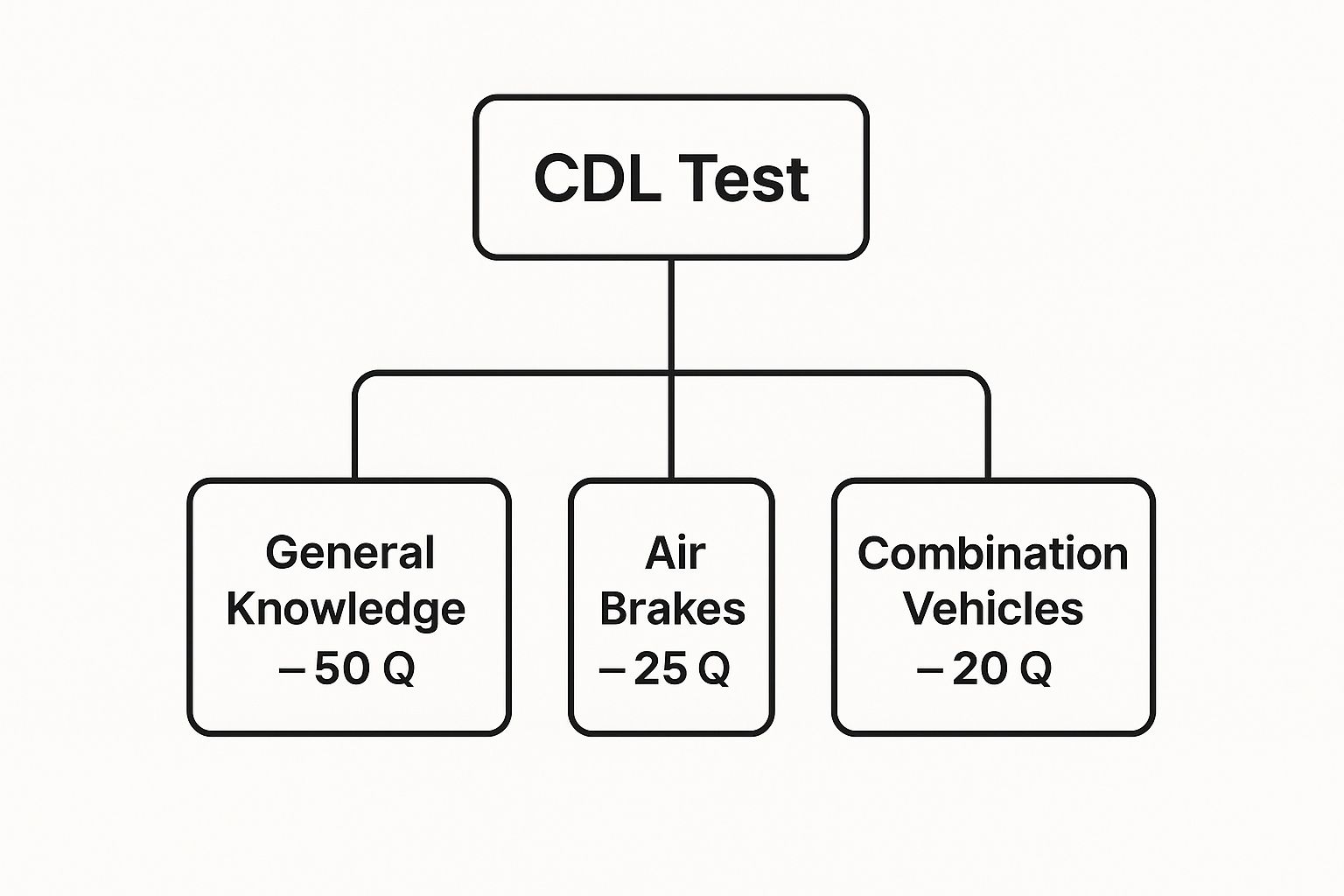
As you can see, the General Knowledge exam is the biggest piece of the puzzle, but the endorsements add their own important, focused knowledge checks to the process.
Most Common Endorsement Tests
The endorsements you go for will depend entirely on your career goals. If you want to haul fuel, you’ll need different qualifications than someone who wants to drive a school bus full of kids. Knowing the most common ones helps you figure out exactly how many questions will be on your CDL test.
Here are a few of the essential endorsements you're likely to come across:
- Air Brakes: This is a big one. It's typically 25 questions and is a must-have for operating any commercial truck with an air brake system. The test covers everything from the system’s components to proper use and daily inspections.
- Combination Vehicles: If you’re aiming for a Class A license, you’ll take this test. It’s usually about 20 questions and dives into the skills needed to safely couple, uncouple, and handle a tractor-trailer.
- Hazardous Materials (HazMat): Planning to transport things like fuel, chemicals, or other sensitive materials? You'll need the HazMat endorsement. It adds about 30 questions that focus on safety regulations, placarding, and what to do in an emergency.
Every endorsement you pass opens up new doors for job opportunities and, often, better pay. It's a direct investment in your career, letting you shape your future on the road.
Choosing the right endorsements is a crucial step. For a complete breakdown of what's involved, you can check out the full CDL requirements to help map out your plan.
How State Rules Can Change Your Test

While the Federal Motor Carrier Safety Administration (FMCSA) lays down the national standards for getting a CDL, the actual test you sit down to take is a state-run affair.
Think of it like this: the federal government provides the main blueprint for the house, but each state is the builder who might make small tweaks during construction. This is why you'll see minor variations in the number of questions and other details on your CDL test, depending on where you live.
For example, the General Knowledge test is almost always right around 50 questions, but one state might give you a slightly different time limit or phrase a few questions differently than the state next door. These little differences are exactly why just grabbing any generic study guide you find online can be a mistake. The core information is the same, but the final exam is tuned to local rules.
Why Local DMV Rules Matter Most
On test day, the only rules that truly matter are the ones set by your local Department of Motor Vehicles (DMV). They have the final say on everything, and knowing their specific procedures is crucial.
- Retake Policies: If you don't pass, how soon can you try again? How many shots do you get? Each state has its own answer to these questions.
- Administrative Procedures: The process for scheduling your test, what documents you need to bring, and how much it all costs will vary.
- Question Pool Variations: While all states cover the federally mandated topics, they often pull from their own slightly different banks of approved test questions.
The single most reliable source of truth for your test is your state’s official commercial driver’s manual. It’s written specifically for the test you’ll be taking, so there’s no guesswork involved.
Getting a handle on your state's specific requirements is non-negotiable. For a concrete example, you can see how the process works by checking out the guide for getting a CDL in Alabama, which details the steps unique to that state. This kind of local knowledge is what keeps you from walking into nasty surprises on test day.
How the CDL Test Adds Up: A Real-World Example
Seeing a list of tests and question counts is one thing, but it's hard to grasp what that means for you. Let's walk through a couple of real-world scenarios to see how it all comes together.
Think of it like building a sandwich. Everyone starts with the bread (the General Knowledge test), but the fillings (your endorsements) are what make it unique to your order.
Alex's Plan: Driving a Tractor-Trailer
Let's imagine a guy named Alex. His dream is to drive a Class A rig, the classic tractor-trailer you see on the highway. To get behind the wheel of that truck, he needs to pass a specific stack of written exams.
Here’s how his test prep breaks down:
- General Knowledge Test: This is the foundation for everyone. It's 50 questions.
- Air Brakes Endorsement: Modern tractor-trailers all run on air brakes, so this test is non-negotiable. That adds another 25 questions.
- Combination Vehicles Endorsement: This is the specific endorsement that qualifies him for a Class A license. It's another 20 questions.
When you do the math, 50 + 25 + 20 = 95 questions. So, Alex knows he has a 95-question exam marathon ahead of him, covering three separate but crucial topics.
It's also worth noting that some modern trucks have automatic transmissions. Drivers who test in an automatic will get a restriction on their license, so understanding an E restriction removal course can be a huge career advantage later on.
Maria's Goal: Driving a School Bus
Now, let's look at Maria. She has a completely different career in mind—she wants to be a school bus driver. Her path requires a different set of endorsements, so her calculation will look a little different.
The total number of questions on your CDL test is a direct reflection of your career goals. Your unique combination of required tests determines your final count.
Maria starts with the same foundational test as Alex but adds endorsements specific to her job.
Here’s her stack:
- General Knowledge Test: She also starts with the mandatory 50 questions.
- Passenger (P) Endorsement: This is essential for transporting more than 15 people. That's another 20 questions.
- School Bus (S) Endorsement: This one is hyper-specific, covering student safety rules and procedures. It adds 25 questions.
For Maria, the total is 50 + 20 + 25 = 95 questions.
Isn't that interesting? Even though their career goals are worlds apart, Alex and Maria face the exact same number of questions. This just goes to show how you can add up the numbers to figure out exactly what your own test day will look like.
Your CDL Test Questions Answered
Even after you've studied the manuals and feel ready, a few practical questions about how the test actually works can pop up. Knowing what to expect on test day at the DMV can make all the difference, helping you walk in with confidence.
Let's clear up some of the most common questions we hear from drivers getting ready to take their written CDL knowledge tests.
Is the CDL Test All Multiple-Choice?
Yes, it is. Every single written CDL test, from the big General Knowledge exam to specialized endorsements, uses a multiple-choice format. You'll see a question followed by three or four possible answers, and your job is to pick the one correct option.
This format keeps the scoring fair and objective for everyone. You won't have to worry about writing essays, short answers, or filling in any blanks—just focus on choosing the best answer provided.
What Happens If I Fail Just One Endorsement Test?
Don't worry, failing one test doesn't send you back to square one. Let's say you pass the General Knowledge and Air Brakes tests but stumble on the Combination Vehicles exam. Your passing scores are safe and sound.
You only have to retake the specific test you failed. Most states will make you wait a day or so before you can try again, but it’s always smart to check your local DMV's rules on retakes and how many attempts you get.
Your passing scores for individual tests are typically valid for a set period. This allows you to focus solely on the material you struggled with, making your next attempt more efficient and less stressful.
Do I Need to Take All the Tests on the Same Day?
Nope, you have some flexibility here. The typical path is to first pass the General Knowledge test to get your Commercial Learner’s Permit (CLP). You can get a full rundown on that crucial first step right here: CDL permit.
Many people do choose to knock out all their endorsement tests on the same day just to get it done, but it’s not required. You can always go back to the DMV later to add another endorsement by taking its specific written test.
How Long Is My Passing Score Valid?
Once you pass the General Knowledge exam and get your CLP, that permit is usually valid for 180 days. Most states will let you renew it once for another 180 days, which gives you up to a full year to finish your training and pass the final skills test.
Your passing scores for any endorsement tests you take are valid for as long as your CLP is. Since these timelines can vary slightly by state, it's always a good idea to confirm the exact expiration rules with your local DMV.
At Patriot CDL, we guide you through every step of the process, ensuring you have the knowledge and hands-on skills to pass your exams with confidence. Find out how our expert-led training can launch your new career. Learn more at https://patriotcdl.com.