If you're wondering how many questions are on the CDL test, the short answer is: it depends. There isn't one single number. The test is tailored to the specific license class and endorsements you're going for.
The foundation for every single CDL applicant is the General Knowledge test, which has 50 questions. But that's just the starting point. From there, you add on other sections based on what you plan to drive.
Your Total Question Count Depends on Your Endorsements
Think of it like building a custom truck. The General Knowledge test is the chassis—everyone gets one. Each endorsement you add, like for air brakes or tanker vehicles, is like adding a specialized component. Each component comes with its own test.
This is why a Class A applicant will face a different number of questions than a Class B applicant. For instance, someone aiming for a Class A license will need to pass the General Knowledge test, the Combination Vehicles test, and the Air Brakes test. This could easily push their total question count to around 95 questions.
A Class B applicant, on the other hand, wouldn't need the Combination Vehicles section, so their exam might be closer to 75 questions in total. It all comes down to the specific requirements for the vehicle you'll be operating.
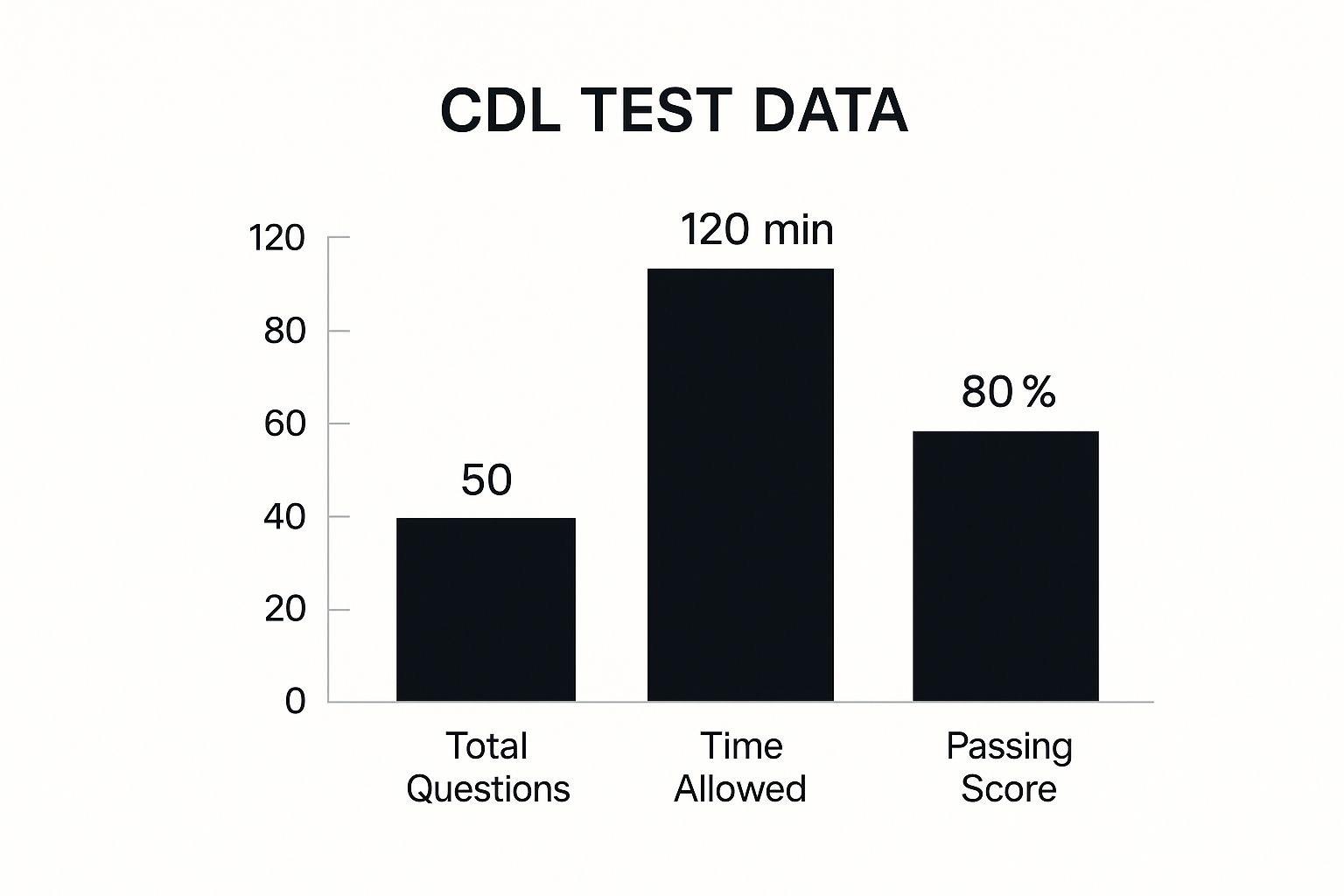
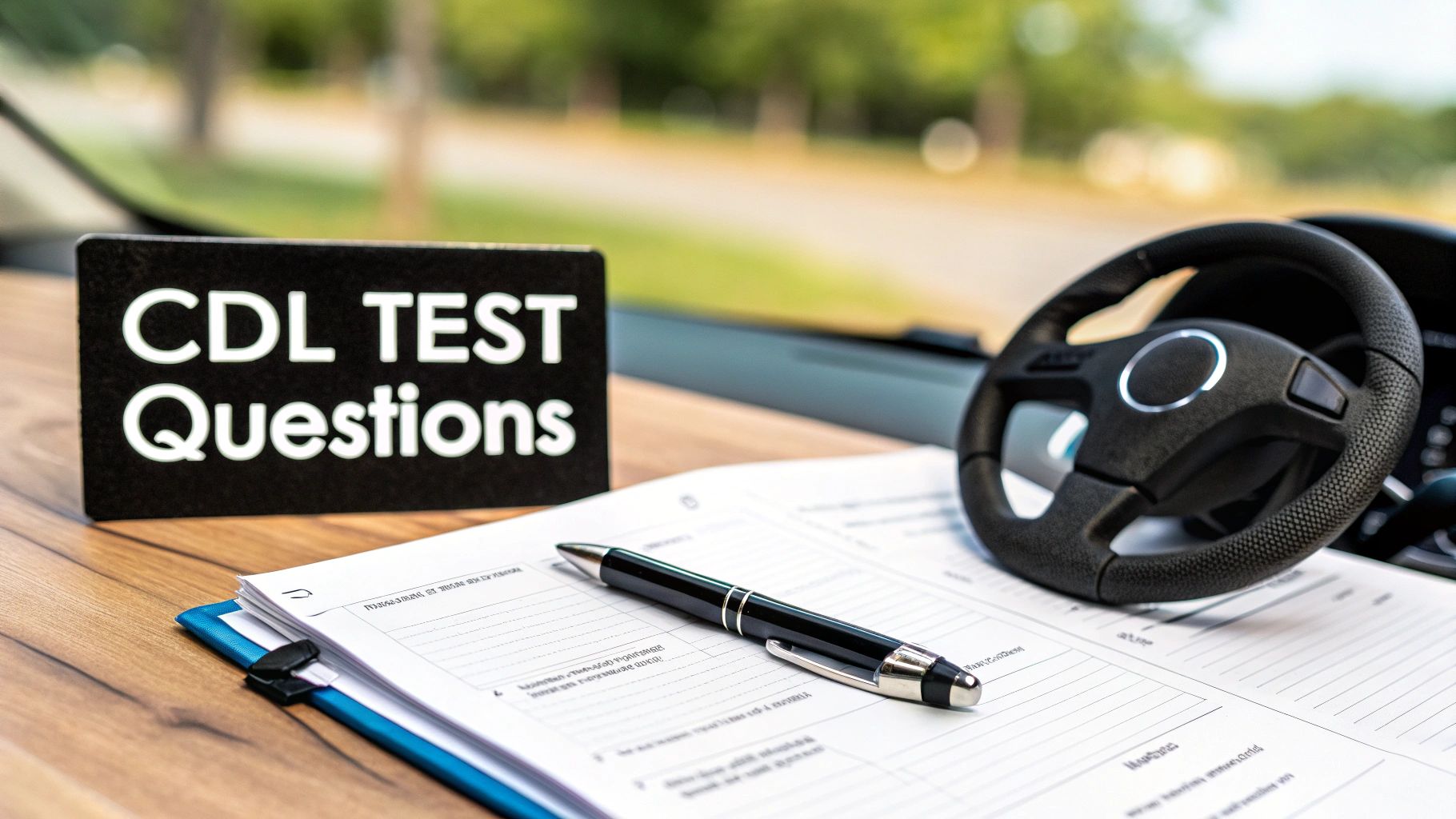
As the image shows, that initial General Knowledge section is a major hurdle. You typically get about an hour to answer those 50 questions, and you must score at least 80% to pass. Getting this one right is the first critical step in your CDL journey.
The big takeaway here is that your career path directly shapes your test. The more specialized your driving role, the more endorsements you'll need, and the more questions you'll have to answer. Knowing this ahead of time is key to building a study plan that actually works.
CDL Test Sections and Their Typical Question Counts
To give you a clearer picture, here’s a quick breakdown of the most common written tests and the approximate number of questions you can expect for each.
| Test Section | Typical Number of Questions |
|---|---|
| General Knowledge | 50 Questions |
| Combination Vehicles | 25 Questions |
| Air Brakes | 25 Questions |
| Tanker Vehicles (N) | 20 Questions |
| Hazardous Materials (H) | 30 Questions |
| Doubles/Triples (T) | 20 Questions |
| School Bus (S) | 25 Questions |
| Passenger Transport (P) | 20 Questions |
Remember, these numbers can vary slightly from state to state, but this table gives you a solid idea of what to prepare for. Tally up the sections you need, and you'll have your estimated total question count.
Mastering the General Knowledge Test
Think of the General Knowledge test as the foundation of your entire CDL career. It’s the first and most important written exam every single aspiring driver has to pass, and it sets the stage for everything that follows. This test typically consists of 50 multiple-choice questions.
But don't mistake this for a simple vocabulary quiz. The test is designed to see how you apply knowledge in the real world. It’s less about memorizing definitions and more about understanding the why behind the rules of the road. This focus on practical application is crucial for the situational judgment questions you’re guaranteed to face.
For a complete breakdown of what's on the exam, you can check out our in-depth guide to the General Knowledge test.
Key Areas of Focus
The General Knowledge test pulls questions from a broad range of topics, all centered on one thing: operating a commercial vehicle safely. You'll need to be sharp on these core concepts:
- Vehicle Inspection: This is all about the pre-trip inspection. You have to know what to look for to catch a small problem before it becomes a major safety hazard on the highway.
- Vehicle Control: This covers the physics of driving a big rig—things like proper stopping distance, managing your space in heavy traffic, and how to safely handle your truck when the weather turns nasty.
- Hazard Perception: Can you spot trouble before it finds you? This section tests your ability to identify potential dangers, from distracted drivers to poor road conditions, and react accordingly.
- Rules of the Road: This goes beyond basic traffic laws. It covers the specific regulations that apply to commercial vehicles, like speed limits, right-of-way, and how to communicate effectively with everyone else on the road.
To pass, you don't have a lot of room for error. Both federal and state guidelines require a minimum passing score of 80% on each section of the CDL written exam. For the General Knowledge test, that means you must answer at least 40 out of the 50 questions correctly to move on.
Passing the General Knowledge test isn’t just about knowing the rules; it's about proving you can apply them to make safe, split-second decisions. It confirms you have the foundational understanding needed to handle the immense responsibility of operating a commercial motor vehicle.
How Endorsements Change the Number of Questions on Your Test
Think of endorsements as specializations for your CDL. They’re what allow you to drive specific types of rigs or haul certain kinds of cargo, often leading to better-paying jobs. But here’s the catch: each endorsement you go for adds another test to your plate, which means more questions on exam day.
The General Knowledge test is the baseline for everyone, but the endorsements you choose will chart the rest of your course. If you plan on driving a tanker full of gasoline, you'll need a different set of skills—and a different test—than someone driving a bus full of people. This is why the CDL exam isn't a one-size-fits-all deal; it's tailored to what you want to do on the road.
A Look at the Most Common Endorsements
Most endorsement tests will tack on an extra 20 to 30 questions to your total exam. Each one is designed to make sure you’re ready for the specific challenges that come with the job.
Here are the endorsements most drivers go for:
- Combination Vehicles (T Endorsement): If you're aiming for a Class A license, this one is non-negotiable. It’s a 25-question test that dives into the nitty-gritty of pivot points, safe coupling and uncoupling, and the dynamics that can lead to rollovers.
- Air Brakes: Just about every big rig on the road uses air brakes, so this endorsement is practically a given. It tests your knowledge of the entire system, from components and inspections to proper stopping techniques.
- Tanker Vehicles (N Endorsement): Liquid cargo is a different beast altogether. This 20-question exam covers the "slosh" effect (liquid surge) and how to handle a high center of gravity to keep your tanker upright.
- Hazardous Materials (H Endorsement): Often called the HazMat test, this one is notoriously tough. With about 30 questions, it covers everything from correctly placarding your truck to handling emergencies when hauling dangerous goods.
The bottom line is pretty straightforward: the more specialized your career goals, the more questions you'll face. Adding endorsements for tankers, HazMat, or combination vehicles customizes both your license and your test, paving the way for a more valuable and specialized career.
How CDL Tests Vary from State to State
Think of the Federal Motor Carrier Safety Administration (FMCSA) as the author of the main CDL rulebook for the entire country. They lay down the essential, non-negotiable standards for what it means to be a safe commercial driver. But then, each state gets to add its own local flavor.
This means the test you take in one state might look a little different from the one your cousin took a few states over. The core concepts—how air brakes work, for instance—are universal. You can't change physics by crossing a state line. The real difference often comes down to the details, like the exact number of questions you'll face. Your state's General Knowledge test might have 50 questions, while the next state over has 55.
It's these small but crucial differences that make state-specific studying so important. Relying solely on a generic, one-size-fits-all study guide is a classic rookie mistake.
Your State's CDL Manual is Your Best Friend
So, what's the single most critical tool in your study arsenal? Without a doubt, it's your state's official CDL manual. This isn't just another book; it's the playbook written by the same people who design your exam.
It lays out the specific laws, rules, and procedures you'll be tested on. For example, if you're getting your license in the Golden State, you'll need to know the specific CDL requirements in California. A national guide might miss the subtle but important local regulations that could show up on your test.
Your state's official CDL manual should always be your number one resource. It's perfectly aligned with the test you'll actually be taking, so there’s no guesswork involved.
One of the biggest reasons people stumble on their first try is because they overlook these state-specific details. The manual doesn't just tell you how many questions are on the test; it highlights unique state laws that you are absolutely expected to know. Make it the foundation of your study plan, and you’ll be in a much better position to pass.
Figuring Out What It Takes to Pass

Knowing the number of questions on the CDL test is one thing, but the real key is understanding the score you need to pass. Across the board, for any written CDL knowledge test, the magic number is 80%.
Think of it this way: for the big 50-question General Knowledge exam, you need to get at least 40 of those questions right. If you're tackling the 25-question Air Brakes test, your target is 20 correct answers. This simple rule applies to every single section.
A critical point to remember is that each test is its own separate challenge. You can't use a great score on one section to make up for a poor one on another. You have to pass each one independently.
This is why having a solid study plan is so important. You can’t afford to be weak in any one area because every endorsement is a new hurdle to clear. Getting familiar with all the CDL requirements will help you see why the standards are set this way to ensure every driver is competent.
To make this crystal clear, here’s a quick breakdown of what that 80% rule looks like for some of the most common test sections.
Passing Score Examples Based on the 80% Rule
| Test Section | Total Questions | Minimum Correct Answers to Pass (80%) |
|---|---|---|
| General Knowledge | 50 | 40 |
| Air Brakes | 25 | 20 |
| Combination Vehicles | 25 | 20 |
| Hazardous Materials | 30 | 24 |
As you can see, the math is straightforward. Once you know how many questions are on a test, you know exactly how many you need to get right.
What Happens If You Don't Pass?
Failing a section isn’t the end of your journey, but it is a speed bump. Most states will make you wait a certain amount of time before you can try that specific test again. This could be anywhere from a single day to a whole week.
Don’t let that time go to waste. It’s the perfect opportunity to go back to the state manual, review what you got wrong, and really focus on the topics that tripped you up. A failed attempt gives you a very clear, personalized study guide for your next—and hopefully successful—try.
Frequently Asked Questions About the CDL Test
It's completely normal to have a few questions buzzing around in your head as test day gets closer. Getting the details straight about how the exam actually works can do wonders for your confidence and help calm those nerves. Let's tackle some of the most common things aspiring drivers ask about the CDL written tests.
Walking into the DMV already knowing the rules of the game is a massive advantage. It frees you up to focus on what you’re there to do: nail the answers.
Are All the Questions on the CDL Test Multiple-Choice?
Yes, they are. Every single question on the CDL written knowledge tests is multiple-choice. You can relax—there are no essay questions or fill-in-the-blanks waiting for you. For each question, you'll see a problem or a scenario followed by a few possible answers.
Your task is simply to pick the one correct option based on what you’ve learned from your state's CDL manual. The test is set up this way to see if you can apply the rules to real-world driving situations, not just memorize facts.
How Much Time Do I Get to Complete the Test?
Time limits can differ from state to state, but you almost always have plenty of time to get the job done. Most states give you somewhere between one and two hours to finish all the sections you're taking that day. That's more than enough time to read every question carefully without feeling the pressure.
A good strategy is to go through and answer the easy ones first. If you hit a tough question, flag it and circle back to it later. It's always a good idea to double-check the exact time limit with your local DMV before you go.
If I Fail One Section, Do I Have to Retake Everything?
Nope, you don't have to start over from square one. The CDL test is broken down into individual sections, and you get credit for each one you pass. So, if you ace the General Knowledge test but stumble on Air Brakes, you only have to retake the Air Brakes part.
Your passing scores are locked in. They'll stay valid for a specific period, and you can focus your energy on the section that gave you trouble.
Most states will make you wait a day or two before you can try again, so use that time wisely. For instance, if you found the inspection questions tricky, you could brush up with our guide on the pre-trip inspection before your next attempt. Just be sure to look up your state's specific rules on retakes.