When you start looking into CDL school, the first thing you'll notice is the price tag. The cost can swing anywhere from $1,500 to $12,000, which is a huge range. Why the big difference? It all comes down to the kind of program you sign up for.
This isn't a small chunk of change, but think of it as the down payment on a solid, in-demand career.
Understanding the True Cost of CDL Training
Asking "how much does CDL school cost?" is a bit like asking how much a car costs. You've got your basic, reliable sedans that get the job done, and then you have your fully-loaded, high-performance sports cars. CDL schools are the same way—some offer the bare essentials to get you licensed, while others provide extensive, hands-on training with all the bells and whistles.
The price of this investment has been climbing. Back in 2023, the median cost hovered around $6,500. On the lower end, you could find programs at community colleges for $1,500 to $5,000. On the other hand, specialized private academies could run you as much as $12,000. This isn't just random inflation; it's driven by real-world factors like rising fuel costs, higher insurance premiums for the big rigs, and the need to train you on modern, up-to-date equipment.
Comparing Your CDL School Options
To really get a handle on that price range, it helps to see how the different types of schools stack up. Each one is built for a different kind of student, with a different budget and career plan in mind.
Here's a quick look at the typical costs you can expect from the main types of CDL training providers. This should help you figure out which path makes the most sense for your wallet and your goals.
Estimated CDL School Cost By Training Provider
| School Type | Average Tuition Range | Best For |
|---|---|---|
| Community College | $1,500 – $5,000 | Students who want a structured, classroom-based program without breaking the bank. |
| Private Academy | $3,000 – $12,000 | Folks looking for a fast-track program that often comes with job placement support. |
| Company-Sponsored | $0 – $1,500 Upfront | New drivers who are ready to sign on with a specific company in exchange for training. |
As you can see, the type of school you choose is the single biggest driver of your upfront cost.
The key takeaway is this: A company-sponsored program might feel "free," but it's really paid for with your commitment to work for them for a year or two. A private academy costs more, but it might get you behind the wheel and earning a paycheck much faster.
Your job is to weigh the immediate cost against the long-term career value you're getting. Next, we’ll break down exactly what that tuition money covers, so you know where every dollar is going.
What Your CDL School Tuition Actually Covers
When you see a price tag of several thousand dollars, it’s fair to ask, "Where is all that money actually going?" Breaking down the cost of CDL school is a lot like looking at the sticker price on a new car—the total number is made up of many smaller, essential parts that deliver the final product.
Your tuition is really a package deal that funds the three pillars of your training. Each piece is designed to build your skills from the ground up, making sure you're not just licensed, but genuinely road-ready and safe.
Behind-the-Wheel Training
The biggest slice of the tuition pie, without a doubt, is the behind-the-wheel (BTW) training. This is where the rubber literally meets the road.
A huge chunk of this cost goes toward just keeping the trucks running—we're talking fuel (and a lot of it), comprehensive insurance for training vehicles, and all the routine maintenance like tires and oil changes. But most importantly, it pays for the invaluable time you get with an experienced instructor sitting right there in the passenger seat.
When you look at the breakdown, hands-on driving is the most expensive component, usually eating up 40% to 50% of the total tuition. In the U.S., you can expect this practical instruction to cost anywhere from $2,000 to $3,500. It's also worth noting that schools with lower student-to-instructor ratios (say, 4:1) often have higher pass rates—around 92% on the first try—compared to schools with a 10:1 ratio. You're paying for that focused attention.
Classroom Instruction
Long before you turn the key, you have to master the rules of the road. Classroom instruction is the engine that drives your knowledge, covering everything from complex federal transportation regulations and hazmat protocols to the nitty-gritty of logbook management and pre-trip inspections.
This part of your tuition pays for the curriculum itself, all your learning materials, and the instructors who know this stuff inside and out. While it's not as costly as the hands-on driving, this is the foundation for a safe, compliant, and successful career.
Think of it this way: The classroom gives you the "what" and the "why," while the behind-the-wheel training gives you the "how." You simply can't be a great driver without mastering both.
This chart gives you a clear visual of how the costs stack up between the different types of CDL schools you'll encounter.
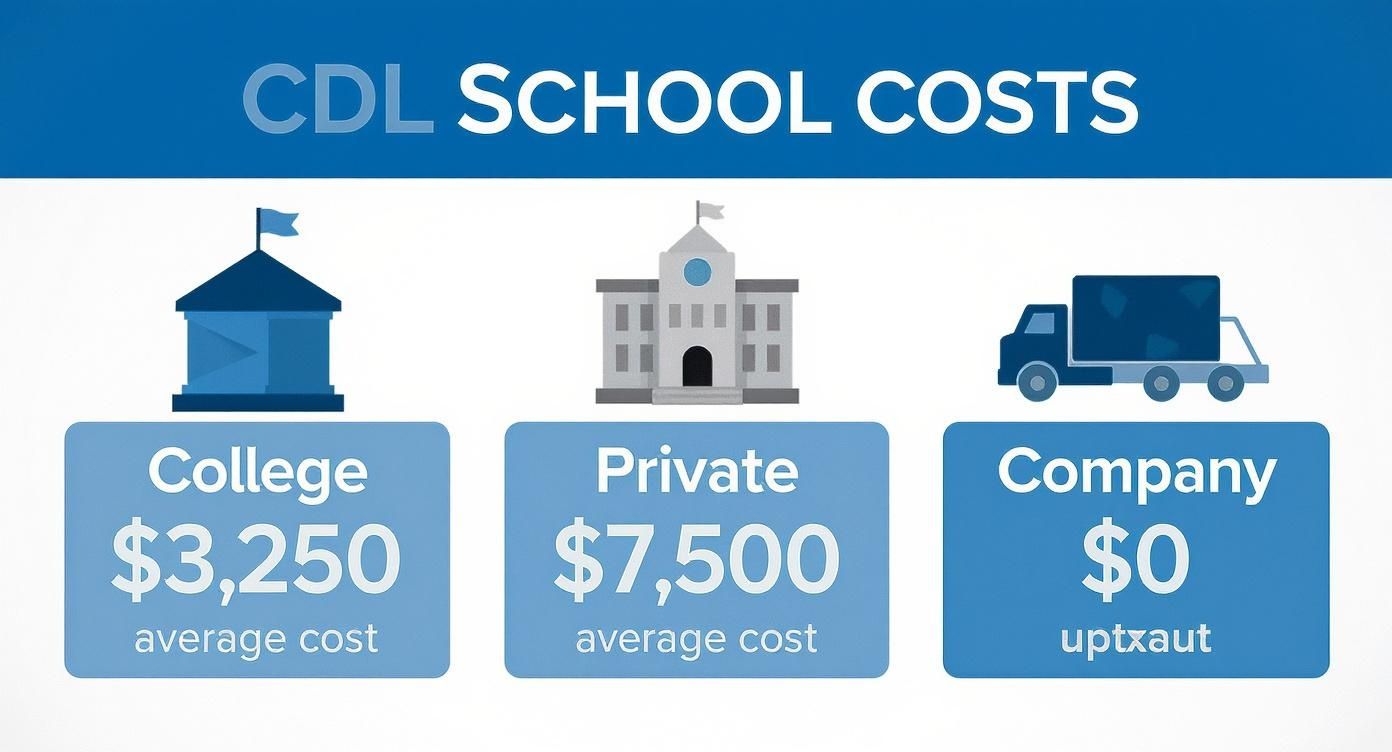
As you can see, company-sponsored programs can get you started with no upfront cost, while private schools represent the biggest initial investment.
Facility and Equipment Use
Finally, a piece of your tuition goes toward the use of the school's facilities and equipment. This isn't just a parking lot—it includes access to a dedicated, safe driving range where you can practice tough maneuvers like backing and parking without the pressure of public traffic.
It also ensures you’re learning on modern, well-maintained trucks that are similar to what you’ll actually be driving in the field. The best schools, like those with a top-tier Class A program, invest a ton into their fleet and training grounds to create a learning environment that’s both realistic and effective.
Budgeting for Expenses Beyond Tuition
The tuition you pay for CDL school is the biggest chunk of your investment, but it's definitely not the whole story. Thinking that the sticker price is the final price is like buying a ticket to a big game and completely forgetting you'll need to pay for parking, food, and maybe a team hat.
To get a real, honest picture of what it's going to cost, you have to account for all the necessary extras. These aren't just suggestions; many of these fees are non-negotiable requirements to get your license. Planning for them now will save you from last-minute financial stress that could throw a wrench in your training.
Mandatory Fees and Licensing Costs
Before you even climb into the driver's seat, you'll face a few administrative and medical hurdles, and each one comes with its own price tag. These are simply the required steps to comply with federal and state trucking regulations.
One of the first things you'll need to budget for is the mandatory CDL physical examination. This is a federally required health check-up to ensure you're physically fit to safely operate a commercial vehicle.
Beyond the physical, you’ll also need to cover:
- Commercial Learner’s Permit (CLP) Fee: This is what your state charges to issue your learner's permit. Expect it to be anywhere from $30 to $100.
- DOT Drug Screening: A required screening that typically costs between $40 and $60.
- Final CDL Issuance Fee: Once you pass your skills test, the state charges a fee to print and issue your official commercial license, usually between $75 and $200.
A quick heads-up: Every state does things a little differently. Your best bet is to check your local DMV's website for the most current and accurate fee schedule.
Checklist of Common Additional CDL Expenses
To help you get the full financial picture, it's wise to create a checklist of all the "extra" costs that pop up. These are the expenses that aren't rolled into your tuition but are just as important for completing your training and getting licensed.
| Expense Item | Typical Cost Range | Why It's Required |
|---|---|---|
| CDL Physical Exam | $80 – $150 | Federally mandated to ensure you're medically fit to drive. |
| CLP Application Fee | $30 – $100 | State fee to apply for and receive your learner's permit. |
| DOT Drug Screen | $40 – $60 | Required by the Department of Transportation for all drivers. |
| CDL License Fee | $75 – $200 | State fee for the issuance of your official CDL after passing tests. |
| Endorsement Tests | $10 – $50 per test | Fees for adding special endorsements like HazMat or Tanker. |
| Skills Test Fee | $50 – $300 | Some states or third-party testers charge a fee for the road test. |
Remember, these figures are estimates. Always confirm the exact costs with your local DMV and the CDL school you plan to attend so you can build a budget with no surprises.
Personal Gear and Other Expenses
Beyond the official fees, you'll need to think about some personal gear and set aside funds for other potential costs. These can vary a lot depending on your school's location and what their program includes. For a full rundown of what to expect, it helps to review detailed CDL requirements so you're not caught off guard.
We're talking about practical necessities like a good pair of steel-toed boots, durable work gloves, and maybe a road atlas or GPS. And if the school you've chosen isn't right around the corner, you absolutely have to factor in costs for travel, a place to stay, and your daily meals. These expenses can easily add several hundred dollars to your total budget, so planning ahead is key to a smooth ride through training.
How Your Location Affects CDL Training Costs
Think about how the price of a house or a gallon of gas can be completely different from one state to the next. The same exact principle applies to CDL school tuition. Where you choose to get your training is one of the biggest variables determining your final bill.
A truck driving school in a major city has to cover much higher operating costs—think rent, fuel, and instructor salaries—than a school in a small, rural town. That's just the reality of the local economy. For instance, you can bet a school in California is paying more for just about everything compared to a similar program in Arkansas. Those costs inevitably get passed on to the student.
As a general rule, schools in the Northeast or on the West Coast tend to have higher sticker prices than those in the Midwest or the South. The local cost of living has a direct impact on the school's expenses, which in turn answers the big question of how much does cdl school cost for you.
State Regulations and Licensing Fees
It's not just about rent and diesel prices, though. Every state plays by its own rulebook when it comes to commercial licensing. Some have stricter training mandates or more red tape, which adds to a school's administrative costs—and you guessed it, your tuition.
On top of that, the state-mandated fees for permits, tests, and the license itself can be all over the map. One state might charge $75 for the final CDL issuance, while its neighbor could charge $200 or more for the very same credential. These aren't huge costs on their own, but they definitely add up. To see how complex it can get, check out the requirements for getting a CDL in California, a state known for having some of the highest associated costs in the country.
Choosing a school is a strategic decision. You might save thousands by attending a less expensive school in a neighboring state, but you must weigh that savings against the costs and logistics of temporary travel and lodging.
Making a Strategic Choice
Knowing how much prices can swing from one area to another gives you a huge advantage. If you happen to live near a state line, it’s absolutely worth pricing out schools on both sides. The savings could be big enough to make a longer commute or even a temporary stay worthwhile.
It all comes down to a balancing act. You have to weigh the potential savings of a cheaper, out-of-state school against the convenience and travel costs of staying local. A little bit of research into schools in your region and just beyond can help you find that sweet spot between price and practicality.
Smart Ways to Fund Your CDL Education
https://www.youtube.com/embed/4XpNrVlHgbA
Don't let the sticker price of training put the brakes on your career goals. It's true—the upfront investment in CDL school can be a major hurdle for a lot of people. But there are more ways than ever to fund your training and get on the road.
Honestly, thinking about how you’ll pay for school is just as important as picking the right one.
The numbers don't lie. A recent survey found that 42% of people either delay or completely give up on CDL training because they can't afford it. The good news? The same study showed that about 30% of students are now getting their start with tuition reimbursement or company sponsorship programs.
By looking at all your options, from programs that pay for you to traditional financing, you can map out a clear path forward. That way, you can focus on mastering your skills, not stressing about the bill.
Company-Sponsored Training Programs
One of the most common ways to get your CDL is through company-sponsored training. It's pretty straightforward: a trucking company pays for your school upfront. In exchange, you agree to drive for them for a set amount of time, usually somewhere between one and two years.
This kind of deal can be a win-win. The carrier gets a loyal, well-trained driver, and you walk away with your license without having to pay a dime out of pocket. Just make sure you read the contract down to the last word. If you decide to leave before your commitment is up, you’ll almost certainly be on the hook for the full cost of your tuition.
This is a fantastic option if you're ready to commit to a specific company and want to get started with zero upfront cost. It’s a direct line from the classroom to a guaranteed job.
Grants, Scholarships, and Veteran Benefits
Another great route is finding what I like to call "free money"—funds you never have to pay back. You just have to know where to look.
- Federal and State Grants: Keep an eye out for programs like the Workforce Innovation and Opportunity Act (WIOA). These government grants are designed to help people train for high-demand jobs, and trucking definitely fits the bill. Your local workforce development office is the best place to start.
- Private Scholarships: Plenty of organizations in the trucking world offer scholarships to help new drivers get their start. A simple search for "trucking scholarships" online will turn up a surprising number of opportunities.
- Veteran Benefits: If you're a veteran, your military benefits are a powerful tool. The GI Bill can often cover the entire cost of CDL school, as long as it's an approved program. This is an incredible resource for anyone transitioning from military to civilian life.
Traditional Financing and Payment Plans
If company sponsorship isn't for you and grants don't cover everything, traditional financing is always on the table. Lots of students go this route to make the cost of CDL school fit their personal budget.
Many schools offer their own payment plans, which let you break up the total cost into smaller chunks while you’re in training. The other option is a personal loan from your bank or credit union. Sure, it means taking on a little debt, but it also gives you total freedom to attend any school you want and work for any carrier you choose after you graduate.
Does a Higher Price Mean Better CDL Training?
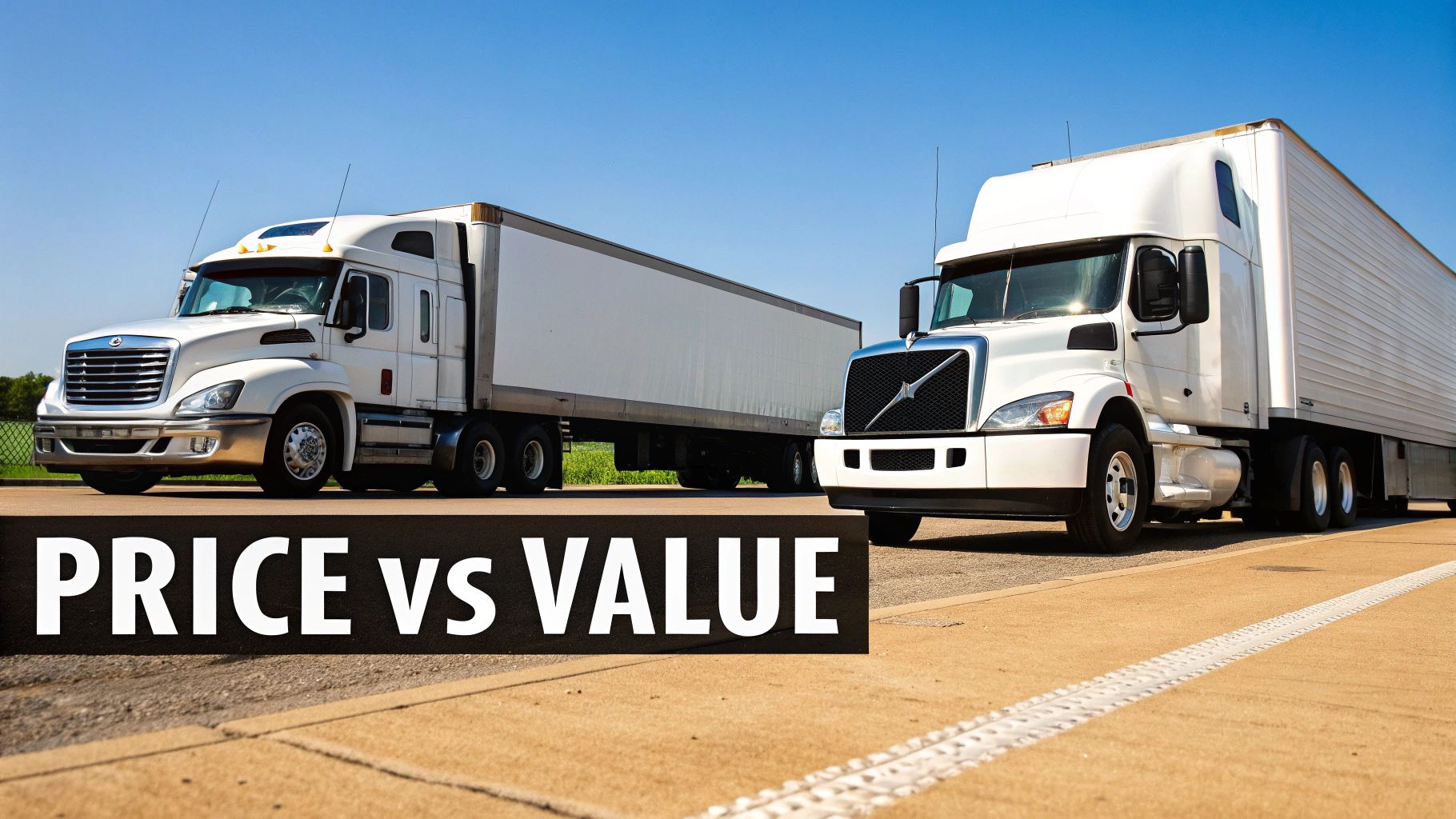
It’s the classic dilemma every student runs into. When you see the wide range of how much CDL school costs, you have to ask: is a pricier program actually a better investment? The short answer is, often, yes—but you really need to understand what you're paying for.
Think of it like buying tools for a new trade. A cheap wrench might get the job done once or twice, but a high-quality one is built to last, performs better under pressure, and ultimately gives you a far better return on your investment. The same logic applies to your CDL education.
A higher price tag often comes with tangible advantages that directly shape your career readiness and long-term success. These schools simply invest more into the resources that truly matter.
What a Premium Price Tag Gets You
More expensive programs almost always offer a superior learning experience by providing better equipment and more individualized attention. It’s not just about passing a test to get your license; it’s about becoming a confident, competent professional driver from day one.
Here are a few key benefits you're likely to see:
- Modern Equipment: You’ll get to train on newer, well-maintained trucks—the kind that top carriers are actually using today. This is crucial for learning modern systems, especially if you want to drive automatic transmissions. In fact, many drivers who train only on automatics later have to seek out an E-restriction removal course to learn how to drive a manual.
- More Behind-the-Wheel Time: A higher tuition usually translates directly to more hours spent physically driving the truck, not just watching from the passenger seat. This hands-on practice is where you build real-world skills and confidence.
- Lower Student-to-Instructor Ratios: With fewer students per instructor, you get more one-on-one feedback and personalized guidance. This helps you master difficult maneuvers much faster.
While a budget school can get you licensed, a premium program is designed to get you hired. They often have dedicated job placement services with strong industry connections, giving you a serious head start in your job search.
When you're sizing up a school, look beyond the sticker price. Ask about their fleet, the experience of their instructors, and their graduate employment rates. A higher upfront cost might just be the smartest investment you can make in your new career.
Common Questions About CDL School Costs
Figuring out the financial side of CDL training can feel like a lot to take on. Let's cut through the confusion and get straight to the answers for the most common questions I hear from aspiring drivers.
Can You Really Get CDL Training for Free?
Believe it or not, yes. It’s absolutely possible to get your CDL training without paying a dime out of pocket for tuition. The most common route is through company-sponsored programs. Here's how it works: a trucking company pays for your schooling, and in return, you agree to drive for them for a specific period—usually about a year. It's a win-win.
Another great option is to look into government workforce grants. If you qualify, these grants can cover the entire cost of your training, making a new career in trucking a real possibility.
How Long Does CDL School Take?
The time you spend in school is a huge factor in the final cost and, more importantly, how quickly you can start earning a paycheck.
- Full-Time Programs: Most full-time Class A CDL programs are intense. You're there to learn, and they can get you road-ready in just three to seven weeks.
- Part-Time Options: If you can't quit your day job just yet, many schools offer part-time or weekend schedules. These give you flexibility but will naturally stretch the training out over a few months.
Generally, the longer and more in-depth the program, the more it's going to cost. You're paying for more time with instructors and more hours behind the wheel.
You're essentially choosing between speed and flexibility. A fast-track program gets you into a paid driving job sooner, but a part-time schedule lets you keep your income flowing while you train.
Do You Have to Pay Everything Upfront?
Thankfully, no. Very few people can drop thousands of dollars in one go, and schools know this. They want to make it work for you.
Most schools have payment plans that let you break down the tuition into manageable installments over the course of your training. Beyond that, you can always look into personal loans, grants, or even tuition reimbursement from a future employer. The key is to talk to the school's admissions folks—they'll lay out all your options.
Why Is Class A Training More Expensive?
The price gap between a Class A and a Class B license really comes down to the sheer difference in what you're learning to drive. A Class A license is the king of the road—it lets you operate the big rigs, the massive tractor-trailers you see on the highway.
Getting you to that level takes a lot more time. You need more hours to master complex maneuvers, handle a much larger vehicle, and burn a whole lot more fuel during your practice runs. Class B training, for things like dump trucks or buses, is just simpler and shorter. Less training time means a lower price tag.
Before you even get to that point, though, you have to get your permit. If you're just starting, you can learn more about securing your commercial learner's permit to get the ball rolling.