
Before you even think about putting the truck in reverse, the real work begins. Getting this prep stage right is what separates a smooth, professional backup from a frustrating, jackknifed mess.
A successful reverse isn't about luck; it's about setting the stage. Rushing this part is the single biggest mistake I see people make. They get impatient, misjudge a blind spot, and end up having to pull forward and start all over again—or worse. A few extra moments of preparation can save you a world of headache.
Setting the Stage for a Perfect Reverse
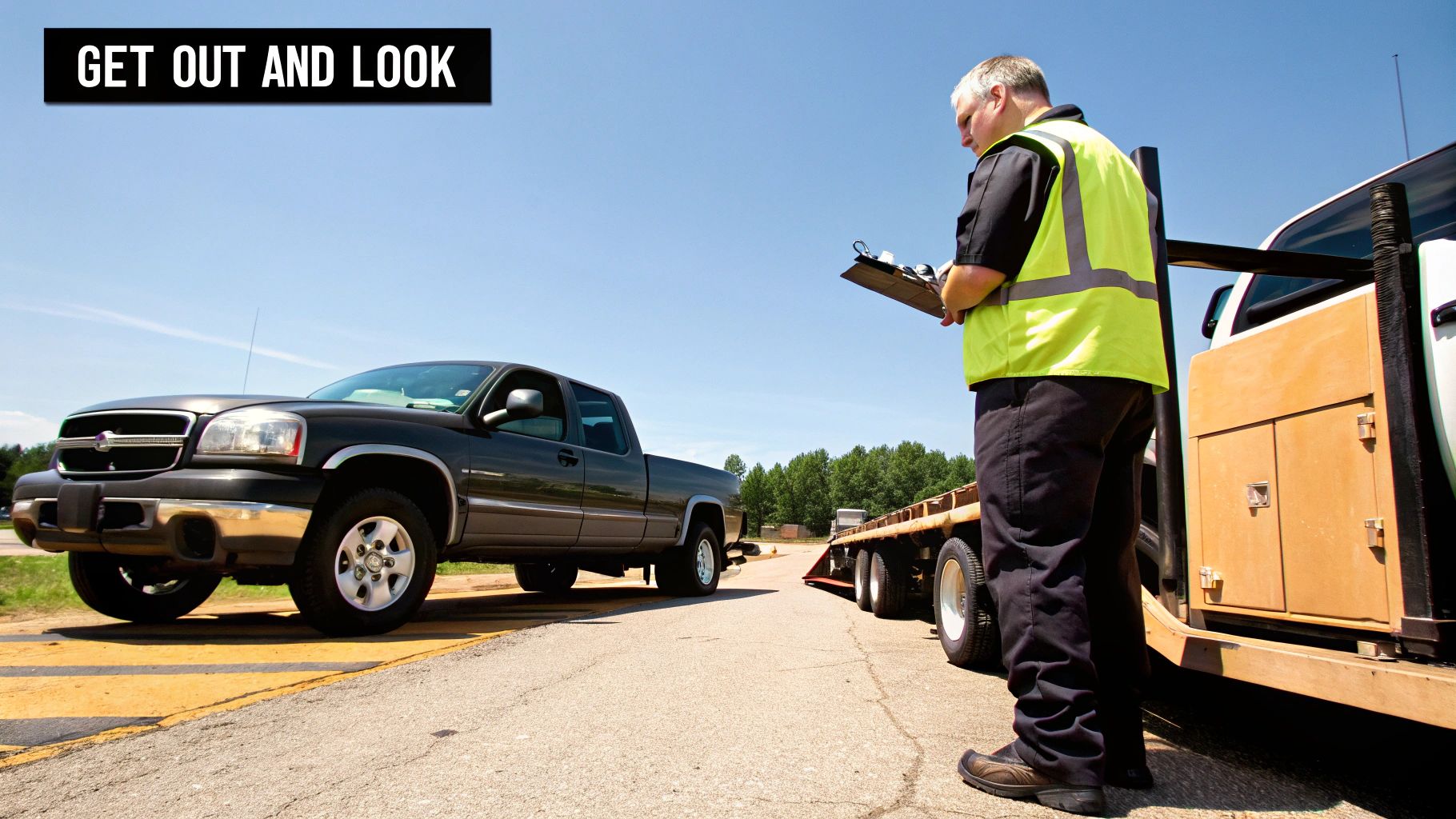
The first rule every seasoned driver lives by is a simple one: G.O.A.L., which stands for Get Out And Look. Your mirrors and cameras are great tools, but they will never replace your own two feet on the ground. Your eyes give you the full, unfiltered picture of the space you're about to enter.
You'd be surprised what you miss from the driver's seat. I've seen everything from low-hanging branches and hidden stumps to forgotten bicycles trip people up. A quick walk-around builds a mental map of your path and eliminates nasty surprises.
The 360-Degree Walk-Around
This isn't just a casual stroll. Your 360-degree walk-around is a systematic check of your entire reversing path. Be methodical and look for anything that could get in your way.
Here’s what I always scan for:
- Overhead Clearance: Are there any tree limbs, power lines, or building overhangs?
- Ground-Level Hazards: Watch out for potholes, soft spots in the grass, curbs, or any debris that could damage a tire.
- Blind Spot Obstacles: Look for things that are too low for your mirrors to catch, like bollards, fire hydrants, or kids' toys.
This habit is a core part of a bigger safety routine. To get a better feel for what professionals check, it's worth reviewing a complete pre-trip inspection guide.
Before you get back in the cab, make sure your mirrors are adjusted perfectly. You need to see the entire length of your trailer on both sides, keeping just a tiny sliver of the trailer visible in each mirror. This gives you a constant point of reference.
Aligning for Success
Whenever possible, try to start your reverse from a straight line. It's infinitely easier. If you’re pulling up to a loading dock or campsite, you might need to do a little "S-turn"—pulling just past the spot and then turning back to straighten out the truck and trailer. Trying to back up from a sharp angle is an advanced move that just adds unnecessary difficulty.
The challenge of backing up is so universal that it has spurred major innovation in the auto industry. The market for Trailer Backup Assist technologies is huge, hitting an estimated USD 1.47 billion in 2024. This is no surprise, especially in North America where towing is a way of life. Automakers like Ford and GM have invested heavily in systems to make this process easier, proving just how common the struggle is.
Before you start rolling backward, run through this quick mental checklist. It reinforces the G.O.A.L. principle and ensures you haven't missed a critical step.
Pre-Reversing Safety Checklist
| Check | Action Required | Why It Matters |
|---|---|---|
| Path Clearance | Perform a full 360-degree walk-around of the truck and trailer. | Identifies hidden obstacles, uneven ground, and overhead hazards your mirrors can't see. |
| Mirror Adjustment | Adjust both side mirrors to see the full length of the trailer, plus the rear tires. | Provides a clear, continuous view of your trailer's position relative to your surroundings. |
| Spotter Communication | If using a spotter, establish clear hand signals before you start moving. | Prevents miscommunication that can lead to collisions. Simple is better: "stop," "left," "right." |
| Initial Alignment | Straighten the truck and trailer as much as possible before starting to reverse. | A straight start is far easier to control than correcting a sharp angle from the beginning. |
| Hazard Lights | Turn on your four-way flashers. | Alerts pedestrians and other drivers that you are performing a slow, deliberate maneuver. |
Following these checks every single time builds muscle memory and turns a potentially stressful situation into a controlled, routine maneuver.
Getting a Feel for Counter-Steering
This is where things can get a little weird for your brain. Backing up a trailer feels completely backward because, well, it is. Every instinct you have from driving forward will steer you wrong here. The relationship between your steering wheel and the trailer's direction is the single biggest hurdle to clear.
The trick is to unlearn your forward-driving habits. Forget complex physics for a moment and focus on one simple rule that all the pros live by: steer toward the problem.
Understanding the Pivot Point
Think of your tow hitch as the pivot point in this whole equation. Every small movement you make with the steering wheel gets magnified by the time it reaches the back of the trailer. This is exactly why tiny, smooth corrections are your best friend, and big, jerky turns are your enemy.
A small turn of the wheel pushes the rear of your truck one way, which then pushes the front of your trailer the other way. This causes the back of the trailer to swing in the direction you originally turned. It's this cause-and-effect that feels so unnatural at first. For anyone driving combination vehicles, really grasping these dynamics is non-negotiable. If you're studying for your CDL, you can sharpen your skills with these practice questions for combination vehicles.
The Golden Rule: Steer Toward the Problem
Let’s walk through a real-world example. You're trying to back up in a straight line, keeping an eye on both side mirrors. Suddenly, you notice too much of the trailer's left side creeping into your driver-side mirror. That's your "problem"—the trailer is drifting left.
Your gut will tell you to turn the steering wheel right (away from the problem) to push the trailer back into line. Fight that urge. To fix the drift, you have to turn the steering wheel toward the problem. In this case, turn it to the left.
A slight turn to the left pushes the back of your truck left. This nudges the front of the trailer to the right, which straightens out its path. The moment it looks straight in your mirrors again, get that steering wheel back to center. Over-correcting creates a whole new problem.
This simple mental checklist—spot the problem, steer toward it, straighten out—will be your guide as you learn.
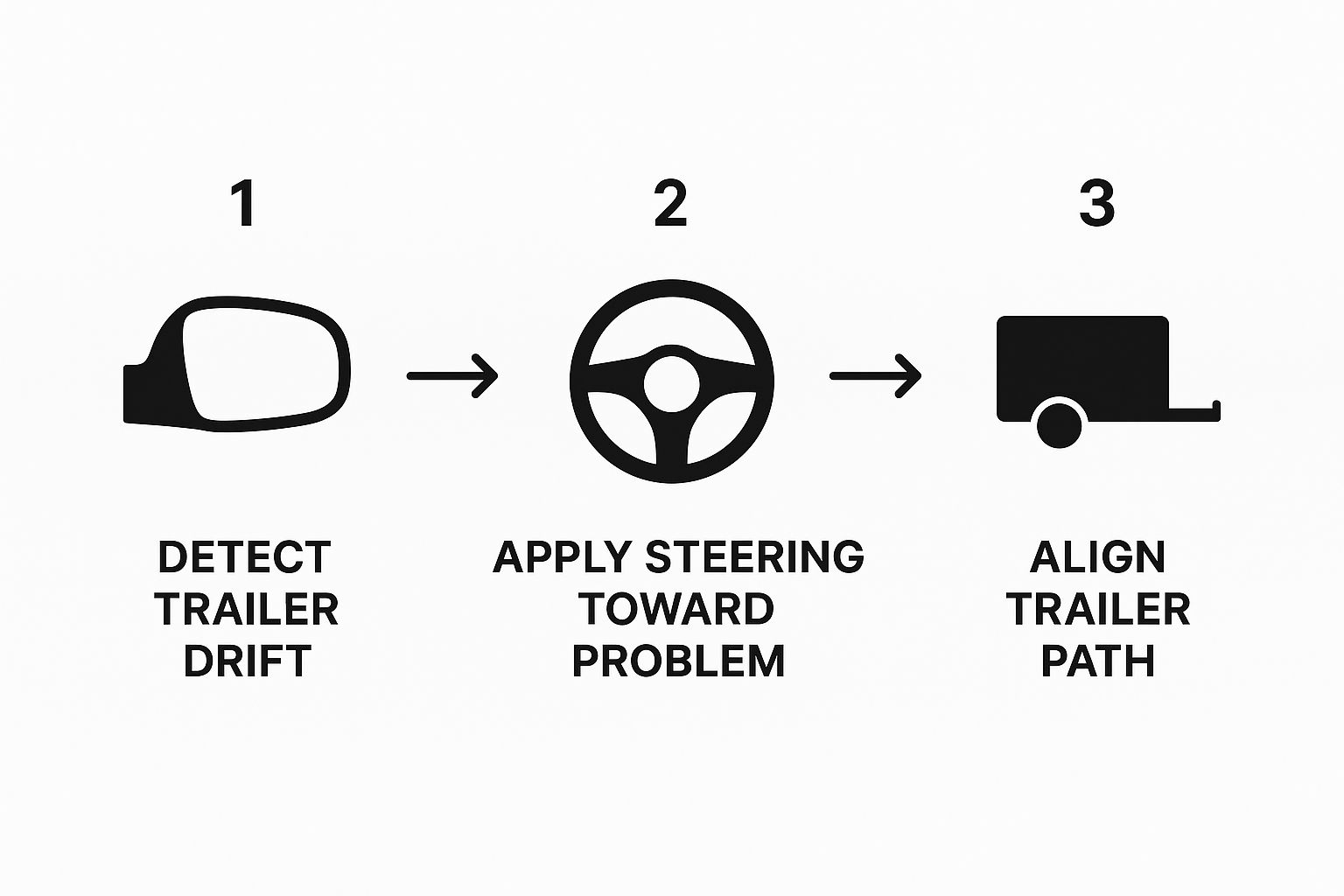
This simple flow—Detect, Apply, Align—is the core concept. The goal is to make it so automatic you don't even have to think about it.
It's All About Muscle Memory
The only way this counter-intuitive process starts to feel natural is through practice. Plain and simple. Your first few dozen attempts will probably feel awkward as your brain wages war against years of forward-driving muscle memory. Don't let it frustrate you.
Find a big, empty parking lot and just practice these three steps over and over:
- Spot the drift: Pick a mirror and watch it until the trailer starts to wander.
- Make a small correction: Gently turn the steering wheel toward the side showing too much trailer.
- Get back to center: As soon as the trailer is straight again, bring your steering wheel back to the neutral position.
By repeating this "see it, fix it" loop, you're literally rewiring your brain. What starts as a confusing, frustrating exercise will eventually become a smooth, controlled maneuver that feels like second nature.
Executing a Flawless 90-Degree Backup
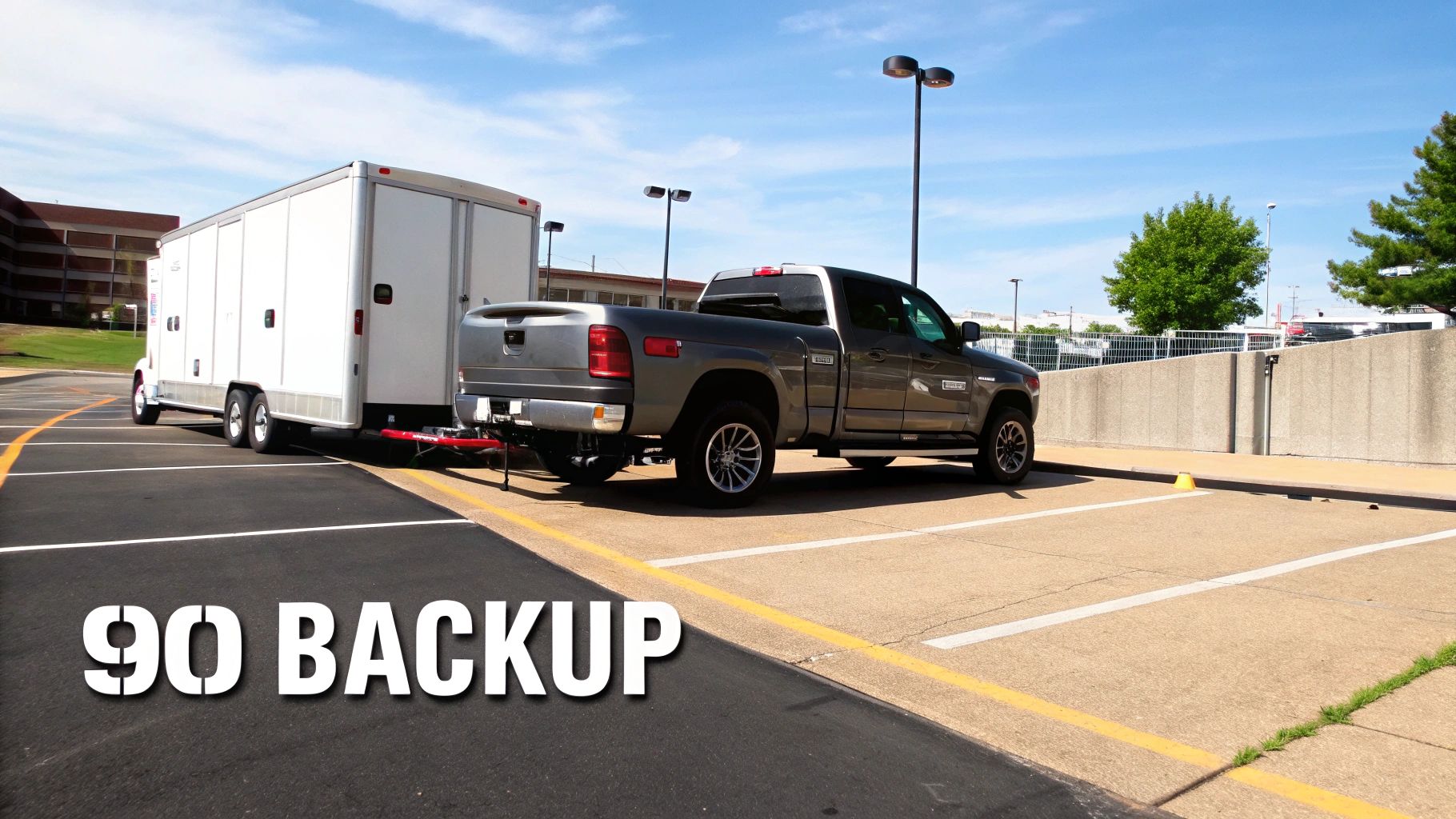
Alright, this is where the rubber meets the road. The 90-degree backup is a maneuver you'll use constantly, whether you're slotting into a campsite, a tight loading dock, or just your own driveway. Get this one down, and you'll have the confidence to tackle almost any reversing challenge.
The secret to a clean 90-degree park isn't one big, dramatic turn. It’s all about a series of small, intentional moves. I see it all the time with beginners—they crank the wheel too hard, which leads to a jerky, frustrating dance of constant corrections. The goal is to be smooth and think one step ahead.
Setting Up Your Approach
How you start this maneuver dictates how it ends. Give yourself plenty of room to work with so you don't feel boxed in from the get-go.
Your first move is to pull your truck and trailer completely past the spot you're aiming for. If you can, keep the space on your driver's side—it makes visibility so much easier. You want to position yourself so the rear of the trailer is a good several feet beyond the entrance of the spot. This creates the angle you need for the trailer to pivot in cleanly.
A rookie mistake is starting the turn way too early. You need to wait. Don't even think about turning the wheel until your truck's cab is lined up with the far edge of the parking space. Hitting this timing just right makes all the difference.
Making the Turn with Precision
Once you're in position, it's time to put those counter-steering skills to work.
- Kick the Trailer Out: Start by turning your steering wheel hard to the right (away from the parking spot). This is what pushes the rear of the trailer to the left and starts it on its path into the space.
- Follow It In: As soon as the trailer begins to arc into the spot, you have to "follow" it. Straighten your wheel, then immediately start turning it to the left. This brings the truck back in line with the trailer as it moves into position.
- Watch Your Tires: Here’s a pro tip: focus on your tow vehicle's tires, not the hood. Your tire placement tells you exactly where your truck is in relation to the trailer and the boundaries of the spot. It's a much more accurate guide.
Remember, small inputs have a huge impact. You’re guiding the trailer, not wrestling with it. If you feel it turning too sharp or getting away from you, just stop. Pull forward a few feet to straighten everything out and start the turn again. There's no shame in a reset.
The Critical Role of a Spotter
No matter how good you get, you will always have blind spots. That's why having a trustworthy spotter isn't just a good idea—it's a must, especially when you're learning. Backing up is inherently risky; the National Safety Council notes that around 25% of car accidents happen while a vehicle is reversing. An extra set of eyes is your best defense.
Before you even put the truck in reverse, agree on a few simple hand signals. Keep it basic, because complicated signals cause confusion when things get tight.
- Open Palm (Stop): This is non-negotiable. It means stop now.
- "Come Back" Motion: A standard beckoning wave to keep coming.
- Directional Pointing: Pointing left or right to tell you which way the back of the trailer needs to go.
Your spotter's job is to stay visible in your driver-side mirror at all times. They are your eyes on the side of the trailer you can't see. This teamwork turns a stressful situation into a controlled, safe operation. This kind of communication is a vital skill, whether you're parking an RV or searching for a safe place to stop for the night with a reliable truck parking finder.
Troubleshooting Common Backing Mistakes
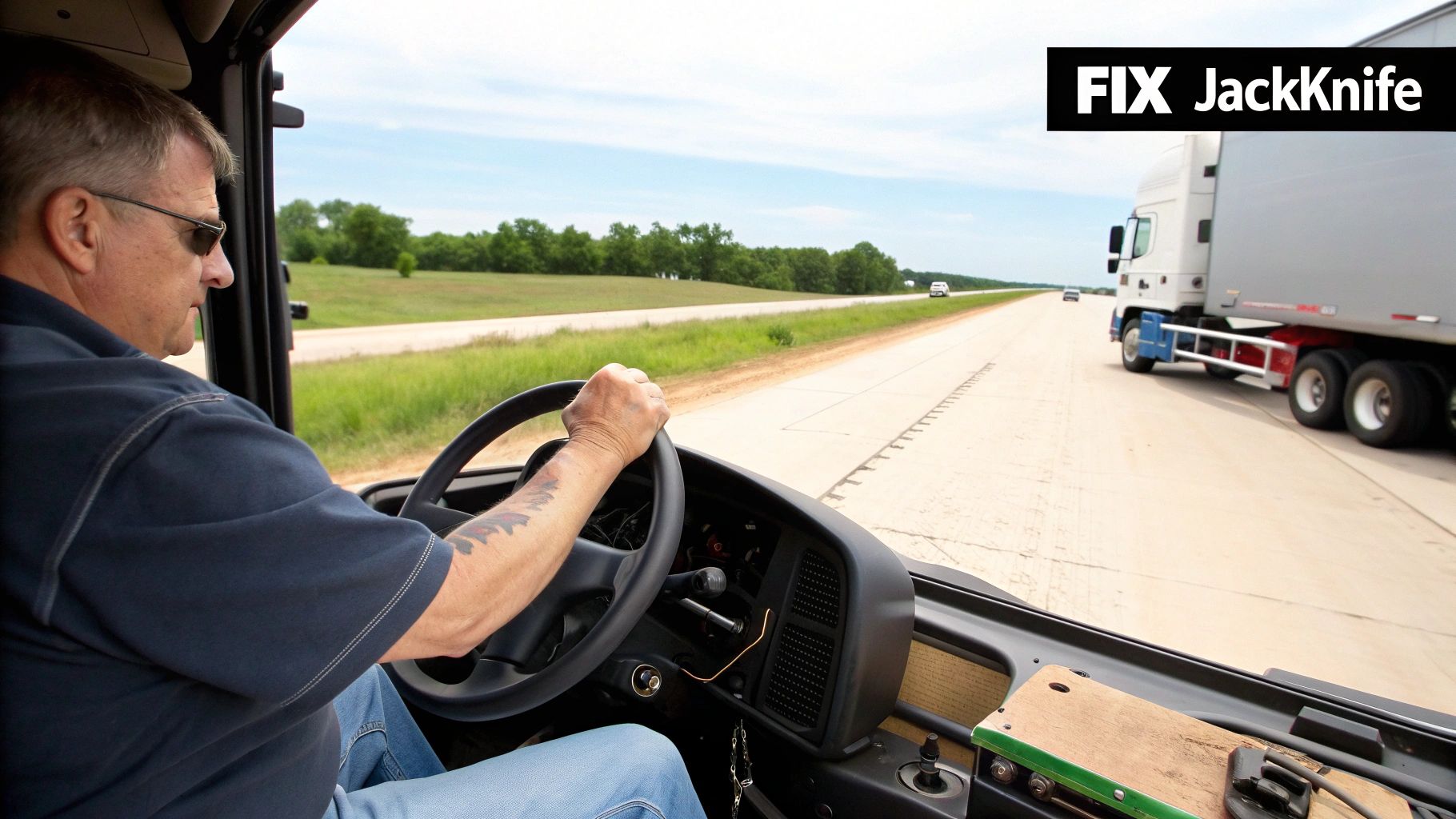
Even with a perfect setup, things can go sideways—literally. Backing up a trailer is a learned skill, and every driver messes up. The real pro is the one who can spot a mistake as it’s happening and fix it without breaking a sweat.
Think of this as your field guide for when the trailer decides to go rogue. We’ll cover the classic blunders, what they look like from your driver's seat, and exactly how to get things straightened out.
The Dreaded Jackknife
Ah, the jackknife. It's the most famous—and feared—backing mistake. It happens when you crank the wheel too hard, creating an angle so sharp that the trailer folds in on your truck. You’ll know it’s coming when you see way too much of the trailer's side in one mirror.
The second you feel a jackknife starting, stop. Seriously, just hit the brakes. Trying to reverse out of it will only make it worse. Shift into drive and pull forward slowly until the truck and trailer are in a straight line again. Now you can take a breath and restart your approach with a much lighter touch on the wheel.
Turning Too Late and Missing Your Spot
This one is frustrating. You back up, start your turn, and quickly realize the trailer is going to completely miss the spot. It's a classic case of misjudging your pivot point—you either started turning too late or not sharply enough.
Don't try to force it. The best move is a simple reset. Pull forward, straighten out, and give yourself a little more room this time. Driving a few feet further past the spot before you begin backing is often all it takes to nail it on the second try.
Your best friend when backing is the brake pedal. Stopping gives you a second to think, check your mirrors, and figure out your next move. Rushing a bad situation is how you end up with dents and a bad day.
Losing Sight of the Trailer
Ever had the trailer just vanish from one of your mirrors? That's a huge red flag that your alignment is off. If it disappears from your driver-side mirror, it’s drifting too far to the passenger side. If it's gone from the passenger side, it's headed for your driver side.
This is the point where you’re driving blind, and that's dangerous. To fix it, just remember to steer toward the problem. If the trailer vanishes from your left mirror, turn the steering wheel slightly to the left. That will nudge the back of the trailer back into view.
Incidents like these highlight just how dangerous operating large vehicles without full visibility can be. For instance, between 1992 and 1996, rear underride crashes led to 934 total fatalities, a grim reminder of the risks when trailer positioning isn't managed perfectly.
Knowing your equipment is just as critical as your technique. For professional drivers, this extends to every system on the rig. To learn more about how vital this knowledge is, check out our guide on the air brakes test.
Quick Fixes for Common Problems
Sometimes it's hard to diagnose the issue in the heat of the moment. This little cheat sheet should help you quickly identify what’s going wrong and how to correct it.
| The Problem (What You See) | What It Means | How to Fix It |
|---|---|---|
| Too much trailer in one mirror. | You're over-steering. | Stop immediately. Pull forward to straighten out and restart with smaller steering inputs. |
| The trailer is about to miss the target space. | You started your turn too late. | Pull forward past the spot, giving yourself more room before you start your turn. |
| The trailer disappears from a mirror. | You've lost alignment. | Steer toward the mirror where it vanished to bring the trailer back into view. |
| The trailer is responding too slowly. | You're making steering corrections too late. | Slow down. Make your steering adjustments earlier and hold them a bit longer. |
The key takeaway is to stay calm and make small, deliberate corrections. Nearly any backing mistake can be fixed with a simple pull-up and a fresh start.
Advanced Backing Techniques for Tough Spots
So you've mastered the straight shot and the standard 90-degree park. That’s great, but now it's time for the real world—the kind of spots that make even seasoned drivers sweat a little. These advanced maneuvers aren't about speed. They’re all about slow, deliberate control when things get tricky.
Take reversing up a hill, for instance. Gravity is suddenly working against you, and it changes everything. You have to find that sweet spot between the brake and the gas to keep the rig from rolling forward when you don't want it to. The trick is giving it just enough throttle to ease backward without lurching, all while using the brake to pause and re-evaluate your path.
Maneuvering in Confined Spaces
We've all been there: trying to squeeze a trailer into a narrow campsite or a ridiculously tight storage unit. In these moments, every single inch matters. Your mirrors are crucial, of course, but nothing replaces getting out of the truck to physically look. Seriously, a "Get Out And Look" (GOAL) check is your best defense against a costly mistake.
The name of the game here is micro-adjustments.
- Think small steering inputs. A tiny nudge of the wheel makes a huge difference way back at the trailer's bumper.
- Move at a crawl. Backing up this slowly gives you a fighting chance to see a problem developing and correct it before it turns into a real mess.
- Don't be too proud to pull up. Trying to force a bad angle is how trailers get dented and tempers get frayed. If it's not working, pull forward, straighten out, and start the turn again.
Your trailer's size plays a huge role here, too. A little utility trailer will pivot on a dime, while a big fifth-wheel needs a much wider, more gradual approach. You have to know your rig's personality.
When you’re backing around a blind corner, your spotter isn’t just a helper—they’re your eyes. You’re driving completely blind on one side, and you have to put your full trust in their directions. Work out your hand signals for "stop," "turn," and "straighten out" beforehand. It’s your lifeline.
Adapting to Different Trailer Types
No two trailers handle exactly alike. A lot of it comes down to the distance between your truck's rear axle and the trailer's axle—that's what dictates how sharply it turns.
- Short Trailers (like small utility or jet ski trailers): These things are incredibly responsive. They turn fast, which is great, but it also means they can jackknife in the blink of an eye if you get a little too aggressive with the wheel.
- Long Trailers (like big travel trailers or fifth-wheels): These are the opposite. They react slowly and gracefully, forcing you to think a few steps ahead. Their movements are more predictable, but they need a lot more room to make a turn.
Getting a feel for your trailer’s unique quirks is the most important thing you can do. Find a big, empty parking lot and just practice. Learn how it pivots and how much input it needs before you're in a high-pressure situation.
Your Top Trailer Backing Questions Answered
Even with the best techniques down, a few questions always seem to pop up. Getting solid answers to these common sticking points is the final piece of the puzzle for building real confidence. Let's dig into the questions I hear most often from drivers.
Which Way Do I Turn the Wheel?
This is, without a doubt, the number one point of confusion. The easiest way to bypass your brain's normal forward-driving instincts is to use the bottom-hand method.
Forget everything you know about turning. Place your hand at the very bottom of the steering wheel—the 6 o'clock position.
Now, it's simple:
- Want the trailer to go right? Move your hand to the right.
- Want the trailer to go left? Move your hand to the left.
Your trailer will always move in the same direction as your hand from that bottom position. This little trick completely eliminates the mental gymnastics of counter-steering.
How Can I Practice Safely?
Nothing beats building muscle memory in a low-stakes environment. Your best bet is to find a big, empty, and level parking lot where you don't have to worry about hitting anything.
Grab a few traffic cones or even some empty cardboard boxes to set up a fake parking space or a makeshift driveway. Start by just backing up in a straight line to get a feel for how the trailer reacts to even the smallest steering adjustments. Once you've got that down, you can start practicing 90-degree turns into your "spot." It's the pressure-free repetition that makes these skills second nature.
Don't sweat the mistakes during practice. This is your lab. It's where you learn to correct a bad angle or recover from over-steering without any real-world consequences. A single hour of focused practice is worth more than a dozen stressful attempts on the street.
How Do I Prevent a Jackknife?
A jackknife is almost always caused by over-steering, which creates an angle between your truck and trailer that’s just too sharp to handle. The key to prevention is making small, gradual corrections.
Keep your eyes glued to your mirrors. If you see way too much of one side of your trailer in a mirror, you're turning too sharply. The moment you sense that happening, your only move is to stop, pull forward to straighten out, and start over. Trying to reverse your way out of a severe angle is a losing battle. Resetting is always the safer and, believe it or not, faster solution.
For anyone looking to get their commercial license, understanding these core safety principles is a massive part of the curriculum. You can get a feel for similar topics with this general knowledge test material.
At Patriot CDL, we turn practice into a profession. Our hands-on training programs are designed to get you on the road with the skills and confidence to handle any maneuver. Learn more about launching your truck driving career at https://patriotcdl.com.