So, you're thinking about becoming a truck driver. It's a solid career choice, essential to our economy, and there's a huge demand for good drivers right now. But getting there isn't just about hopping into a big rig. There's a clear path you need to follow, from meeting the basic requirements to passing your final skills test.
Your Roadmap to a Career on the Open Road
Think of this journey as a series of achievable milestones. It all starts with getting a clear picture of what the industry looks like today and the critical role you'll play in it. With so many companies looking for qualified drivers, the opportunities are real for anyone ready to put in the work.
This guide is your map. It’s designed to show you exactly what to expect and what you'll need to commit to along the way.
The Three Core Phases
The entire process of becoming a professional truck driver really boils down to three main stages: first, confirming you’re eligible; second, getting the right professional training; and finally, landing that first job. Each step is built on the one before it, moving you progressively closer to your goal.
This is the straightforward path from those initial eligibility checks all the way to starting your first paid driving position.
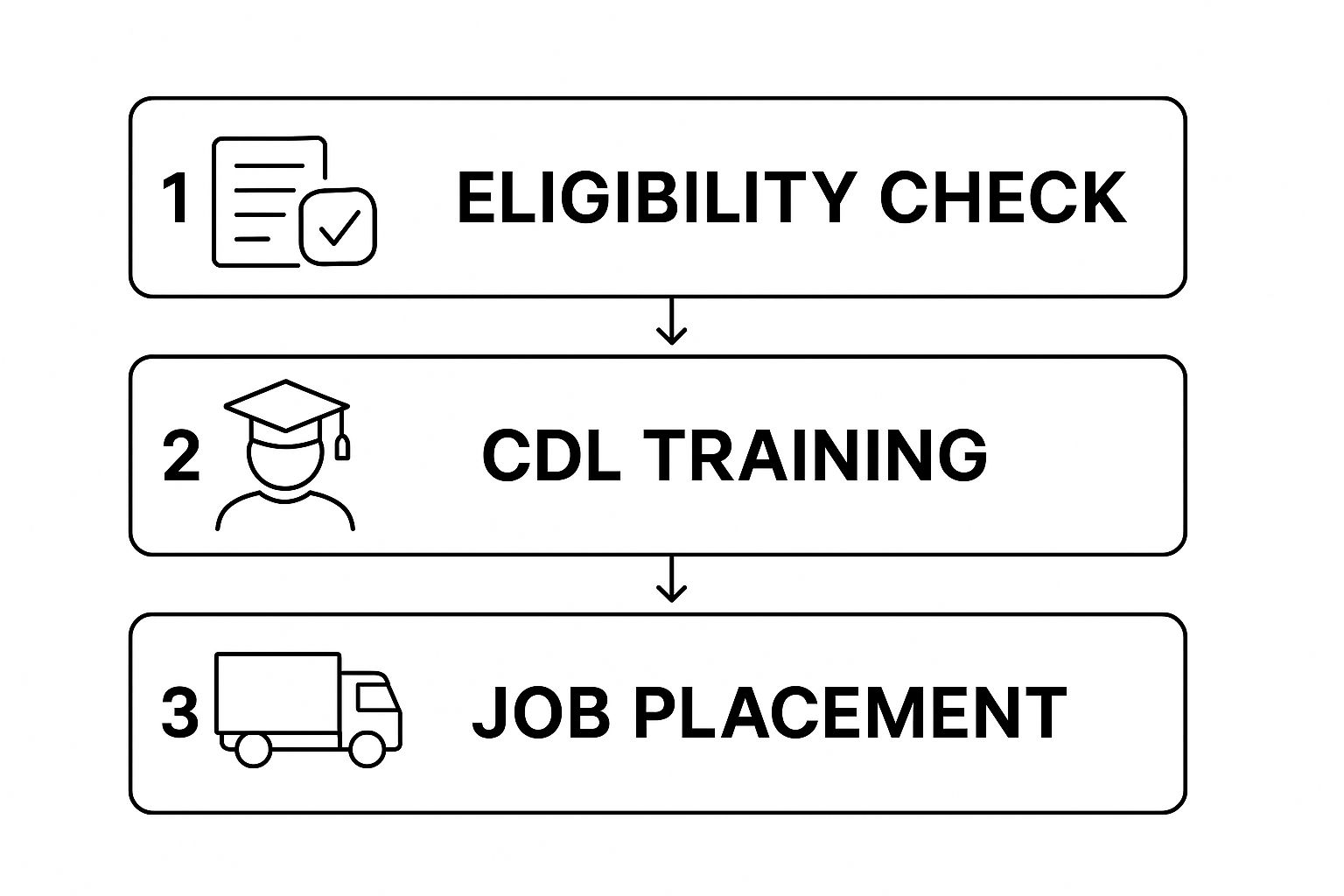
As you can see, each stage acts as a gateway to the next. It’s a structured process that makes entering the profession manageable and clear.
Understanding the Opportunity
The need for new truck drivers isn't just a local thing—it’s a global reality. The profession is facing a massive shortage, with an estimated 3.6 million unfilled truck driver positions across 36 different countries.
What makes it tougher is the age gap. Younger drivers under 25 account for only about 6.5% of the workforce. For you, this gap between supply and demand means one thing: job security and competitive pay, even right out of school.
My Two Cents: The current driver shortage creates an incredibly favorable job market for newcomers. Companies are actively recruiting to fill empty seats, which means it’s a fantastic time to get your CDL and start your career.
To give you a bird's-eye view, I've broken down the journey into a clear, phase-by-phase table. This will help you see how everything fits together from start to finish.
Key Phases to Becoming a Professional Truck Driver
| Phase | Primary Goal | Key Activities | Typical Duration |
|---|---|---|---|
| Phase 1 Eligibility & Permitting | Confirm you meet all requirements and get your Commercial Learner's Permit (CLP). | Pass your DOT physical and background checks, then study for and pass the written knowledge tests. | 2–4 Weeks |
| Phase 2 CDL Training | Master the skills to safely operate a commercial vehicle. | Attend a quality CDL school, learn pre-trip inspections, and log plenty of behind-the-wheel hours. | 3–7 Weeks |
| Phase 3 Licensing & Job Placement | Earn your official CDL and find your first driving job. | Pass the three-part CDL skills test, put together a solid resume, and start applying to trucking companies. | 1–4 Weeks |
Following this structured approach does more than just prepare you for the test—it gives you the solid foundation you need to build a long, successful, and rewarding career out on the open road.
So, You Want to Drive a Truck? First, Let's See If You Qualify.
Before you even start dreaming about the open road or shopping for the right CDL school, we need to talk about the absolute basics. Think of this as the first, and most critical, checkpoint. These are the non-negotiables—the fundamental requirements set up to make sure every driver on the road is safe, capable, and ready for the job.
Honestly, getting these things sorted out from the get-go will save you a world of headaches later. It’s about making sure your age, physical health, and driving history are all in order. Without this solid foundation, everything else is just wishful thinking.
The Age and License Check
First things first: age. This is a common point of confusion for new drivers, especially when it comes to driving in-state versus crossing state lines. The rules are federally mandated and crystal clear.
- Driving Within Your State (Intrastate): You can get your CDL at 18 years old in most states. The catch? You’re restricted to driving commercial vehicles only within that state’s borders.
- Driving Across State Lines (Interstate): To haul freight from, say, Texas to Florida, you must be at least 21 years old. This is why the big national carriers and most Over-the-Road (OTR) jobs require you to be 21.
You'll also need to have a standard, valid driver's license from your home state before you can even think about getting a Commercial Learner's Permit (CLP). And a clean driving record isn't just a suggestion—it's paramount. Companies dig deep into your background, so it pays to know what’s on your record. If you’re not sure where you stand, just head to your local DMV and request a copy of your Motor Vehicle Record (MVR).
For a full rundown, it’s worth looking over a complete list of CDL requirements to see the whole picture.
The DOT Physical and Your Medical Card
Operating an 80,000-pound machine for hours on end is a huge responsibility, and your health is a major factor. The Department of Transportation (DOT) physical exam is how you prove you're medically fit for the task. This isn't just any checkup; it has to be done by a medical examiner who is certified by the DOT.
The doctor isn't there to find a reason to fail you. Their job is to ensure you don’t have a health condition that could suddenly put you, and others, in danger.
What the DOT Physical Exam Covers
| Health Category | What They're Looking For | Common Hurdles |
|---|---|---|
| Vision & Hearing | At least 20/40 vision in each eye (glasses or contacts are fine) and the ability to hear a "forced whisper" from 5 feet away. | Color blindness can be an issue for telling traffic signals apart. |
| Blood Pressure | Your blood pressure needs to be at or below 140/90. Higher readings might mean you need more frequent check-ups or medication. | Uncontrolled high blood pressure is a top reason drivers get temporarily or permanently sidelined. |
| Urinalysis | This checks for protein and sugar levels to screen for underlying issues like diabetes. | Important note: This is separate from the mandatory drug test. |
| General Health | The doctor will check your heart, lungs, and neurological functions, plus look for any limb impairments. | Certain conditions like epilepsy, narcolepsy, or uncontrolled diabetes are usually disqualifying. |
Once you pass, you’ll get your Medical Examiner's Certificate, what everyone in the industry calls a "DOT med card." This little piece of paper is gold. You have to keep it on you and keep it current. Depending on your health, it can be valid for up to 24 months.
A past medical issue doesn't always mean the end of the road. For example, a driver with well-managed sleep apnea who uses a CPAP machine can often get cleared. The key is demonstrating that the condition is controlled and won't interfere with safe driving.
Getting ahead of these requirements is the smartest way to start. Being honest and proactive ensures your journey into trucking begins on solid, eligible ground.
Choosing Your Path for CDL Training
Alright, so you’ve confirmed you meet all the basic requirements. What’s next? This is where the real work—and fun—begins. You’re about to dive into the core training that turns a regular driver into a professional trucker. But before you can even think about hitting the road, you need one key piece of paper: the Commercial Learner's Permit (CLP).
Think of the CLP as your "student driver" license for the big leagues. It's the official document that allows you to get behind the wheel of a commercial truck, but only with a licensed CDL holder riding shotgun. You absolutely cannot skip this part; it's the gateway to every bit of practical, hands-on training you’ll receive.
Conquering the Commercial Learner's Permit Tests
To get that CLP in your hands, you’ll need to head to your local DMV and pass a series of written knowledge tests. These exams are no joke—they're designed to make sure you understand the fundamental principles of commercial driving before you ever touch a steering wheel.
You should be prepared for a few key tests:
- General Knowledge: This is the big one. It covers a huge range of topics, from vehicle control and safety protocols to pre-trip inspections and handling emergencies. It truly is the foundation of all your CDL knowledge.
- Air Brakes: Almost all Class A and B trucks rely on air brake systems, which operate completely differently than the brakes in your car. This test confirms you know how they work, how to check them, and how to use them properly.
- Combination Vehicles: If a Class A CDL is your goal, this test is mandatory. It covers the unique physics and challenges of driving a tractor-trailer, like safely coupling and uncoupling, and avoiding the dangerous "crack-the-whip" effect during quick maneuvers.
I can't stress this enough: study for these exams. Don't just show up and hope for the best. Grab your state's official CDL manual, find some practice tests online, and focus on actually understanding the concepts, not just memorizing the answers. For a much more detailed look at what's involved, this guide on the commercial learner’s permit process is a great resource.
Finding the Right CDL Training Program
Once you’ve successfully earned your CLP, it’s time to pick a school. This is easily one of the most critical decisions you'll make. The quality of your training will directly shape your skills, your confidence on the road, and even your job prospects down the line. Broadly speaking, you have three main paths to choose from.
The U.S. trucking industry is a behemoth, employing roughly 3.55 million drivers who are responsible for a fleet of about 13 million large trucks. Getting your CDL is your ticket into this vital workforce, and these training programs are built to get you there.
Key Insight: There’s no single "best" school for everyone. The right choice for you will depend on your finances, how you learn best, and what you want out of your career. What’s a perfect fit for one person could be a terrible choice for another.
Let's break down your options so you can make a smart decision that lines up with your goals.
Comparing CDL School Options
| Training Type | Key Advantages | Potential Downsides | Best For… |
|---|---|---|---|
| Private CDL Schools | Offer focused, fast-paced training. Give you the freedom to work for any company after graduating. | Higher upfront cost (often $3,000-$10,000). No guaranteed job placement. | Drivers who can afford the investment and want the flexibility to choose their employer. |
| Community Colleges | Generally more affordable and may qualify for financial aid. Offer a more in-depth, semester-long curriculum. | Slower programs mean it takes longer to start earning. Class schedules are often less flexible. | Students who aren't in a rush, prefer a traditional classroom setting, and may need financial aid. |
| Company-Sponsored Training | Little to no upfront cost for tuition. You're guaranteed a job with that company when you finish. | You must sign a contract to work for them (usually for a year). If you leave early, you're on the hook for the full tuition cost. | People with limited funds who want a direct path to a job and are comfortable with a contractual commitment. |
When you're looking at schools, don't be shy about asking tough questions. What's their student-to-instructor ratio? How old are the trucks in their training fleet? What are their real-world job placement rates? A reputable program will have no problem answering these questions. Your mission is to find a school that doesn’t just teach you to pass the test, but truly prepares you for a long and successful career on the open road.
Mastering the CDL Skills Test
Alright, this is the final hurdle. The CDL skills test stands between you and your new career, and it's the moment all your training has been leading up to. Think of it less as a single test and more as a three-part evaluation designed to prove you can safely handle a massive 80,000-pound machine.
This isn't just about ticking boxes; it's about showing an examiner you have the real-world knowledge, precision, and safe driving habits of a professional. Let's break down what you'll face: the pre-trip inspection, basic control skills, and the open road test.
Acing the Pre-Trip Inspection
Talk to any seasoned instructor, and they'll tell you the same thing: the pre-trip inspection is where a surprising number of students stumble. It’s not physically hard, but it’s a memory-intensive, systematic process. You’re not just looking at parts; you’re expected to verbalize every single check to the examiner, explaining what you're inspecting and why it's critical for safety.
You'll have to walk the entire vehicle, covering everything from fluid levels and brake systems to tire integrity and the security of the coupling. The only way to nail this under pressure is to develop a rock-solid routine and stick to it every single time. Get your flow down, and you won't miss a beat.
To really get this down, you need a structured game plan. Our guide offers a detailed checklist to help you prepare for the pre-trip inspection, so you can walk in with the confidence that you’ve covered all your bases.
Proving Your Control with Basic Maneuvers
Next up is what some call the "yard skills" or basic control skills test. This all happens on a closed course, far away from public traffic. The examiner wants to see if you can truly control the truck and trailer in tight situations.
You'll be asked to perform several core backing maneuvers. They typically include:
- Straight-Line Backing: The foundation of all backing. You have to keep the entire rig straight as you reverse into a designated lane.
- Offset Backing (Left or Right): This is where you back your rig from one lane into an adjacent one. It requires very precise steering to swing the trailer over correctly.
- Parallel Parking (Driver or Conventional Side): Yes, just like in a car, but on a much, much bigger scale. This is a true test of your spatial awareness and fine control.
Here’s a tip every veteran driver lives by: G.O.A.L. — Get Out And Look. When you're practicing, don't ever hesitate to stop, hop out of the cab, and see exactly where your trailer is. This builds the muscle memory and visual instincts you'll rely on when it counts.
The secret here is simple: slow is smooth, and smooth is fast. Go slow. Make small, deliberate steering corrections. The biggest mistakes—rushing and overcorrecting—are what lead to failing scores.
Taking Your Skills to the Open Road
The final piece of the puzzle is the on-road driving test. This is where you put it all together in live traffic. An examiner will ride shotgun, giving you directions and observing how you handle the truck in the real world.
Don't worry, they aren't trying to trick you. They just need to see that you can operate safely and professionally alongside everyone else on the road.
Key Areas the Examiner Will Evaluate
| Driving Skill | What They're Looking For |
|---|---|
| Intersections | Coming to a proper stop behind the line, thoroughly checking cross-traffic, and making clean turns without hitting curbs or drifting. |
| Lane Control | Keeping your truck centered and maintaining a consistent, safe following distance—your "space cushion." |
| Gear Shifting | Shifting smoothly (if you're in a manual), always being in the right gear for the speed and grade, and no grinding or coasting. |
| Safety Habits | Constant, effective use of your mirrors, signaling well ahead of any move, and showing you can anticipate what other drivers might do. |
A huge part of passing this final section is just managing your nerves. You've been trained for this. Trust what you've learned, take a deep breath, and focus on one command at a time. When you drive with calm confidence, you're showing the examiner you're more than ready for the road ahead.
Landing Your First Truck Driving Job
Alright, you’ve done the hard part. The tests are passed, and you have a brand-new CDL in your wallet. Now comes the exciting part—turning that license into a career. This is where you shift gears from being a student to a professional driver, and finding that first job is the most important step.
The trucking world is huge, and there’s no single "truck driver" job description. Before you even start applying, you need to figure out which slice of this industry fits you best. We're talking about a global market valued at around $2.2 trillion, with massive growth expected. That means one thing for you: opportunity. Companies are always looking for new, qualified drivers.
Your first move is to understand the different lanes you can run. Each one comes with a totally different lifestyle, schedule, and paycheck.
OTR, Regional, or Local: Which Is Right for You?
The three main buckets for driving jobs are Over-the-Road (OTR), regional, and local. Your choice here will define your day-to-day life more than anything else, so let's break down what each one really means.
Over-the-Road (OTR): This is the classic long-haul trucking life. You're crisscrossing the country, hauling freight from coast to coast, and often staying out on the road for weeks at a time. The upside? The pay can be fantastic, and you'll see more of the country than most people do in a lifetime. The trade-off is significant time away from family and friends.
Regional: Think of this as the middle ground. Regional drivers stick to a specific part of the country—maybe the Midwest, the Southeast, or the Pacific Northwest. You're still on the road for several days, but you'll likely be home every weekend. It offers a nice balance of solid miles and more consistent home time.
Local: With a local job, you’re home every single night. These routes operate within a smaller radius around a home base. You can expect more physical work, like frequent stops with loading and unloading (think beverage or food service delivery), but the routine and nightly home time are a huge plus for many drivers.
A Little Insider Advice: For most brand-new drivers, OTR is where you'll get your start. The big national carriers have the resources and insurance to hire drivers with no on-the-job experience. They’ll put you through a finisher program with a trainer, which is invaluable. It's often the quickest path to getting the one year of experience that opens up almost every other door in trucking.
Be honest with yourself about what you want. If being home for dinner is a dealbreaker, start hunting for local delivery or construction jobs. If you're ready for an adventure and want to stack up cash, OTR is calling your name.
Building Your Resume and Finding Companies
Your resume is your foot in the door. Even without driving experience, you can make it shine. The most important thing on that paper is your new Commercial Driver's License. Put it right at the top. Make sure to list the class (Class A) and any special endorsements you earned, like HazMat (H) or Tanker (N).
Next, think about skills from past jobs. Did you work in a warehouse? That shows you get how logistics works. Have a perfect attendance record from your last job? That screams reliability. Any skill that proves you are a safe, dependable, and hard-working person is gold.
When you start looking for companies, cast a wide net. The giant carriers are a great starting point, but don't stop there. Also, look into:
- Trucking-specific job boards online.
- Your CDL school’s job placement office—they have connections!
- Smaller, local outfits that might not advertise nationally.
What to Expect in the Interview
The interview for a driving job is usually pretty direct. The company wants to verify three things: you are who you say you are, you have a clean CDL and medical card, and you have a professional, safety-first attitude.
Get ready to talk about your driving record. Be completely honest—they're going to pull your MVR (Motor Vehicle Record) anyway, so you might as well get ahead of any dings on your record and explain them. They also want to know that you remember your training. It wouldn’t hurt to quickly review our guide on the CDL general knowledge test to have those core safety principles fresh in your mind.
Remember, you're interviewing them, too. This is your chance to find out if a company is a good fit for you. Don't be shy about asking tough questions.
Key Questions to Ask a Potential Employer
| Category | Sample Questions |
|---|---|
| Pay Structure | "How is the pay calculated—by the mile, hourly, or percentage? What's a realistic weekly take-home for a new driver here?" |
| Home Time | "What's the official home time policy? Is it 'one day off for every week out'? Is that time guaranteed, or is it 'if freight allows'?" |
| Equipment | "What kind of trucks are in the fleet, and how old are they? Are they assigned trucks, or will I be slip-seating? How do you handle maintenance?" |
| Company Culture | "What does your driver training or finishing program look like? Who is my point of contact if I have an issue on the road?" |
Finding the right company is about so much more than the cents-per-mile. It's about finding a place that respects its drivers and gives you a real shot at building a successful career. Do your research, ask good questions, and you'll land a first gig that sets you up for a great future on the open road.
Frequently Asked Questions About Becoming a Trucker

Starting any new career brings up a lot of questions. As you get closer to your goal of becoming a professional truck driver, you'll naturally have some specific things you're wondering about—the details of the process and what life is really like out on the road.
We get it. Here are some of the most common questions we hear from aspiring drivers, answered in a straightforward way to help you move forward with confidence.
How Long Does It Realistically Take To Become a Truck Driver?
The timeline can be surprisingly fast, but it really depends on the individual and the program they choose. If you can commit to a full-time, intensive CDL training program, you could be done in as little as three to seven weeks. For those who need to balance training with other life commitments, a part-time program might take a few months.
But earning your CDL is just the first major milestone. After you’re licensed, most large trucking companies will have you go out with an experienced trainer for a company-specific finishing program. This is where the rubber really meets the road. This phase typically lasts another four to eight weeks, giving you essential real-world experience before you take the keys to your own rig.
From your first day in the classroom to going solo in your own assigned truck, a realistic total timeline is usually somewhere between two and four months. Just remember that outside factors, like a backlog at your local DMV for skills testing, can sometimes add a few weeks to the process.
What Are CDL Endorsements and Which Ones Should I Get?
Think of endorsements as special qualifications you can add to your CDL. They prove you have the skills and knowledge to haul specific types of freight, and getting the right ones can open up a lot more job opportunities and boost your earning potential right out of the gate.
For new drivers, some of the most valuable endorsements are:
- (T) Endorsement: This one lets you pull double or triple trailers, which is common practice for many of the biggest LTL (Less-Than-Truckload) carriers.
- (N) Endorsement: You'll need this to operate a tanker vehicle designed to haul bulk liquids or gases.
- (H) Endorsement: This certifies you to transport hazardous materials, or HazMat.
When you combine the Tanker (N) and HazMat (H) endorsements, it becomes the (X) endorsement. If you're looking to make yourself as marketable as possible, the T and X endorsements are fantastic starting points. A quick heads-up: the HazMat endorsement requires a separate, detailed background check from the Transportation Security Administration (TSA), so it’s smart to get that ball rolling early.
Can I Become a Truck Driver With a Bad Driving Record or Criminal History?
This is a big concern for many people, and the short answer is: it depends. The key factors are the seriousness of the offense and how long ago it happened. Every company has its own hiring criteria, but there are some general industry rules of thumb.
When it comes to your driving record, most companies don't want to see more than two or three moving violations in the last three years. A major conviction, like a DUI or DWI, will likely be a non-starter until at least five to ten years have passed.
As for a criminal record, non-violent felonies might be acceptable to some carriers after a certain amount of time has passed, often 7-10 years. The most important thing is to be 100% honest on your applications. Lying will get you disqualified instantly. Don't lose hope—some companies even specialize in giving drivers a second chance, so a past mistake doesn't have to kill your dream of a trucking career.
What Is the Difference Between Company-Sponsored CDL Training and Private School?
Choosing how you get your CDL training is a major financial and career decision. With a private CDL school, you pay tuition upfront, which can cost anywhere from $3,000 to $10,000. The big benefit here is freedom. Once you graduate, you own your CDL outright and have no obligation to any specific company.
Company-sponsored training, often called "paid CDL training," is offered by large carriers with little or no upfront cost to you. The trade-off is that you sign a contract to work for that company for a specific period, usually about one year.
If you decide to leave before your contract is fulfilled, you'll be on the hook for the full cost of the training. Private school offers more flexibility and career choice, while company-sponsored training provides a guaranteed job and removes that initial financial hurdle. If you're unsure which path is best for you, it can be really helpful to reach out to a training advisor for some one-on-one guidance.
Article created using Outrank