Parallel parking a truck is a game of inches, and it's won or lost before you even shift into reverse. It all comes down to how you set the stage. A calm, methodical approach is what separates a stressful, multi-point turn nightmare from a smooth, controlled maneuver.
Setting Yourself Up for a Perfect Park
Let's face it, the idea of squeezing a big truck into a tight spot can get your heart racing. You're definitely not the only one. Parallel parking anxiety is a real thing. A study spanning 32 countries revealed that in 64% of those nations, drivers are more scared of parallel parking than they are of having their car stolen. That stat alone shows you why preparation is everything.
The secret to a good park starts between your ears. Before you even flick on that turn signal, just take a breath. Rushing is your worst enemy here and the single biggest cause of mistakes. Instead of seeing it as one massive, complicated challenge, think of it as a series of small, easy-to-handle checks. That simple mental shift can turn pure anxiety into focused, deliberate action.
Mastering Situational Awareness
Your first job is to get a complete read on your surroundings. This isn't just about spotting an open space. A true professional driver scans the entire environment, building a mental map of everything happening around the truck.
Start with the traffic. Is it a busy street? Are the cars behind you getting antsy? A quick signal and a momentary pause is all it takes to let everyone know what you're about to do. That buys you the time you need. Next, scan for pedestrians, cyclists, or anything else that could suddenly cross your path.
The best parallel parkers are always thinking one step ahead. They don't just see what's currently there; they anticipate what could happen next—a car door swinging open, a person stepping off the curb, you name it.
Evaluating the Parking Space
Not every open spot is a good spot, especially when you're in a truck. A space that looks plenty big from a distance can have all sorts of hidden surprises.
Here's what you need to look for beyond just the length of the spot:
- Curb Height and Condition: Is the curb unusually high? A high curb can easily chew up your tires or scrape a rim. Look for any broken or uneven sections, too.
- Overhead Obstacles: Always look up. Low-hanging tree branches, signs, or wires can do serious damage to the top of your truck.
- Ground-Level Hazards: Scan for fire hydrants, utility poles, or nasty potholes that could get in your way as you back in.
- Surface Slope: Trying to park on a hill adds a whole new level of difficulty. It demands much finer control over your brakes and accelerator to keep from rolling.
This kind of detailed check is no different from the safety mindset you should have every day. Making sure your vehicle and the area around it are safe is the top priority, just like what you'd cover in a detailed pre-trip inspection. When you make these observations a habit, you're building the muscle memory to park your truck safely and perfectly every single time.
Finding the Right Spot and Setting Yourself Up for Success
The first—and most important—part of parallel parking a truck happens before you even touch the steering wheel. It’s all about selecting the right spot. Not every gap you see is going to work, and learning to spot a winner from a dud is a skill in itself.
As a general rule, I tell new drivers to look for a space that’s at least one-and-a-half times the length of their truck. Anything less is just asking for trouble and a whole lot of back-and-forth. This gives you the wiggle room you need to swing the truck in without white-knuckling it.
Before you pull up, give the spot a quick scan. Are there any low-hanging tree branches? Fire hydrants lurking by the curb? Is the curb unusually high or the road sloped? These little things can turn an easy park into a nightmare, so it pays to look first.
Nail the Initial Alignment
Your starting position dictates everything that follows. Get this part right, and the rest of the maneuver feels almost automatic.
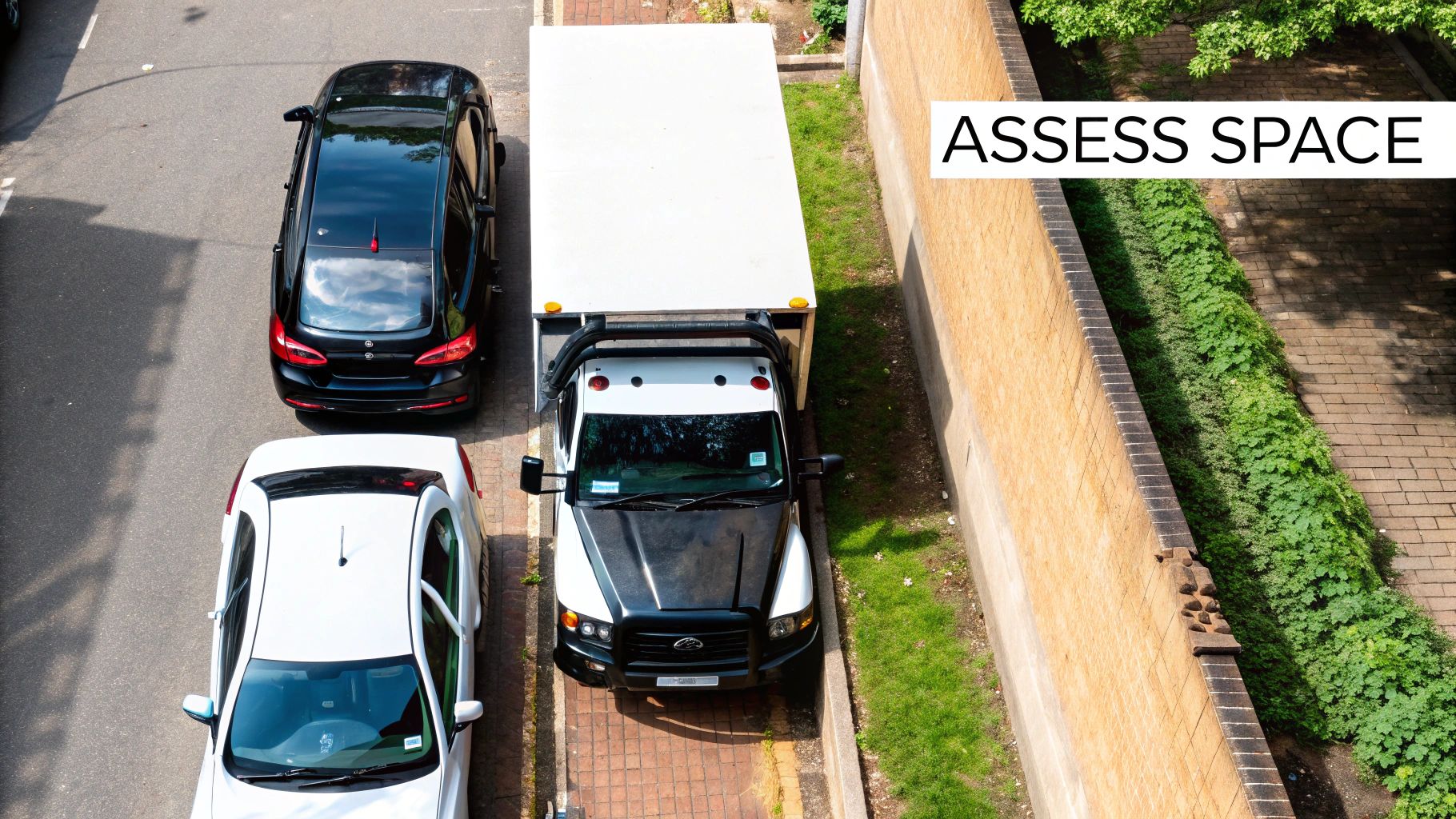
Pull up parallel to the vehicle you plan to park behind. You want to leave a gap of about two to three feet between your truck and that car. If you're too close, you won't have room to pivot and might end up scraping their vehicle. Too far away, and your angle of entry will be too shallow, leaving you sticking out in the street.
The key is finding a consistent reference point. A great one for most trucks is to line up the back of your cab with the rear bumper of the car you're next to. If you’re in a pickup, you might find it easier to align your rear tire with their rear bumper. Experiment and see what works for you.
This isn't just about getting close; it's about creating a repeatable setup. Once you find the alignment that works for your truck, you can nail it every single time, and the rest of the park becomes pure muscle memory.
Make Your Mirrors Your Best Friend
You can't park what you can't see. Your mirrors are your lifeline here, so take a second to get them right before you shift into reverse.
Your driver-side mirror should be angled to show you the side of your truck and a clear view of the traffic lane. You need to know if anyone is trying to squeeze past you.
The passenger-side mirror is the real hero of this operation. Tilt it down—way down. You want a perfect, clear view of your rear passenger-side tire and the curb. This is how you'll judge your distance and avoid shredding your tire or grinding a brand-new rim on the concrete. Seriously, a well-adjusted mirror turns a blind guess into a precision move. Mastering your mirrors is a foundational skill that ties into many of the core competencies detailed in official CDL requirements.
A Quick Word on Truck Size
It goes without saying that trucks take up more real estate. A typical commercial truck can be around 18 meters (or about 60 feet) long, which highlights why all this precision matters so much. Studies on parking scenarios have shown that how you position your vehicle directly impacts a lot's overall capacity. Getting it right isn't just about you; it's about being efficient.
Knowing your truck’s specific dimensions is a huge help. Here's a quick cheat sheet to give you an idea of what you’re working with.
Truck Parking Space Size Guide
This table provides a handy reference for estimating the minimum space you'll need based on some common truck sizes.
| Truck Type | Average Length | Recommended Minimum Parking Space |
|---|---|---|
| Mid-Size Pickup | 18-19 feet | 27-29 feet |
| Full-Size Pickup | 20-22 feet | 30-33 feet |
| Box Truck | 24-26 feet | 36-39 feet |
Keep these numbers in mind when you're out there hunting for a spot. It'll save you a lot of time and frustration.
Executing the S-Curve Maneuver
Alright, this is where the magic happens. We're talking about the smooth, controlled motion that slides your truck perfectly into that spot. It's often called the "S-curve" because you're literally tracing a gentle 'S' with your truck as you back in. Forget about speed here. This is all about precision, timing, and letting your mirrors be your guide for every single inch of movement.
You should be lined up next to the vehicle in front of the empty space. Take one last, deep breath and scan your mirrors and surroundings. Shift into reverse, but keep your foot on the brake. You’re in control. Remember the old saying: slow is smooth, and smooth is fast.
The image below shows you exactly what that critical starting position looks like—perfectly parallel, ready to begin the turn.
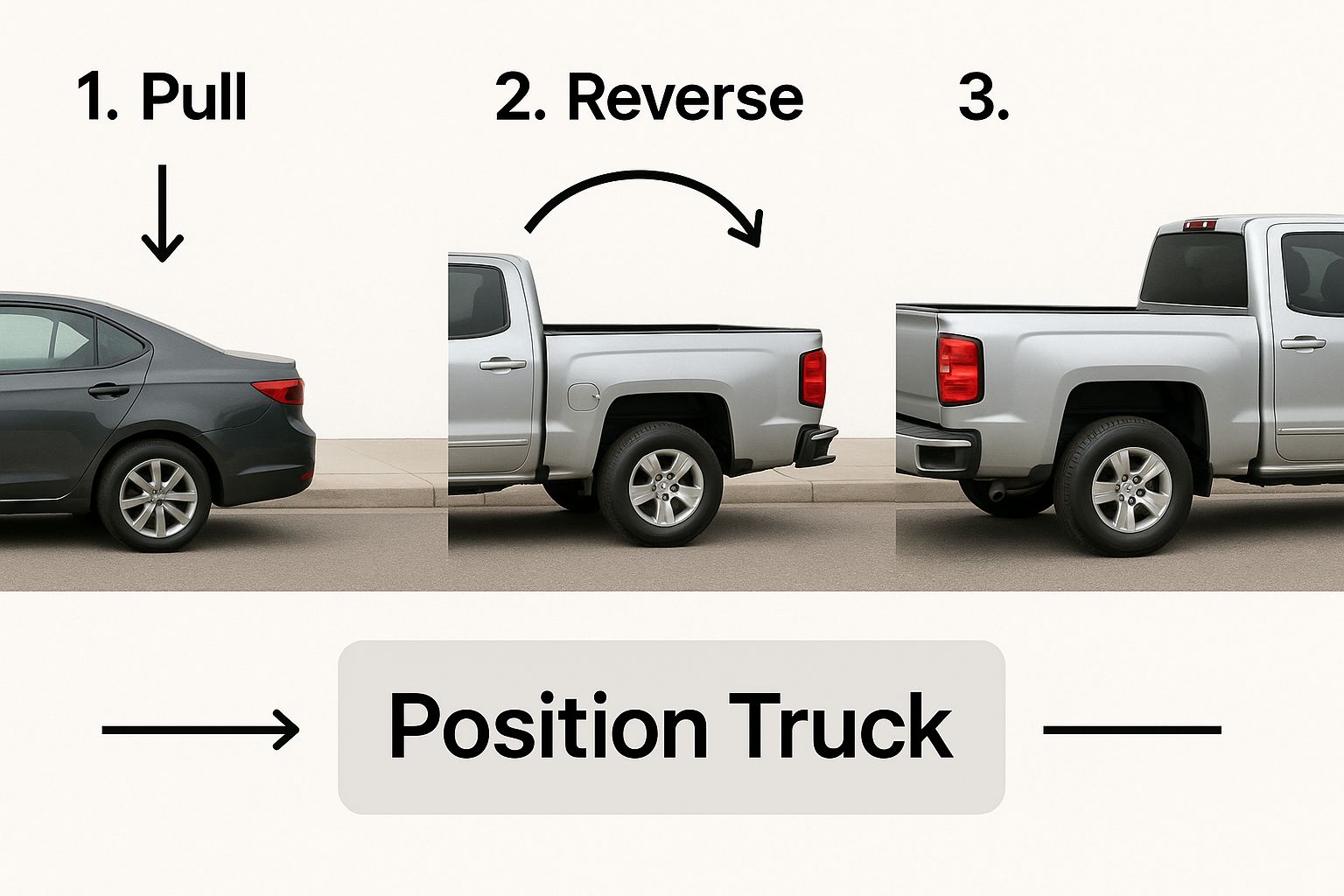
Don't rush this initial setup. Getting this alignment right from the get-go makes the entire S-curve predictable and a whole lot less stressful.
Making Your First Turn Toward the Curb
As you start to ease off the brake and roll backward, your first move is to crank the steering wheel hard toward the curb. If the parking spot is on your right, you'll turn the wheel all the way to the right. This is what starts guiding the back of your truck into the space, aiming for about a 45-degree angle.
This is probably the most critical moment of the entire park. The timing of this turn is everything—it's the difference between kissing the curb and nailing the landing. A great reference point I always use is to start that hard turn the instant the back of my truck's cab lines up with the rear bumper of the car beside me.
Keep backing up slowly, holding that wheel steady. Your eyes should be glued to your passenger-side mirror. You're looking for a very specific visual cue that tells you it's time to make your next move.
Straightening Out and Finding Your Second Cue
As you keep reversing at that 45-degree angle, stay locked on that passenger-side mirror. So, what are you looking for? You’re waiting until you can see the full front end—that means both headlights—of the car parked behind your target spot.
The moment you see both of that car’s headlights pop into view, that's your signal. It’s time to stop turning toward the curb and start straightening your steering wheel back to center.
This visual cue is a game-changer. Seriously. It removes the guesswork and gives you a reliable checkpoint every single time. Once you see those headlights, you know your truck is deep enough in the space to clear the vehicle in front.
While you straighten the wheel, continue to reverse straight back. This will pull more of your truck into the spot. It’s a quick phase, but it’s what sets you up for the final part of the S-curve. Honing these kinds of precise maneuvers is a fundamental skill, just as crucial as the knowledge needed for your CDL permit test.
Counter-Steering to Finish the Park
You're in the home stretch now. As your truck moves straight back, you’ll see your front bumper is about to safely clear the rear bumper of the vehicle in front. This is your moment to execute the final piece of the S-curve.
Now, you’ll crank the steering wheel hard in the opposite direction—away from the curb. So, if you were parking on the right, you’ll now spin the wheel all the way to the left.
This single action accomplishes two things at once:
- It swings the front of your truck neatly into the parking space.
- It pulls your rear tires away from the curb, so you don't scrape the rim.
Keep easing back slowly as you hold this counter-steer. Watch your front right bumper to make sure you have plenty of room, and keep glancing at your passenger mirror to check your distance from the curb. Your truck will slide right in, straightening out perfectly. Once you’re parallel with the curb, stop, and straighten your wheels. You're in.
Fine-Tuning Your Park: The Final Touches
You've nailed the S-curve and tucked the truck into the spot. The heavy lifting is done, but don't just throw it in park and call it a day. These last little tweaks are what make the difference between a passable park job and a truly professional one. It’s all about safety, courtesy, and setting yourself up for an easy departure.
First things first: straighten out those wheels. Just crank the steering wheel until your front tires are pointing straight ahead. It’s a small thing, but leaving your wheels turned puts unnecessary stress on your power steering system over time. Plus, it makes pulling out later a whole lot smoother.
Getting Centered in the Space
Alright, now take a second to see where you’ve landed. The goal is to be perfectly centered between the cars in front of and behind you. This gives everyone, including you, a comfortable buffer. Nobody likes being boxed in.
Your mirrors are your best friends here. A quick glance in each one, maybe even a peek out the window, will tell you everything you need to know. You might need to ease forward a foot or back up just a touch. Go slow, be deliberate, and keep your eyes glued to your surroundings.
A pro doesn’t just get it in the spot; they own the spot. Taking that extra 10 seconds to center your truck shows you have total command of your vehicle. It’s a courtesy that prevents headaches for other drivers trying to maneuver around you.
Think of these tiny forward and backward nudges as the finishing polish on your work. It's a clear sign of skill and a nod of respect to the other folks on the road.
Nailing the Curb Distance
The last piece of the puzzle is your distance from the curb. You're aiming for that sweet spot: close enough to be well clear of traffic, but not so close you're scraping your rims or sidewalls. A gap of 6 to 12 inches is the industry standard and what you should shoot for.
That passenger-side mirror you tilted down earlier? This is where it really shines. It gives you a perfect, clear view of the space between your rear tire and the curb.
- Too far out? You might have to pull out and redo the last part of your S-curve. It's better to take a moment and get it right.
- Too close? Often, you can fix this by pulling forward slightly while turning the wheel just a bit away from the curb.
Getting these finishing touches right is a huge part of learning how to parallel park a truck like you’ve been doing it for years. It turns what can be a nerve-wracking chore into a smooth demonstration of precision, leaving your truck perfectly and safely placed every single time.
Advanced Tricks from Seasoned Pros
Once you get the hang of the basic maneuver, you'll start running into the real-world curveballs. The pros aren't just good at the standard S-curve; they've developed a sixth sense for how their rig moves and reacts, especially when things get tricky. We're talking steep hills, crowded city streets, and spots that look downright impossible.
A huge part of this is knowing your specific truck. The way you ease a long-nosed conventional into a spot is a world away from parking a cab-over. With a cab-over, your pivot point is way up front, which means the nose will swing out wide and fast. If you don't account for that, you're going to get a nasty surprise and maybe a new scrape on the bumper.
Tackling a Hill
Parking on an incline throws another wrench in the works. Suddenly, gravity is working against you, and you need a much more delicate touch on the brakes and throttle to keep from rolling. It’s all about control.
And here’s a non-negotiable safety rule: always angle your wheels correctly. When you're parked facing downhill, turn your wheels into the curb. Facing uphill? Turn them away from the curb. Think of it as a mechanical backup—if your parking brake ever decides to give up, the curb will stop you from rolling away.
Finding Your Marks When There Aren't Any
In a perfect world, you'd always have another vehicle to use as a guide. But out on the road, you learn to get creative. Experienced drivers are masters of using whatever is around them to line up a perfect park.
- Look for shadows. On a bright day, the shadow of your truck—or the one cast by the vehicle you're parking behind—can give you a surprisingly accurate line to follow.
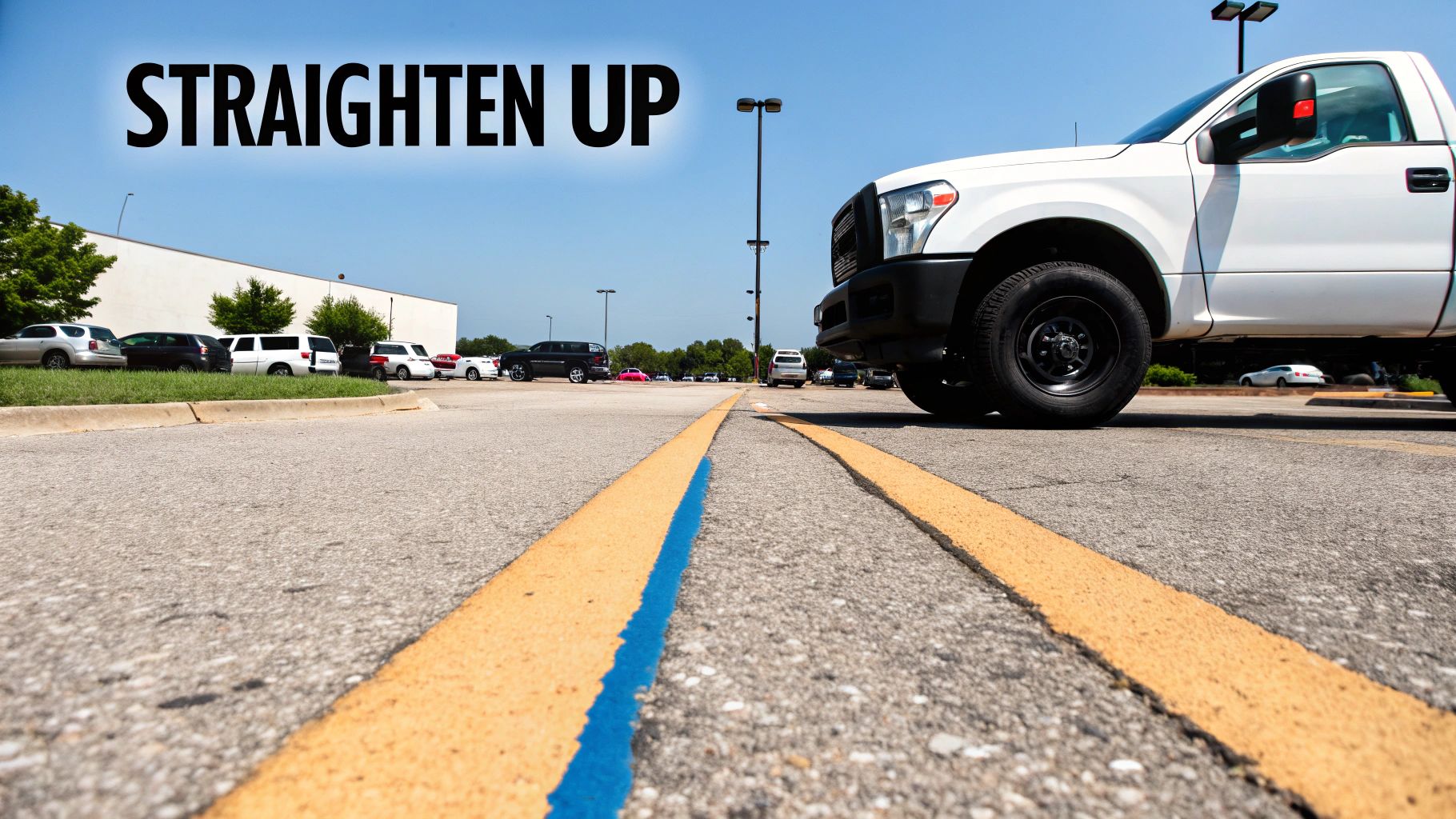
- Use the pavement. A crack in the asphalt, a faded paint line, or even a storm drain can become a temporary reference point to help you judge your angle and distance.
The real secret is learning to see the space and use your environment. Anything that helps you visualize where your truck is and where it needs to go becomes a tool. It's how you learn how to parallel park a truck when conditions are far from perfect.
It might sound impossible, but the level of precision you can develop is incredible. The world record for parallel parking a tractor was set in a space just 90 cm (about 3 feet) longer than the truck itself. You don't need to be a record-breaker, but it proves that with practice, even the tightest spots aren't off-limits.
This kind of masterful control is built on a solid foundation of knowledge—the very same fundamentals you learn while studying for your CDL. It all starts with what you cover in the general knowledge test. These advanced skills are just that core knowledge put into practice, giving you the confidence to park that rig anywhere.
Answering Your Top Truck Parking Questions
Even the most seasoned drivers had to start somewhere, and a few common questions always seem to come up when you're getting the hang of parallel parking a big rig. Let's break down some of those sticking points so you can approach any tight spot with total confidence.
How Much Space Do I Actually Need?
Here’s a solid rule of thumb that has saved me countless headaches: look for a space that's at least one and a half times the length of your truck. So, if you're behind the wheel of a 20-foot pickup, you'll want to find a spot that’s at least 30 feet long.
That extra room isn't about being lazy; it’s about giving yourself a realistic buffer. Trying to jam a large vehicle into a space that's "just big enough" is where frustration and fender benders are born. When you're new to this, always err on the side of more space. It makes a world of difference.
What's the Single Biggest Mistake to Avoid?
Without a doubt, the most common error is getting the timing wrong on that first turn toward the curb. It's a real balancing act.
- Turn too soon? You'll hear that awful scrape of your rear tire hitting the curb.
- Turn too late? You'll either be way too far from the curb or, worse, clip the front of the vehicle behind you as you swing in.
This is why your reference points are so critical. I've found the sweet spot is usually when the back of your cab lines up with the rear bumper of the vehicle you're parking behind. Getting that visual cue right is what sets you up for a smooth, predictable park every time.
The vast majority of parallel parking mistakes can be traced back to a rushed or sloppy setup. Taking an extra five seconds to get your initial position and mirrors right will save you five minutes of back-and-forth corrections.
How Do I Keep from Bumping the Curb?
Your passenger-side mirror is your best friend here. Before you even think about putting it in reverse, tilt that mirror down until you have a crystal-clear view of your rear passenger-side tire and the curb itself.
As you back into the spot at that initial 45-degree angle, your eyes should be glued to that mirror, watching the distance between the tire and the curb. The second you start to counter-steer (turning the wheel away from the curb), you'll see that gap start to open up. That's your confirmation that the back of your truck is moving away from the curb as the front swings into place.
Slow and steady is the name of the game. Deliberate, controlled movements are the best way to avoid scraped rims and a bruised ego. On a related note, true vehicle control comes from understanding all its systems, which is why a solid grasp of concepts like the air brakes test is fundamental to overall safety.
Ready to turn pro driving skills into a rewarding career? At Patriot CDL, we provide the hands-on training you need to master every maneuver and launch your journey on the open road. Learn more at https://patriotcdl.com.