Getting your DOT medical card is the first real hurdle on the path to becoming a professional truck driver. This isn't just a simple doctor's visit; it's a mandatory federal requirement designed to confirm you're medically fit to safely handle a commercial vehicle. Plain and simple, without this card, you can't get a Commercial Driver's License (CDL) or keep your current one valid.
Why Your CDL Depends On a DOT Medical Card
Think of your CDL as having two essential parts: the driving skills you prove on the road and the physical fitness you prove in the exam room. One is worthless without the other. The DOT medical card serves as the official, government-mandated proof of that fitness, enforced by the Federal Motor Carrier Safety Administration (FMCSA) to keep everyone safe.
This is far more than a piece of bureaucratic red tape. The health of a driver is just as important as the mechanical condition of their truck. Imagine a medical emergency happening behind the wheel of an 80,000-pound rig—the consequences could be devastating. The DOT physical is specifically designed to catch and manage any health conditions that could compromise your ability to drive.
The Federal Mandate Behind the Medical Card
The rule requiring a medical card isn't up to your company or your state; it's a federal law. This applies to virtually any driver operating a vehicle with a Gross Vehicle Weight Rating (GVWR) over 10,001 pounds in interstate commerce.
This net catches a wide variety of commercial drivers, not just the long-haul truckers you see on the highway. The regulation impacts:
- Interstate Truck Drivers: Anyone whose route takes them across state lines.
- Intrastate Drivers: Most states have adopted federal medical standards, so even drivers who never leave their home state usually need the card.
- Bus Drivers: Anyone operating a vehicle built to carry more than 15 passengers.
- Hazmat Haulers: Drivers transporting hazardous materials that require a placard.
The Role of Certified Medical Examiners
You can’t just walk into your family doctor’s office for this exam. The FMCSA maintains a National Registry of Certified Medical Examiners to ensure consistent, high standards. Only a healthcare professional on this official registry has the authority to conduct a DOT physical and issue your medical card.
This system was created to make sure examiners are properly trained on the unique physical and mental stresses of commercial driving. The certification process is a tightly controlled examination, and this framework was significantly strengthened after regulatory updates in 2014. In fact, when those new nationwide rules kicked in, the FMCSA had already registered over 22,000 medical professionals as certified examiners.
Key Takeaway: The DOT medical card is a federal prerequisite for your CDL. It validates your physical ability to handle the demands of professional driving and ensures you meet the strict safety standards set by the FMCSA.
Nailing down these foundational requirements is your first move. You can also explore our comprehensive guide on CDL requirements to see exactly how the medical card fits into the bigger picture of starting your career.
What Really Happens During the DOT Physical Exam?
Walking into the exam room for your DOT physical can be a little nerve-wracking, especially the first time. You know it’s a critical step for your medical card for cdl, but what are they actually going to check?
It helps to remember that this isn't your typical annual check-up. Every single test is designed with one goal in mind: to make sure you're medically fit to handle the demands of driving a commercial vehicle safely. Knowing what to expect can take a lot of the mystery out of the process, so let's break it down.
H3: Vision and Hearing: Your First Line of Defense
Your eyes and ears are your most important tools on the road, so it’s no surprise they get close attention. These aren’t just simple pass/fail checks; the examiner is measuring specific capabilities essential for safe driving.
When it comes to your vision, they’ll look at three key things:
- Acuity: You’ll need to have at least 20/40 vision in both eyes. This can be with or without corrective lenses, so if you wear glasses or contacts to drive, make sure you bring them.
- Peripheral Vision: Spotting a car in your blind spot or a hazard from the side is crucial. You must have at least 70 degrees of peripheral vision in the horizontal meridian for each eye.
- Color Distinction: You have to be able to tell the difference between red, green, and amber—the standard colors of traffic signals.
The hearing test is just as important but often much simpler. The standard method is the forced whisper test. The examiner stands five feet away and whispers a short phrase or a few numbers, and you just have to repeat them back correctly. You need to pass this in at least one ear.
Don't panic if you struggle with the whisper test. It doesn't mean you've failed. The examiner can refer you for an audiometer test, which gives a much more precise measurement of your hearing levels.
H3: Blood Pressure and Urinalysis: What Are They Really For?
These are the two parts of the exam that seem to cause the most stress for drivers. The key is understanding what they're actually screening for.
High blood pressure is a major red flag for the FMCSA because it increases the risk of a heart attack or stroke, which would be catastrophic behind the wheel. Your reading will directly affect how long your medical card is valid:
- 140/90 or lower: This is the sweet spot. You'll get the full 2-year medical card.
- 140/90 to 159/99: This is considered Stage 1 hypertension. You'll likely walk away with a 1-year certification.
- 160/100 to 179/109: This is Stage 2. You might get a temporary 3-month card, giving you time to get your blood pressure down before coming back for a longer certification.
- 180/110 or higher: This is Stage 3 hypertension and is considered a disqualifying condition until it's treated and under control.
A huge point of confusion is the urinalysis. Let's be clear: this is not a drug test. The urine sample is used to screen for underlying health problems, like checking for sugar and protein that could point to diabetes or kidney disease.
The DOT drug screen is a completely separate test that's usually done during the pre-employment process, not during the physical for your medical card.
The table below breaks down the main components you'll encounter during the exam.
Key Components of the DOT Physical Exam
| Test Component | What It Measures | Passing Standard |
|---|---|---|
| Vision | Visual acuity, peripheral vision, and color recognition. | At least 20/40 vision in each eye (with/without correction), 70-degree peripheral vision, and ability to distinguish traffic light colors. |
| Hearing | Ability to hear at a distance. | Pass a forced whisper test at 5 feet or an audiometer test. |
| Blood Pressure | Cardiovascular health and risk of hypertension. | Below 140/90 for a 2-year card. Higher readings result in shorter certifications or disqualification until managed. |
| Urinalysis | Signs of underlying medical conditions like diabetes or kidney disease. | No specific value; used as a screening tool for protein, sugar, or blood in urine. |
| Physical Exam | Overall physical health, including heart, lungs, spine, and reflexes. | No conditions present that would interfere with the safe operation of a CMV. |
As you can see, each test has a clear purpose tied directly to your ability to do the job safely.
H3: The Head-to-Toe Physical Assessment
Finally, the examiner will perform a complete physical exam, pretty much from head to toe. This is where they look for any condition, big or small, that could make driving unsafe.
The examiner will check your general appearance, listen to your heart for murmurs, and check your lungs for clear breathing. They'll also assess your musculoskeletal system—looking at your spine and checking your limbs for proper strength, flexibility, and range of motion.
You can also expect a few basic neurological checks. This involves testing your reflexes, balance, and coordination to make sure your nervous system is firing on all cylinders. The goal is a 360-degree view of your health.
It's also worth noting that requirements can have slight variations from place to place. For example, understanding the specific medical card for CDL process in California can give drivers in that state an extra layer of preparedness. In the end, every single part of this exam comes back to one simple, crucial principle: ensuring you are medically fit for the big responsibilities that come with driving a big rig.
How Health Conditions Affect Your CDL Medical Card
The thought of a pre-existing health condition derailing your driving career can be a huge source of stress. I've seen countless drivers walk into an exam worried that one diagnosis will automatically disqualify them. But here's the reality: that's rarely the case.
The FMCSA is far more concerned with how a condition is managed than with the diagnosis itself. Think of it this way: the Certified Medical Examiner’s job is to assess risk. If you can show them you're on top of your health, you're showing them you're safe to be on the road.
So, a diagnosis of high blood pressure, diabetes, or even a past heart issue isn't an automatic "no." It just means you'll need to bring a little more paperwork to the table and prove you have a solid, consistent treatment plan.
Navigating Common Health Concerns
Let's be honest, some health issues get a closer look during the DOT physical, and for good reason—they can directly impact your ability to drive safely. Knowing what the examiner is looking for can make all the difference.
Take hypertension, for example. It's one of the most common things we see. If your blood pressure is a bit high on exam day, it doesn't mean you've failed. The examiner will likely follow a tiered system. Instead of a full two-year card, you might get a one-year or even a three-month certification. This gives you a window to work with your primary doctor to get your numbers down.
Diabetes is another condition that's completely manageable. If you're on insulin, you can absolutely still get certified. You'll just need to meet the FMCSA’s specific requirements for Insulin-Treated Diabetes Mellitus (ITDM). This usually involves bringing in records from your doctor that show your blood sugar is stable and well-controlled.
The Impact of Sleep Apnea
One condition that’s getting a lot more attention these days is obstructive sleep apnea (OSA). If you’re not familiar, What Is Obstructive Sleep Apnea and How Is It Treated? It’s a disorder where you repeatedly stop and start breathing during sleep, which can lead to serious daytime fatigue—a massive red flag for any professional driver.
If the examiner suspects you might have OSA (based on risk factors like a high BMI or a large neck size), they may require you to get a sleep study. But a diagnosis doesn't mean you're done driving. The key is proving you're treating it effectively.
- CPAP Machine: If you're prescribed a CPAP, you’ll need to bring in compliance data showing you’re actually using it every night.
- Documentation: A letter from your sleep specialist confirming the treatment is working is a must-have.
Show them you're eliminating the risk of fatigue, and you'll be in a much better position to get certified.
Your Overall Health Profile Matters
While we focus on specific conditions, your general health provides the bigger picture. Research has shown a pretty clear link between a driver's weight and their chances of getting a full-term medical card. Back in 2012, more than half of all commercial drivers—a staggering 53.3% of those examined—were classified as obese with a BMI over 30.0 kg/m².
Drivers in the normal weight category had an 81.2% probability of receiving a full 2-year medical certification, while those who are morbidly obese experienced this certification only 46.2% of the time. The research also identified that obese drivers reported substantially higher rates of disqualifying conditions, including heart disease, hypertension, diabetes mellitus, nervous disorders, sleep disorders, and chronic low back pain.
This isn't about judgment; it's about risk. The data clearly shows that maintaining a healthier weight directly boosts your odds of securing a longer medical card, mainly by lowering your risk for all those other related conditions.
Being Proactive with Documentation
If there’s one piece of advice I can give you for any chronic condition, it’s this: documentation is everything. Don't show up empty-handed and wait for the examiner to ask for records. Be prepared.
Example Scenario: A Driver with a Past Heart Condition
Let's say a driver had a heart attack two years ago. It’s easy to assume that’s a career-ender. But what if that driver walks into their DOT physical with a folder containing:
- A letter from their cardiologist that explicitly clears them to operate a commercial vehicle.
- Results from a recent stress test showing their heart function is strong.
- A complete list of their medications, confirming they're taking everything as prescribed.
Suddenly, the narrative changes. This driver isn't a "risk"; they're a responsible professional who has their health under control. You've just handed the examiner all the evidence they need to make an informed, and likely favorable, decision. At the end of the day, your health is your responsibility, and proving you're managing it well is the surest way to keep your medical card—and your career—on track.
Your Game Plan for Getting and Keeping Your Medical Card
Knowing the rules is one thing, but having a clear plan is what actually gets you certified. Let's walk through the exact process for getting your first medical card and making sure it stays current, so you can stay on the road without a hitch.
Finding the Right Medical Examiner
First things first, you need to find the right person for the job. You can't just pop into your family doctor's office for this one. The exam must be done by a professional on the FMCSA National Registry of Certified Medical Examiners. This is the only official list of healthcare providers who are actually authorized to perform these specific physicals.
The simplest way to track one down is by using the official search tool on the FMCSA website. You can search by city, zip code, or even by an examiner's name to find a certified clinic near you. Don't skip this step—an exam from a non-certified provider is completely invalid and a total waste of your time and money.
Prepping for Your Appointment
Walking into your exam prepared can mean the difference between a smooth, quick process and a frustrating delay. Don't just show up and hope for the best. Take a few minutes to get your ducks in a row.
Here’s what you should have in hand:
- Your valid driver's license.
- A complete list of all medications you're taking. Be sure to include the name, dosage, and who prescribed it. This goes for over-the-counter stuff, too.
- Your glasses or contact lenses if you need them for driving. They'll need to check your vision with them on.
- Your hearing aids, if you use them.
- Any specialized medical records. If you have a condition like diabetes, sleep apnea, or a heart issue, bring the paperwork. This could be a letter from your specialist, recent lab results, or your CPAP compliance report.
It’s no secret that managing blood pressure is a huge part of passing the DOT physical, as hypertension is a common reason for disqualification or a short-term card.
This visual gives you a quick look at how to approach some of the most common health conditions that examiners will be looking at closely.
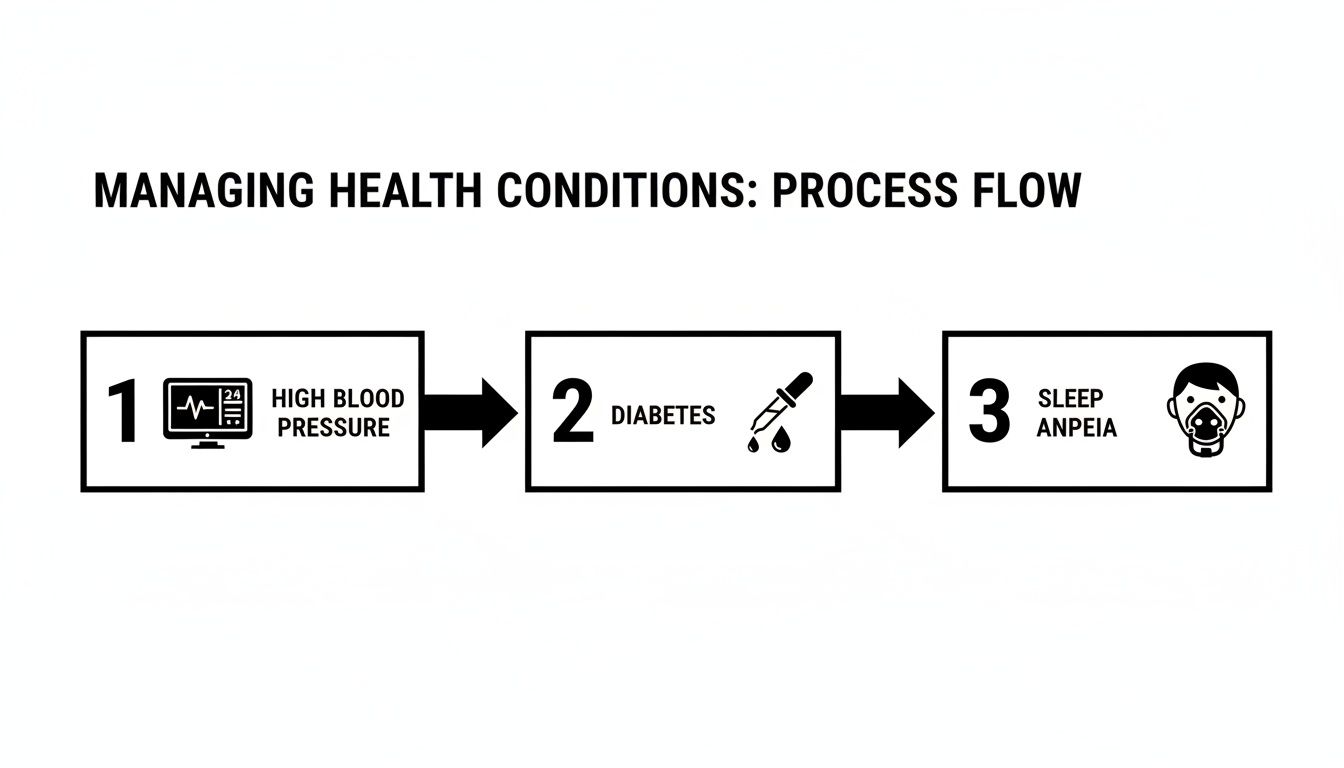
As you can see, conditions like high blood pressure, diabetes, and sleep apnea don't have to be a roadblock, but they do require you to be on top of your game with proper management and documentation.
Understanding the Possible Outcomes
Once the physical is done, the examiner will make a call on your medical fitness. There are a few ways it can go, depending on your overall health.
- 2-Year Certification: This is the gold standard. It's the full-term card for drivers who meet all the health requirements with no red flags.
- 1-Year or Shorter Certification: If you have a condition that needs to be monitored, like well-managed high blood pressure, the examiner might issue a card for a shorter time. This could be for a year, six months, or even just three months to make sure you're staying on track.
- Disqualification: If you have a health condition that falls outside the FMCSA's safety standards, the examiner won't be able to certify you. They'll tell you what needs to be addressed before you can come back and be re-evaluated.
Key Takeaway: Getting a shorter certification isn't a failure. It's a way for you to keep driving while ensuring a potentially serious health condition is being properly watched by a professional.
After the Exam: The New Digital Process
What happens after you pass is just as critical. The FMCSA has finally moved into the 21st century, and as of June 23, 2025, the whole process is digital. This shift, which took nearly a decade to roll out, means you no longer have to trek to the DMV to submit your paperwork.
The medical examiner now sends your results directly to the FMCSA, which then zaps them over to your State Licensing Agency. Even though it's all electronic, it's still a smart move to keep your paper copy with you for at least 15 days. You never know when there might be a lag in the system.
Don't Let Your Card Expire
This part is all on you. Letting your medical card expire is a surefire way to get your CDL automatically downgraded, which takes you off the road immediately. No excuses.
Set a reminder on your phone or circle a date on your calendar at least 45 days before your card is set to expire. This gives you plenty of breathing room to book an appointment and sort out any unexpected issues without jeopardizing your job.
With your medical card squared away, you're that much closer to hitting the road. The next big step is often getting your learner's permit. We've got you covered there, too—check out our guide on how to get your CDL permit.
What to Do After Securing Your Medical Card
Getting that DOT medical card in your hand is a fantastic feeling. It’s a huge milestone, but it's not the finish line. Think of it as the official green light for the most exciting part of your journey: actually getting behind the wheel and starting your career.
You’ve proven you’re medically fit to drive, which clears one of the biggest regulatory hurdles out there. Now, you can finally shift your focus from doctor's appointments and paperwork to what you came here to do—learn how to handle a big rig with skill and confidence.
From Medical Card to Learner's Permit
So, what's next? Your very first move is to take that shiny new medical card and apply for your Commercial Learner's Permit (CLP). You literally can't get your CLP without it. This permit is your ticket to legally start your hands-on, behind-the-wheel training with a certified instructor.
This is where a quality training program really shows its value. A good school doesn’t just teach you how to pass the test; they guide you through every single step, making sure all your Ts are crossed and Is are dotted. Your medical card got you in the door, but now the real work—and the real fun—begins.
Key Insight: Don't think of the medical card as the end goal. It’s the official starting pistol for your practical training and the very first tangible step you take toward earning your full CDL.
A formal program takes that medical clearance and helps you turn it into real-world competence, getting you ready for whatever the road throws at you.
Building Your Skills for a Lasting Career
With your CLP and medical card squared away, it’s all about mastering the truck. This is where you’ll dive into everything from detailed pre-trip inspections to nailing those tricky backing maneuvers. Your medical exam proved you’re fit for the job, but it’s the expert instruction that teaches you how to do the job safely and efficiently.
This phase is all about building the muscle memory and situational awareness that separate the amateurs from the true professionals. Every hour you spend in the driver's seat builds on that foundation your medical card provided.
If you’re thinking about maximizing your job prospects down the road, this is the perfect time to get specialized training, like learning to drive a manual transmission. Getting rid of that automatic-only restriction opens up a lot more doors. Learn more about the E-Restriction removal course and see how it can expand your career options.
You've proven you're fit to drive. Now it's time to build the skills that will make you a great driver. Keep that momentum going and take the next step toward a rewarding career on the open road.
Common Questions About the CDL Medical Card
Getting your head around the rules for a medical card for cdl can feel like a job in itself. Let's clear up some of the most common questions I hear from drivers, whether they're just starting out or getting ready for their next recertification.
How Much Does a DOT Physical Cost and Will Insurance Cover It?
Let's talk money first, because that's always a top concern. You can expect the cost of a DOT physical to land somewhere between $85 and $150. The exact price really depends on where you live and which clinic you go to.
Here’s the thing you need to know: this is almost always an out-of-pocket expense. Most health insurance plans won't touch it because they see it as a work requirement, not preventative care. It’s always a good idea to ask your trucking company or training school about their policy; some will reimburse you for the cost once you’re on board.
What Happens If I Fail My DOT Physical Exam?
Failing the exam can feel like a punch to the gut, but it's rarely a career-ender. The examiner will tell you exactly why you didn't pass, so you'll know precisely what the issue is.
If it's something treatable—say, your blood pressure is too high—you can go work with your own doctor to get it under control. Once you have it managed and can show documentation that you meet the FMCSA standards, you can go back for a re-evaluation. Think of it as a temporary detour, not a permanent roadblock in your driving career.
How Long Is a DOT Medical Card Actually Valid?
The lifespan of your medical card isn't one-size-fits-all. If you're in good health with no red flags, you'll likely get a card that's valid for a full 24 months.
However, if you have a condition that needs watching, like hypertension or diabetes, the examiner can issue a card for a shorter period. You might get a one-year, six-month, or even a three-month card. This is just to make sure your condition stays stable and you're safe behind the wheel. It's completely on you to track that expiration date and get recertified on time to keep your CDL from being downgraded.
Important Reminder: A shorter certification isn't a punishment. It's a safety precaution that allows you to keep driving while making sure any health issues are properly managed.
Do I Still Need to Carry the Physical Medical Card With Me?
This is a big point of confusion now that everything is going digital. Medical examiners are required to upload your results directly to your state's licensing agency. That electronic record is the official proof of your medical status.
So, while federal law doesn't technically require you to carry the paper card anymore, I highly recommend you do. Keep that physical card in your wallet for at least the first 15 days after your exam. It’s your backup plan if there's a lag in the system or if you get pulled for an inspection before the digital record shows up.
Staying sharp on the rules is what makes you a pro. For more real-world advice on building your trucking career, check out the other articles on the Patriot CDL blog.
You've cleared the medical exam—that's a huge step. Now it's time to get the hands-on skills that will make you a successful driver. At Patriot CDL, we take that medical clearance and turn it into real-world confidence, getting you on the road and job-ready in just a few weeks. Take the next step and see what our training can do for you. Visit us at https://patriotcdl.com to get started.