
Proper weight distribution is all about loading your trailer so the cargo's weight is balanced correctly over the axles and the hitch. It’s not just about fitting everything in; it's about maintaining control, stopping dangerous trailer sway, and making sure your entire rig is safe on the road.
Think of it this way: a well-balanced load isn't just a "best practice"—it's a non-negotiable part of the job for legal, safe driving.
Why Weight Distribution Is a Skill Every Pro Driver Needs

For any professional driver, getting weight distribution right isn’t just about following the rules—it's about survival and staying in the game for the long haul. This is one of those skills that separates the seasoned pros from the rookies who are, frankly, a danger to themselves and everyone else.
Get it wrong, and you're looking at catastrophic failures. We're talking about dangerous rollovers or jackknifes that can happen in a split second, with no time to correct.
Understanding how to balance a load has real-world consequences that hit your safety and your wallet. A poorly distributed load puts a ton of stress on your rig. It chews up your tires, grinds down your brakes, and wears out your suspension way faster than it should. That means more time in the shop and more money spent on repairs.
Even worse, an imbalanced trailer is a neon sign for a DOT inspection. All it takes is a quick stop at a weigh station to find an overloaded axle. Next thing you know, you’re hit with hefty fines that come straight out of your pocket and citations that mess with your driving record. For more real-world insights into the life of a pro driver, you can check out other topics on the Patriot CDL blog.
The Core Principles of a Balanced Load
To really get a handle on proper weight distribution on trailers, you have to think beyond just throwing freight on. It boils down to a few key concepts that become your go-to tools on every single haul. These aren't just terms from a textbook; they’re the principles that keep your rig stable and legal.
Here’s what you need to know cold:
- Gross Vehicle Weight Rating (GVWR): This is the absolute maximum weight your vehicle can be, as set by the manufacturer. It includes everything—the truck, trailer, fuel, you, and the cargo. Going over this number is illegal and incredibly unsafe.
- Axle Weight Ratings: It’s not just about the total weight. Each axle group—your steers, your drives, and your trailer axles—has its own specific legal weight limit. You can be under the overall GVWR but still get a ticket if one axle group is overloaded.
- Center of Gravity (CG): This is the balance point of your cargo. Keeping the CG low and centered is the single most important thing you can do to prevent a rollover and stay stable in a sharp turn or a sudden evasive maneuver.
A great rule of thumb, especially with lighter trailers, is the 60/40 rule. The idea is to place about 60% of the cargo's weight in front of the trailer's axle line and the remaining 40% behind it. This creates the right amount of tongue weight, which is what keeps that trailer from swaying all over the road.
When you truly internalize these principles, you stop just following a load diagram and start actively thinking about how to make your rig safe. That proactive approach is what makes a real professional—someone who takes full responsibility for their truck, their load, and everyone’s safety on the highway.
Getting the Numbers Right: Legal Axle Weights and Ratings
While knowing the principles of balance is a great start, what really matters on the road—and at the weigh station—are the hard numbers. The DOT officer isn't going to ask you about your center of gravity; they're going to look at your axle weights. This is where the rubber truly meets the road, and every CDL holder needs to know these limits by heart.
Everyone throws around the 80,000-pound gross vehicle weight limit, but that big number can be misleading. You can be well under 80,000 lbs and still get slapped with a hefty fine for being overweight on a single axle group. It's all about how that weight is distributed.
Breaking Down the Axle Weight Limits
Think of your rig's weight as being split into three buckets. Federal law puts a cap on each bucket to protect our roads and bridges from damage. These aren't just suggestions; they're engineered limits that keep the infrastructure from crumbling.
An experienced driver knows that a bill of lading showing a 79,000-pound load doesn't automatically mean you're legal.
I've seen it a thousand times: a rookie gets a load, sees the total weight is good, and hits the road. But the cargo is shoved all the way to the back, putting 36,000 lbs on the trailer tandems. That’s a guaranteed ticket, no questions asked.
To avoid that headache, you have to nail the distribution. A little too much weight on your trailer axles, for example, can lift the front of your tractor just enough to make your steering feel light and unresponsive—a dangerous situation you want no part of.
Below is a quick-reference guide to the federal maximum weight limits for each axle group on a standard Class 8 tractor-trailer. While these are the absolute legal maximums, most seasoned drivers aim for a buffer to stay safe and avoid any close calls at the scale house.
Standard Axle Weight Limits for Class 8 Trucks
| Axle Group | Federal Weight Limit (lbs) | Common Real-World Target (lbs) |
|---|---|---|
| Steer Axle | 12,000 | 11,000 – 11,800 |
| Drive Axles | 34,000 | 32,500 – 33,500 |
| Trailer Axles | 34,000 | 32,500 – 33,500 |
When you add them up (12,000 + 34,000 + 34,000), you get your 80,000-pound total. This is the ideal balance you should always be shooting for.
Don't Forget Manufacturer Ratings: GVWR vs. GAWR
When you do your pre-trip, take a look at the compliance plate or sticker on the truck and trailer. You'll see a few acronyms that are just as critical as the legal limits. These are the manufacturer's safety ratings, and ignoring them is asking for equipment failure.
Here’s what you need to know:
- GVWR (Gross Vehicle Weight Rating): This is the absolute maximum weight the vehicle (tractor or trailer by itself) is designed to handle, including its own empty weight.
- GAWR (Gross Axle Weight Rating): This is the most weight a single axle can safely carry, according to the people who built it. You'll see separate ratings for the steer, drive, and trailer axles.
- GCWR (Gross Combination Weight Rating): The total maximum weight for the entire combination—tractor, trailer, and cargo—all together.
Here's the critical part: you must always follow whichever limit is lower—the legal federal limit or the manufacturer's rating. If a trailer's axles have a GAWR of 19,000 lbs each, you can't load them to 20,000 lbs, even though the tandem group would still be under the 34,000 lb federal limit.
Mastering this interplay between federal laws and manufacturer specs is a huge part of being a professional driver. It's a foundational skill for meeting the strict CDL requirements in any state. It also goes beyond just you and your truck; the Transport Chain of Responsibility means shippers and brokers can also be held accountable. Getting these numbers right isn't just about avoiding tickets—it’s about upholding your professional duty to keep yourself and everyone else safe on the road.
The Science of Balancing Your Load
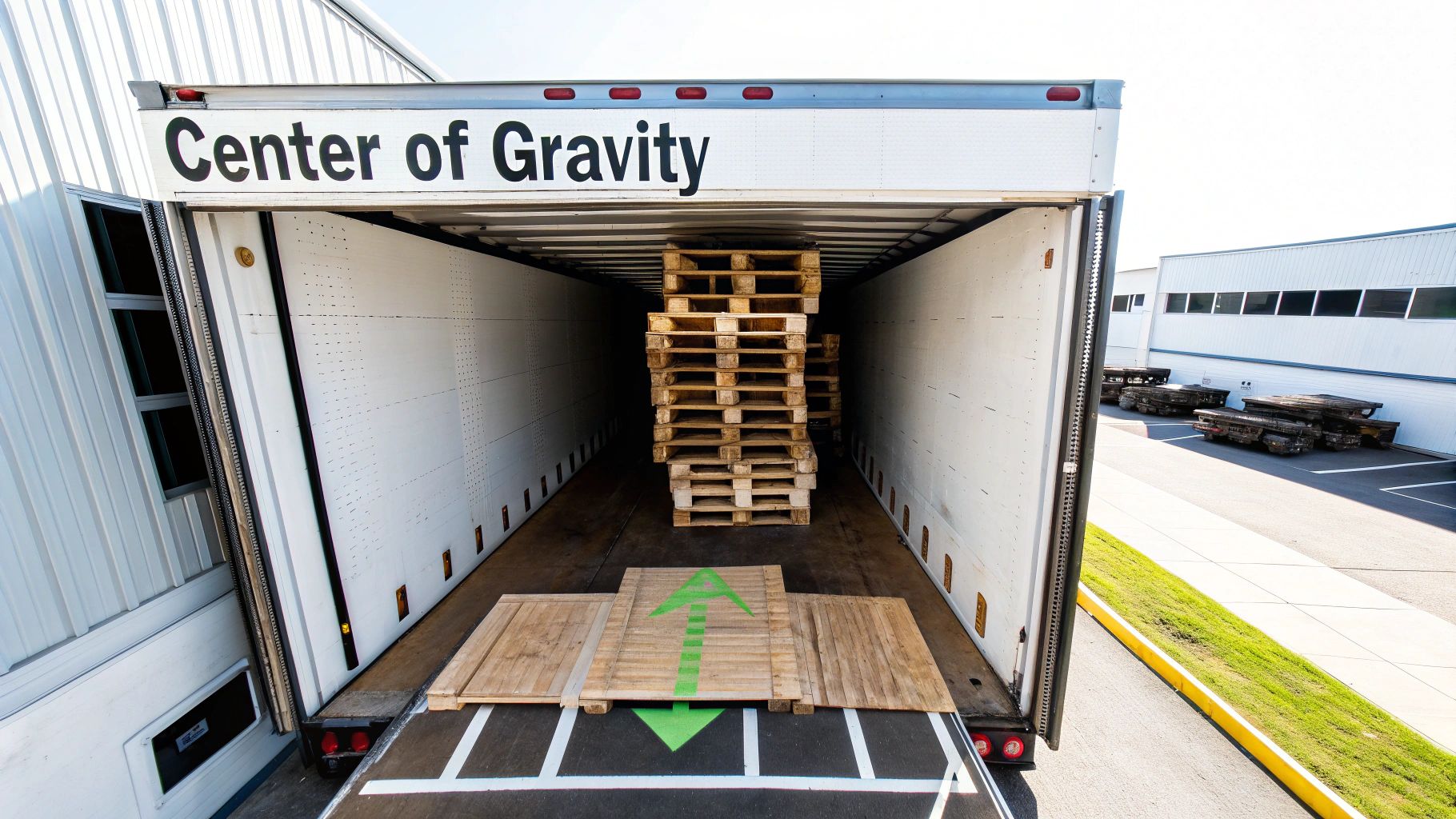
Knowing the numbers is half the battle; the other half is getting a feel for how weight actually behaves inside your trailer. The single most important concept behind proper weight distribution on trailers is the Center of Gravity (CG). Think of it as the one single point where your entire cargo balances. Where you put that CG dictates how much weight pushes down on your steer, drive, and trailer axles.
You don't need a physics degree for this job. What you do need is an instinct for how freight placement impacts your rig's stability and legality. Every pound of cargo creates leverage, and the farther it sits from an axle, the more leverage it has. This is the simple "why" behind every load plan you'll ever get.
How a Few Feet Changes Everything
Picture a seesaw at a playground. If you put a heavy kid right over the pivot point, it’s easy to balance. But move that same kid a few feet to one end, and the whole dynamic changes. It takes a massive effort on the other side to level it out. Your truck and trailer work on the exact same principle, with your axle groups acting as the pivot points.
Let's say you have a pallet that weighs 2,000 pounds. If you place it directly over the trailer axles, it adds pretty close to 2,000 pounds to that axle group. Simple enough. But if you slide that same pallet just ten feet forward, a big chunk of that weight transfers right onto your drive axles. Your trailer axles get lighter, and suddenly, you could be overloading your drives.
This is the fundamental principle that shippers and load planners live by. They run basic calculations—multiplying an item's weight by its distance from a reference point—to figure out how cargo placement will affect the axle weights before you even show up. Understanding this lets you spot a bad load before you even turn the key.
The next time a loader tries to stick a heavy piece of machinery at the very back of your trailer, you'll know why it’s a problem. You can confidently tell them, "If you put that there, you’ll take too much weight off my drives and my steering will be dangerously light."
The Engineering Behind the Balance
This isn't just a guessing game; it's a science. Before a truck ever hits the scale, engineers and fleet managers use precise calculations to ensure proper axle loading. A professional weight distribution analysis involves finding the weight and CG for every single component—the cab, the chassis, the trailer body, the fuel, and of course, the cargo itself.
They multiply each item’s weight by its distance from a fixed point to get what’s called a "moment." By adding up all these moments and dividing by the wheelbase, they can calculate the exact load on the rear axle. The rest of the weight falls on the front. This is how a truck builder can guarantee that a front axle rated for 12,000 lbs and a rear axle rated for 20,000 lbs won't be overloaded once the payload is on.
This level of detail just goes to show how critical precise placement is. A small shift in cargo can send a ripple effect across the entire rig's balance.
Putting It All Together
Your job as the driver isn't to do the complex math on a clipboard. You’re the final checkpoint. You need to be able to look at a load plan and visualize how it’s going to sit on your axles.
A good mental checklist looks something like this:
- Heavy Items: The heaviest cargo should always go between or just slightly forward of the trailer's axle group. This keeps the CG low and centered where it belongs.
- Lighter Items: Use the lighter freight to fill in the nose and the very back of the trailer, distributing the rest of the weight as evenly as possible.
- Multiple Stops: This is where you really have to think ahead. If you're dropping off freight at stop #1, how will that affect your axle weights for the rest of the journey? You might need to rearrange the remaining freight to stay balanced and legal.
Developing this mindset is what separates a rookie from a seasoned pro. It helps you move from just following orders to actively managing your load, letting you have smart conversations with loaders and ensuring your rig is balanced, legal, and safe every time you hit the road.
Practical Loading Strategies for Different Trailers
Knowing the theory behind weight distribution is one thing. Putting it into practice on the road, with all kinds of different freight and trailers, is where a driver’s real skill comes out. The core principles of balance don't change, but your strategy has to adapt to what you're hauling.
Figuring out these differences is what makes you a safe, efficient, and legal professional. You simply can't load a flatbed of steel coils the same way you’d pack a dry van full of mixed pallets. Each type of trailer brings its own set of challenges, and that calls for a specific game plan.
Dry Van Loading: The 60/40 Guideline
The dry van is the workhorse of this industry, so getting its load balance right is a skill you’ll use every day. A solid rule of thumb to follow is the 60/40 rule. It’s simple: you want about 60% of your cargo's weight in the front half of the trailer—the section closest to your tractor—and the other 40% in the back half.
This front-heavy approach puts the right amount of weight on your drive axles for good traction and keeps enough tongue weight on the fifth wheel to stop dangerous trailer sway. But remember, it's a guideline, not a strict law.
Things get a little more interesting when you're dealing with pallets of different weights. Your best bet is to load the heaviest pallets first, placing them right over or just a bit forward of the trailer's axles. After that, you can fill in the nose and tail of the trailer with the lighter freight. This keeps your center of gravity low and centered, which is exactly what you want for a stable ride.
A rookie mistake is to stick a single, heavy pallet all the way at the front or the very back. Put it in the nose, and you risk overloading your drive axles. Put it at the tail, and your steering can feel dangerously light and twitchy.
Flatbed Trailers: Securing and Centering Unique Loads
Hauling on a flatbed demands a whole other level of precision. You’re often working with heavy, awkward, and indivisible freight like big machinery, steel coils, or concrete structures. The main goal here is to get that load perfectly centered over the trailer's axles, not just lengthwise but also side-to-side.
Take a "suicide" loaded steel coil, for instance. You have to position it so its center of gravity is dead on the trailer's centerline. If it’s off by even a few inches, you’ll feel a noticeable lean, and the whole rig will be unstable in turns. On a flatbed, proper securement is just as much a part of weight distribution; if your load shifts, your balance is gone.
- Machinery: Position heavy equipment to spread its weight across as many axles as you can. This often means placing the heaviest part of the machine right between the drive axles and the trailer tandems.
- Lumber or Pipes: Distribute the bundles evenly down the length of the trailer. You want the weight to be consistent from front to back so you don't overload a single axle group.
Tanker Trailers: The Danger of Liquid Surge
Tankers throw one of the biggest curveballs at you when it comes to proper weight distribution on trailers, all because of liquid surge. When you hit the brakes or accelerate, all that liquid sloshes forward or backward, creating a powerful shove that can throw your entire rig off balance. This is especially dangerous in a partially filled tank.
Since you can't see the load, you have to rely on your feel for the truck and an understanding of how liquids move. The absolute key is to be incredibly smooth with your controls—no jerky starts or sudden stops. The baffles inside most modern tankers are there to help reduce the surge, but they don't get rid of it completely.
The skills you learn from managing dynamic loads in tankers are valuable across all types of trucking, as they teach you how powerful forces can mess with your vehicle's stability. For drivers who really want to nail these concepts, a great way to prepare is by running through scenarios involving combination vehicles. You can put your knowledge to the test with resources like this practice test for combination vehicles, which goes over many of these essential hauling principles.
Loading Principles by Trailer Type
Every trailer has its own personality when it comes to loading. The table below breaks down the main challenges and strategies you'll face with the most common types.
| Trailer Type | Primary Challenge | Key Loading Strategy |
|---|---|---|
| Dry Van | Uneven pallet weights, maintaining proper axle loads. | Follow the 60/40 guideline. Place the heaviest items over or just ahead of the axles. |
| Flatbed | Irregular, heavy, or oversized items; side-to-side balance. | Center the load precisely, both lengthwise and widthwise. Securement is critical to prevent shifting. |
| Tanker | Liquid surge creating dynamic forward/backward forces. | Drive with exceptionally smooth acceleration and braking. Be aware of the effects of partial loads. |
Whether you're hauling liquids or specialized equipment, understanding the unique safety rules is non-negotiable. For example, knowing the details of shipping container tow bar safety is crucial for preventing accidents when dealing with unconventional setups.
Common Loading Mistakes and How to Avoid Them
Even the saltiest old-timer can get complacent, but for new drivers, small loading mistakes are practically a rite of passage. The key is to learn from these common slip-ups before they become a headache at a weigh station or, even worse, cause an accident. Getting proper weight distribution on trailers right is all about spotting these traps before you even think about leaving the yard.
A lot of rookie mistakes boil down to one simple thing: not thinking about how the load’s weight is actually sitting on the axles. It’s never just about making it all fit. It’s about smart placement that keeps your rig stable, legal, and safe.
The Pitfall of Concentrating Weight
One of the biggest blunders I see is heavy freight getting piled into one spot. A loader might shove a single, dense pallet all the way to the nose or the tail just to get it on. This one move can throw your entire rig’s balance completely out of whack.
When you stick a heavy load right up front, hard against the headboard, you're putting a ton of pressure on your drive axles. You can easily find yourself overweight on your drives while your trailer tandems are barely carrying a thing. Not only is that asking for a ticket, but it makes the truck handle like a pig—the steering gets heavy and feels sluggish.
Shoving that same heavy pallet to the very back of the trailer is just as bad, if not worse. It acts like a lever, prying weight off your drive axles. This kills your traction and can make the steering feel terrifyingly light, which is a perfect recipe for a jackknife on a wet or icy road.
Here's the golden rule I live by: heavy freight belongs over or just a bit forward of the trailer axles. This placement anchors the load where it should be, keeps your center of gravity low, and spreads the weight out properly.
Overlooking Side-to-Side Balance
Everybody worries about front-to-back, but side-to-side balance often gets ignored until you see the trailer leaning in your mirror. An unbalanced load from left to right puts a crazy amount of stress on the tires, springs, and even the trailer frame on the heavy side.
This is a huge safety risk. Go into a turn, and that lean gets magnified by the forces pushing you outward. It dramatically increases your chances of a rollover, especially on tight on-ramps or sharp curves. Thankfully, the fix is simple if you pay attention.
- For Palletized Freight: Don't just load one side and then the other. Alternate heavier and lighter pallets from side to side as you go.
- For Single Heavy Items: Make absolutely sure the item's center of gravity is parked right over the trailer's centerline. Being off by just a few inches can create a dangerous lean.
This isn't just talk. Studies on multi-axle trailers have shown that bad freight placement often forces the first couple of trailer axles to carry way more than their share—some were found to be running up to 5.8% over their intended load.
Forgetting the Hidden Weight
Another classic rookie move is forgetting about all the "extra" weight you're hauling. I'm talking about dunnage, pallets, and all your securement gear. That dunnage—the wood or padding used to brace everything—can add hundreds, or even thousands, of pounds.
A single standard wood pallet can weigh anywhere from 30 to 70 pounds. If you're hauling 40 of them, you could be looking at an extra 2,800 pounds you forgot to account for. You have to factor this stuff into your math, or you'll be in for a nasty surprise at the first scale you cross.
Ultimately, avoiding these mistakes just means being hands-on. Don't blindly trust the load sheet. Eyeball the freight yourself, ask the forklift operator questions, and start developing a gut feeling for how your truck should handle. Knowing these dynamics is just as important as knowing your equipment, like your braking system. To brush up on that, take a look at our guide covering the air brakes test and make sure every part of your rig is ready to roll.
Your Weigh Station and Pre-Trip Checklist
All the number crunching and theory in the world boils down to this moment: the real-world checks that confirm your load is safe, balanced, and legal. This isn't just one last box to tick; it’s a non-negotiable part of your professional routine that protects you, your truck, and everyone else on the road.
Trust Your Eyes and Your Gut
Before you even turn the key, do a thorough walk-around. Your eyes can catch problems long before you feel them on the highway. Does the trailer have a visible lean to one side? Is the suspension squatting down hard over the axles? These are instant red flags signaling a lopsided or poorly concentrated load.
This visual check is a fundamental piece of any good vehicle inspection. For a deep dive into everything you should be looking for, check out our guide to a rock-solid pre-trip inspection to make sure your entire rig is ready to roll.
Once you get moving, pay close attention to how the truck and trailer feel. If the steering feels heavy and fights you in the turns, your steer axle might be overloaded. On the flip side, if the steering feels light and disconnected, you could have too much weight at the tail of the trailer—a genuinely dangerous situation that can lead to a loss of control.
The Scale Tells the Real Story
Those feelings are your first clue, but the CAT scale gives you the hard facts. There's no substitute for a scale ticket, and knowing how to get an accurate reading is a core skill for any driver.
Getting Your Axle Weights:
- Steer Axle: Pull onto the scale so only your steer axle is on the first platform. Get your weight.
- Drive Axles: Roll forward until your drive axles are on the second platform (your steers will be off the scale). This gives you the weight for your drive tandem.
- Trailer Axles: Pull up again until your trailer tandems are on the second platform to get the weight for your trailer axle group.
This simple process removes all the guesswork and gives you the exact numbers you need to be confident and legal. The infographic below shows exactly what you’re trying to avoid.
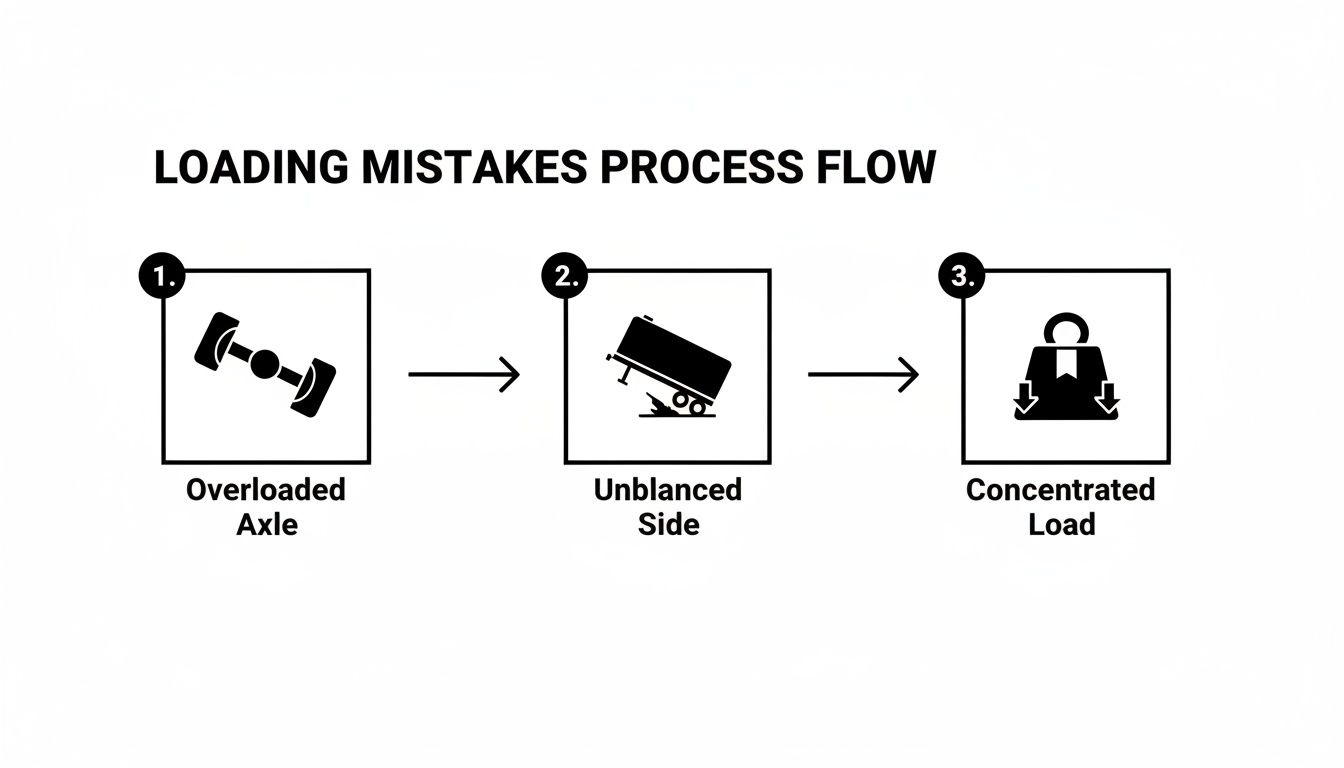
As you can see, an overloaded axle, an unbalanced side, or a concentrated load can cause major safety and legal headaches. A proper scale check will catch all of them.
What to Do When the Numbers Are Wrong
So, what happens if that scale ticket shows you're over on an axle group? First, don't panic. Second, do not get back on the highway.
Your first move is to slide your tandems. If your drives are heavy, slide the trailer tandems forward to pull more weight onto them. If the trailer axles are heavy, slide them back to shift some of that weight up to the drives. Make small adjustments and re-weigh.
If sliding the tandems can't get you legal, you have no choice but to get the load reworked. It’s a pain, no doubt, but it's infinitely better than a multi-thousand-dollar fine, being put out of service by the DOT, or causing an accident.
Making these checks a routine part of every single trip is what separates the pros from the steering wheel holders. It's the final, critical piece of the puzzle for mastering proper weight distribution on trailers.
Got Questions? Here’s What New Drivers Often Ask
When you get out of the classroom and start dealing with real freight, you'll find that theory and practice don't always line up perfectly. It's only natural to have a few questions as you start putting all this knowledge to use. Here are a couple of the most common ones I hear from drivers just starting out.
Can I Just Slide My Fifth Wheel to Fix an Overweight Axle?
You can, but it's a tool for fine-tuning, not a magic fix. Sliding the fifth wheel forward will shift some weight off your drive axles and onto your steer axle. Sliding it back does the reverse—it moves weight from the steers to the drives.
Think of it this way: this is your last little adjustment, not your first move. It's for when you're just a little bit off.
A fifth wheel adjustment might help you shift 500 pounds or so between your steer and drive axles. It’s not going to do a thing for a 2,000-pound overload on your trailer tandems because the warehouse crew loaded all the heavy pallets at the very back. Start with a balanced load first, then tweak from there.
What’s This 60/40 Rule I Keep Hearing About?
The 60/40 rule is a classic rule of thumb that works great for loading most dry vans and reefers. It’s pretty simple: aim to place about 60% of your cargo’s weight in the front half of the trailer—that's the section in front of the trailer axles. The other 40% of the weight goes in the back half.
Following this guideline helps put the right amount of downward pressure (tongue weight) onto the fifth wheel and your drive axles. Getting that tongue weight right is what gives your truck the traction it needs and, just as importantly, prevents the trailer from trying to pass you in a phenomenon known as trailer sway.
Ready to turn this knowledge into a career? The expert instructors at Patriot CDL provide the hands-on training you need to master every aspect of safe and professional truck driving. Learn more about our affordable, accelerated CDL programs.