Getting your Commercial Driver's License isn't just about passing a test; it's a step-by-step process designed to make sure every driver on the road is safe, skilled, and ready for the job. At its core, you'll need to prove you're medically fit, pass written knowledge exams, and demonstrate you can handle a rig in the real world.
This process ensures that when you get behind the wheel of an 80,000-pound vehicle, you have the competence and confidence to operate it safely.
Understanding the Journey to Your CDL
Think of earning your CDL as a structured journey with a few key milestones, not a single hurdle. The Federal Motor Carrier Safety Administration (FMCSA) sets the baseline rules to keep standards consistent across the country, but your state's DMV will handle the actual licensing.
This guide will break down every part of that journey, from the first piece of paperwork to the final road test. We'll give you a clear roadmap so you can navigate the path to your new career without any surprises. The whole system is built to layer your skills—starting with the basics and building up to real-world driving.
The Foundational Pillars of CDL Licensing
No matter where you live, every aspiring driver has to clear three main hurdles. These are the non-negotiable stages that form the backbone of the entire licensing process.
- Eligibility and Documentation: First things first, you have to prove you meet the basic requirements for age, legal residency, and physical health.
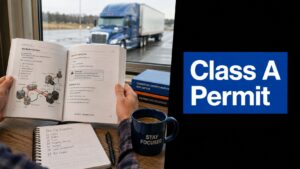
- Knowledge and Written Exams: Before you ever start the engine, you need to hit the books and pass a series of written tests to get your Commercial Learner's Permit (CLP).
- Skills and On-Road Testing: This is the final, hands-on part where you prove your stuff—showing you can inspect your vehicle, master basic maneuvers, and drive safely on public roads.
At its heart, the CDL process is about verification. It verifies you have the physical health, foundational knowledge, and practical skill to handle the immense responsibility of operating a commercial motor vehicle.
For anyone serious about starting this journey, a good training program can be a game-changer. Taking a look at a dedicated CDL training program is a smart move, as it provides the expert instruction you'll need to master each step.
Before we dive into state-specific details, let's look at the big picture. The table below outlines the core federal mandates that apply to everyone, everywhere.
Federal Baseline CDL Requirements at a Glance
This table summarizes the core requirements set by the federal government. Think of these as the foundation upon which all state-specific rules are built.
| Requirement Category | Federal Mandate Details |
|---|---|
| Minimum Age | You must be at least 18 for in-state (intrastate) driving and 21 to cross state lines (interstate). |
| Medical Certification | You must pass a DOT physical exam and get a Medical Examiner's Certificate to prove you're fit to drive. |
| Learner's Permit | You have to get a Commercial Learner's Permit (CLP) before you can start any behind-the-wheel training. |
| Driver Training | You must complete Entry-Level Driver Training (ELDT) from an approved provider on the federal registry. |
| Skills Test | You must pass a three-part skills test: vehicle inspection, basic controls, and an on-road driving exam. |
These federal rules create a consistent standard for safety and skill across the United States, ensuring every new driver starts with the same fundamental qualifications.
Checking Your Eligibility for a CDL
Before you even think about training schools or pouring money into a new career, the very first step is a simple reality check: do you qualify? Think of these requirements as the foundational checkpoints. They're non-negotiable rules set by both federal and state governments to make sure every driver on the road starts with a solid baseline of maturity and a responsible driving history.

Passing this initial screening is the first hurdle. Let's break down exactly what you'll need.
Age and Driving Zones
Your age is one of the biggest factors right out of the gate, as it determines where you're legally allowed to drive a commercial truck. This one detail can define the first few years of your entire career.
The federal government has two distinct age requirements, and understanding the difference is key to matching your career goals with what's legally possible.
- Intrastate Driving: At 18 years old, you can get a CDL to operate a commercial vehicle, but you have to stay within your home state's borders. This is a great starting point for local delivery routes, construction jobs, or any regional work that doesn’t cross state lines.
- Interstate Driving: To haul freight across state lines, you must be at least 21 years old. This is the ticket to long-haul trucking, opening up a much wider world of opportunities with national carriers.
This system is designed to let younger drivers build real-world experience on local roads before they tackle the much greater demands of interstate driving.
Residency and Legal Presence
Next up, you have to prove you are a legal resident of the state where you’re applying for your CDL. This isn't just bureaucratic red tape; it’s a crucial step for identity verification and security.
You'll need to walk into the DMV with a specific set of documents that prove who you are and where you live. This confirms you have the legal right to work and reside in the U.S.
Most states will ask for a combination of the following documents:
- Proof of U.S. Citizenship or lawful permanent residency (like a birth certificate, passport, or green card).
- Your current, valid state-issued driver's license.
- Your Social Security card.
- Proof of residency, which can be recent utility bills, a rental agreement, or bank statements with your name and address.
Remember, the exact list of acceptable documents can vary from one state to another. For anyone looking to get licensed in the Golden State, you can get a complete rundown of the paperwork by checking the CDL requirements in California. When in doubt, a quick call or visit to your local DMV's website is your best bet.
Major Disqualifying Factors
Finally, let’s talk about what can stop you in your tracks. A clean driving record isn't just a suggestion—it's essential.
Certain offenses can lead to a temporary suspension or even a lifetime ban from holding a CDL. These deal-breakers include things like recent DUIs, hit-and-runs, using a vehicle to commit a felony, or a pattern of serious traffic violations like reckless driving.
You will have to go through a thorough background check as part of the application process, so honesty about your driving history is always the best policy.
Passing Your Commercial Learner's Permit Exam
Before you can even think about getting behind the wheel of a big rig, you have to prove you know your stuff. That’s where the Commercial Learner's Permit (CLP) comes in. Think of it as the "student driver" phase for the world of commercial trucking. It’s the official piece of paper that says you’re ready to start your hands-on, on-the-road training with a licensed instructor by your side.

Earning your CLP is the first real hurdle you’ll clear on this journey. It all comes down to passing a series of written exams at your local DMV, which are designed to cover the fundamental rules of the road for commercial drivers. These tests make sure you have the book smarts down cold before you ever turn the key in a real truck.
Don't treat this step like a simple formality. The knowledge you lock in now is the foundation for your entire career—everything you do out there on the highway starts right here.
What to Expect from the Written Exams
To get your CLP, you're going to face a few written tests. While the exact process can vary a bit from state to state, federal rules keep things pretty consistent across the country. You'll almost certainly have to tackle three main exams, and most states require you to score at least 80% on each one to pass.
Here’s a look at the core tests you’ll be up against:
- General Knowledge: This is the big one. It's a comprehensive test covering everything from traffic laws and safe driving techniques to basic vehicle control and spotting hazards on the road.
- Air Brakes: If you plan on driving a truck with air brakes—and that includes most Class A and Class B vehicles—this test is non-negotiable. It proves you understand how these critical systems work, how to inspect them properly, and what to do when something goes wrong.
- Combination Vehicles: This exam is a must for anyone going for a Class A license. It zeroes in on the specific challenges that come with driving a tractor-trailer, like safely coupling and uncoupling and, most importantly, how to prevent a rollover.
The whole point of these exams is to make sure the core principles of safety, vehicle mechanics, and the law are second nature to you. Mastering this material is your first major step toward becoming a true professional driver.
Strategies for Passing the First Time
Passing your CLP exams on the first try really boils down to two things: dedicated study and smart preparation. Your state's official CDL manual, provided by the DMV, should be your bible. Don't just skim it. Read it, highlight it, and take notes. Focus on actually understanding the concepts, not just memorizing answers for the test. For example, instead of just learning the steps for an air brake check, learn why you do it in that specific sequence.
Practice tests are also an absolute game-changer. They get you comfortable with the way questions are worded and help you pinpoint the areas you're weak in. To really get a leg up, check out our guide on how to ace the general knowledge test so you can walk into the DMV feeling prepared and confident.
When you combine serious study with plenty of practice tests, you’re setting yourself up for success. You'll be ready to pass on your first attempt and move on to the next step.
Navigating the ELDT Mandate
A major federal rule change has completely altered the path to getting a CDL, and it’s one you absolutely need to know about. This is the Entry-Level Driver Training (ELDT) mandate, and it essentially makes professional training a non-negotiable step for all new drivers.
Think of it as the official, universal curriculum for commercial driving. Before February 2022, training standards were all over the map. Now, ELDT sets a single, high bar for safety and skill across the country, ensuring every new driver learns the same core fundamentals before they get behind the wheel.
This isn’t just more red tape. It’s a foundational program designed to equip you with the knowledge to handle the real-world challenges you'll face on the road.
Who Needs to Complete ELDT?
The rule is pretty clear-cut. If you’re trying to get certain commercial credentials for the very first time, ELDT applies to you. You'll need to complete an approved ELDT program if you are:
- A first-time applicant for a Class A or Class B CDL.
- Looking to upgrade from a Class B to a Class A CDL.
- Adding a School Bus (S), Passenger (P), or Hazardous Materials (H) endorsement to your license for the first time.
Basically, whether you're brand new to the industry or moving up the ladder, the federal government wants to ensure you have the specific training needed for the job.
What the Training Involves
ELDT is broken down into two main components: theory instruction (the classroom part) and behind-the-wheel training (the hands-on part). You have to master both.
The theory curriculum is comprehensive, covering dozens of subjects from basic vehicle controls and safe operating procedures to advanced skills like hazard perception and managing distracted driving. To move on, you have to score at least an 80% on the final written assessment.
After that, you'll get in the cab for behind-the-wheel training on both a practice range and public roads, always under the watch of a certified instructor.
Here's the most important thing to understand: ELDT isn’t about checking a box for a certain number of hours. It’s a proficiency-based program. This means your instructor has to personally sign off that you’ve mastered every required skill, regardless of how long it takes you to get there.
This makes choosing the right school more critical than ever. Only providers listed on the federal Training Provider Registry (TPR) are authorized to give this training. You can learn more about finding a registered school and get a full breakdown of the ELDT training requirements to make sure you start your career on the right foot.
Mastering the Three-Part CDL Skills Test
After all the bookwork and practice runs, the CDL skills test is the final hurdle. This is where the rubber literally meets the road. It’s the hands-on exam where you prove you can safely and skillfully handle a commercial vehicle.
Think of it as the big final exam that rolls all your training into one. It’s a comprehensive, three-part evaluation, and you’ve got to pass each section to get that license in your hand.
Part 1: The Vehicle Inspection Test
First up, you won't even turn the key. The Vehicle Inspection Test, better known as the pre-trip inspection, is all about showing the examiner you know your rig inside and out. This isn't just a memory game of naming parts; it’s about proving you can catch a small problem before it becomes a major one on the highway.
You'll physically walk the examiner around the truck, pointing out and explaining what you're checking on critical systems. This includes everything from the engine and coupling system to the brakes, tires, and lights. You have to show them you're looking for specific things, like leaks, cracks, or unsafe wear. The best way to nail this is to have a consistent routine you follow every single time. For a full walkthrough, check out our detailed guide on the pre-trip inspection—it has a step-by-step checklist that will make you a pro.
Part 2: The Basic Control Skills Test
Once the examiner is confident you know the vehicle is safe, it's time to show you can control it in tight quarters. The Basic Control Skills Test happens on a closed course, far away from traffic. This part is all about low-speed, high-precision maneuvers.
You'll likely be asked to perform several specific drills, such as:
- Straight Line Backing: Can you reverse in a perfectly straight line without veering off course?
- Offset Backing: This involves backing up and moving the rig one full lane over to the left or right.
- Alley Docking: Here, you’ll back your trailer into a narrow space, just like you would at a real loading dock.
This section is all about finesse, not speed. The examiner is watching to see how well you use your mirrors, judge your angles, and make tiny, deliberate corrections. Bumping a cone or crossing a boundary line will cost you points.
Part 3: The On-Road Driving Test
Finally, the moment of truth. You’ll take the truck out on public roads with the examiner riding shotgun. This is your chance to demonstrate that you can handle the vehicle safely in the real world, surrounded by everyday traffic.
The examiner will be grading you on how you navigate intersections, execute turns, change lanes, and merge onto highways. They’re watching to see if you’re following traffic laws, using your signals correctly, and keeping a safe following distance. Situational awareness is crucial here. They need to see that you're constantly scanning for hazards and thinking ahead. A smooth, defensive, and confident performance is exactly what they’re looking for.
Choosing the Right CDL Class and Endorsements
Not all trucking jobs are the same, and the license you carry needs to match the work you want to do. Think of picking your Commercial Driver's License (CDL) class like choosing the right key for a specific lock—it has to be the perfect fit for your career path. This single decision will determine the exact size and type of vehicle you're legally cleared to get behind the wheel of.
The whole CDL system is essentially a tiered structure. Each class opens up a new category of commercial vehicles, from the massive big rigs you see on the highway to smaller passenger vans. Getting this choice right from the start is your first major step toward a successful career, whether you're dreaming of cross-country hauls or staying closer to home with local deliveries.
Breaking Down the CDL Classes
The federal government sets the baseline with three main CDL classes, which are all about the vehicle's weight and design. Getting a firm grip on these is the only way to meet the specific requirements for cdl license for the job you’re after.
Class A CDL: This is the heavyweight champion of CDLs. It lets you operate combination vehicles—like a tractor-trailer—with a Gross Combination Weight Rating (GCWR) of 26,001 pounds or more, provided the trailer you're pulling is over 10,000 pounds. If you want to be a long-haul trucker, this is almost always the license you'll need.
Class B CDL: This license is for large, single vehicles with a Gross Vehicle Weight Rating (GVWR) of 26,001 pounds or more. It also covers towing a smaller trailer, as long as it doesn't exceed 10,000 pounds. Good examples are straight trucks, large dump trucks, and most city buses.
Class C CDL: This class is a bit more specialized. It’s for vehicles that don't meet the massive weight requirements of Class A or B but are designed to transport 16 or more passengers (including you, the driver). It's also the class required for hauling certain hazardous materials that require a placard.
Adding Power with Endorsements
While your CDL class dictates the type of truck or bus you can drive, endorsements are special qualifications that prove you can handle specific types of cargo or equipment. Think of them as certifications that bolt onto your license, each one requiring an extra written test and, in some cases, a thorough background check.
Endorsements are like special keys that unlock more specialized—and often higher-paying—job opportunities. They tell an employer you've got the extra training and knowledge to handle challenging loads safely.
The infographic below gives you a quick visual breakdown of the most common endorsements you can add to your CDL.
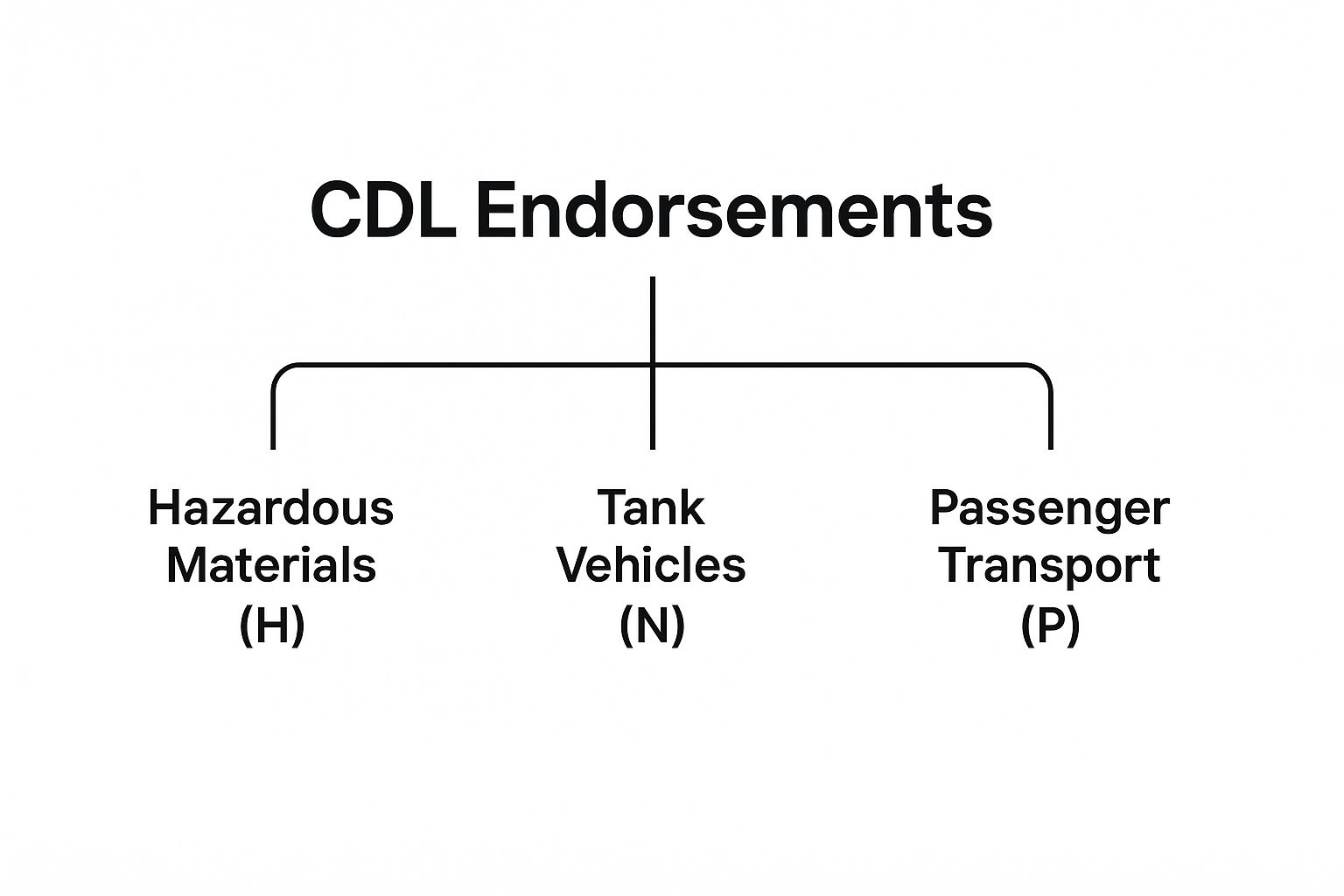
This shows how you can stack endorsements on top of your base CDL to qualify for very specific roles, like a tanker truck driver, a HAZMAT hauler, or a school bus operator.
The table below breaks down how these classes and endorsements line up with real-world jobs.
Comparison of CDL Classes and Common Endorsements
| License Class / Endorsement | Allows You to Drive | Typical Jobs | Additional Tests Required |
|---|---|---|---|
| Class A | Tractor-trailers and other combination vehicles over 26,001 lbs. | Long-haul trucking, regional freight hauling, livestock transport. | General Knowledge, Combination Vehicles, Air Brakes. |
| Class B | Single vehicles over 26,001 lbs (straight trucks, buses). | Local delivery driver, dump truck operator, bus driver. | General Knowledge, Air Brakes. |
| Class C | Vehicles for 16+ passengers or placarded HAZMAT, not in Class A/B. | Shuttle bus driver, small HAZMAT vehicle operator. | General Knowledge, and applicable endorsement tests. |
| H – Hazardous Materials | Vehicles carrying placarded hazardous materials. | HAZMAT driver, chemical transport specialist. | HAZMAT knowledge test, TSA background check. |
| N – Tank Vehicle | Trucks designed to transport liquids or gasses in a tank. | Tanker truck driver (gas, milk, chemicals). | Tank Vehicle knowledge test. |
| P – Passenger | Vehicles designed to carry 16+ passengers. | City bus driver, tour bus operator. | Passenger Transport knowledge test. |
| S – School Bus | School buses. | School bus driver. | School Bus knowledge test, Passenger test. |
| T – Double/Triple Trailers | Vehicles pulling two or three trailers. | Long-haul driver for specific freight carriers (LTL). | Doubles/Triples knowledge test. |
| X – Tanker/HAZMAT | A combination endorsement for hauling hazardous materials in a tank. | Fuel tanker driver, industrial chemical hauler. | Both Tank Vehicle and HAZMAT tests. |
Understanding this table helps you map out a clear path from the license you're pursuing to the career you want.
Finally, for drivers who plan on running international routes, it’s crucial to know how licenses are treated across borders. The United States has agreements with its neighbors, but they are very specific. Currently, only CDLs issued by the federal government of Mexico and the provinces and territories of Canada are recognized for operating commercial vehicles in the U.S. These reciprocity agreements are key to keeping cross-border trade moving smoothly between the U.S., Mexico, and Canada.
Got Questions About Getting Your CDL? We've Got Answers.
When you're thinking about a career in trucking, a lot of practical questions pop up. How much will this really cost? How long will I be in training instead of earning? What if I have a less-than-perfect background? Getting straight answers is the first step toward hitting the road with confidence.
Let's tackle the questions we hear most often from aspiring drivers.
How Much Does It Cost to Get a CDL?
Plan on investing somewhere between $3,000 and $10,000 to get your CDL. It's a wide range, I know, but the final number really comes down to where you live and which training school you pick.
Most of that money goes toward tuition for a certified Entry-Level Driver Training (ELDT) program, which is now mandatory. The rest covers smaller but necessary expenses like your permit application, the skills test fee, and the required DOT medical exam.
How Long Does It Take to Get a CDL?
If you can commit to a full-time program, you could be fully licensed and ready to work in as little as three to seven weeks. That’s a pretty quick turnaround for a whole new career, covering everything from classroom theory to hands-on driving practice and the final exam.
Of course, if you need a more flexible schedule, part-time programs are available, but they will stretch out the timeline. Also, be prepared for potential delays—sometimes just getting an appointment at the DMV can add a week or two to the process.
Can I Get a CDL with a Felony?
This is a big one for a lot of people. A felony on your record doesn't automatically kill your chances, but it does make things more complicated. It really depends on the nature of the crime, how long ago it happened, and your state's specific regulations. Many drivers with past convictions get their CDLs and have successful careers.
However, certain offenses are deal-breakers. Things like drug trafficking or using a commercial vehicle to commit a felony will almost certainly lead to a denial.
The best advice? Be completely honest and check directly with your state's DMV. They have the final say. Keep in mind that some endorsements, especially for hauling hazardous materials (the Hazmat or 'H' endorsement), require a much tougher federal background check that's very difficult to pass with a criminal record.
It's also worth noting that the rules and demographics of trucking are constantly shifting. For example, federal regulators are taking a closer look at state practices after a huge spike in CDLs issued to drivers living outside the U.S.—with over 60,000 such licenses issued as of 2025.
At Patriot CDL, we're here to give you the expert training and clear guidance you need to handle every part of the licensing process. Learn more about our CDL programs and take the first step toward your new career today.