

If you're looking to get your Class A CDL, the core requirements boil down to this: you need to meet age and residency rules, pass a DOT medical exam, complete mandatory training, and then nail both a written knowledge exam and a three-part skills test. It's a structured staircase you climb to become a safe, professional truck driver.
Your Roadmap to a Class A CDL License
Getting your Class A Commercial Driver's License might seem like a lot to take on, but it’s actually a clear, step-by-step process. Every milestone is designed to make sure new drivers are competent and safe behind the wheel. We're going to break down every single part of that journey, from the first eligibility checks to the final exams.
Ever since April 1, 1992, federal rules have made this a standard process for anyone wanting to drive large commercial vehicles. A Class A license specifically covers any combination vehicle with a gross weight rating of at least 26,001 pounds, as long as the trailer you're towing weighs more than 10,000 pounds. This is the license for the big rigs—the tractor-trailers that are the lifeblood of American logistics.
To make it simple, you can think of the path in three main phases: proving you’re eligible, getting the right training, and passing the tests. Each step builds on the one before it, giving you the knowledge and hands-on skill you need to operate a large vehicle safely.
This roadmap breaks down that journey into three simple steps.
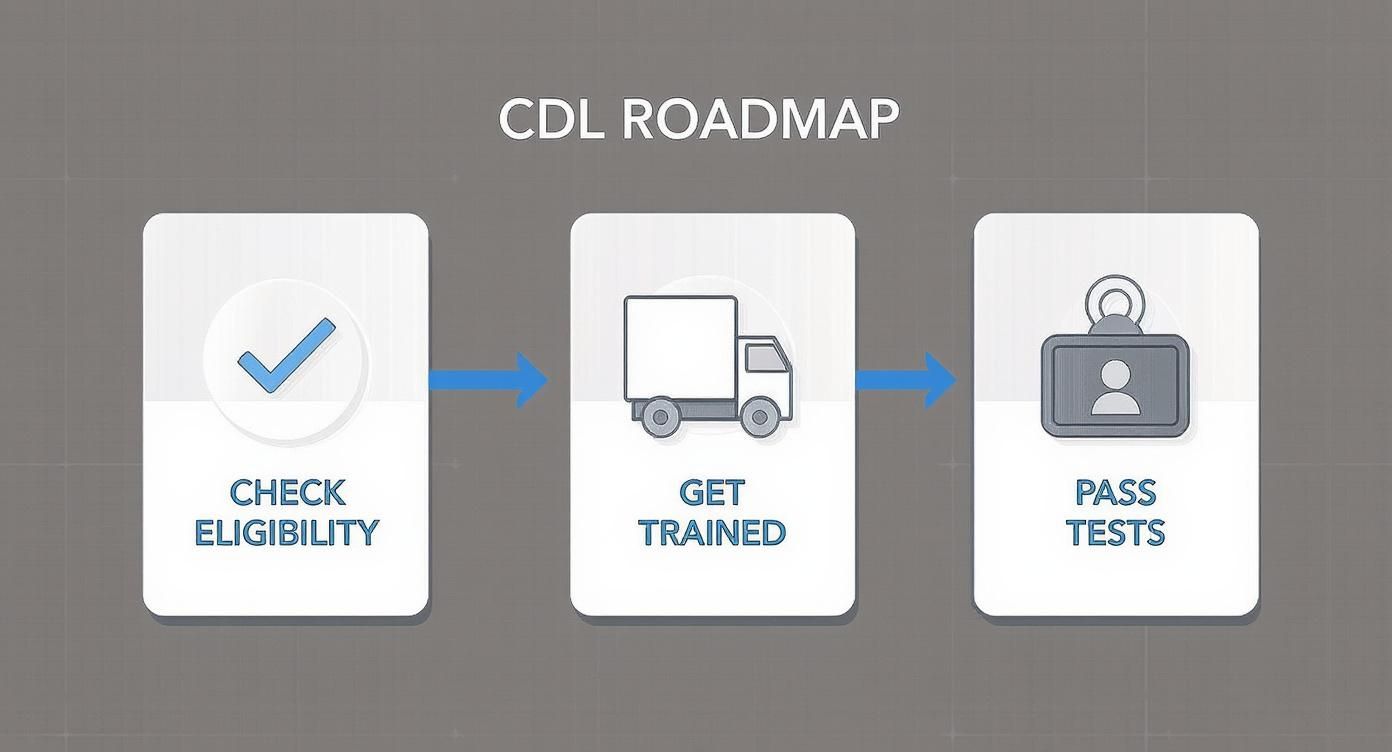
As you can see, becoming a professional driver is a clear, sequential path—not a confusing maze.
To give you a bird's-eye view, here's a quick summary of the entire process from start to finish.
Class A CDL Requirements At a Glance
| Stage | Key Requirement | Brief Description |
|---|---|---|
| 1. Eligibility & Permitting | Meet basic criteria and get your CLP. | You must meet age/residency rules, pass a DOT medical exam, and pass initial written tests to earn your Commercial Learner's Permit (CLP). |
| 2. Mandatory Training | Complete Entry-Level Driver Training (ELDT). | This federal requirement involves both classroom theory and behind-the-wheel instruction from a registered training provider. |
| 3. Final Testing | Pass the three-part CDL skills test. | You'll be tested on your pre-trip inspection, basic vehicle control skills, and on-road driving performance. |
This table outlines the key milestones you'll hit on your way to earning your license. Let's dig a little deeper into what each one involves.
Key Milestones on Your Journey
The first thing you’ll do is confirm you meet the basic state and federal requirements. We'll get into the specifics in the next section, but this covers things like your age, residency, and having a valid driver's license.
Next up is the federally mandated Entry-Level Driver Training (ELDT). This isn't just a suggestion; it's a critical phase that combines classroom theory with hands-on practice on a driving range and public roads. Our complete guide on ELDT training requirements explains this in more detail. You absolutely must complete this training with a registered provider before you're even allowed to take your final CDL skills test.
The whole CDL process is designed to build your skills progressively. You start with foundational knowledge, move to basic vehicle control, and finally prove your abilities in real-world driving scenarios.
Finally, you’ll face the CDL skills test. It's broken into three distinct parts: the pre-trip vehicle inspection, basic control skills (like backing maneuvers), and the on-road driving test. Passing this final exam is the last hurdle to clear before you earn your license and start your career on the open road.
Checking Off the Foundational Eligibility Boxes
Before you even dream about hitting the open road, there are a few fundamental boxes you have to check. Think of these as the absolute non-negotiables. They’re the baseline requirements every single aspiring commercial driver has to meet before the real training can even begin.
First up, let's talk age. The government draws a hard line between two types of driving: intrastate (staying within your home state) and interstate (crossing state lines). In most states, you can get your Class A CDL at 18 years old to drive locally. But if you want to run coast-to-coast, you have to be at least 21 years old. That federal rule is there for a reason—interstate hauling comes with a whole new level of responsibility.
Proving You Are Who You Say You Are
Once you've cleared the age hurdle, it's time to get your paperwork in order. Your state’s DMV needs to verify your identity and residency, and they are extremely strict about it. No photocopies, no excuses.
Here’s what they’ll almost certainly ask for:
- Proof of Legal Presence: This means your U.S. birth certificate, a valid U.S. passport, or your permanent resident card.
- Social Security Card: Bring your actual, original card. They need it to verify your identity.
- Proof of Residency: You'll need a couple of documents with your name and current address on them. Think utility bills, a lease agreement, or a recent bank statement.
- Valid Driver's License: You can't get a commercial license without first having a valid regular driver's license from the state you're applying in.
I can't stress this enough: have all of this ready to go before you walk into the DMV. Showing up with a missing document is the quickest way to get sent home and have to start all over again.
The Importance of a Clean Driving Record
Beyond who you are, the DMV cares a lot about what you’ve done behind the wheel. They’re going to pull your driving record to see if you’ve been a safe, responsible driver. A single speeding ticket from five years ago probably won't be a dealbreaker, but serious offenses can stop you in your tracks.
Your driving record is your resume before you even have one. It tells regulators and future employers that you’re a low-risk professional they can trust.
Certain violations are major red flags, including things like:
- A recent DUI or DWI conviction.
- Leaving the scene of an accident.
- Using any vehicle to commit a felony.
- A string of serious tickets in a short time (like for reckless driving or excessive speeding).
Commercial drivers are held to a much higher standard, and for good reason. If you made bad decisions in a 4,000-pound car, they’re not going to hand you the keys to an 80,000-pound rig. If you have any doubts, get a copy of your MVR (Motor Vehicle Record) from the DMV and see what's on there. This kind of foundational knowledge is also a key part of your initial studies, so it's smart to start reviewing the material covered in the CDL general knowledge test. Nail these first steps, and you've cleared the way for the real work to begin.
Passing Your DOT Medical Exam and Drug Test
Before you even think about getting behind the wheel, you have to prove you’re physically and mentally up for the job. This isn’t just about skill; it’s about safety. That’s why a mandatory Department of Transportation (DOT) medical exam and drug test are some of the very first hurdles you’ll clear on your way to a Class A CDL.
Think of these as non-negotiable safety checks. They ensure every professional driver on the road meets a consistent federal standard for health. In fact, you can't even get your Commercial Learner’s Permit (CLP) until you’ve passed. You'll need to find a healthcare professional on the official FMCSA National Registry of Certified Medical Examiners to conduct the exam.
What to Expect During the DOT Physical
The DOT physical is a comprehensive health check-up, but don't let that intimidate you. It’s not designed to see if you’re a super-athlete; it's designed to identify any medical condition that could make it unsafe for you to operate an 80,000-pound vehicle. The examiner is looking for anything that might cause a sudden problem on the road.
Here’s a quick rundown of what they’ll check:
- Vision and Hearing: Can you see well enough to spot road hazards? You’ll need at least 20/40 vision in each eye (glasses or contacts are fine) and the ability to tell colors apart. They'll also check your hearing to make sure you can pick up on sirens, horns, and other critical sounds.
- Blood Pressure and Pulse: Your blood pressure needs to be at or below 140/90. High blood pressure is a major concern in this line of work, so they take it very seriously.
- Urinalysis: This isn't a drug test. It's a simple screening to check for underlying issues like diabetes by looking for things like sugar in your urine.
The examiner will also give you a general physical once-over, checking everything from your heart and lungs to your basic neurological functions.
Once you pass, you'll be issued a DOT medical card. This is your official green light, health-wise. It's typically valid for 24 months, but if you have a condition that needs watching, you might get one for a shorter period.
The Mandatory Drug Screening
Along with the physical, you must pass a separate DOT drug test. There's no gray area here—the industry has a zero-tolerance policy for substance use, and for good reason. Safety is the top priority.
This is a standard screening that looks for substances like marijuana, cocaine, opiates, amphetamines, and PCP. And don't think it's a one-and-done deal. As a professional driver, you'll be subject to random drug and alcohol testing for your entire career.
Failing a drug test is a career-ender for many. It leads to an immediate disqualification and a long, difficult road back that involves completing a substance abuse program. A failed test on your record can make finding a good trucking job nearly impossible. A clean record isn't just a suggestion; it's a cornerstone of a long, successful career on the road.
Getting Your Permit and Completing ELDT Training
Once you've cleared the initial eligibility checks and have your medical card, it's time to shift gears from paperwork to practice. This next phase is all about earning your Commercial Learner's Permit (CLP) and completing the federally required Entry-Level Driver Training (ELDT). Think of these two steps as the bridge that takes you from being a qualified applicant to a skilled driver-in-training.
Your CLP is essentially a student driver's license for a big rig. It’s what lets you finally get behind the wheel, but there's a catch: you have to have a licensed CDL holder right there in the passenger seat with you. Getting your permit is your first real test of knowledge, proving you've got a solid grasp of the fundamental rules for operating a commercial vehicle.
Earning Your Commercial Learner's Permit
To get that CLP, you'll head to your local DMV and take a series of written knowledge tests. These aren't just random questions; they're pulled straight from the official CDL manual and cover the essential information every professional driver needs to know cold. The exact tests can differ a bit depending on your state and what you plan to drive, but for a Class A, you can count on at least three main exams.
Here's what you'll be tested on:
- General Knowledge: This is the big one. It's a comprehensive exam covering everything from basic vehicle controls and safe driving techniques to emergency procedures and federal regulations. This test is the bedrock of your CDL education.
- Combination Vehicles: Since you're going for a Class A, this test is mandatory. It zeroes in on the unique physics and challenges of driving a tractor-trailer, like proper coupling and uncoupling, air brake checks on a combination rig, and how to prevent a rollover.
- Air Brakes: Nearly every Class A truck on the road uses an air brake system, so you have to prove you know how they work. This test covers everything from how the system functions to proper inspection and safe use on the road.
Passing these takes real studying. Many aspiring drivers find that using a solid guide on preparing for the permit tests gives them the edge they need. Once you pass, the DMV will issue your CLP, and you're ready for the next big step.
The Entry-Level Driver Training Mandate
With your new CLP in hand, you can finally start the most important part of your education: Entry-Level Driver Training (ELDT). This isn't optional—it's a federal requirement that creates a single, national training standard for all new commercial drivers.
As of February 7, 2022, anyone getting their CDL for the first time, upgrading their license class, or adding certain endorsements has to complete this training. The Federal Motor Carrier Safety Administration (FMCSA) designed the ELDT mandate to make sure every new driver receives consistent, quality instruction, which ultimately makes our roads safer. The rule also specifies that you must hold your CLP for a minimum of 14 days before you can even attempt the final CDL skills test.
ELDT is all about leveling the playing field for safety. It ensures every new driver in the country, no matter where they train, learns the same essential skills and safety protocols before testing for their CDL.
The training itself is split into two parts:
- Theory (Classroom) Instruction: This is where you learn the "why" behind the rules of the road. You’ll dive deep into topics like hours-of-service regulations, vehicle systems, and basic operational theory. To move on, you have to score at least 80% on the final theory assessment.
- Behind-the-Wheel (BTW) Training: This is where you put all that theory into practice. BTW training is split between "range" work (a closed course) and public road driving. You'll master everything from basic maneuvers and backing skills on the range to safely navigating traffic, intersections, and highways out on the open road.
It's critical to know that you can only get your ELDT from a provider listed on the official FMCSA Training Provider Registry. A registered school like Patriot CDL is certified to deliver this training and will submit your successful completion to the registry. That's what makes you officially eligible to schedule and take your final CDL skills exam.
How to Master the Final CDL Skills Test
You've put in the work, completed your training, and now you’re at the finish line. The final Class A CDL skills test is the last major hurdle between you and your license, and it’s your chance to prove you have what it takes to operate a commercial vehicle safely and with confidence.
Think of it less as a single, overwhelming exam and more as a series of three distinct challenges. Each part is designed to evaluate a different, critical aspect of your driving competence. Success here isn’t about luck; it’s about solid preparation, precision, and knowing exactly what the examiner is looking for.
As you prepare for both the written exams and the hands-on assessments, getting organized is a game-changer. You can seriously boost your confidence by creating an effective study guide that breaks down all this information into bite-sized pieces.
Part 1: The Vehicle Inspection Test
Before you even turn the key, you have to prove you know a safe vehicle when you see one. The first part of the skills test is the pre-trip vehicle inspection. This is far more than a casual walk-around—it's a systematic, verbal demonstration of your knowledge of the truck and trailer’s most critical components.
You’ll be asked to point to and explain the condition of various parts, from the engine compartment to the coupling system and wheels. You need to be able to clearly state what you're checking for—things like leaks, worn parts, or improper connections—and why it’s critical for safety. The examiner needs to hear that you understand not just what to check, but why it matters.
This is a non-negotiable skill. To get it down cold, check out our in-depth guide covering every step of the Class A CDL pre-trip inspection.
Part 2: Basic Vehicle Control Skills
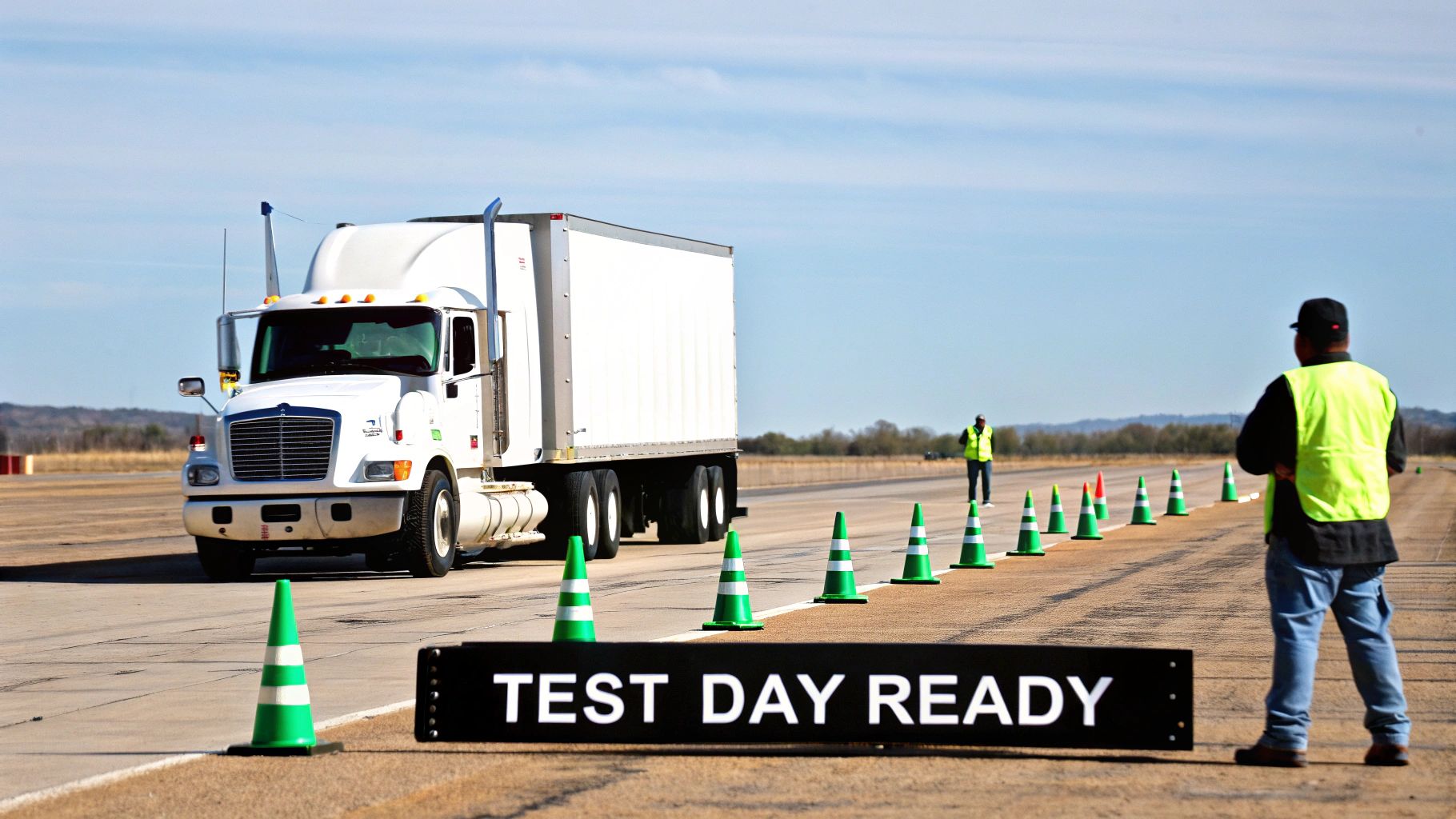
Next up, you'll head to the driving range for the basic vehicle control test. This part zeroes in on your ability to handle the rig in tight quarters, focusing on precision and control. You’ll perform a series of low-speed maneuvers that are the bread and butter of daily life at loading docks, truck stops, and distribution centers.
This is where all those hours you spent on the training yard really pay off. Examiners are looking for smooth, deliberate actions and your ability to judge the vehicle's footprint without hitting a single cone or crossing a boundary line.
The maneuvers you’ll be tested on almost always include:
- Straight Line Backing: Proving you can back the tractor-trailer in a straight line for about 100 feet.
- Offset Backing: Skillfully backing the rig from one lane into an adjacent lane, either to the right or left.
- Parallel Parking: It’s a classic for a reason. This tests your ability to park the rig in a space parallel to a curb, either on the driver's side or the conventional passenger's side.
- Alley Docking: Backing the trailer from the street into a simulated loading dock, typically at a 90-degree angle.
Each maneuver comes with specific rules, like how many times you can pull forward to correct your angle. Know them well.
Part 3: The On-Road Driving Test
The final piece of the puzzle is the on-road driving test. This is your moment to show the examiner you can safely operate the vehicle in the real world, surrounded by traffic. You'll drive a route planned by the examiner that includes a mix of different road types and traffic situations.
During this drive, the examiner is grading you on a whole host of skills. They’re watching how you manage the space around your truck, navigate intersections, and maintain a constant awareness of your environment.
To help you understand what's being evaluated, here's a quick look at the three parts of the test and what each one focuses on.
Class A CDL Skills Test Breakdown
| Test Component | Primary Objective | Skills Assessed |
|---|---|---|
| Vehicle Inspection | Verify your ability to identify a safe and legally operable vehicle. | Knowledge of key components, identifying potential defects, verbal communication. |
| Basic Control Skills | Demonstrate precision maneuvering in a controlled, off-road environment. | Judging vehicle dimensions, low-speed control, backing maneuvers. |
| On-Road Driving | Safely operate the vehicle in real-world traffic and road conditions. | Lane control, speed management, signaling, hazard perception, intersection navigation. |
Ultimately, passing the on-road test is about more than just following the rules of the road. It’s about proving you have the defensive driving mindset of a true professional. It’s about showing you’re ready.
Breaking Down the Costs and Staying Out of Trouble
Getting your Class A CDL is a serious investment in your future, so it's smart to go in with your eyes wide open about the costs and potential pitfalls. You're not just paying for a piece of plastic; you're paying for a career-launching education. The price tag for a solid CDL training program typically lands somewhere between $3,000 and $8,000, and that number really depends on the school you choose and how deep their training goes.
But the tuition is just the biggest piece of the puzzle. You'll also need to budget for all the little administrative fees that pop up along the way. Think of things like the DOT medical exam, your Commercial Learner's Permit (CLP) application, the final skills test fee, and the cost of the actual license. None of them are huge on their own, but they can easily add up to a few hundred dollars.
What to Expect for Time and Money
The school you pick is the single biggest factor affecting both your timeline and your budget. If you're looking to get on the road fast, an accelerated, full-time program can have you ready to test in just 3 to 4 weeks. For folks juggling a job or family, part-time options offer more breathing room but will naturally stretch out the process.
When you're comparing schools, don't let the price tag be your only guide. Sometimes, paying a bit more upfront for a top-tier program gets you more hours behind the wheel, better trucks to learn on, and real help with job placement after you graduate. That's a much better return on your investment in the long run.
Your Class A CDL is more than just a license; it's a professional credential that must be protected. The same high standards you meet to earn it will apply throughout your entire career.
And it’s an investment worth making. The industry is hungry for new drivers. With the average age of a Class A driver hovering around 48, a huge wave of retirements is coming. Plus, turnover in trucking can be incredibly high—sometimes reaching 95%—which means companies are always on the lookout for qualified people to fill those empty seats.
How to Avoid Career-Ending Mistakes
Just as crucial as knowing the costs is understanding the rules that can derail your career before it even gets rolling. The FMCSA doesn't mess around when it comes to safety, and certain offenses will get your CDL disqualified—fast. These aren't just minor traffic tickets; they are serious violations that put everyone on the road at risk.
A disqualification isn't a slap on the wrist. It means you are legally barred from driving a commercial vehicle for a specific amount of time… or even for life.
Here are some of the big ones to watch out for:
- Driving Under the Influence (DUI/DWI): This applies to any vehicle you're driving, even your personal car. A first offense will typically knock you out of the driver's seat for a full year.
- Leaving the Scene of an Accident: If you're involved in a crash, you stay. Fleeing the scene is a fast track to a disqualification.
- Using a Vehicle to Commit a Felony: Things like drug trafficking are an automatic lifetime ban from holding a CDL. No second chances.
- Serious Traffic Violations: Racking up multiple major violations—like excessive speeding (15 mph or more over the limit) or reckless driving—within a three-year period will get your license pulled.
Some drivers might also start with a specific limitation, like the E restriction, which means they can't operate a truck with a manual transmission. The good news is that you can always upgrade your skills. We can tell you more about our E restriction removal course that opens up more job opportunities.
By simply steering clear of these major offenses, you protect the time and money you've invested and set yourself up for a long, successful career on the open road.
Common Questions About Class A CDL Requirements
Even when you have a solid plan, specific questions about the requirements for class a cdl always pop up. Let's tackle some of the most common ones so you can move forward with confidence.
How Long Does It Take to Get a Class A CDL?
It doesn't have to take forever. The single biggest factor in your timeline is the kind of training program you pick. Some schools might stretch things out over a couple of months.
But if you jump into an accelerated, full-time program, you can be ready for your final test in just three to four weeks. That fast-paced schedule covers everything: prepping for your learner’s permit, holding it for the mandatory 14 days, finishing all your ELDT training, and acing the final skills test.
Can I Get a Class A CDL With a Criminal Record?
This is a big concern for many people, and the honest answer is, it really depends on the specific offense. While most misdemeanors won’t stop you, certain felonies can be a major roadblock, especially if they’re recent or related to driving and transportation.
Both federal rules and the hiring policies of individual trucking companies come into play. Your best bet is always to be upfront and honest about your history right from the start.
Your past doesn't automatically close the door on a trucking career. Many employers evaluate candidates on a case-by-case basis, focusing on the nature of the offense and how much time has passed.
What Is the Difference Between a Class A and Class B CDL?
The main difference boils down to the weight of the vehicle you can drive. A Class A license is the king of the road—it’s for combination vehicles like a tractor-trailer, where the trailer you're pulling weighs more than 10,000 pounds.
A Class B license, on the other hand, is for heavy single vehicles like dump trucks, school buses, or straight trucks. You can still tow a small trailer with a Class B, but it has to weigh less than 10,000 pounds.
Do I Need to Own My Own Truck for CDL School?
Nope, not at all. Any good CDL training school will provide all the trucks and equipment you need to learn. The cost of using their vehicles for your classroom, yard, and on-the-road training is all wrapped up in your tuition.
This lets you focus 100% on learning to drive without the headache of finding a truck. Your only job is to show up ready to master the requirements for class a cdl.
Ready to stop wondering and start driving? At Patriot CDL, we provide accelerated, hands-on training that gets you on the road in weeks, not months. Learn more and enroll today!