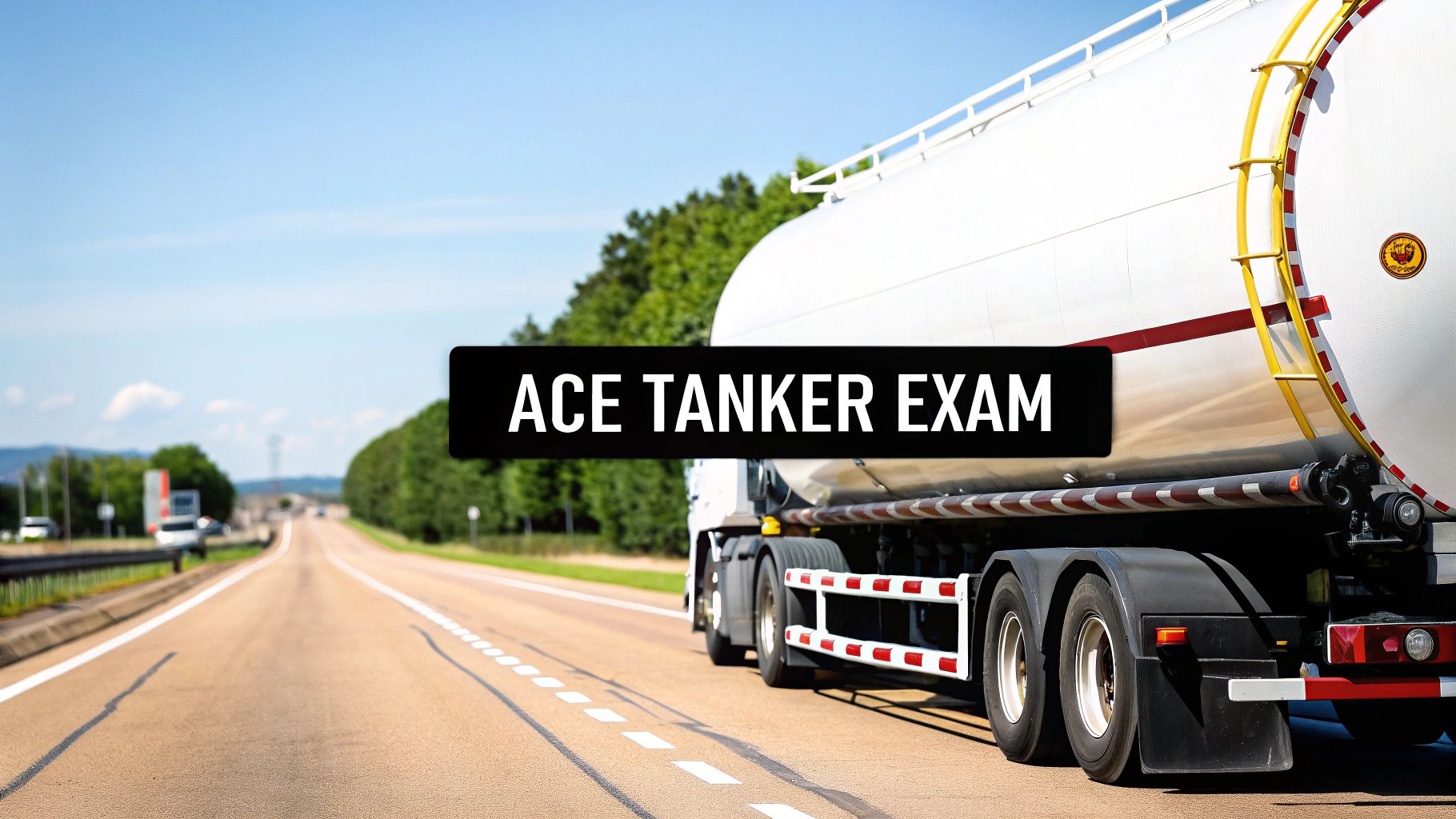
If you're looking to haul liquid or gas in bulk, you'll need the tanker endorsement (N) on your CDL. This isn't just a rubber stamp; it's a test of your ability to handle the unique physics and safety challenges that come with this kind of work, like managing liquid surge and a high center of gravity. For anyone serious about entering this specialized, high-demand field, passing this test is your first critical step.
What Is the Tanker Endorsement Test
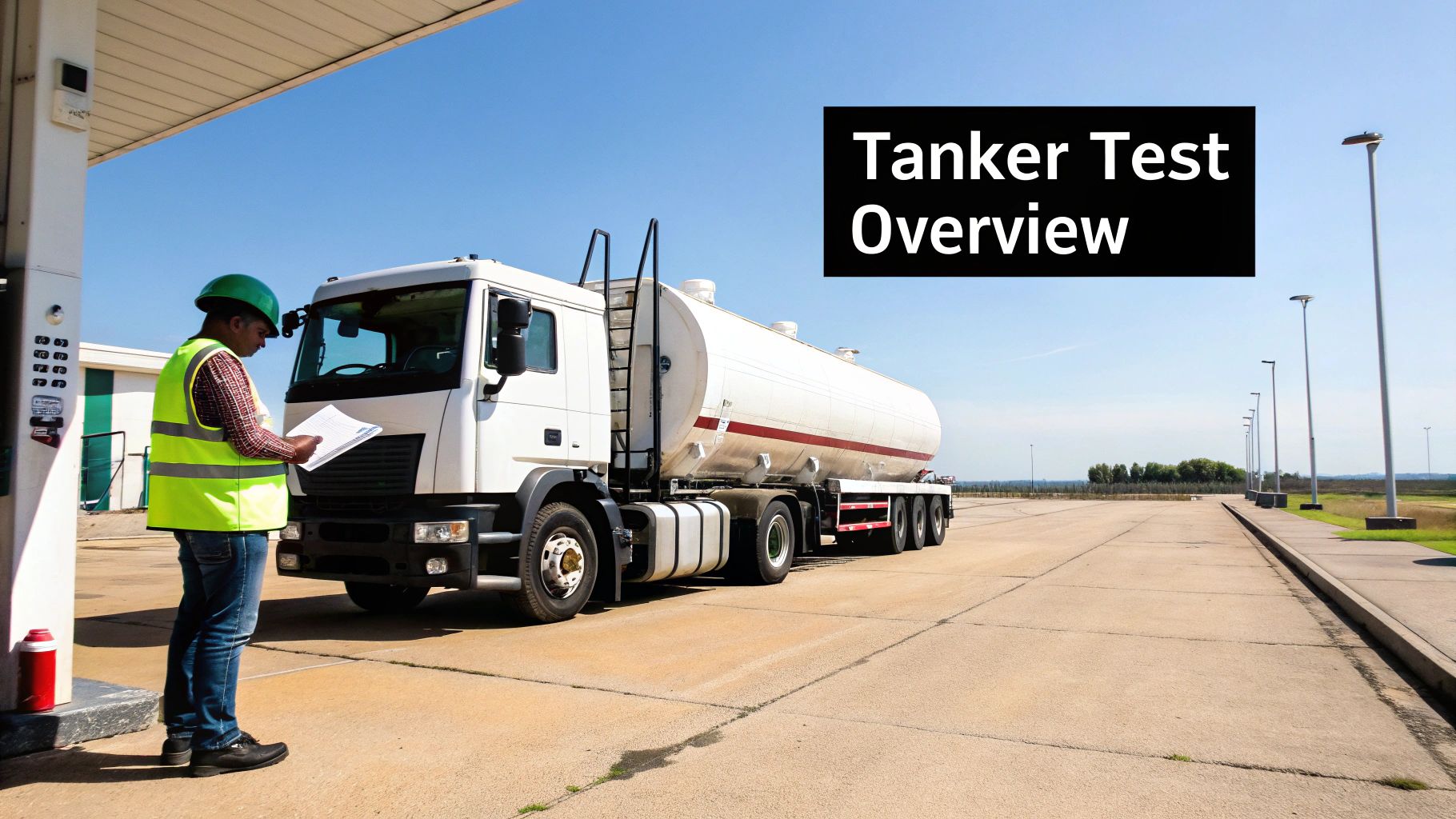
Before you hit the books, let's get a clear picture of what the N endorsement test is all about. Think of it as your license to manage one of the most dynamic—and potentially hazardous—loads a trucker can haul.
The tanker endorsement is a special certification added to your CDL that qualifies you to operate vehicles hauling liquid or gaseous cargo, from gasoline and industrial chemicals to milk and water. It's so important because a tanker isn't like a dry van. The load moves. This movement, known as liquid surge, can dramatically impact your truck's stability and handling, which is why specialized knowledge is non-negotiable.
Who Needs the N Endorsement
Federal regulations leave no gray area here. You must have an N endorsement on your CDL if you operate a vehicle that fits either of these descriptions:
- Individual Tank Size: Any single tank with a rated capacity over 119 gallons.
- Total Vehicle Capacity: A combination of tanks on your vehicle with a combined rated capacity of 1,000 gallons or more.
This rule applies across the board, covering drivers in fuel hauling, chemical transport, agriculture, and even food-grade delivery. It doesn't matter if the liquid is hazardous or not; hauling a large tank of milk requires the same endorsement as hauling fuel.
Understanding the Test Format and Requirements
The test is designed to see if you truly understand the core safety principles of tanker operations. It’s less about rote memorization and more about how you’d apply that knowledge in real-world situations you'll encounter on the road every day.
To give you a quick overview, here's a breakdown of what to expect from the N endorsement exam.
Tanker Endorsement Test at a Glance
| Component | Details |
|---|---|
| Test Type | Written Knowledge Exam |
| Number of Questions | Typically 20 to 25 multiple-choice questions |
| Passing Score | 80% or higher (e.g., at least 16 out of 20 correct) |
| Key Topics | Liquid surge, high center of gravity, tanker inspections, driving techniques, loading/unloading |
| Endorsement Code | N (Tank Vehicles) |
| Who Needs It | Drivers hauling liquids/gases in tanks >119 gallons or a total of >1,000 gallons |
As you can see, with a required score of 80%, there's very little room for error. You can only miss a few questions, so walking in unprepared isn't an option.
A common mistake I see drivers make is underestimating the physics involved. The test heavily emphasizes your understanding of how liquid surge affects braking distances, turning stability, and overall vehicle control. It’s less about the truck and more about the unpredictable force you're hauling.
Questions will cover everything from tanker-specific pre-trip inspections to the safest ways to navigate curves with a high center of gravity. While there's some overlap with general commercial driving knowledge, like what you’d find on the combination vehicles test, the N endorsement exam zeroes in on the unique dynamics of liquid cargo. Mastering these concepts is your ticket to passing the test and building a safe, long-lasting career.
Getting a Grip on Core Tanker Knowledge for the Test
To nail the tanker endorsement test, you have to start thinking less like a trucker and more like a physicist. This exam isn't about memorizing rules; it’s about understanding how a massive, shifting liquid load behaves on the road. The key to passing is grasping why a tanker does what it does.
The absolute biggest concept you need to master is liquid surge. Seriously, burn this into your brain. Picture thousands of gallons of milk or gasoline sloshing around in your tank. This isn't a gentle ripple—it's a powerful force that can shove your rig forward when you brake or yank it backward when you accelerate.
This constant movement is no joke. It can mess with your traction, stretch out your stopping distances, and make taking a turn a whole lot more dangerous than it would be in a standard dry van.
Taming the Uncontrollable: Liquid Surge
Tanker manufacturers aren't just throwing a big metal can on a chassis; they build in features to help manage that surge, and you bet the test will ask you about them. The two main designs you'll see are baffles and bulkheads.
Baffles are walls inside the tank with holes in them. Think of them as speed bumps for the liquid. They break up the forward-and-back motion, which helps, but the liquid can still travel the full length of the tank. The force is dampened, not eliminated.
Bulkheads are different. These are solid walls that chop a tanker into several smaller, completely separate compartments. A truck with bulkheads is basically a train of small tanks. This design stops the surge completely from front to back, giving you way more stability.
A classic test question will pit a baffled tanker against a smoothbore (one with no baffles) or a bulkheaded one. Remember: baffles help, but they don't get rid of the surge entirely.
Safe Driving Habits That Examiners Are Looking For
You can't drive a tanker like you drive a flatbed. You have to adapt, and the test is designed to see if you know how. The name of the game is smoothness.
Every move you make—from braking and accelerating to turning and changing lanes—has to be deliberate and gentle. Any sudden, jerky maneuver can create a surge so powerful you might not be able to recover from it.
Here are the critical adjustments you’ll be tested on:
- Stopping Distance: Tankers need a lot more room to stop. When you hit the brakes, that forward surge of liquid is pushing right against them. It can feel like the truck simply doesn't want to stop.
- Speed in Curves: You have to slow down way before you even enter a curve. A tanker’s high center of gravity combined with liquid pushing to the outside is a perfect recipe for a rollover—one of the most common and deadly tanker accidents.
- Anticipation: Get your eyes way up the road, much farther than you normally would. This gives you time to see what’s coming and react smoothly, so you can avoid the sudden braking or swerving that could get you into real trouble.
Here’s the rule of thumb I live by when I’m in a tanker: do everything early. Brake earlier than you think you need to. Take turns slower. Accelerate more gradually. The test wants to see that you have this proactive, defensive mindset down cold.
Loading and Unloading: Where Safety Starts
Your trip doesn't start safely when you turn the key—it starts at the loading rack. You can expect plenty of questions about proper loading and unloading procedures because this is where a lot can go wrong.
A crucial concept is outage. This is just the empty space you leave at the top of a tank to give the liquid room to expand. Liquids expand when they get warm. Without enough outage, the pressure can build up and literally rupture the tank. Knowing how to calculate this is non-negotiable.
Static electricity is another huge hazard, especially with flammable cargo like gasoline. You absolutely have to know the procedure for grounding the truck. This means connecting a cable from your truck to the loading rack to discharge any static buildup before you start the flow. Skip this step, and you could create a spark that causes a catastrophic fire.
When Things Go Wrong: Emergency Response
Finally, you have to be ready for the worst. The exam will check if you know what to do in an emergency, like a rollover or a leak.
They'll want to see that you know the first steps: assess the situation, call the right authorities, and keep the public a safe distance away. Your main job is to drive, but being a professional tanker operator means knowing the basics of containment and emergency response. This isn't just for the test; it’s for keeping yourself and everyone else safe out there.
While these topics are specific to the tanker endorsement, don't forget that it all builds on the fundamentals. A quick review of the material from the CDL general knowledge test can only help. Building on a strong foundation is one of the most powerful knowledge retention strategies you can use.
How to Perform a Tanker-Specific Inspection
You already know the standard CDL pre-trip inspection, but strapping a tank to your tractor changes the game entirely. This isn't just about ticking boxes; it's about understanding that a tanker has unique points of failure that can turn a small issue into a massive problem.
The tanker endorsement test will absolutely hit you with questions on this, and any DOT officer worth their salt will expect you to know this stuff cold. Forget just kicking the tires—your focus needs to be on the integrity of the tank itself. You're making sure thousands of gallons of liquid stay right where they belong.
Checking the Tank Shell and Structure
Your very first job is a meticulous walk-around, and I mean meticulous. You're hunting for any sign of compromise, no matter how small it seems.
Keep a sharp eye on the tank shell. You're looking for dents, cracks, or gouges that could weaken the metal. A dent that looks like nothing can compromise the tank's structural integrity, especially when you have a few thousand gallons of liquid sloshing around inside. I always tell my students to run their hands along the seams and welds, feeling for stress fractures. A tiny, hairline crack can easily become a catastrophic failure once you're rolling down the highway.
Sealing the Deal: Manholes, Vents, and Gaskets
A tanker is designed to be a completely sealed system. Any breach can cause a dangerous spill or a serious pressure imbalance. This makes your manhole covers and vents critical inspection points.
Check every single manhole cover. Does it have a secure, tight-fitting gasket? If a gasket looks dry, cracked, or is missing altogether, that's an immediate no-go. Make sure the covers latch down securely. Next, move on to the pressure and vacuum relief vents. They need to be clean, clear of any obstruction, and ready to do their job. A blocked vent can cause a tank to implode during unloading or even rupture from pressure buildup.
When I train new drivers, I tell them to treat every seal and valve like it's the only thing preventing a major incident—because it just might be. A quick glance isn't enough; you need to physically check that everything is seated, sealed, and secure before you even think about starting the engine.
Valves, Hoses, and Emergency Shut-Offs
The discharge system is where your product leaves the tank, making it a high-risk area for leaks. This part of your inspection demands your full attention.
Start with the discharge valves. Are they all closed? Are there any signs of dripping or leaking? Now look over the hoses. You’re checking for cracks, bulges, or excessive wear. Verify that the couplings are clean and in good shape.
Most importantly, you need to know your emergency shut-off system inside and out. Test the remote shut-offs and the internal valve to be certain they work instantly. On your skills test and out on the road, knowing how to kill the flow immediately can be the difference between a small mess and a full-blown disaster.
The principles of a safe haul are built on the foundation of a perfect inspection.
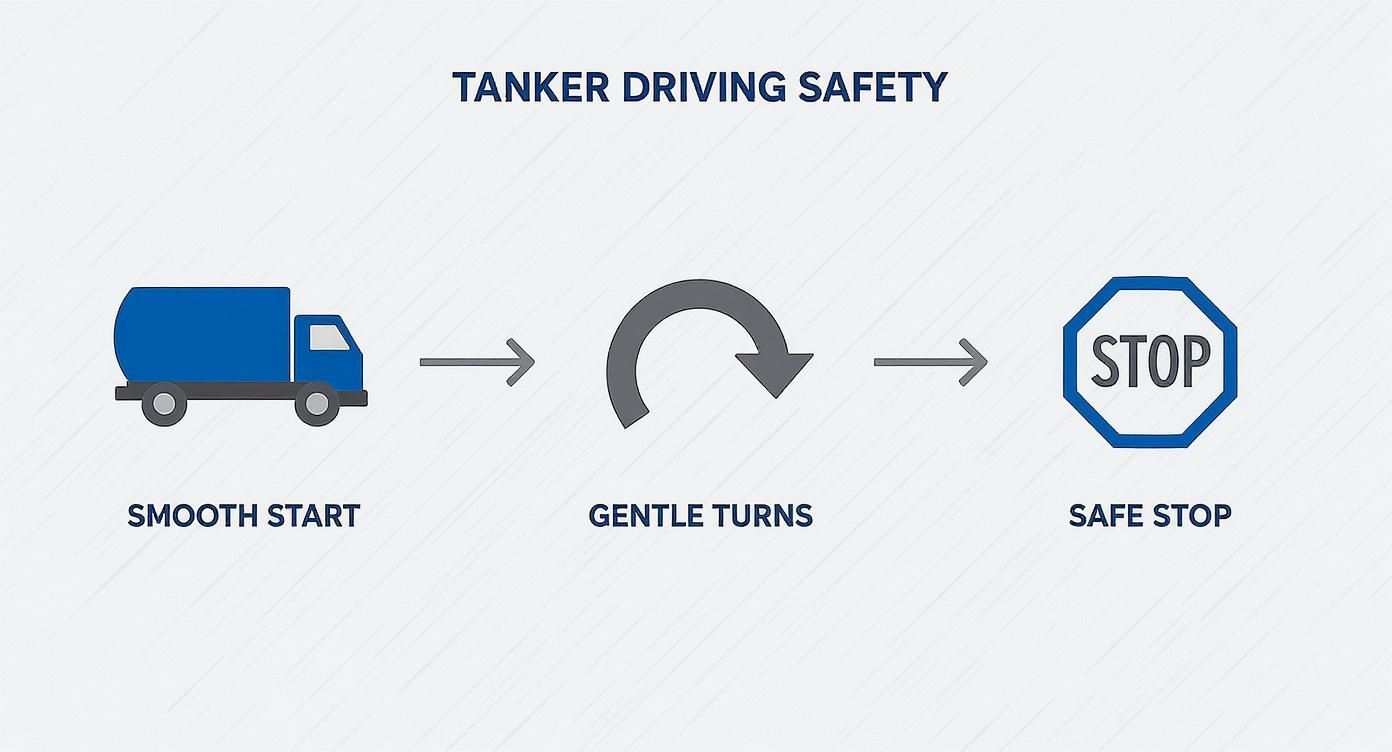
As you can see, a smooth start, gentle turns, and safe stops all depend on the vehicle being in top condition—something you confirm during your pre-trip.
Finally, if you're pulling a tanker with a vapor recovery system, give those hoses and connections a thorough check. Make sure everything is secure and undamaged. This system is a critical safety and environmental feature, and you're responsible for it. Mastering these specialized checks is what separates the pros from the rookies and will get you ready for both the test and the realities of the job.
A Smarter Way to Study and Practice
Look, just reading the CDL manual from cover to cover is probably the worst way to get ready for the tanker endorsement test. I've seen too many drivers try it. A passive approach like that just doesn't work when you're dealing with complex physics like liquid dynamics.
To really get this stuff to stick, you have to get your hands dirty with the material.
Instead of just highlighting passages, start quizzing yourself. This method is called active recall, and it forces your brain to pull the information out from memory. Trust me, it locks in the knowledge far better than just reading the same page five times. It’s about building strong mental pathways, so the answers are there when you need them on test day.
Building Your Study Toolkit
Think of your state's official CDL manual as your foundation, not the whole house. It’s essential, but you need to supplement it with high-quality online resources that offer realistic practice questions. This one-two punch ensures you cover all the required theory and get a real feel for how the exam questions are worded.
A solid study kit should always include:
- The Official State CDL Manual: This is your primary source for all the rules and core concepts. No getting around it.
- Reputable Online Practice Tests: These are perfect for simulating the test environment and finding out where you’re still a little shaky.
- Flashcards (Digital or Physical): Great for drilling key terms like "outage," "baffles," and "bulkheads" until they become second nature.
When you're looking for practice tests, make sure they give you detailed explanations for the answers. It’s not enough to know what the right answer is—you need to understand why. That deeper comprehension is what will help you navigate those tricky scenario questions they love to throw at you.
Getting Real with Practice Questions and Scenarios
Let's talk about what you'll actually see on the test. They're not going to ask you to just spit back definitions. They’ll put you in a situation and ask you to apply what you know. Here are a couple of examples that are a lot like the real thing.
Example Question 1:
You are driving a tanker with baffles and must come to a quick stop. What should you expect?
A) The truck will stop smoothly with no liquid movement.
B) The liquid will surge forward and then backward.
C) The baffles will completely prevent any liquid surge.
D) The liquid will surge only to the sides of the tank.
Explanation: The correct answer here is B. Baffles are designed to slow down the slosh of liquid, but they absolutely do not stop it. You'll still feel a powerful surge forward and back, which is something you have to be ready for.
A critical part of your preparation is understanding the 'why' behind the rules. Don't just memorize that you need more stopping distance; internalize the fact that a 6,000-gallon liquid surge can dramatically increase braking distance and impact steering control, turning a routine stop into a high-risk maneuver.
The statistics don't lie. A liquid surge can lead to up to a 50% increase in your braking distance and seriously mess with your steering. Knowing that fact is one thing; understanding how it feels and what to do about it is what makes you a safe tanker driver.
Example Question 2:
When loading a tanker, why is it important to allow for "outage"?
A) To make the truck lighter and more fuel-efficient.
B) To leave room for the liquid to expand with temperature changes.
C) To prevent the liquid from freezing in cold weather.
D) To make the tank easier to clean after unloading.
Explanation: The answer is B. "Outage" is just the term for the empty space you leave at the top. Liquids expand when they get hot, and if there's no room for that expansion, the pressure could build up and even rupture the tank. It’s a simple concept, but it’s incredibly important.
While you're mastering tanker-specific knowledge, don't forget the fundamentals. A solid grasp of how your air brakes work under a heavy, shifting load is non-negotiable. You can brush up and test your knowledge with our guide to the air brakes test. Building your expertise layer by layer is the only way to do it right.
Navigating Test Day and Your Next Steps
You’ve spent weeks drilling liquid surge dynamics and memorizing inspection protocols. Now, the final hurdle is the test itself. Knowing exactly what to expect when you walk into the testing center can make all the difference, calming your nerves and letting you focus on what you know.
Your prep work isn't just about the study guide; it's also about getting your logistics ironed out. A simple slip-up, like forgetting a key document, can mean you're turned away at the door before you even get a chance to sit down.
What to Bring to the Testing Center
Walking in prepared is half the battle. Before you even think about leaving the house, run through a final checklist to make sure your check-in goes off without a hitch.
Here's what you absolutely must have in hand:
- Your Valid CDL or Commercial Learner's Permit (CLP): This is the main event. It’s your ID and proof of eligibility all in one.
- Proof of Identity and Residency: Don't get caught off guard. States often need more than just your license, so bring a passport, birth certificate, or a recent utility bill. Always check your state’s specific list of accepted documents beforehand.
- Payment for Fees: Be ready to cover any testing or endorsement fees. Find out ahead of time what your local DMV accepts—some are cash-only, while others take cards.
My best last-minute advice is simple: read every single question twice. The test questions are often worded to catch you off guard. Taking an extra moment to fully understand what is being asked can be the difference between a pass and a fail.
After You Pass the Test
You did it. Passing the tanker endorsement test is a fantastic achievement, and once that initial wave of relief washes over you, it's time to make it official.
Typically, you'll head over to the DMV counter, show them your passing score report, and pay a fee to get that valuable 'N' endorsement added to your CDL. The cost and how long it takes can vary by state, but it’s usually a pretty quick process. That one little letter on your license opens up a whole new world of high-demand, specialized driving jobs.
This is also a great moment to think about what's next. If you earned your CDL in an automatic, getting your E restriction lifted is a smart move. An E restriction removal course will qualify you to operate manual transmission trucks, which really broadens your job prospects.
If You Don't Pass on the First Try
Failing a test stings, there's no doubt about it. But it's far from the end of the road. Plenty of fantastic tanker drivers I know didn't ace it on their first attempt. The trick is to see it not as a failure, but as a roadmap for what to study next.
Your score report is your best friend here. It breaks down exactly which areas you need to work on. Instead of just rereading the entire manual, you can now laser-focus on the specific topics that gave you trouble, whether it was outage calculations, rollover prevention, or emergency response.
Most states require a short waiting period before you can retest—anywhere from a day to a week. Use that time productively. Hit the practice questions, really drill down on your weak spots, and walk back into that testing center with the confidence to nail it.
Got Questions About the Tanker Endorsement?
If you're gearing up for your tanker test, you've probably got a few questions bouncing around. It's totally normal. Let's run through some of the most common ones I hear from drivers so you can walk into the test with confidence.
How Long Is My Tanker Endorsement Good For?
This is a frequent point of confusion, but the answer is simple. Your tanker endorsement's expiration date is tied directly to your Commercial Driver's License. It doesn't have a life of its own.
As long as your CDL is valid, so is your N endorsement. When it's time to renew your license, the endorsement just renews right along with it. That said, it never hurts to double-check with your state's DMV, as local rules can sometimes have their own quirks.
Do I Have to Get a HAZMAT Endorsement Too?
This is a big one. The short answer is no, not necessarily. The tanker endorsement (N) and the Hazardous Materials endorsement (H) are two completely different credentials. You often see them combined into the "X" endorsement, but they don't have to be.
You can absolutely get a standalone N endorsement. In fact, plenty of drivers do.
- N Endorsement Only: This is all you need for hauling non-hazardous bulk liquids. Think milk, water, juice, or other food-grade products.
- X Endorsement (N + H): This combination is mandatory if you plan on hauling anything hazardous, like gasoline, industrial chemicals, or certain liquid fertilizers.
The right choice really boils down to what kind of freight you want to haul. Going for the X endorsement opens up more job opportunities, but it's definitely not a requirement just to get behind the wheel of a tanker.
What’s the Difference Between Baffles and Bulkheads?
You absolutely have to know this for the test, and it's a concept that trips a lot of people up. Both are inside the tank to control liquid surge, but they work in completely different ways and dramatically change how the truck handles.
Here’s a simple way to remember it: baffles are like speed bumps for liquid, while bulkheads are roadblocks. One slows the surge, the other stops it cold in separate compartments.
Let's break it down:
Baffles are walls inside the tank with holes in them. They don't stop the liquid from moving, but they disrupt the flow and weaken the force of the surge. The liquid can still slosh from front to back, but the baffles make it much less violent.
Bulkheads, on the other hand, are solid walls. They chop the tanker up into several smaller, fully sealed compartments. Because they're solid, they completely prevent any front-to-back surge within each section. This makes the load far more stable. Expect to see a few questions on your test that hinge on you knowing this difference.
Ready to stop studying and start driving? At Patriot CDL, we provide the hands-on training and expert guidance you need to ace your exams and launch a successful trucking career. Visit us to get started.