So, you're thinking about a career on the open road and want to know what you can actually make. Let's get right to it. The straightforward answer is that most new truck drivers can expect to pull in between $50,000 and $65,000 in their first year.
Think of that number as your starting line. It's a solid financial foundation, especially for a career that doesn't require a four-year college degree.
Your First-Year Trucking Salary at a Glance
To give you a quick snapshot, here’s a breakdown of what to expect when you're just starting out as a professional truck driver.
| Metric | Typical Range / Detail |
|---|---|
| Annual Starting Salary | $50,000 – $65,000 |
| Key Influencing Factors | Company type, location, endorsements, pay structure |
| Common Pay Structures | Per-mile (CPM), hourly, or percentage of the load |
| Additional Earnings | Sign-on bonuses, safety bonuses, detention pay, layover pay |
This table provides a high-level view, but the numbers can shift based on several factors we'll dig into.
What Goes Into That Starting Paycheck?
Your initial salary is more than just a simple annual figure; it's a package. Understanding the different parts of your compensation is crucial when you're comparing job offers.
It all starts with how you get paid. Companies structure their pay in a few common ways, and each has its pros and cons.
- Pay Structure: You might get paid per mile (CPM), by the hour, or as a percentage of what the load is worth. Each method changes how you approach your work and your weekly earnings.
- Bonuses: This is where the numbers can really jump. Many carriers offer hefty sign-on bonuses to get you in the door, plus extra cash for maintaining a good safety record or hitting performance goals.
- Additional Pay: The clock doesn't always stop when the wheels do. You can often earn extra for things like detention time (waiting to be loaded or unloaded), layovers, and making multiple stops on a single run.
Your starting salary is a direct reflection of current industry demand. With driver shortages and a booming logistics sector, companies are more willing than ever to offer competitive packages to attract and retain new talent.
In 2025, that $50,000 to $65,000 starting range has become the new normal. It’s a significant jump from what new drivers were making just a decade ago, and it's all thanks to the non-stop demand for qualified CDL holders.
This trend makes truck driving one of the best-paying careers you can get into with a relatively short training period. If you're ready to get on the road, you can learn more about our comprehensive CDL training program.
The Key Factors That Influence Your First Paycheck
Your starting salary as a truck driver isn't a fixed number. Think of it less like a set price and more like a final dish where several key ingredients—the truck you drive, the routes you run, and how you're paid—all come together to create your take-home pay. Getting a handle on these factors is the best way to size up job offers and see your true earning potential right from the start.

When you look at the big picture, the numbers tell a fascinating story. A deep dive into 500,000 truck driver salaries shows a massive annual range from $44,963 to $201,435, with the average landing around $95,169. As a new driver, you can expect to start closer to the beginning of that range, typically between $40,000 and $50,000. That huge gap shows just how much room for growth there is in this career, all depending on your experience, the kind of truck you drive, and the job you take.
Route Type and Your Paycheck
One of the biggest pieces of the salary puzzle is the type of route you’ll be driving. Each one offers a completely different lifestyle and, you guessed it, a different pay structure.
- Local Driving: These are the jobs that get you home every night. You’re running routes in your area, and the pay is usually hourly. It’s consistent, predictable, and great for those who want a set schedule.
- Regional Driving: This keeps you within a certain part of the country—think the Midwest or the Southeast. You’ll be on the road for a few days at a time but typically home on the weekends. Pay here is often a mix of hourly and per-mile compensation.
- Over-the-Road (OTR): OTR is the long-haul life. You’re crossing state lines, crisscrossing the country, and out on the road for weeks at a time. It's a big commitment, which is why it commands higher pay, usually calculated by cents-per-mile. The more miles you log, the more you earn.
Freight Specialization and Your Earnings
What you're hauling is just as important as where you're hauling it. Most new drivers start out pulling a standard dry van trailer, but branching out into specialized freight is where the real money is. Why? Because it often involves more skill, a bit more risk, or special endorsements on your CDL—and companies pay a premium for drivers who can handle it.
The more specialized the cargo, the more valuable the driver. Earning endorsements for things like hazardous materials or tankers is a direct investment in your future income.
For instance, hauling hazardous materials (Hazmat) or operating a tanker truck filled with liquids isn't something just anyone can do; it requires extra training and certifications. Because of that, drivers with those skills are always in demand and earn more. The same goes for flatbed drivers who have to secure oversized or tricky loads. It's a more complex, physical job, and the pay reflects that.
The road to these higher-paying jobs begins with the right training. It all starts with understanding the Entry-Level Driver Training (ELDT) requirements. You can learn more about this crucial first step in our guide on ELDT and what it means for new drivers.
How Your Location Shapes Your Earning Potential
When you're figuring out what you'll make as a new truck driver, your home base matters more than you might think. It's a lot like real estate—a house in a major city costs more than one in a small town. For truckers, the same logic applies. Your paycheck can look very different from one state to the next.
This isn't just random chance. It all comes down to basic supply and demand. Busy economic hubs simply need more drivers, and they're willing to pay a premium to keep their freight moving.
Think about regions with massive shipping ports, sprawling manufacturing plants, or booming oil and gas fields. These are freight magnets, constantly pushing goods across the country. That high volume of freight creates a strong, steady demand for qualified drivers, which naturally pushes starting salaries higher. A driver based near a major port will almost always find more lucrative opportunities than someone in a state with less economic action.
High-Demand Regions Mean Higher Pay
The link between a state's economic pulse and what a driver earns is crystal clear. States that are major industrial players or serve as critical logistical crossroads consistently offer better pay. Why? Because the sheer amount of freight flowing through these areas creates a competitive job market where companies have to offer more to attract and keep good drivers.
According to the Bureau of Labor Statistics, the national median wage for truck drivers was around $57,440 as of May 2024. But some states blow that number out of the water.
Here’s a quick look at some of the top-paying states for truck drivers and what fuels their economies.
Top Paying States for Truck Drivers
| State | Average Annual Salary | Key Economic Drivers |
|---|---|---|
| Washington | $68,400 | Major seaports, aerospace manufacturing, agriculture |
| New York | $67,500 | Financial hub, major port, significant manufacturing |
| North Dakota | $66,000 | Oil and gas industry (Bakken formation), agriculture |
As a new driver, you'll likely start on the lower end of the scale, probably somewhere in the $43,000 to $50,000 range. However, as you can see, choosing the right home base can give that starting number a serious boost right from the get-go.
Simply put, where you park your truck at the end of the day directly influences the size of your paycheck. Choosing a home base in a high-freight state can give your career a significant financial head start.
This infographic breaks down how those starting salaries look across different U.S. regions, highlighting just how much geography impacts your bottom line.
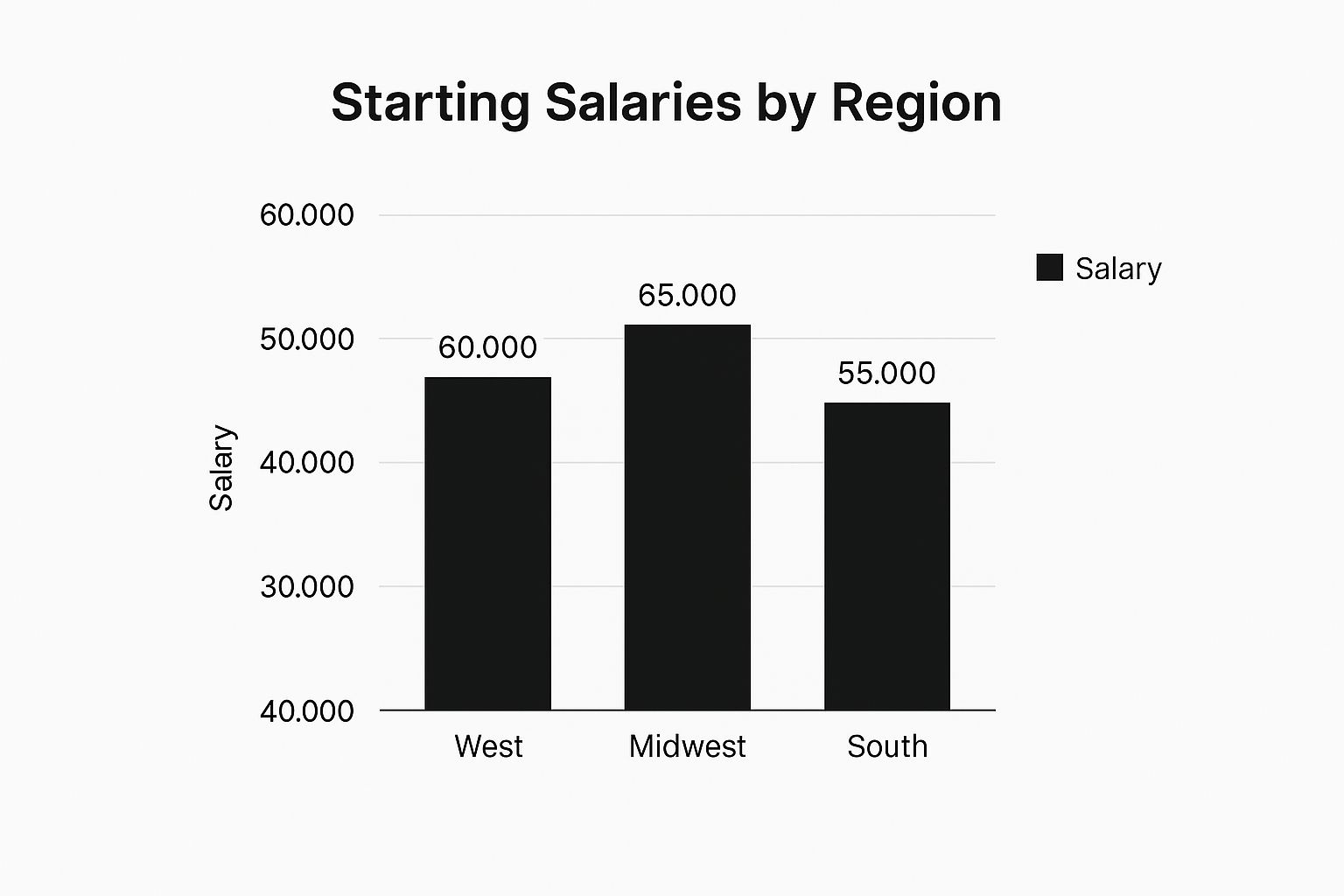
As the chart makes clear, drivers starting their careers out West often have a leg up on earning potential compared to those in other parts of the country.
Comparing High-Paying and Low-Paying States
The salary gap between states can be pretty dramatic. For instance, states with massive port operations like Washington or California offer higher wages because there's a constant flood of international goods that need to be hauled across the country. If you're curious about what it takes to get started in one of these top-paying states, you can learn more about driving careers in California and see what the opportunities look like.
On the flip side, states with less industrial muscle or lower freight volumes tend to have a lower cost of living, but they also offer lower starting salaries for drivers. It’s a trade-off you have to consider. A bigger paycheck in an expensive state might not go as far as a more modest one in a place where your dollar stretches further. It's a crucial calculation to make when deciding where to launch your trucking career.
Unpacking Your Total Compensation Package
The advertised starting salary for a truck driver is often just the tip of the iceberg. To get a real sense of what a job offer is worth, you have to look past the cents-per-mile rate or the big annual number and dig into the entire compensation package. Think of your base pay as the engine—it gets you moving. But it’s the bonuses, benefits, and special pay that act like a turbocharger, giving your earnings some serious power.

Many carriers will sweeten the deal with bonuses that can easily add thousands to your yearly income. A sign-on bonus is a classic way to get new drivers in the door, but the extra cash doesn't have to stop there. Good companies will also offer performance and safety bonuses, which are basically their way of rewarding you for being a professional—efficient on the road and, most importantly, keeping a clean driving record.
Beyond the Base Pay Rate
A savvy driver quickly learns to spot the hidden value in a pay package. These other pay structures are designed to protect your income when the wheels aren't turning, and they can make a huge difference in your take-home pay over the course of a year.
- Detention Pay: This is what you get paid for your time spent waiting—and waiting—at a shipper or receiver's dock. Without it, you’re just giving away your time for free.
- Layover Pay: If you find yourself stuck on the road for a full 24 hours waiting on your next dispatch, layover pay ensures you aren't left high and dry.
- Per Diem Allowances: This is a daily allowance for meals and other small expenses you have on the road. The best part? Per diem is usually non-taxable, which means more of that money stays right in your pocket.
The best job offers provide a safety net that protects your income. Look for companies that value your time by offering fair compensation for delays, layovers, and other events outside of your control.
Understanding these details is what separates a good choice from a bad one. A job with a slightly lower per-mile rate but great detention pay and solid benefits could easily be more profitable than a high-CPM offer that leaves you hanging every time there's a delay.
The Value of Strong Benefits
Finally, a truly great compensation package has benefits that look out for your health, your future, and your sanity. These aren’t just perks; they are a critical part of what you're actually earning.
- Health Insurance: You need solid medical, dental, and vision coverage. It's a non-negotiable part of any good benefits plan.
- Retirement Plans: A company that offers a 401(k) with a match is directly investing in your future. It's free money you don't want to leave on the table.
- Paid Time Off (PTO): Getting paid vacation and sick days is absolutely essential for avoiding burnout and taking a well-deserved break.
Some drivers can also open up more earning opportunities by removing certain restrictions from their CDL. For instance, if you have an automatic-only restriction, learning to drive a manual transmission can make you eligible for a wider range of jobs. If that sounds like something you'd be interested in, check out our E-Restriction Removal Course to see how it could expand your career path.
By looking at the complete picture—salary, bonuses, extra pay, and benefits—you can properly size up any job offer and pick the one that truly puts you on the road to success.
Strategies To Grow Your Income After Year One
Your first year on the road is all about getting your footing, but it’s just the beginning. The truck driver starting salary you make is a launchpad, not a permanent ceiling. Once you have that crucial first year of experience under your belt, a whole world of opportunity opens up to grow your income and build a career you can be proud of.
Think of that first year as your apprenticeship. You've proven you can handle the lifestyle, you can meet your deadlines, and you can operate safely. Now it's time to cash in on that hard-earned experience by adding new skills that make you a more valuable asset to any carrier.
Specialize With High-Value Endorsements
The fastest and most direct way to get a pay bump is by adding endorsements to your Commercial Driver's License. These certifications are proof that you have the specialized knowledge to handle trickier, higher-risk, or in-demand freight. Naturally, companies are willing to pay a premium for drivers with those qualifications.
Here are the endorsements that really move the needle on your paycheck:
- Hazmat (H): This one lets you haul hazardous materials, which can be anything from industrial chemicals to flammable liquids. Because of the extra risk and heavy regulations, Hazmat drivers consistently earn more. It’s just a fact of the industry.
- Tanker (N): Hauling thousands of gallons of liquid that sloshes around in a tank takes a special kind of skill. Getting your tanker endorsement opens up lucrative jobs in the chemical and food-grade transportation industries.
- Doubles/Triples (T): The ability to pull two or even three trailers at once is a massive efficiency boost for carriers, especially for LTL (less-than-truckload) outfits. Drivers with a T endorsement are always in demand and are often paid higher rates for their ability to move more freight in a single run.
Getting these endorsements means passing a few more knowledge tests—and for Hazmat, a federal background check. Each one you add unlocks a new tier of higher-paying jobs that are completely off-limits to drivers with a standard CDL. A solid understanding of your braking system is critical for nearly all of these, so it never hurts to practice with an air brakes test to keep your knowledge sharp.
Your CDL is a living document. The more endorsements you add, the more doors you open to specialized freight, which almost always translates to a bigger paycheck.
Become an Expert in Niche Freight
Beyond official endorsements, you can become the go-to person for specific types of freight that require more than just driving from A to B.
For instance, a great flatbed driver who really knows how to secure an oversized or weirdly shaped load is worth their weight in gold. The same goes for drivers who master refrigerated (reefer) loads, where keeping the temperature perfect is everything, or those who handle delicate, high-value electronics. This kind of expertise commands respect—and better pay.
Consider the Owner-Operator Path
After you’ve got a few years of solid experience, you might start thinking about becoming an owner-operator. This is a huge step—it means buying your own rig and essentially running your own small business.
It’s not for everyone, as it comes with a ton more responsibility and significant upfront costs. But the trade-off is massive earning potential, since you keep a much, much larger slice of the revenue from every load you haul.
No matter which path you take, the most important strategy of all is keeping your driving record clean. A spotless safety record makes you a low-risk, high-value professional. It’s what gets you in the door at the best companies, qualifies you for the top jobs, and puts you in a position to command the highest pay rates in the business.
Where Do You Go From Here?
Your first year on the road is just that—the beginning. While it's crucial to understand your starting salary, your long-term success really depends on the path you map out for yourself. Think of it like laying the foundation for a house. It's absolutely essential, but the real value comes from what you build on top of it.
A high-earning, fulfilling career in trucking doesn't just happen by chance. It’s a direct result of the choices you make, especially in those first few years.
Let's boil it down to the most important points. First, always dig deeper than the advertised annual salary. A job offer is a whole package—look at everything from detention pay to the quality of the health insurance to see what it’s really worth. Second, where you live and work matters. A lot. Your home base can dramatically affect your starting pay and the kinds of opportunities that come your way.
Your career is in your hands. A starting salary is just a launchpad. The moves you make in the beginning will set the stage for your earning potential for years to come.
And finally, never stop adding to your skillset. Getting valuable endorsements like Hazmat or Tanker is one of the best investments you can make in your career. These certifications open doors to specialized, better-paying jobs, giving you more stability and control over your financial future.
If you’re smart and proactive, you can take a decent starting salary and turn it into an incredible, lifelong career. The road ahead is wide open with chances to grow and earn. Now it's up to you to build it, one mile at a time.
Got Questions About Truck Driver Pay? We've Got Answers.
When you're starting out, figuring out truck driver pay can feel like learning a whole new language. You've seen the salary ranges and the things that can move your pay up or down, but there are always those nagging little questions that pop up.
Let's clear those up. Think of this as a quick chat with a seasoned pro who's seen it all and can give you the straight scoop on what to expect.
How Quickly Can I Expect My Salary to Go Up?
This is the big one, right? You want to know how long you'll be stuck at that "new driver" pay rate. The good news is, in trucking, your value jumps up fast. That first year is your proving ground.
Once you have a full year of safe, on-time driving under your belt, you're not a rookie anymore. You're an experienced professional, and that's when the better-paying opportunities really open up. It’s pretty common to see your income climb by $5,000 to $10,000 after that first year. Why? Because you can now get your foot in the door at top-tier companies offering better routes, higher cents-per-mile, and specialized gigs that demand a solid track record.
Does Getting Company-Paid CDL Training Hurt My Starting Pay?
Company-sponsored CDL training is a fantastic way to get into the driver's seat without emptying your savings account. But, as with most things in life, there's a trade-off involved.
When a company foots the bill for your training, they need to get that investment back. So, you'll almost always start at a slightly lower per-mile rate than a driver who paid for their own school. You'll also have to sign a contract, usually agreeing to drive for them for about a year.
It's a simple exchange: you get your CDL with no upfront cost, and in return, you commit to a company for a set period at a modest starting wage. It’s a great option if cash is tight, but it does mean your initial paychecks will be a bit smaller.
What’s the Pay Difference Between Driving Solo vs. as a Team?
Team driving is a whole different ballgame. You and a partner keep the truck rolling nearly around the clock, which means you can rack up an incredible number of miles. More miles equals more money for the truck, and that trickles down to you.
Even though your individual per-mile rate is less than a solo driver's, the sheer volume of miles you run usually means a much bigger weekly paycheck. New team drivers often out-earn new solo drivers right from the start. The catch? You have to be okay with sharing a very small space with another person for weeks on end. It’s a great way to earn, but it’s a lifestyle that definitely isn’t for everyone.
Ready to get behind the wheel and start your high-earning career? Patriot CDL provides the expert training you need to get your CDL and land a great-paying job fast. Learn more about our CDL programs.