When you’re thinking about a career change, the first question is almost always about the money. Let's get right to it: The average truck driver training cost for a solid Commercial Driver's License (CDL) program in the U.S. usually lands somewhere between $4,000 and $7,000. Think of this as your ticket to a stable, in-demand career out on the open road.
The Real Price of a Trucking Career
Choosing a new career path is a lot like picking a vehicle for a long road trip. You have to weigh the upfront cost against how quickly it’ll get you where you want to go. For many people, the choice boils down to a traditional four-year college degree versus a hands-on program like CDL training. Both can lead to success, but they operate on completely different timelines and budgets.
A four-year degree is a long-term commitment, often saddling you with significant debt long before you see your first professional paycheck. CDL training, on the other hand, is a fast track. It’s built to get you skilled, licensed, and behind the wheel in a matter of weeks, not years. This means you can start earning a great wage almost immediately after you finish, quickly turning that initial training cost into a smart investment.
To put it in perspective, let's compare the two paths side-by-side.
Truck Driver Training Cost At A Glance
| Metric | CDL Training Program | Four-Year College Degree |
|---|---|---|
| Average Cost | $4,000 – $7,000 | $100,000+ |
| Time to Completion | 4-7 Weeks | 4+ Years |
| Starting Salary Potential | $70,000 – $95,000 | Varies widely, often lower initially |
| Time to Start Earning | Immediately after graduation | Years after starting |
This quick comparison makes it obvious: CDL training offers a much faster and more affordable entry into a well-paying profession.
This infographic breaks down the numbers even further, showing just how different the financial journey is for each path.
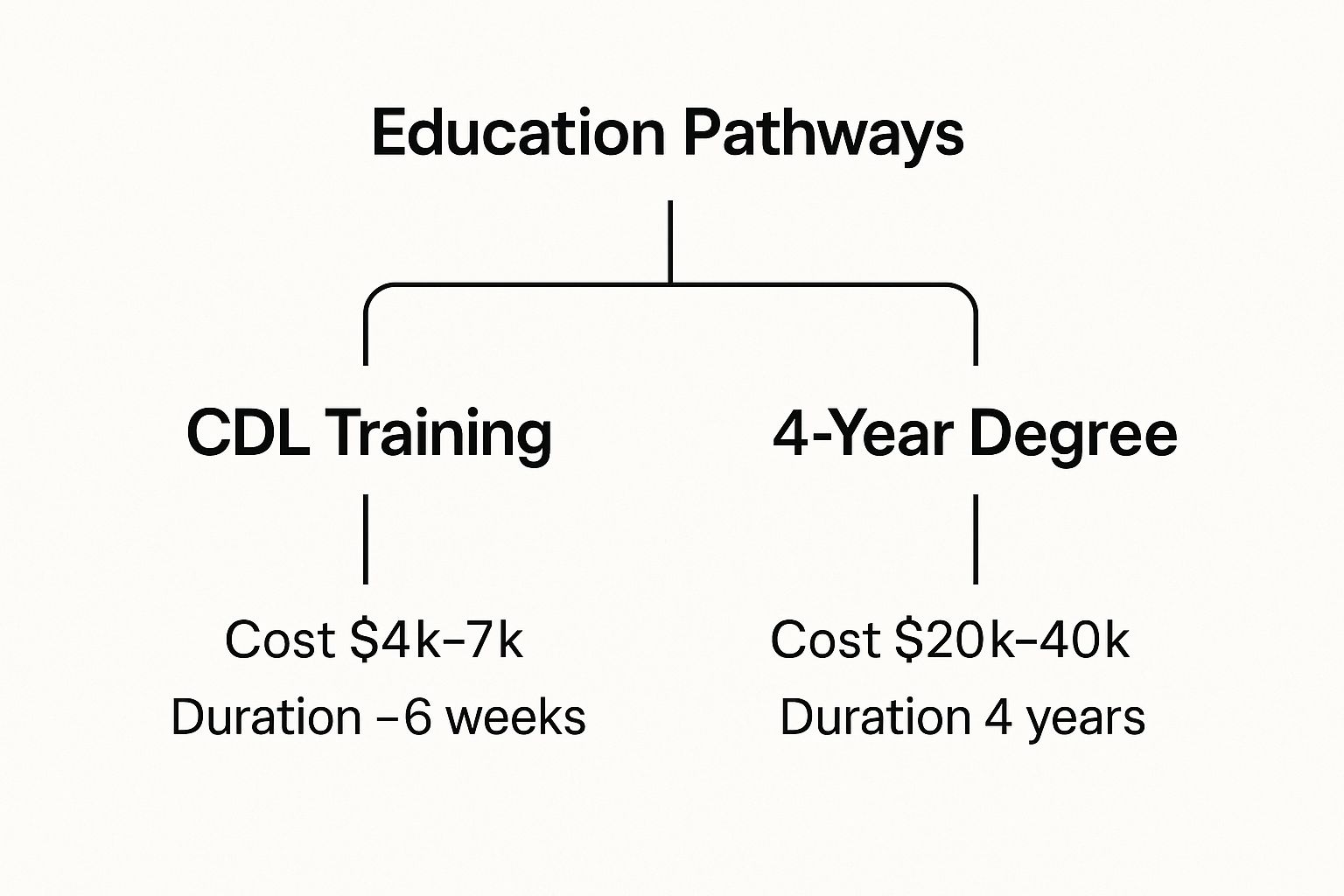
As you can see, the route to becoming a professional truck driver is significantly shorter and more direct.
Think of it this way: Investing in CDL training is like buying a direct flight to a high-demand job. A traditional degree can feel more like a scenic—but far more expensive—cross-country road trip with no guaranteed destination.
A Favorable Cost-To-Earnings Ratio
When you look at what you put in versus what you get out, the numbers really speak for themselves. The cost for most quality CDL programs ranges from $4,000 to $7,000. Right after training, it’s common for new drivers to start earning between $70,000 and $95,000 annually.
This makes trucking one of the few careers where your initial investment can be earned back so quickly. The cost-to-earnings ratio is incredibly strong, especially when you compare it to the years and tens of thousands of dollars required for many other professions.
What Your CDL Training Costs Actually Cover
When you first see the price for a CDL program, it’s easy to focus on that single number. But the reality is, the total truck driver training cost is a lot more than just tuition. It’s a complete package of services, fees, and requirements that all come together to get you licensed and ready for the road.
Think of it this way: buying a car isn't just about the sticker price. You also have to factor in taxes, registration, and insurance to understand the true cost of ownership. CDL training works the same way.
The biggest chunk, of course, is the tuition. This is what pays for your classroom instruction and, most critically, the time you spend behind the wheel with an experienced instructor. It covers their expertise, the fuel and maintenance for the training trucks, and access to the practice yard. But your budget can't stop there.
Beyond the Classroom Costs
To get your CDL, you have to clear several hurdles that come with their own price tags. These aren't optional upgrades; they're mandatory steps on your journey. Some schools bundle these into an all-inclusive price, but more often than not, you'll pay for them separately as you go.
Here are the most common out-of-pocket expenses you need to plan for:
- DOT Physical Exam: Before you can even get your learner’s permit, you have to pass a Department of Transportation physical. This exam confirms you're medically fit for the demands of the job and usually costs between $50 and $150.
- Drug Screening: A drug test is another federal requirement you must pass to get your permit. This is a non-negotiable step that typically runs from $50 to $75.
- State Licensing and Permit Fees: Every state charges its own fees for issuing a Commercial Learner’s Permit (CLP) and the final CDL. These costs vary quite a bit by location but generally fall in the $100 to $250 range.
Think of these as the gatekeepers. You have to pass the medical exam and drug screen to even begin the official licensing process.
To give you a clearer picture, let's break down all the potential costs you might encounter. This checklist separates the main tuition from all the other necessary expenses.
CDL Training Cost Component Checklist
| Expense Category | Typical Cost Range | Description & Notes |
|---|---|---|
| School Tuition | $3,000 – $10,000+ | This is the core cost covering instructors, vehicle use, and classroom/yard time. It varies widely based on school type and program length. |
| DOT Physical Exam | $50 – $150 | A mandatory medical examination by a certified examiner to ensure you meet federal health standards for commercial driving. |
| Drug Screening | $50 – $75 | A required pre-permit drug test. Many employers will also require this before hiring. |
| Commercial Learner's Permit (CLP) Fee | $50 – $150 | The fee charged by your state's DMV to take the written tests and issue your permit, allowing you to practice driving. |
| CDL Issuance Fee | $75 – $200 | The state fee for taking the final skills test and having the physical CDL card printed after you pass. |
| Endorsement Fees | $10 – $50 per endorsement | Additional state fees for adding special endorsements to your license, such as Hazmat, Tanker, or Doubles/Triples. |
| Study Materials & Supplies | $50 – $150 | This can include textbooks, a motor carrier atlas, logbooks, and other required classroom supplies. Some schools include this in tuition. |
| Fingerprinting & Background Check | $80 – $120 | Required for certain endorsements, most notably the Hazardous Materials (Hazmat) endorsement. |
This table should help you build a more realistic budget by showing you where every dollar goes. Always ask a school for a detailed cost breakdown so you know exactly what’s included and what isn’t.
Additional Training and Supply Expenses
On top of the official fees, you should also set aside a little extra for the tools you'll need to succeed. Many programs expect you to show up with your own gear, like a trucker's atlas, logbooks, or proper work boots. These might seem like small purchases, but they can add up quickly if you're not prepared for them.
A critical piece of your preparation is mastering the written exams. Successfully passing these tests is a non-negotiable part of the process, and understanding the material is key to your confidence and success.
For example, the written portion of the CDL exam is extensive. To pass, you'll need solid study materials and maybe even some practice tests. You can get a head start by reviewing our guide on what to expect from the CDL general knowledge test, which breaks down the key areas you'll need to master before heading to the DMV.
By factoring in these smaller but essential costs, you’ll have a much more accurate picture of your total investment and avoid any financial surprises along the way.
Why Do CDL Training Costs Vary So Much?
When you first start looking into the cost of truck driver training, you'll see prices all over the map. One school might quote you $3,500, while another down the road is asking for $7,500. This isn't just random pricing; a few key things really drive what you’ll end up paying for your CDL.
First off, the type of license you're going for is a huge factor. A Class A CDL, the one you need for driving big rigs, is almost always more expensive than a Class B CDL for things like dump trucks or buses. Class A training is just more involved—it covers more complex skills, tougher maneuvers, and uses bigger, more expensive equipment.
On top of that, any extra endorsements you want will add to the bill. If you're planning to haul hazardous materials (HazMat) or drive a tanker, you'll need specialized training and testing. Each endorsement adds a new layer of skill and responsibility, and schools charge for that extra instruction.
Quality of Training and Equipment
A school's reputation and the kind of gear they have are major price drivers. A top-notch school with a fleet of modern trucks and a small class size is naturally going to cost more than a bare-bones setup. What you're paying for is better instructor access and hands-on experience with equipment that’s actually used in the industry today.
You’ve heard it before: "you get what you pay for." A higher price tag often translates to better job placement services, newer trucks that are easier to learn on, and instructors who have spent decades behind the wheel.
Many of the best schools are also investing in serious training technology. It's not just about classroom time and driving on the road anymore. High-tech driving simulators are becoming a game-changer, letting you practice dangerous situations—like hitting a patch of black ice or dealing with a sudden tire blowout—in a completely safe environment.
This kind of tech doesn't come cheap. A single truck driving simulator can cost anywhere from $125,000 to $290,000. That massive investment for the school, plus the upkeep, gets passed on in the tuition. The payoff for you is that you walk away a much safer and more confident driver.
Program Structure and Location
Finally, how a program is set up and where it's located will affect the price. A fast-paced, four-week course might cost something different than a part-time program designed for people who need to keep their day jobs. Even the school's physical location matters, since things like fuel, insurance, and rent vary from one region to another.
Getting a handle on these factors helps you see beyond the sticker price and understand the real value a school is offering. To get a better idea of what you’ll be tested on, you can learn more about the specific CDL requirements you'll need to meet. This will help you find a program that truly fits your career goals.
How to Finance Your CDL and Reduce Costs
The initial truck driver training cost can look like a major roadblock, but it doesn't have to stop you from launching a new career. Think of it like mapping out a long haul—there are always multiple routes to your destination. Plenty of options exist to bring down, or even completely cover, your out-of-pocket expenses.
You just need to know where to look. From federal grants to company sponsorships, a whole host of financial tools are out there to help aspiring drivers get the training they need without breaking the bank. A little research can turn what seems like a barrier into a manageable first step.
Exploring Grants and Financial Aid
One of the smartest ways to lower your costs is to find programs that don't ask for the money back. Several government-backed initiatives are specifically designed to help people get into high-demand fields like trucking.
- Workforce Innovation and Opportunity Act (WIOA): This is a federal grant program built to help job seekers get the training they need for good jobs. If you qualify based on your income or employment history, WIOA could cover a huge chunk of your CDL tuition.
- Veterans' Benefits: If you've served in the military, programs like the GI Bill® are there for you. This is an earned benefit that can be used to pay for vocational training, including CDL school, making your move into a civilian trucking career much smoother.
- State and Local Grants: Don't forget to look in your own backyard. Many states have their own grants for workforce development. A good first step is to check with your local unemployment office or job center to see what’s available.
These options do involve some paperwork and eligibility checks, but the payoff is massive. They can turn an expensive investment into a very affordable career change.
Considering School and Company Options
Beyond government aid, many CDL schools and trucking companies have their own financial solutions. These are often more direct and can be set up right when you enroll or sign on with a carrier.
Many schools offer straightforward payment plans. This lets you spread the tuition cost over several months, which makes the upfront financial hit much less intense. It’s a simple way to budget for your training while you're still in the classroom.
The most widely advertised option is company-sponsored training. While often marketed as "free," this route almost always involves a contractual commitment to drive for that company for a set period, typically one to two years.
This kind of arrangement can be a fantastic deal if you already like the company, as it wipes out the initial cost. The catch? If you decide to leave before your contract is up, you'll likely be on the hook for the full tuition. It's absolutely critical to read the fine print and understand exactly what you're committing to.
If you're ready to look into your options and get rolling, you can sign up for more information on CDL programs and find the path that works best for you.
Is a More Expensive Trucking School Worth It?
When you're staring at different price tags, it’s natural to wonder if a higher truck driver training cost really pays off in the long run. It’s tempting to just go with the cheapest school that gets you the license, but a more expensive program often means a much deeper investment in your future career. The real question is, what are you actually paying for with that higher price?
Think of it this way. You could buy a cheap, basic toolset that will probably handle a few small jobs. Or, you could invest in a professional-grade set that's built to last, performs flawlessly under pressure, and makes you a more capable worker. The best trucking schools operate on that same principle. They're not just handing you a license; they're equipping you with superior skills and industry connections that will benefit you for years to come.
Back in 2022, the Federal Motor Carrier Safety Administration (FMCSA) rolled out the Entry-Level Driver Training (ELDT) mandate. This created a new federal baseline for training, making sure every new driver gets a minimum amount of classroom and behind-the-wheel instruction. Every legitimate school has to meet these standards, but the top-tier schools see them as just the starting point.
Beyond the Minimum Standards
The ELDT requirements are the floor, not the ceiling. A school with a higher tuition is usually investing in a far more comprehensive program designed to produce safer, more competent drivers—the kind that the best trucking companies are eager to hire.
So, what does this "better" training actually involve?
- More Behind-the-Wheel Time: Instead of just scraping by with the minimum hours to pass the test, elite schools put you on the road for extensive practice. This includes navigating dense city traffic, handling rough weather, and mastering steep mountain passes.
- Modern Equipment: You'll be training on the same kind of late-model, well-maintained trucks that top carriers operate. This makes the jump from student to professional driver feel much more natural.
- Low Student-to-Instructor Ratio: Smaller class sizes mean you get more direct, one-on-one time with your instructor. This personalized coaching helps you nail difficult maneuvers, like alley docking, much faster.
A higher initial cost often reflects a school's commitment to quality over quantity. They aren't just pushing students through to get a license; they're building the foundation for a safe, successful, and long-lasting career.
The Return on Investment
The true value of a premium school really shines through after you graduate. These programs typically have strong, established relationships with the best-paying trucking companies in the business. Carriers know that graduates from these schools are well-trained and lower-risk, which often leads to better job offers, higher starting salaries, and more attractive routes right from day one.
This direct line to quality employers is a massive return on your initial investment. On top of that, the advanced defensive driving and maneuvering skills you learn can mean fewer accidents and violations down the road. A clean driving record is absolutely critical for advancing your career.
Ultimately, investing a little more upfront can seriously accelerate your earning potential and open doors that budget programs simply can't. You can learn more about the specifics by exploring our in-depth CDL training program and seeing how it prepares you for success.
Your Next Steps to Becoming a Truck Driver
Alright, you've got a handle on what goes into the truck driver training cost. Now it's time to put that knowledge to work and move from just thinking about it to actually doing it. This is your game plan for turning that career goal into a reality.
The trick is to be strategic. Don't just pick the first school you see.
Think of it like you're buying a car—you wouldn't just look at the price tag. You'd check under the hood, take it for a test drive, and ask about its history. You need to do the same thing with a CDL school to make sure you're getting real value for your hard-earned money.
Assembling Your School Checklist
Before you start making calls, get your questions in order. Having a checklist ready means you can compare every school apples-to-apples, making your decision a whole lot easier. You're trying to figure out if they're genuinely good at what they do.
Here are the must-ask questions for any school you're considering:
- Job Placement Rate: What's your track record? How many of your grads get a job within 30 days? And who hires them?
- Training Fleet: Tell me about your trucks. How old are they? Are they manuals or automatics?
- Student-to-Instructor Ratio: How much actual one-on-one time will I get with a teacher, both behind the wheel and practicing maneuvers in the yard?
- Total Training Hours: Let's get specific—how many hours of real, on-the-road driving time does the tuition cover?
Getting straight answers to these questions is how you spot a quality training program versus a "license mill" just churning out drivers. A school that's confident in its program will have these stats on hand and be happy to share them.
For example, if you know you want to drive a manual rig, but the school only has automatics, you could end up with a license restriction. It’s a common situation, and you can learn more about what to do by checking out our E restriction removal course. Doing this homework upfront ensures you're ready for whatever the road throws at you.
Frequently Asked Questions
Thinking about the financial side of CDL training naturally brings up a lot of questions. Let's tackle some of the most common ones that come up for aspiring drivers, so you can get a clearer picture of the investment.
How Quickly Can I Pay Off CDL School Debt?
This is one of the best parts about getting into trucking—you can start earning a solid income almost immediately. With many new drivers making between $70,000 and $95,000 in their first year, paying back a $4,000 to $7,000 training loan can happen surprisingly fast.
Think about it this way: even with a monthly loan payment, a first-year driver's salary leaves plenty of room to cover it. Many drivers find they can completely wipe out their training debt in just a few months, not years. This quick turnaround is what makes the truck driver training cost such a smart investment compared to a four-year degree.
The ability to erase your training debt in under a year, while already earning a substantial income, is almost unmatched in other industries. It sets you up for financial stability right from the start of your new career.
Is "Free" Company-Sponsored CDL Training a Good Deal?
On the surface, company-sponsored training seems like a no-brainer. No upfront cost and a job waiting for you? It's a fantastic option for many, but you have to read the fine print. That "free" training is almost always tied to an employment contract.
Typically, this means committing to drive for that company for one to two years. If you leave before the contract is up—for any reason—you'll likely be on the hook for the full cost of the training. It's a solid path if you're confident in the company, but it does limit your freedom to shop around for other jobs early on.
Can I Get a CDL Without Going to School?
Technically, no. While you don't have to attend a massive school, the old days of just reading the manual and taking the test are gone. Since 2022, the FMCSA's Entry-Level Driver Training (ELDT) rule has been in effect.
This federal mandate requires all new drivers to get training from a provider listed on the official Training Provider Registry. You have to complete both theory (classroom) and behind-the-wheel instruction from an approved source. This makes some kind of formal training an absolute must-have to get your initial CDL.
Ready to invest in a career with a fast and powerful return? At Patriot CDL, we provide the expert training you need to get on the road and start earning. Explore our programs today.