

The truck driving hours of service rules aren't just red tape; they're a set of federal regulations from the Federal Motor Carrier Safety Administration (FMCSA) built to combat driver fatigue. Think of them as a mandatory safety clock for every professional driver, making sure there's enough time for rest to keep everyone safe on the road.
These rules spell out the maximum time a driver can legally operate a commercial motor vehicle before taking a required break.
The Foundation of Road Safety
At its heart, the entire HOS framework is built on one simple, non-negotiable principle: safety. When a driver is exhausted, they're a danger to themselves and everyone else on the highway. Driver fatigue is a huge risk in the trucking industry, and it’s a direct cause of thousands of preventable accidents every year.
That’s why the FMCSA created these regulations. They establish a clear, enforceable standard that limits driving time and mandates rest, tackling the problem of tired drivers head-on.
Why These Rules Matter
Following these rules is about so much more than just avoiding fines. For a driver, it's a fundamental professional responsibility—a commitment to being alert and ready for whatever the road throws at them. For a fleet manager, enforcing these rules is crucial for running a safe operation and protecting the company's reputation.
Ultimately, HOS regulations create a safer environment for every single person on the road. By setting firm, predictable limits, the rules help prevent the devastating consequences of crashes caused by fatigue. It's a proactive safety measure, not a punitive one.
For companies looking to train their teams on these vital rules, modern tools can make a huge difference. You can learn more about effective training methods by checking out resources on creating interactive videos for corporate training.
Quick Overview of Key HOS Driving Limits
While the complete HOS rulebook has its complexities, the system is built around a few core time limits. The following table breaks down the most important ones that every driver must know.
| Rule Type | Time Limit | Brief Description |
|---|---|---|
| 11-Hour Driving Limit | 11 hours | Maximum time a driver can spend driving after 10 consecutive hours off-duty. |
| 14-Hour Driving Window | 14 hours | A driver cannot drive beyond the 14th consecutive hour after coming on duty. |
| 30-Minute Break | 30 minutes | Mandatory after 8 cumulative hours of driving without a 30-minute interruption. |
| 60/70-Hour Limit | 60 or 70 hours | The total on-duty hours a driver can accumulate over 7 or 8 consecutive days. |
These rules all work together to structure a driver's workday and workweek, ensuring rest is always part of the equation.
For instance, the 11-hour driving limit means a driver can be behind the wheel for a maximum of 11 hours after they’ve had a full 10 consecutive hours off duty. This rule is paired with the 14-hour on-duty limit (often called the "14-hour clock"), which gives them a 14-hour window to get that driving done. Once that 14-hour window closes, they're done driving for the day. Mastering these regulations is a non-negotiable part of the CDL requirements for any professional.
The ultimate goal of HOS regulations is straightforward: to ensure that a commercial motor vehicle driver is rested, alert, and focused while on the road. Every rule is a building block toward achieving that objective.
Navigating Daily Driving and On-Duty Limits
To really get a handle on the hours-of-service rules, you need to wrap your head around two core daily limits: the 14-hour driving window and the 11-hour driving limit. It helps to think of the 14-hour rule as a non-stop countdown clock for your workday. The second you go on-duty, that clock starts ticking and doesn't stop for anything—not for lunch, not for a nap, nothing.
Within that bigger 14-hour window, you have a separate, smaller limit for your actual time behind the wheel. The 11-hour driving limit means that of those 14 available hours, a maximum of 11 can be spent with the truck in motion. These two rules are a team; one sets a hard "pencils down" for your day, and the other caps how long you can physically drive.
The 14-Hour On-Duty Window Explained
Picture your shift as a 14-hour container. The moment you do anything work-related—even just starting your pre-trip inspection—that container starts filling up, and the clock is officially running. It's a continuous countdown from that point on.
Here’s how it plays out on the road. Let’s say a driver clocks in at 6:00 AM. Their 14-hour window slams shut at 8:00 PM, period. It makes no difference if they only drove for five or six hours that day. Once 8:00 PM hits, they are legally parked until they take a full rest break.
This timeline gives you a great visual of how a driver's day breaks down between the different time limits.
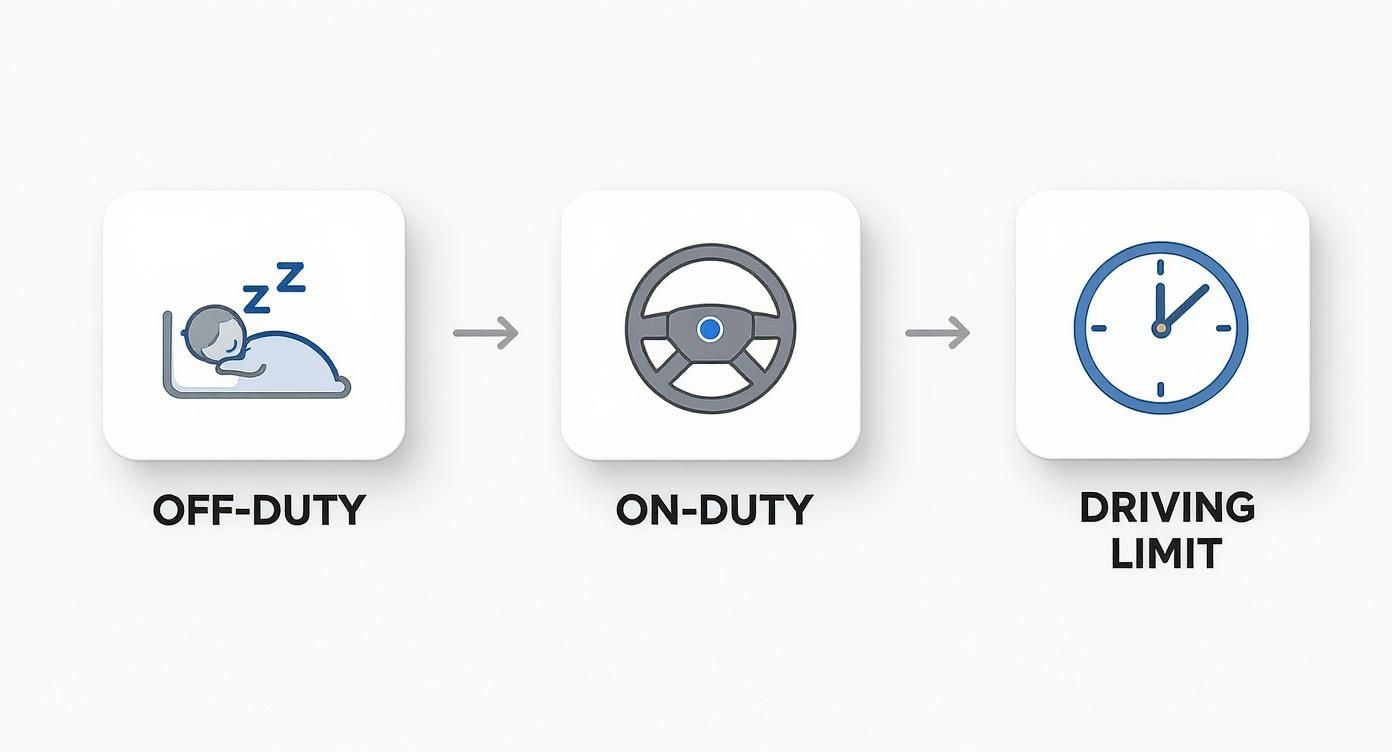
As you can see, every single on-duty task, driving included, has to be squeezed in before that 14-hour window closes.
Differentiating On-Duty Time from Driving Time
One of the most common mix-ups for new drivers is understanding the difference between "on-duty" time and "driving" time. Getting this right is absolutely critical for keeping your logs clean and staying compliant.
- Driving Time: This one’s easy. It’s any time the truck is moving. Your ELD (Electronic Logging Device) tracks this automatically.
- On-Duty, Not Driving Time: This is the bucket for all your other work-related tasks that happen when you're not actually driving.
So, what counts as "On-Duty, Not Driving"? Think of things like:
- Doing your vehicle inspections, which you can learn all about in our pre-trip inspection guide.
- Fueling up the rig.
- Filling out paperwork or managing your logbook.
- Sitting at a dock waiting to get loaded or unloaded.
- Dealing with a roadside inspection.
All these activities eat into your 14-hour on-duty clock but not your 11-hour driving limit. This is a huge deal. A driver who burns three hours waiting on a shipper has just 11 hours left in their workday, even if they haven't driven a single mile yet.
The 10-Hour Off-Duty Reset
So what happens when you hit that 14-hour wall or use up your 11 hours of drive time? The rules are clear: you must take 10 consecutive hours off-duty. This is the magic number that fully resets both your 14-hour and 11-hour clocks, giving you a fresh start for the next shift.
Key Takeaway: That 10-hour off-duty period is non-negotiable. It's the core safety rule designed to make sure every driver is properly rested before they get back on the road, directly fighting the dangers of fatigue.
This reset is your ticket to legally start a new driving day. If you don't get that full, uninterrupted 10 hours of rest, you can't start a new shift. It all comes down to managing your day wisely within the 14-hour window to get your driving done while still ensuring you hit that crucial rest period.
Understanding Breaks and Weekly Hour Caps
It’s not just about the daily 11-hour driving and 14-hour on-duty clocks. The FMCSA’s hours-of-service rules have a few more layers designed to keep fatigued drivers off the road. We’re talking about the mandatory 30-minute break and some hard caps on your total weekly hours. Getting a handle on these is non-negotiable for planning smart routes and staying out of trouble with the DOT.
Think of these rules as a safety net. The 30-minute break is your mandatory "time-out" during a shift, while the weekly limits are the hard stop that prevents you from burning out over the long haul. Both are critical for safety.
The Critical 30-Minute Driving Break
This one trips up a lot of drivers, new and old. The rule is simple on the surface: you must take at least 30 consecutive minutes off-duty after 8 hours of driving time.
The key detail here is that the clock for this break is tied strictly to driving time, not your total on-duty time. That's a huge distinction that was clarified in a recent rule change.
Back in 2020, the FMCSA updated the regs to specify that the break is required after eight cumulative hours behind the wheel. This was a welcome change, giving drivers a lot more flexibility to schedule that break when it makes the most sense in their day, not just after being on the clock for eight hours straight.
Demystifying Weekly On-Duty Limits
While the daily rules manage your shift, the weekly limits keep an eye on your entire work cycle. They’re there to stop drivers from racking up endless hours week after week, even if each individual day is perfectly legal. You’ll typically fall under one of two rules.
- The 60-Hour/7-Day Rule: This one means you can't be on-duty for more than 60 hours in any 7-day stretch. It’s pretty common for local carriers or companies that don't run their trucks 24/7.
- The 70-Hour/8-Day Rule: The standard for most over-the-road and long-haul operations. Under this rule, you can't exceed 70 on-duty hours in any 8-day period.
Remember, these are rolling totals. To see if you’re compliant, you have to add up today’s on-duty hours with the past 6 or 7 days. If you're over the limit, you can't legally drive.
Your weekly hour cap is like a bank account for your work hours. Every hour you spend on-duty is a withdrawal. Once you hit the limit, you cannot legally drive again until you make a "deposit" by taking a reset.
Of course, these breaks and limits mean you've got to find a safe and legal spot to park it. Finding good parking is a constant challenge, which is why resources like our guide on safe truck parking are so important for planning your stops. For many drivers, this means learning how to legally and safely sleep in your vehicle becomes an essential skill.
Resetting Your Week with the 34-Hour Restart
So, what do you do when you’re bumping up against that 60 or 70-hour weekly limit? You hit the reset button. The 34-hour restart rule lets you wipe your weekly clock clean by taking at least 34 consecutive hours off-duty.
Imagine you're on the 70-hour/8-day rule and you've already logged 68 hours by the end of day seven. You're almost out of time and can't possibly take on another long haul. By parking the truck and taking a full 34-hour break, your weekly clock resets to zero. Suddenly, you have a fresh 70-hour cycle to work with. It's the mechanism that ensures drivers get that extended rest needed to fully recover before hitting the road again.
How to Use HOS Exemptions Correctly
The standard hours-of-service rules are built for the long haul, but let's be honest—not every day on the road is standard. The FMCSA gets this, which is why they've built in specific exemptions to give drivers some much-needed flexibility. Knowing how to use these provisions correctly is the difference between staying compliant and facing a citation.
Think of these exemptions less like loopholes and more like specialized tools in your compliance toolkit. They’re there to help you handle unusual situations without breaking the law, but you have to know exactly when and how to use them.
Let's break down some of the most common ones you'll encounter.
The Short-Haul Exemption
This is a game-changer for local drivers. If you operate close to your home base, the short-haul exemption might mean you don't have to keep a detailed Record of Duty Status (RODS) or take the mandatory 30-minute break. For local delivery fleets, this is a huge boost to efficiency.
So, how do you qualify? It’s pretty straightforward. You must:
- Operate within a 150 air-mile radius of your normal work reporting location.
- Start and end your day at that same location.
- Be released from duty within 14 consecutive hours.
Picture a driver based in Sacramento making runs throughout Northern California. As long as they stay inside that 150 air-mile bubble and get back to the terminal within 14 hours, they're good to go. But if a last-minute dispatch sends them outside that radius, they have to start logging immediately for that day. For drivers in the Golden State, our guide on CDL requirements in California offers more localized insights.
Crucial Reminder: The short-haul exemption gets you out of keeping a detailed log, but it doesn't eliminate all timekeeping. Your company still must maintain accurate time records showing your start time, end time, and total daily on-duty hours.
Adverse Driving Conditions Exemption
We’ve all been there. The weather turns on a dime, or a bad wreck shuts down the interstate for miles. The adverse driving conditions exemption gives you an extra two hours of drive time on top of your 11-hour limit. The idea is to give you enough time to get to a safe place without pushing you to drive recklessly against a ticking clock.
But this isn't for your everyday traffic jam. It only applies to situations you couldn't have seen coming when you started your shift.
- What qualifies: A sudden blizzard, a flash flood that washes out a bridge, or a massive pile-up that closes the highway.
- What does NOT qualify: Normal rush-hour gridlock, predictable construction delays, or a storm that was on the forecast for days.
Imagine you're two hours from your drop when a surprise ice storm hits, slowing traffic to a crawl. If you're about to hit your 11-hour limit, this exemption lets you tack on up to two more hours to either finish your run or find a safe spot to park for the night.
The Sleeper Berth Provision
For drivers with a sleeper berth, this provision is a powerful tool for managing rest. It allows you to split your required 10-hour off-duty period into two shorter rests, which is perfect for team drivers or solos trying to work around long waits at shippers and receivers.
The split has a specific formula that you must follow:
- One rest period has to be at least 7 consecutive hours in the sleeper berth.
- The other rest period has to be at least 2 consecutive hours, taken either off-duty or in the sleeper berth.
- Together, the two breaks must add up to at least 10 hours.
When you pair these two periods correctly, they reset your 11-hour driving clock and your 14-hour duty clock. It gives you incredible control over your schedule, letting you grab a quick nap while getting loaded and then take a longer rest later on, all while staying 100% compliant.
Common HOS Exemptions at a Glance
Navigating these exemptions can feel complicated, but they all serve a specific purpose—to add flexibility where the standard rules don't quite fit. The key is knowing which one applies to your situation and what the exact requirements are.
Here’s a quick comparison of the exemptions we've covered to help you see how they stack up.
| Exemption | What It Allows | Key Requirements |
|---|---|---|
| Short-Haul | Relief from ELD/RODS and 30-minute break | Operate within 150 air-miles, start/end at the same location, and finish within a 14-hour duty day. |
| Adverse Driving Conditions | Adds up to 2 extra hours of driving time to the 11-hour limit | Conditions must be unexpected and not known at the start of the trip (e.g., sudden storm, major wreck). |
| Sleeper Berth Provision | Splits the 10-hour off-duty period into two qualifying rests | Must be two periods: one of at least 7 hours (in berth) and another of at least 2 hours, totaling 10+ hours. |
Ultimately, using these provisions correctly comes down to understanding the fine print. When in doubt, always double-check the rulebook or consult with your safety manager before you find yourself in a bind during a roadside inspection.
The Role of ELDs in HOS Compliance
Remember the old days of paper logbooks? Scribbled entries, last-minute catch-ups, and the constant worry of a messy audit. Those days are largely behind us, thanks to Electronic Logging Devices, or ELDs. While some old-school drivers initially grumbled about them feeling like "Big Brother," ELDs have become a standard-issue tool for a good reason: they bring accuracy, fairness, and safety to the forefront.
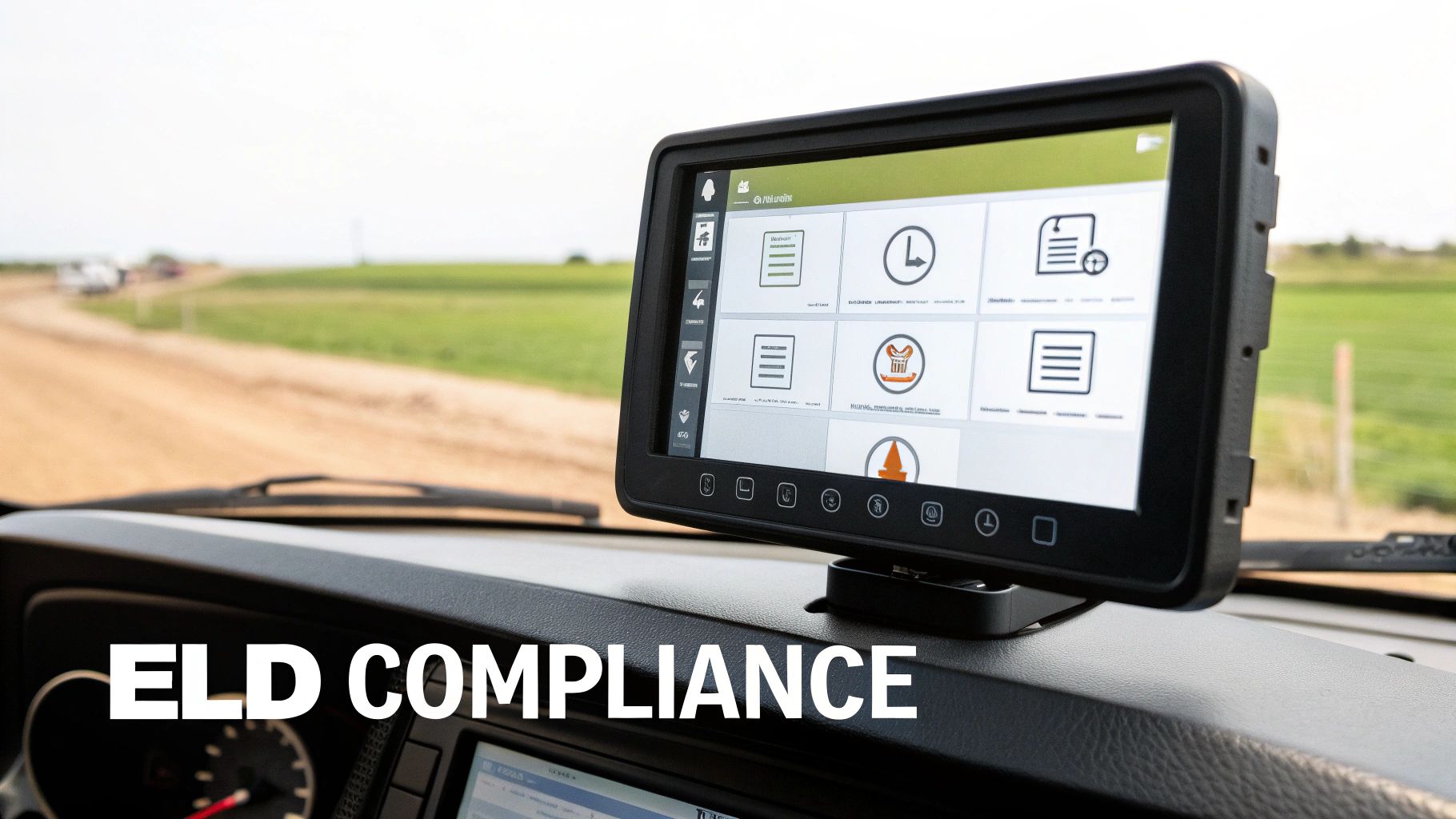
The federal ELD mandate means most commercial trucks you see on the road have one of these devices installed. Think of it as a smart, digital timekeeper that’s hardwired right into the truck’s engine. It doesn't guess, and it doesn't forget. It just records the facts.
This direct connection is the whole point. ELDs automatically track when the engine is on, when the truck is moving, its GPS location, and the miles driven. This creates an airtight, undeniable record of your hours, making it nearly impossible to fudge the numbers and incredibly easy to prove you’re running legally during a roadside inspection.
How ELDs Simplify HOS Compliance
Instead of juggling a pen and a ruler to keep your logbook straight, the ELD does the heavy lifting for you. This switch from paper to digital has made life a lot simpler for both drivers and the folks back at the office.
For starters, the mountain of paperwork is gone. An ELD automates the entire logging process, which means less time spent filling out grids and more time focused on the road or enjoying your break. It also makes for much quicker roadside inspections. DOT officers can review a clean digital log in seconds instead of trying to make sense of a driver's handwriting.
An ELD is your best defense against a wrongful violation. By keeping a precise, time-stamped record of every move you make, it protects you from false claims and proves you’re doing your job by the book.
Plus, these devices help create a more level playing field for everyone. When all drivers are on an automated system, it cuts down on the temptation for some carriers to push their drivers past the legal limits, which ultimately makes our highways safer.
Mastering Your ELD for Roadside Success
Now, an ELD might be automatic, but it’s not a "set it and forget it" kind of tool. Knowing your way around the specific device in your cab is a crucial skill for staying out of trouble. It’s about more than just tapping a button to change your duty status.
You have to know how to handle the little things that come up every day to keep your log clean and accurate. This includes:
- Managing Edits: We all make mistakes. Maybe you forgot to log "Off Duty" when you stopped for lunch. Knowing how to legally edit that entry is key.
- Adding Annotations: Every single edit you make needs a short, clear note explaining why you made it. This is non-negotiable for inspectors.
- Troubleshooting Malfunctions: What happens if the device breaks? You’re required to have the ELD manual and a backup supply of paper logs on hand. Knowing the exact procedure to follow is part of being a professional.
Getting these functions right ensures your logs are always inspection-ready. For new drivers just getting started, quality training is essential. The skills needed to operate these systems are covered in programs like those found in our Entry-Level Driver Training (ELDT) guide. When you learn to see your ELD as a partner in compliance, not an adversary, you're setting yourself up for a long, successful career.
How US Rules Stack Up Globally
Every country with a major trucking industry grapples with the same fundamental problem: how to keep tired drivers off the road. While we live and breathe the FMCSA's rules here in the States, it's worth taking a look over the fence to see how other places handle it. This isn't just an academic exercise; it shows that the core goal of preventing fatigue is a worldwide priority.
The European Union is a great example. They've got a mature, comprehensive set of regulations for their commercial drivers. You'll notice right away that their numbers are different from ours, but the spirit of the law is exactly the same. They're all about limiting time behind the wheel and forcing drivers to take real, restorative breaks.
A Peek at European HOS Regulations
Across the pond, drivers operate under a directive that puts a hard cap on driving time. Their daily driving limit is usually 9 hours—a couple of hours shy of our 11-hour rule. They do get a little wiggle room, though, with the option to extend that to 10 hours twice a week.
Their break schedule is also a bit more aggressive. European regulations demand a 45-minute break after you’ve been driving for 4.5 hours straight. A driver can take that all at once or split it into two chunks: a 15-minute break first, followed by a 30-minute one later on.
When you boil it down, both the US and EU systems are aiming for the exact same thing: rested drivers are safe drivers. The methods might be different, but the mission to fight fatigue is identical.
Key Differences and Similarities
This comparison really highlights how different regions can attack the same safety issue from slightly different angles. Our system in the US operates with that 14-hour on-duty clock and requires a 30-minute break before you hit 8 hours of drive time. The EU, on the other hand, puts more emphasis on interrupting the driving period itself more frequently.
Here’s how they line up side-by-side:
- Daily Driving Limit: The US gives you 11 hours, while the EU generally holds the line at 9 hours.
- Mandatory Breaks: We require a 30-minute break after 8 driving hours. They mandate a 45-minute break after just 4.5 hours behind the wheel.
- Weekly Rest: Both systems build in long weekly rest periods. This is a shared recognition that fatigue doesn't just happen day-to-day; it builds up over time and needs to be managed.
Seeing how other countries structure their rules reinforces just how crucial the truck driving hours of service rules are. They aren't just arbitrary regulations; they're part of a global, unified effort to make our roads safer for everyone.
Common Questions About HOS Rules Answered
Even with the rulebook in hand, real-world situations pop up that can make hours-of-service rules feel a bit tricky. Let’s clear up some of the most common questions that drivers and fleet managers run into on a daily basis.
What Happens if I Break an HOS Rule?
Let's be blunt: violating HOS rules is a big deal, and the consequences can sting. If you're caught during a roadside inspection, it’s not just a slap on the wrist. The fallout can hit both the driver and the company hard.
Here’s what you can expect:
- Being Put 'Out of Service' (OOS): This is the most immediate consequence. An officer will order you to stop driving right then and there. You won't be able to turn a wheel until you’ve logged enough off-duty time to get back into compliance.
- Fines and Penalties: HOS violations come with hefty price tags. Fines can run from a few hundred to several thousand dollars, depending on how serious the violation is.
- Hits to Your CSA Score: Every HOS violation adds points to your carrier's Compliance, Safety, Accountability (CSA) score. Higher scores can mean higher insurance premiums and more attention from DOT inspectors down the road.
Does Personal Conveyance Count Against My Hours?
Generally, no. When you use your truck for personal reasons—what the FMCSA calls personal conveyance—that time doesn't eat into your available driving hours. This allows you to do things like drive from your last delivery point to a safe place to park for the night or run to a nearby restaurant for a meal.
But there are some critical ground rules. Your company has to have a clear policy allowing it, and your truck must be unladen (no cargo). You can't use personal conveyance to get closer to your next pickup or otherwise advance the load. That’s a serious misuse of the rule.
The best way to think about personal conveyance is to ask, "Am I truly off the clock?" If the move is for you and not the freight, it's likely legitimate. Always double-check your company's specific policy.
Can I Use the Adverse Driving Conditions Exemption for Traffic?
This is a classic point of confusion, and the answer is a hard no. The adverse driving conditions exemption is not for your everyday traffic jam, no matter how bad it gets.
This rule is reserved for genuinely unexpected and severe conditions that you couldn't have known about when you started your day. Think sudden, un-forecasted weather like a blizzard or a flash flood, or a major, unforeseen road closure from a multi-car pileup. Using it for predictable rush-hour delays is a guaranteed way to get a violation.
Ready to start a rewarding career on the open road? At Patriot CDL, we provide the expert, hands-on training you need to get your commercial driver's license quickly and affordably. Learn more about our programs.