When people ask about the cost of truck driving school, the number one thing to know is that there's a pretty wide range. You can expect the total investment to fall somewhere between $3,000 and $10,000. That price gets you from zero to a licensed professional, covering everything from classroom learning to the hands-on driving that really matters.
Think of it as the price of admission to a solid, in-demand career.
What Is the Real Cost of Truck Driving School?
Budgeting for truck driving school is a bit like planning a cross-country haul. The sticker price of the truck (or in this case, the tuition) is just the start. You've also got to account for all the other costs along the route to get you to your destination. The total investment isn't just about passing a test; it's about building the skills, safety know-how, and confidence you need to succeed on the road.
The final price tag you'll see depends heavily on the school's reputation, how long the program runs, and even what part of the country you're in.
Your tuition is really paying for two distinct but equally important things. First, there's the classroom time where you’ll nail down the rules of the road, critical federal regulations, and how to plan a trip like a pro. The second, and usually bigger, piece of the pie is the behind-the-wheel training. This is where the rubber literally meets the road and you build real-world driving skill. Before you sign on the dotted line, it’s a good idea to get familiar with the full list of CDL requirements.
This infographic gives a great visual breakdown of where your money typically goes.
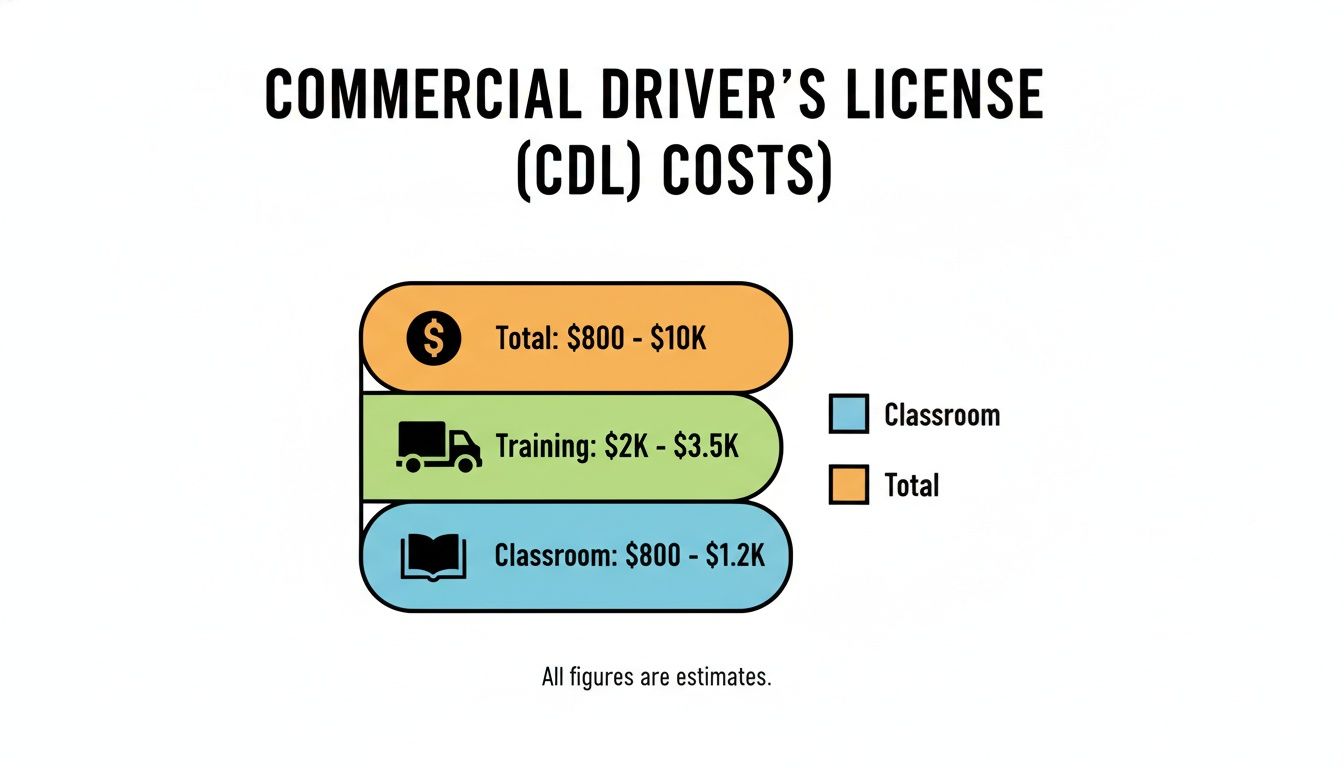
As you can see, the biggest chunk of your investment goes directly into practical, hands-on time in the driver's seat.
Typical Truck Driving School Cost Breakdown
Here’s a quick look at the common expenses you'll encounter on your way to earning a CDL. This table separates the main tuition fees from the other costs you'll need to cover.
| Cost Category | Typical Price Range | What It Covers |
|---|---|---|
| Classroom Instruction | $800 – $1,200 | Textbooks, theory, safety regulations, trip planning, and logbook management. |
| Behind-the-Wheel Training | $2,000 – $3,500+ | Hands-on driving, instructor time, vehicle use, fuel, and insurance. |
| Licensing & Exam Fees | $100 – $300 | State fees for the learner's permit, final skills test, and physical license. |
| DOT Physical & Drug Test | $100 – $200 | Mandatory medical exam and screening required to prove you're fit to drive. |
These figures give you a solid baseline for what to expect, but remember that your final cost will depend on the specific program and your location.
Why Do Prices Vary So Much?
So, why isn't there just one flat rate for getting your CDL? That big $3,000 to $10,000 range isn't arbitrary. It comes down to real differences in what schools offer, their resources, and where they're located.
A few key factors drive the price up or down:
- Program Length and Depth: A quick, three-week accelerated course will naturally have a different price point than a more comprehensive eight-week program that packs in way more driving hours.
- School Reputation and Resources: Top-tier schools with modern trucks, high-tech simulators, and small class sizes have higher overhead, and their tuition reflects that quality. You're paying for better equipment and more one-on-one time with instructors.
- Geographic Location: It's simple economics. A school operating in a major city has to deal with higher rent, fuel costs, and insurance rates than one in a rural area, and those costs get passed on.
Investing in a quality CDL program isn't just about paying for a piece of plastic. It’s about buying the skills, muscle memory, and safety instincts that will protect you—and your career—for decades to come. It’s the foundation for being a true professional on the road.
What Your CDL Tuition Actually Buys You
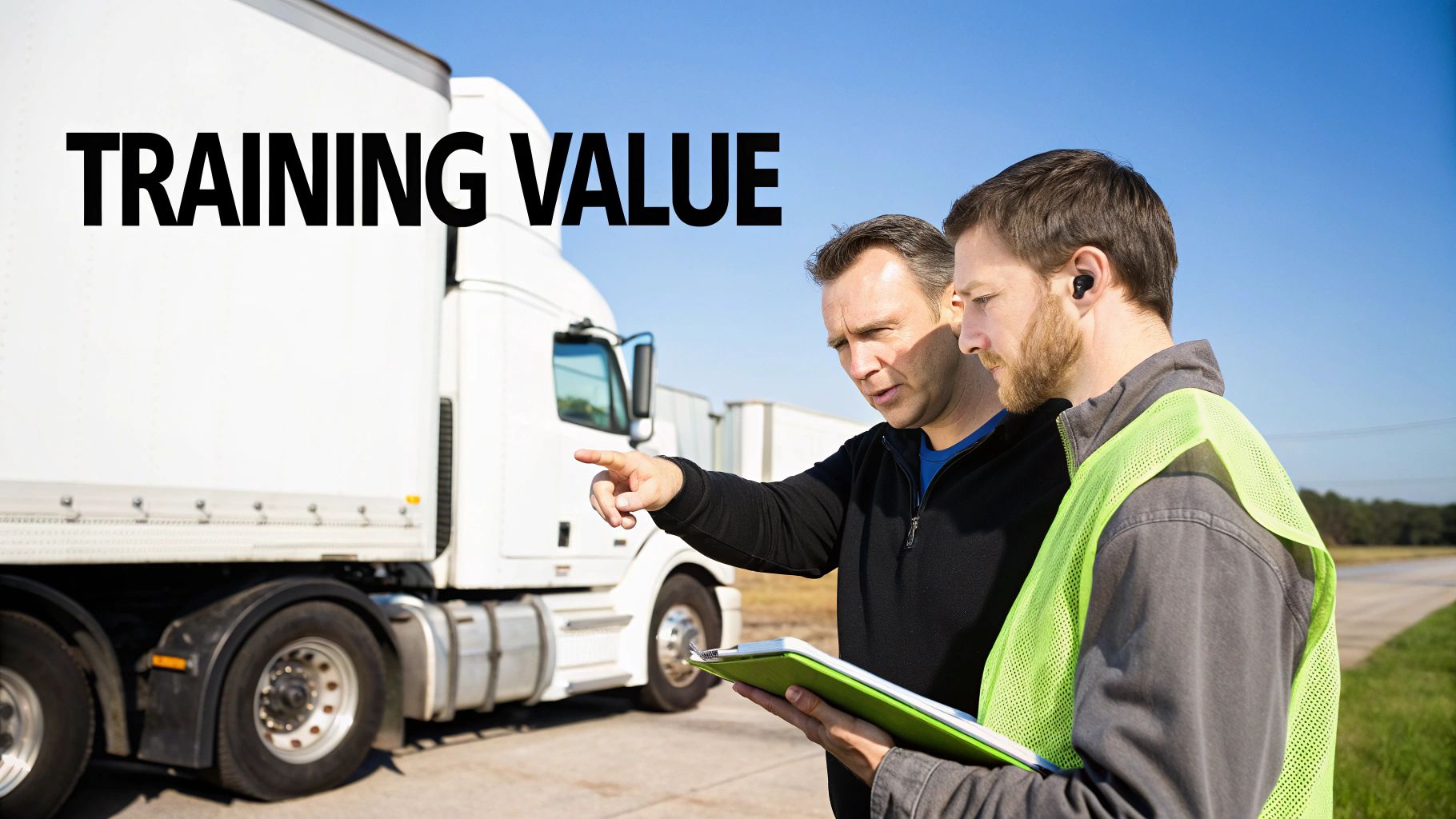
When you see the price tag for CDL training, it’s natural to wonder where all that money is going. It's a significant investment, after all. But that tuition isn't just a fee for a license; it's funding a complete career change, designed to take you from a total beginner to a confident, road-ready professional.
Think of it less like buying a product and more like paying for a specialized apprenticeship. The truck driving school cost bundles together the instruction, the heavy equipment, and the direct support you need to become not just licensed, but genuinely hirable.
Classroom Instruction and Theory
Before you ever climb into the cab, your journey starts in the classroom. This is where you build the foundation for a long, safe career. It’s a whole lot more than just flipping through the standard driver’s manual—you'll be diving deep into the real-world complexities of commercial trucking.
Your tuition pays for time with instructors who know their stuff, often seasoned drivers with decades of experience on the road. They’re not just reading from a book; they’re sharing firsthand knowledge.
This critical classroom time covers:
- The Rules of the Road: You'll get a handle on the complex regulations from the Federal Motor Carrier Safety Administration (FMCSA), from Hours of Service (HOS) logs to properly securing your cargo.
- Defensive Driving: This is about learning to think ahead and anticipate hazards—an absolute must-have skill for anyone driving an 80,000-pound vehicle.
- Trip Planning & Navigation: Instructors show you how to plan routes efficiently, manage your clock, and navigate with both GPS and old-school maps.
- Knowing Your Rig: You have to understand the mechanics of the machine you’re driving. A huge piece of this is mastering the detailed pre-trip inspection, which is a core part of your CDL exam and your daily routine on the job.
Hands-On Behind-the-Wheel Training
This is where the rubber meets the road, and it’s where the biggest chunk of your tuition goes. Behind-the-wheel (BTW) training is how you turn classroom theory into real skill. You won't just be driving around a cone course in an empty lot; you’ll be operating a full-sized tractor-trailer with a certified instructor right there in the passenger seat.
The costs here are substantial for any school:
- Trucks & Maintenance: These rigs are incredibly expensive to buy, insure, and keep in top shape. Your tuition helps ensure the training fleet is modern, safe, and up to code.
- Fuel, Fuel, and More Fuel: A semi-truck is thirsty, often getting just 6-7 miles per gallon. All those hours you spend practicing maneuvers add up to a serious fuel bill.
- One-on-One Instructor Time: A good program keeps its student-to-instructor ratio low. This means you get personal coaching to fix bad habits and build the confidence you need behind the wheel.
Your tuition buys you time—time to practice, time to make mistakes in a safe environment, and time to develop the muscle memory for tricky skills like shifting, backing, and coupling a trailer. It’s a direct investment in your competence and safety.
Preparation for Your CDL Exam
At the end of the day, the goal is passing that CDL exam. A quality school builds its entire program around getting you ready for this three-part test. They don’t just teach you how to drive; they teach you how to prove your skills to a state examiner under pressure.
Your payment guarantees you’ll train on the same class of vehicle you’ll test in, so you’re completely comfortable with its size and handling. Instructors will drill you on the specific maneuvers required for the skills portion—straight-line backing, offset backing, parallel parking—until they become second nature.
By running you through mock exams and giving direct feedback, a good school ensures there are no surprises on test day. This kind of targeted prep makes it far more likely you’ll pass on the first try, saving you the headache and cost of retesting fees.
Key Factors That Drive CDL Training Prices
Ever wonder why one CDL school quotes you $4,000 while another down the road wants $9,000? That gap isn't random. The price tag on truck driving school is tied directly to a few key factors that define the quality and type of training you get. Once you understand what's behind the numbers, you can look past the initial sticker shock and figure out what you're really paying for.
Think of it like buying a car. A basic sedan will get you around, but a fully-loaded truck designed for heavy-duty work comes with better performance, more features, and a higher price. Your CDL education works the same way.
Location and Local Economy
It might surprise you, but where a school is located has a huge impact on tuition. A school in a big city has to cover much higher overhead than one in a small town. We’re talking about rent for the classrooms and the practice yard, insurance costs, and even the local price of diesel fuel.
All those operational expenses get factored into your tuition. It’s why you might find a school in a major hub like Atlanta charging more than a similar program in a smaller town, even if the training itself is nearly identical. The local cost of doing business plays a big role.
Type of School: Private vs. Public
The kind of institution you choose is another big piece of the puzzle. For the most part, you'll run into two types of places offering CDL training.
- Private CDL Schools: These are businesses built from the ground up to train professional drivers. They usually offer fast-paced, accelerated programs to get you licensed and working as quickly as possible. Their prices reflect that specialized focus, often including modern trucks and strong job placement connections.
- Community Colleges: Many local community colleges offer fantastic CDL programs as part of their vocational training. Since they get public funding, their tuition is often lower than private schools. The trade-off? Their programs tend to follow a traditional semester schedule, so it might take you longer to earn your license.
Program Length and Intensity
How long you're in school is one of the clearest things affecting the final cost. A shorter, more intense program packs everything into a few weeks, while a longer course spreads the material out and often includes more drive time.
An accelerated three-week program, for example, will likely have a lower total cost than a full eight-week course. But that longer program probably gives you more hours behind the wheel, which can build a lot more confidence. You’re essentially paying for more of the instructor's time, more fuel, and more time using the school's equipment.
Choosing between a short or long program is a personal call. It really comes down to your learning style, your budget, and how fast you want to hit the road and start earning.
Equipment and Endorsements
The trucks you train on also move the needle on price. A lot of major carriers still run fleets with manual transmissions, and learning to shift a 10-speed or 13-speed is a skill that takes more time and coaching to master. Schools that teach manual often charge a bit more than those that only use automatics.
And what about endorsements? If you want to add endorsements like HazMat or tanker to your license, expect to pay a little extra for the specialized classroom and hands-on training they require. It’s usually a smart investment, though, as those endorsements open the door to higher-paying jobs.
No matter the program, every legitimate school must meet the federal standards for Entry-Level Driver Training (ELDT) to make sure you're ready for the job. Looking at the ELDT requirements is a great way to see the baseline of what your tuition money should be getting you.
How to Pay for Your CDL Training
That initial price tag for CDL school can feel like a major roadblock. For a lot of people ready to hit the road, the real challenge isn't the drive to learn—it's figuring out how to cover the truck driving school cost. The good news? You've got more options than you probably think.
Think of it like building a financial roadmap. From the school's own payment plans to government grants and niche scholarships, there’s a path forward for almost every situation. Let's break down the best ways to piece together a strategy that gets you behind the wheel without derailing your finances.
In-House Financing and Payment Plans
Often, the most straightforward way to tackle tuition is by working directly with the school you plan to attend. Most private CDL schools get it; they know the upfront cost is a hurdle, so they offer their own financing or payment plans. It’s in their best interest to see you succeed, after all.
These plans usually break down in a few common-sense ways:
- Tuition Installments: Instead of one lump sum, you can chop the total cost into smaller, more manageable payments over the course of your program.
- Deferred Payment: Some schools will let you pay a chunk upfront and then hold off on the rest until you've graduated and landed your first driving job.
- School-Arranged Loans: Many schools have built relationships with lenders who specialize in vocational training. This can make the loan application process much simpler for students.
Your first move should always be to talk to the school’s admissions or financial aid office. They’ll give you the clearest picture of what’s available and help you find a plan that actually works for your budget.
Government Grants and Federal Aid
Don't write off help from Uncle Sam. There are several federal programs out there designed specifically to get people trained for high-demand jobs, and trucking is absolutely on that list. Best of all, this is money you don't have to pay back.
The big one you need to know about is the Workforce Innovation and Opportunity Act (WIOA). This program is all about helping job seekers get the training they need to thrive. If you're eligible, a WIOA grant could cover the entire cost of your CDL school.
The trick is finding out if you qualify. Get in touch with your local American Job Center or workforce development board. These folks are there specifically to connect you with funding opportunities right in your area.
Scholarships for Aspiring Truck Drivers
Scholarships aren't just for kids heading to a four-year college. A surprising number of organizations offer awards specifically for people getting into the trucking industry. These can be based on anything from financial need to your background or career aspirations.
Finding them takes a little legwork, but it's well worth the effort. Start your search by looking into scholarships offered by:
- Trucking Associations: Both national and state-level groups often have funds set aside to help bring new drivers into the fold.
- Major Carriers: Some of the big trucking companies offer scholarships as a way to recruit top talent early on.
- Industry Groups: Look for organizations that support specific communities, like women in trucking or military veterans.
A few hours of digging online can literally uncover free money to slash your out-of-pocket costs.
Personal Loans and Financial Aid
When grants and scholarships don't cover the full truck driving school cost, a personal loan is a common next step. It’s a reality that financing is a major hurdle for many aspiring drivers, impacting everything from enrollment numbers to which school they ultimately choose. Many students blend options, using a WIOA grant along with a small loan or sponsorship.
If you go the loan route, you absolutely must understand the long-term cost of interest. Take the time to compare interest rates, what the repayment terms look like, and any hidden fees. To get a better handle on this, you can learn how to calculate interest on a loan and see how it impacts your total cost.
Ready to map out your own plan? You can sign up for a Patriot CDL training program today and have a straightforward conversation with our team about your payment options.
Using Employer Sponsorship to Fund Your CDL

What if someone else picked up the tab for your CDL training? For many aspiring drivers, that’s not just wishful thinking—it's a very real opportunity through employer sponsorship. This is hands-down one of the most popular ways to get a commercial license because it can dramatically lower, or even completely wipe out, your upfront truck driving school cost.
With a massive driver shortage across the country, trucking companies are scrambling to find new talent. Sponsoring students is a direct investment in their own future, ensuring they have qualified drivers to keep their fleets moving. It’s a classic win-win: you get your education paid for, and they get a committed, well-trained employee ready to hit the road.
How Company-Sponsored Training Works
Employer-sponsored CDL training usually comes in one of two flavors. Figuring out the difference is key to knowing which path makes sense for you. You can think of it as getting your training paid for directly versus getting a rebate after the fact.
- Company-Paid Training: This is the most straightforward option. A trucking company pays the school directly for your entire tuition. You don’t have to take out loans or scrape together savings. It's about as close as you can get to "free" CDL training.
- Tuition Reimbursement: In this scenario, you pay for your schooling upfront, whether out of pocket or with a loan. Once you graduate and start working for the company, they pay you back over time. These payments are usually added to your regular paycheck until your tuition is fully reimbursed.
The Big Advantage: A Guaranteed Job
Besides the obvious financial perks, the single biggest advantage of employer sponsorship is having a guaranteed job waiting for you the second you pass your CDL exam. This completely sidesteps the stress of job hunting right out of school. No more polishing resumes or sitting through interviews—your career is already lined up.
That kind of security is huge. It lets you put 100% of your focus on mastering your driving skills, knowing that a steady paycheck is just around the corner. For a lot of new drivers, this built-in career launchpad is just as valuable as the free tuition.
Understanding the Commitment
Of course, there’s no such thing as a free lunch. When a company sinks thousands of dollars into your training, they need to know you’ll stick around. That’s where the work contract comes in.
By accepting sponsored training, you are agreeing to work for that specific company for a set period, which is typically between one to two years. This contract is the core of the sponsorship agreement.
This is a serious commitment. If you leave before your contract is up, you’ll almost certainly have to pay back the full tuition cost, sometimes with interest and other penalties tacked on. It is absolutely critical that you read the fine print and understand every detail of the agreement.
Before you sign, make sure you’re comfortable with the company culture, the pay structure, and the kind of routes you’ll be driving. When you choose a sponsored program, you're not just picking a school—you're picking your first employer. Do your homework and be sure it’s a partnership you’re ready for.
Is a More Expensive CDL School a Better Investment?
When you're looking at different truck driving schools, it’s easy to let the price tag do all the talking. A cheaper program feels like an obvious win for your wallet, right? But when it comes to your career, the cheapest option isn't always the smartest.
Choosing a CDL school is really about finding the best value, not just the lowest price. A quality education might cost more upfront, but it pays you back big time with better job offers, higher starting salaries, and the confidence to handle anything the road throws at you.
The Value of Quality Training
Imagine the difference. Some low-cost schools, often called "CDL mills," are designed to do one thing: get you to pass the test as fast as possible. They check the boxes, but that's about it.
A reputable school, on the other hand, is invested in making you a skilled, professional driver.
That higher investment gets you:
- More Behind-the-Wheel Time: We're talking real-world hours on actual highways and city streets, not just endless loops in a deserted parking lot.
- Experienced Instructors: You learn from pros who have been there and done that. They teach you the unwritten rules of the road and the defensive driving habits that companies demand.
- Modern Equipment: You’ll train on the same up-to-date rigs that major carriers are using today, so there's no learning curve when you start your first job.
- Strong Carrier Connections: The best schools have built solid relationships with top trucking companies, opening doors to better job placements before you even graduate.
This push for better training is a huge reason the global driving school market, valued at $98.71 billion, is projected to hit $103.11 billion. The industry knows that well-trained, safe drivers are worth the investment.
Cost vs. Long-Term Earning Potential
A driver who graduates from a top-tier program doesn't just have a license; they have skill. They walk into their first job ready for prime assignments and are often on a faster track to higher pay.
On the flip side, someone from a bare-bones school might have their CDL but struggle with tight backing maneuvers or navigating a busy city. That can mean a frustrating job hunt, lower pay, or even needing extra training from their first employer—which completely wipes out any money they saved on tuition.
A higher initial truck driving school cost can be a direct investment in your future earning power. It's the difference between simply getting a license and launching a successful, high-paying career.
By choosing a school that focuses on quality, you're building a solid foundation for your entire career. You can see for yourself how an accelerated, high-quality Patriot CDL program gets you road-ready. The right training pays for itself again and again.
Your Top Questions About Trucking School Costs, Answered
When you start digging into the cost of truck driving school, the same questions always pop up. It's smart to ask them! Getting solid answers is the only way to map out a realistic budget and feel good about your decision. Let's break down what most aspiring drivers want to know.
Is it Possible to Get a CDL for Free?
Believe it or not, yes—but "free" always comes with a catch. When you see ads for free CDL training, they're talking about a company-sponsored program. A carrier will cover your tuition from start to finish, and in return, you sign a contract to drive for them for a specific amount of time, usually one to two years.
This can be a golden opportunity if you're looking to start your career with zero upfront debt. The key is to read the fine print. If you leave that company before your contract is up, you'll be on the hook for the full cost of the training, and sometimes they'll add extra fees on top.
How Fast Can I Pay Back a CDL School Loan?
If you go the financing route, the news is good. The trucking industry pays well, even for brand-new drivers. Most first-year drivers can expect to earn between $55,000 and $75,000, which gives you a lot of power to knock out that loan quickly.
With some smart budgeting, many graduates are able to pay off their entire tuition loan within their first year or two on the road.
Think of your CDL as an investment that starts paying you back almost immediately. A little focus in that first year can wipe the slate clean and let you start building real savings.
What Other Fees Should I Be Ready For?
Tuition covers your training, but it's rarely the final number. A handful of smaller, non-negotiable costs are part of the process, and they aren't always rolled into the sticker price. To avoid any surprises, make sure you budget for these.
Keep these extra expenses on your radar:
- DOT Physical & Drug Screen: This is a mandatory medical exam to certify you're healthy enough to drive. It typically runs between $100 and $200.
- State Licensing Fees: Your state government charges fees for issuing your commercial learner’s permit (CLP) and your official CDL.
- Personal Gear: You'll likely need to buy a few things yourself, like sturdy work boots, gloves, and a trucker's atlas.
Ready to start a new career without breaking the bank? At Patriot CDL, our accelerated programs are built to be affordable, getting you trained and earning money faster. Find out more at https://patriotcdl.com.