So, you’re thinking about starting a career in trucking? That’s fantastic. Before you can get behind the wheel of a big rig, there are a few boxes you need to check. Think of it like getting your ducks in a row before building something great—it ensures you have a solid foundation for success.
Let's walk through exactly what you'll need to get started on the right foot.
Your Pre-Enrollment Checklist for Truck Driving School
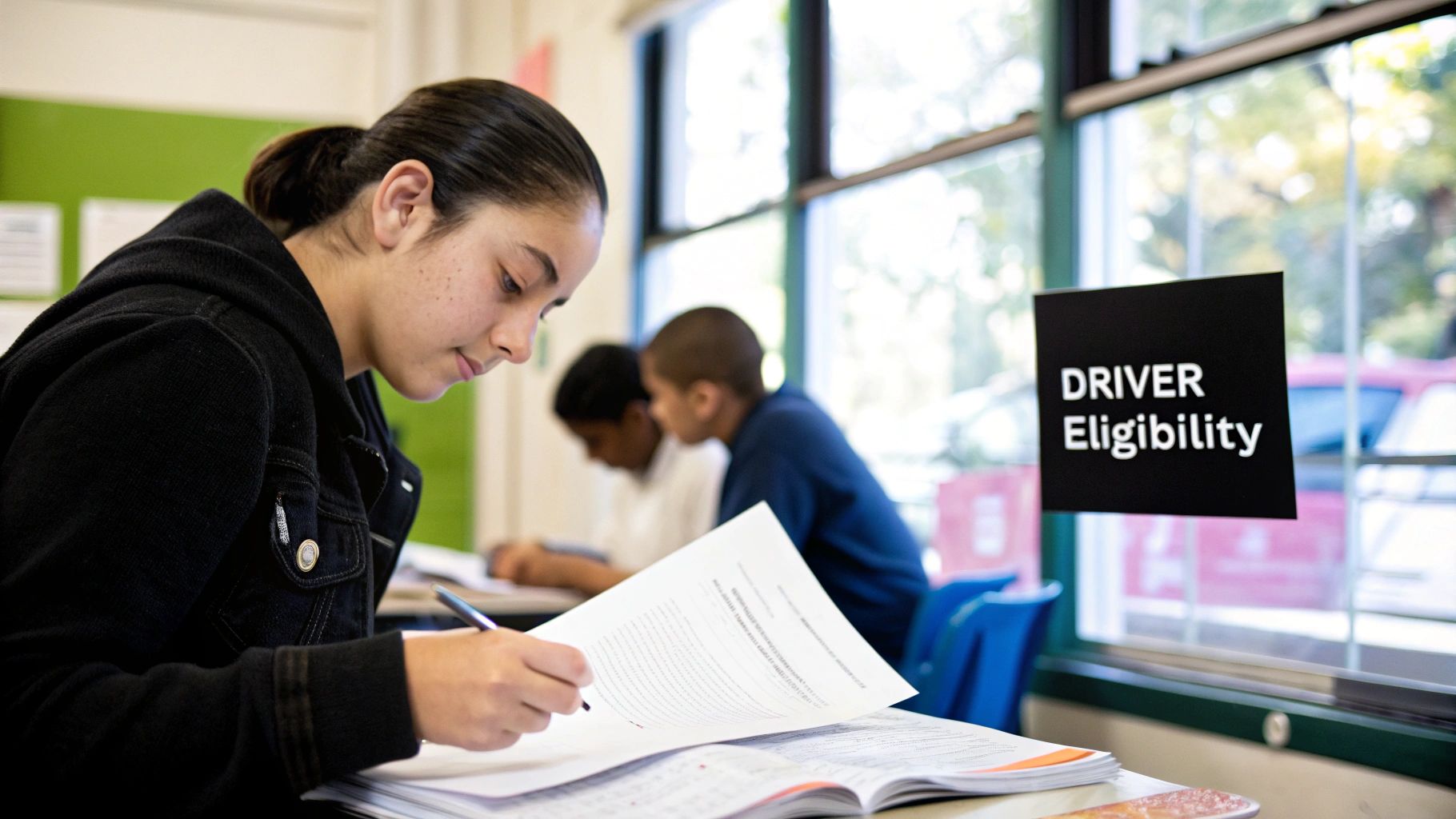
Before you even start dreaming about hitting the open road, there’s some essential groundwork to cover. This isn't about your driving skills just yet; it's about making sure you meet the baseline legal and personal qualifications that both the government and the schools require.
Nailing these fundamentals from the get-go is the key to a smooth start. It prevents annoying delays and shows everyone—from the admissions office to your future employer—that you’re serious about becoming a professional driver.
The Absolute Must-Haves
Every single truck driving school has a few core requirements that are non-negotiable. First up is your age. You need to be at least 18 years old to get a Commercial Driver’s License (CDL) for driving within your home state (this is called intrastate driving).
If your sights are set on crossing state lines, which is what most long-haul truckers do, you’ll need to be at least 21 years old. This is a federal rule for interstate commerce.
Next, you absolutely must have a valid, standard driver's license. This shows you already understand the basic rules of the road. Schools will also pull your driving record, so a history of responsible driving is crucial. A string of serious violations could stop you in your tracks.
Finally, you'll need to gather some basic paperwork to prove who you are and where you live. This usually means a birth certificate, your Social Security card, and proof of residency like a recent utility bill.
To make this easier to track, here’s a quick-glance table of the initial requirements.
Initial Requirements for Trucking School
| Requirement Category | What You Need | Key Details |
|---|---|---|
| Age | Minimum of 18 or 21 years old | 18 for driving within your state (intrastate); 21 for crossing state lines (interstate). |
| Driver's License | A valid, current standard driver's license | Your driving record will be checked. A clean history is a huge plus. |
| Medical Fitness | Pass a DOT Physical & Drug Screen | This ensures you are medically qualified to operate a large commercial vehicle safely. |
| Documentation | Proof of identity and residency | Typically includes a birth certificate, Social Security card, and proof of address. |
| Learner's Permit | Obtain a Commercial Learner's Permit (CLP) | You must pass written tests at the DMV to get this permit before you can train on the road. |
Getting these items in order is your first major step toward getting accepted into a quality CDL program.
Your First Big Milestone: The Permit
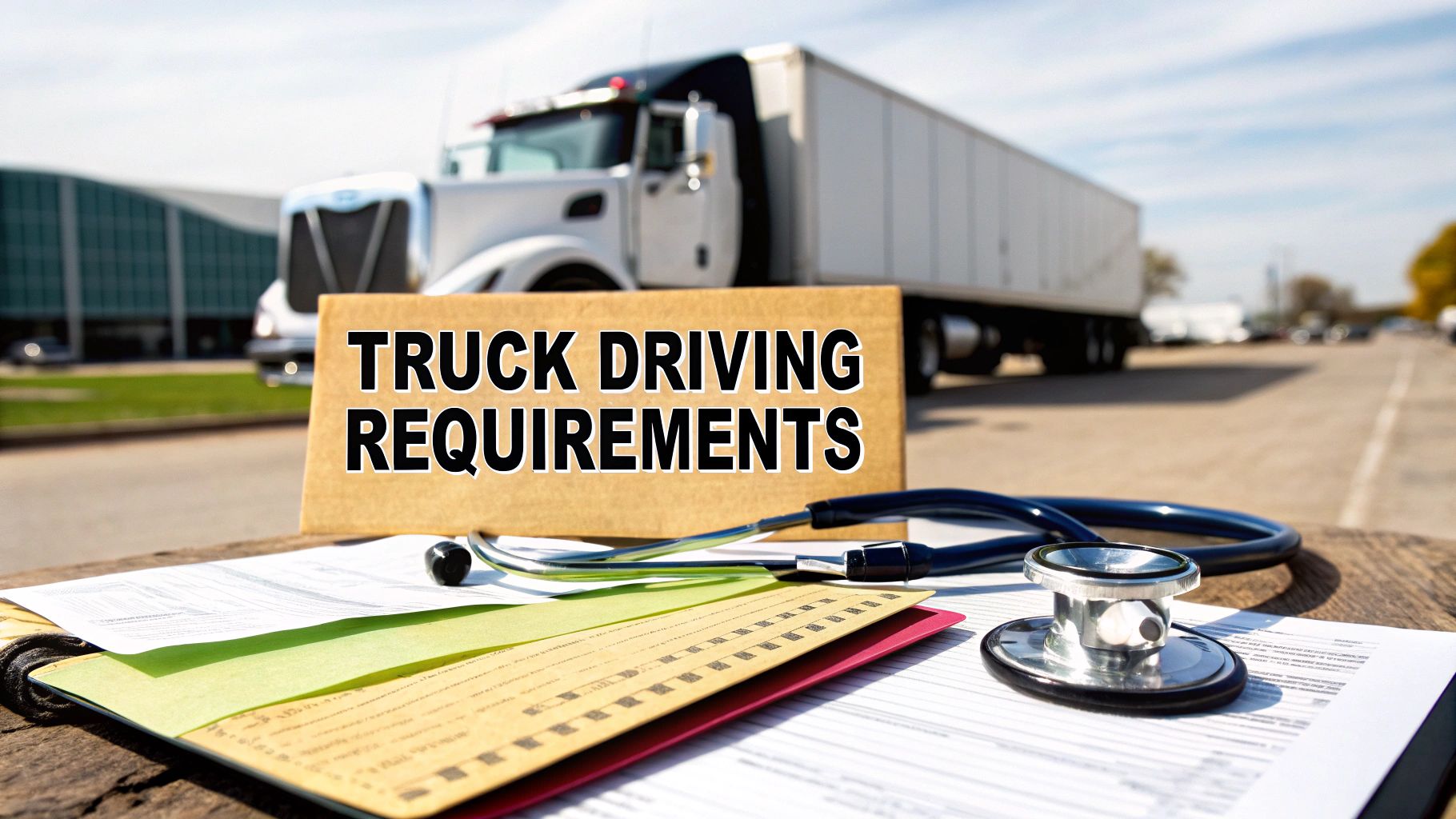
Beyond the basics, you'll need to clear a few more hurdles before you can start your hands-on training. This means passing a Department of Transportation (DOT) physical and a drug screening. These are mandatory checks to ensure you're medically fit for the demands of the job.
The next major step is getting your Commercial Learner's Permit (CLP). This is a critical milestone. Without it, you can't legally get behind the wheel of a semi-truck with an instructor.
The Commercial Learner's Permit (CLP) is your ticket to hands-on training. It's the essential bridge between classroom knowledge and real-world driving experience, and you cannot start practicing on the road without it.
Getting your CLP involves passing a series of written knowledge tests at your local DMV. It’s your first real test of trucking knowledge. To get a head start, you can dive deep into the CDL permit and its requirements in our detailed article. Showing up to a school with your CLP already in hand proves you’re prepared and ready to learn.
The Two Big Tickets: Your CLP and the ELDT Mandate
Alright, you've got your basic documents lined up. Now we get to the real starting line of your trucking career, and it involves two acronyms you'll get very familiar with: CLP and ELDT.
These aren't just school policies; they're federal requirements that fundamentally shape how new drivers are trained. Getting a handle on them is a non-negotiable part of the process.
Think of the Commercial Learner's Permit (CLP) as your passport to the practice yard. It's the trucking world's version of a learner's permit for a car. Once you have a CLP, you can legally get behind the wheel of a big rig on public roads, as long as a licensed CDL instructor is right there in the passenger seat with you.
What’s the Deal with the ELDT Mandate?
The other half of this equation is the Entry-Level Driver Training (ELDT) mandate. This is a game-changer from the Federal Motor Carrier Safety Administration (FMCSA). It basically said, "No more wild west of truck training," and created a national standard for what every new driver must learn.
Before ELDT, the quality of training could be all over the map. Now, every single new driver has to complete a specific curriculum from a school on the FMCSA's approved list. It ensures everyone starts with the same solid foundation.
This training is broken into two core components:
- Theory (The Classroom Stuff): This is where you learn the rules of the road. It covers everything from basic vehicle controls and safety protocols to the nitty-gritty of cargo handling and Hours of Service (HOS) logs.
- Behind-the-Wheel (BTW) Training: Time to hit the road. This is where you take all that classroom theory and put it into practice, mastering maneuvers and navigating real traffic with an instructor guiding you.
The bottom line? You can't even book your final CDL skills test until you've officially passed an ELDT-certified course.
Putting It All Together: CLP + ELDT
So how do these two work in tandem? It’s a simple, one-two punch.
First, you get your CLP. This involves passing the written knowledge exams at the DMV and showing all your required paperwork for identity, residency, and medical clearance.
"The ELDT mandate ensures that all new drivers share a common foundation of safety knowledge and practical skill, creating a safer environment on our roads for everyone."
With that CLP in your wallet, you can enroll in an ELDT-certified training program to start your hands-on training. Federal rules require you to hold onto that CLP for at least 14 days before you’re even allowed to take the final CDL road test. This mandatory waiting period is designed to give you enough time to actually practice and build confidence behind the wheel.
Our complete guide to CDL requirements walks you through this entire timeline in more detail. Remember, the CLP and ELDT aren't just hoops to jump through. They are structured steps designed to make sure you’re a safe, skilled, and road-ready professional from day one.
Passing Your DOT Medical and Physical Exams
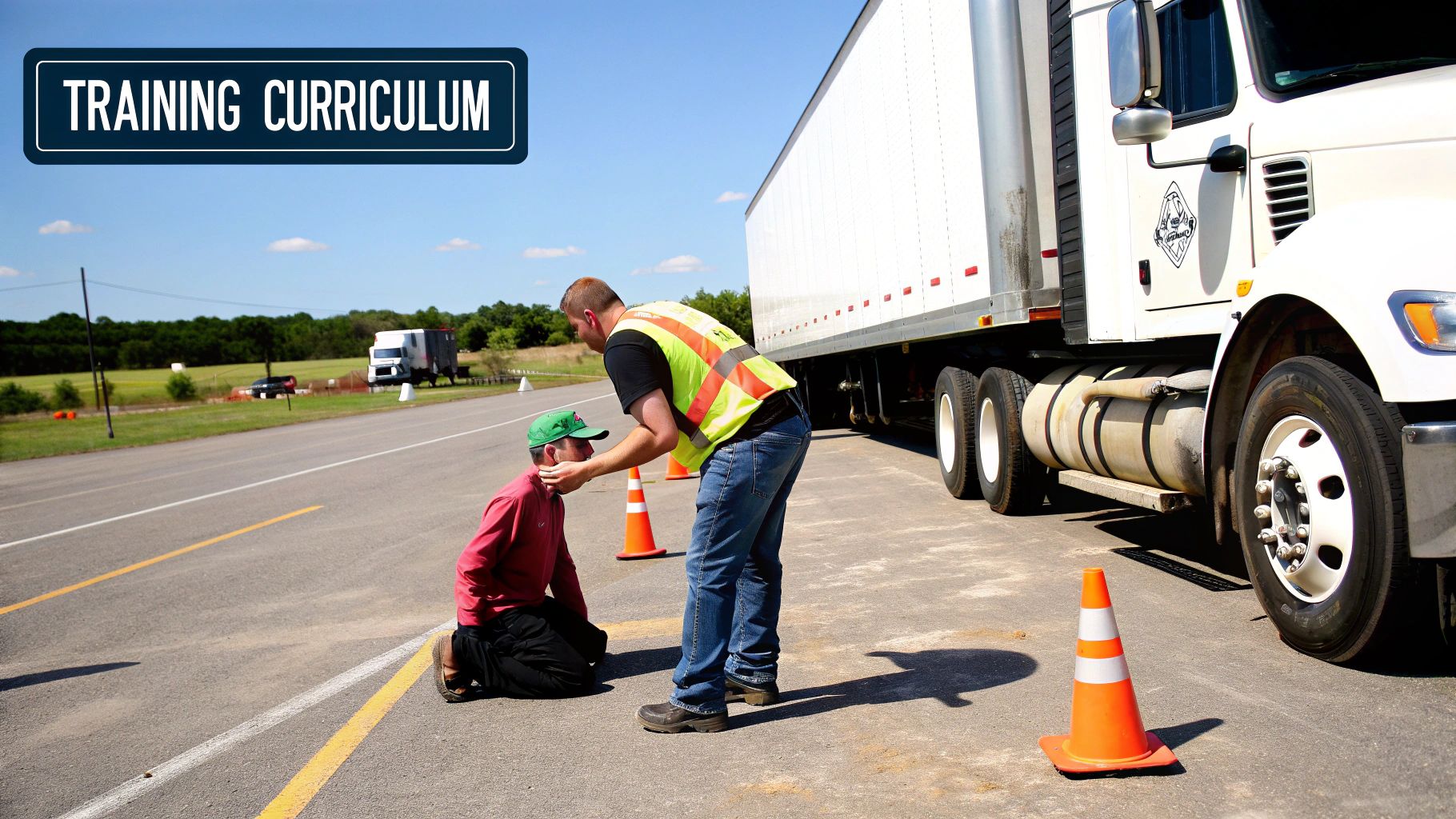
Before you can legally get behind the wheel of a commercial truck, you have to prove you’re medically up to the task. That's where the Department of Transportation (DOT) physical exam and drug screening come into play. This isn't just a box to check; it’s one of the most critical truck driving school requirements because a driver's health is directly tied to everyone's safety on the road.
Don't mistake this for a routine check-up. The DOT physical is a comprehensive assessment performed by a certified medical examiner. They're there to make sure you can handle the unique physical and mental rigors of a trucking career. It's a straight-up pass/fail test that determines if you're even eligible to get a CDL.
What the Medical Examiner Checks
During your exam, the doctor will look at several key health markers. Their main job is to spot any condition that could potentially get in the way of you driving safely. You should be ready for a deep dive into your health history and a hands-on physical evaluation.
Here's a breakdown of what they'll be focusing on:
- Vision and Hearing: Can you see well enough to spot road hazards and read signs, even with glasses or contacts? Can you hear a "forced whisper" from a set distance? It's all about making sure you can perceive what's happening around your rig.
- Blood Pressure and Pulse: The examiner will check your blood pressure and heart rate for any signs of hypertension or other cardiovascular problems that could become a serious risk while you're on a long haul.
- Urinalysis: This simple test serves two purposes. It screens for underlying medical issues like diabetes and is also part of the mandatory drug screening for controlled substances.
- Overall Physical Health: You'll be checked for any physical impairments, respiratory conditions, or neurological problems that could affect your ability to control a commercial vehicle for hours on end.
Navigating Potential Health Roadblocks
Some medical conditions can make things a bit more complicated. If you have an issue like sleep apnea, diabetes, or high blood pressure, it doesn't automatically mean you can't drive. However, it does mean the condition needs to be properly managed, and you might receive a medical certificate that’s valid for a shorter period.
Acing your DOT physical is just as crucial as passing your skills test. It’s the official green light that confirms you are physically prepared for the responsibilities of a professional driver.
In some cases, you might need to get a federal exemption, but be warned—that can be a long and involved process. The best strategy is always to be completely honest about your medical history with the examiner. This medical clearance is a non-negotiable step in your journey, just like the required training programs. You can learn more about what that training involves by looking into the Entry-Level Driver Training (ELDT) mandate, which all new drivers now have to complete. By getting ready for both your physical exam and your hands-on training, you're building a solid foundation for a long, successful career.
Navigating State-Specific Rules and Documents
Think of it this way: federal regulations lay down the national highway system for becoming a truck driver, but your state’s DMV builds the local roads you'll actually drive on. While everyone follows the same basic federal rules, the specific twists and turns of getting your CDL are decided at the state level.
Getting this part wrong is a classic rookie mistake. You could meet every single federal standard, but if you miss one of your state’s unique requirements, you’ll hit a major roadblock. What gets you a license in Texas might not be enough to get you one in California.
This is a great breakdown of the typical costs you can expect to run into, including those tricky state-specific fees.
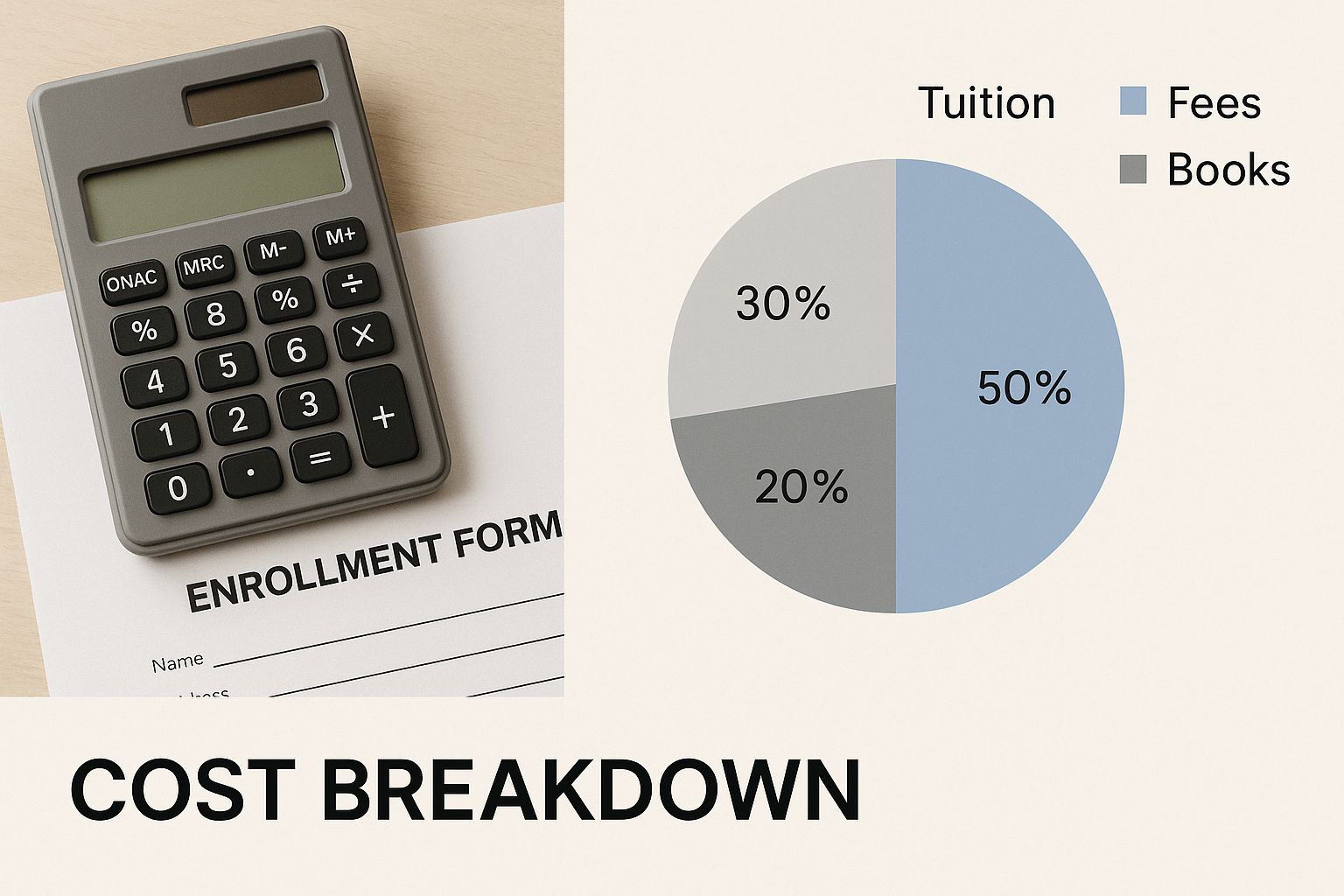
As you can see, tuition is the big ticket item, but those smaller fees for permits, licenses, and background checks are dictated by your state and can definitely add up.
Where State Rules Often Differ
So, where do things usually change from one state line to the next? You’ll see the biggest differences in three main areas: the documents you need, how they handle background checks, and the nitty-gritty details of your final skills test.
For instance, proving who you are and where you live can be surprisingly different. One DMV might be perfectly happy with a utility bill and your birth certificate. The one next door? They might demand a passport, a social security card, and two different proofs of residency, all dated within the last 30 days.
It’s crucial to understand these variations. Here’s a quick look at how things can differ.
Common State-Level Requirement Variations
| Requirement Area | Federal Baseline | Examples of State Variations |
|---|---|---|
| Proof of Residency | Must prove residency in the state of application. | Some states require 1 proof of address (e.g., utility bill), while others may demand 2 or 3 from a very specific list of approved documents. |
| Background Checks | Requires a TSA background check for a HAZMAT endorsement. | States may have their own lists of disqualifying criminal offenses or traffic violations that are stricter than federal rules. |
| Medical Certification | All drivers must pass a DOT physical. | Some states require you to submit your medical certificate before you can even take the CLP written test. Others let you do it later. |
| Vision Standards | Requires 20/40 vision in each eye (with or without correction). | A few states have slightly different standards or may require additional paperwork for drivers with certain vision conditions. |
Ultimately, the best advice I can give is to assume nothing.
Finding Your State's Exact Requirements
Your absolute best friend in this process is your state’s official DMV or licensing agency website. Search for the "Commercial Driver's Manual" or "CDL Handbook." That document is the rulebook for your state, period.
Another smart move is to talk with the admissions advisors at truck driving schools in your area. These folks deal with the local DMV every single day. They know the processes, the paperwork, and the common hang-ups inside and out.
Getting this state-specific guidance is key. To see what I mean, check out this detailed breakdown on getting a CDL in Wisconsin. This kind of local information ensures you’re prepared not just for the big federal rules, but for every little requirement your state throws at you.
Finding the Right School and Program for You
Alright, you've got your paperwork lined up, passed the medical exam, and you understand what your state requires. Now for the fun part—and arguably the most important decision you'll make: picking the right truck driving school.
Think of this as more than just a place to get a license. This is where you build the foundation for your entire career. The quality of your training will directly impact your safety, your confidence, and the kinds of jobs you can land down the road.
First things first, and this is non-negotiable: you absolutely must check that the school is listed on the FMCSA's official Training Provider Registry. If it's not on that list, it’s not ELDT-certified. That means even if you complete their program, you legally won't be allowed to take your CDL skills test. It would be a complete waste of your time and money.
Evaluating Program Structures
Once you've confirmed a school's certification, it's time to dig into what they actually offer. Schools know that everyone's situation is different, so they have all kinds of schedules. Your job is to find one that fits your life without cutting corners on the training itself.
You'll generally see a few common formats:
- Full-Time, Intensive Programs: These are the fast track. You’ll be in class Monday through Friday for several weeks, completely immersed in training. It's designed to get you licensed and earning as quickly as possible.
- Part-Time or Weekend Courses: Perfect if you can't just quit your current job. These programs are spread out over a longer period but give you the flexibility to train while still paying the bills.
- Company-Sponsored Training: Some of the big carriers have their own in-house schools or partnerships. They'll often front the cost of your tuition, but in return, you'll sign a contract to drive for them for a specific period, usually about a year.
Take a hard look at your finances and your personal timeline. A full-time program gets you behind the wheel and making money sooner, but if you have family or work commitments, a part-time schedule might be the only realistic path.
Understanding the Financial Investment
Quality training isn't free, and it's important to know what you're paying for. Good programs are a mix of classroom learning and, most importantly, hands-on driving time. They have to meet strict government standards.
For instance, you might see a comprehensive 245-hour course that covers everything from regulations in the classroom to mastering maneuvers out on the lot.
Choosing a school is your first major career decision. Focus on the quality of the training, not just the price tag. A good education pays for itself with better job opportunities and a stronger safety record.
A program like that might have a sticker price of around $5,650, but don't let that number scare you off. Most schools have ways to help you manage the cost.
Always ask about financial aid, payment plans, grants, or student loans. Many schools also have strong ties to trucking companies that offer tuition reimbursement programs after you've been hired. Looking into these financial options is just as important as any other prerequisite.
Got Questions About Truck School? We’ve Got Answers.
Even after laying out all the basic requirements, you probably still have a few questions. That’s completely normal. The path to getting your CDL is pretty straightforward, but life has a way of throwing curveballs that can make things feel a little confusing.
Let's dive into some of the most common questions we hear from aspiring drivers. We'll give you straight, honest answers to help you navigate these potential bumps in the road.
Can I Go to Trucking School with a Felony?
This is one of the toughest and most frequent questions we get. The short answer is: it depends. Having a felony on your record isn't an automatic "no," but it definitely makes things more complicated.
It really comes down to a few things: what the crime was, how long ago it happened, and what the school's (and future employer's) policies are. Some convictions—especially those involving violence, major theft, or drugs—are serious red flags for this industry.
Your best bet is to be completely upfront. Call the admissions office of any school you're interested in and just be honest about your situation. You'd be surprised; some schools and even some trucking companies have "second-chance" programs, but you’ll never know if you don't ask.
What Happens If I Fail the DOT Medical Exam?
Failing the DOT medical exam means you won't get the medical card you need to drive a commercial truck. But don't panic—it’s not always the end of the line. What happens next depends entirely on why you failed.
If it's for something manageable, like high blood pressure, the examiner might give you a temporary certificate, often for 3 months. The catch is you have to see a specialist and get the condition under control. For some other conditions, you might be able to apply for a special waiver from the FMCSA, but be warned, that process can take a while.
Failing the DOT physical can feel like a major setback, but it’s there for a reason: safety. Your first step should always be to talk with the examiner to understand your options. It might just mean managing a condition or looking into an exemption.
Unfortunately, if you have a condition that is permanently disqualifying with no chance for a waiver, a career in commercial driving won't be possible.
Do I Need a High School Diploma or GED?
Legally, no. There's no federal law that says you need a high school diploma or a GED to get a CDL. But in the real world? Most reputable schools and the big trucking companies absolutely require one. They see it as a basic sign that you can handle the written tests and the daily paperwork that comes with the job.
If you don't have one, your options for quality training and good-paying jobs will be seriously limited. Honestly, the single best thing you can do to open up doors in this industry is to go get your GED. It's the key that unlocks the better schools and better careers.
How Much Does Truck Driving School Cost?
This is the big one. You can expect to see tuition costs ranging anywhere from $3,000 to $10,000. That's a huge range, and it depends on the school's location, how long the program is, and what you're learning. Training for a Class A license, for instance, is almost always more expensive than for a Class B.
Before you sign anything, demand a detailed breakdown of the costs. Does that big number include your permit exam fee, the DOT physical, drug tests, and the final CDL road test? Those extras can add up fast. Also, ask about financial aid, payment plans, or grants for veterans.
Another great option is tuition reimbursement from a trucking company. They’ll pay for your school if you agree to drive for them for a year or so. Just remember, you’ll have to pass the written exams before you can even start. It’s a good idea to start studying for the CDL general knowledge test now so you're ready to go.
At Patriot CDL, we provide clear, affordable training paths to get you on the road to a successful career. Our expert instructors guide you through every step, ensuring you have the skills and confidence to succeed. https://patriotcdl.com