A Class A Commercial Driver's License (CDL) isn't just another license; it's the top-tier certification a professional driver can earn. Think of it as the master key for the trucking industry, unlocking the most versatile and highest-paying jobs on the road.
Understanding the Power of a Class A CDL
It helps to think about licenses like toolkits. Your standard driver’s license is like a basic set you keep in a kitchen drawer—great for everyday fixes. A Class B CDL is a step up, like an apprentice’s kit, letting you handle bigger jobs like dump trucks or city buses.
So, what’s a Class A? It’s the professional-grade master set. It gives you the power and authority to operate pretty much any commercial vehicle combination you see rolling down the highway. This is your ticket to driving the iconic tractor-trailers that are the backbone of the American economy, hauling everything from groceries to industrial machinery.
The Key to Heavy Hauling
The real difference with a Class A license boils down to one thing: weight. Federal regulations are very specific about this, and it’s what sets this license apart. With a Class A, you can legally operate a combination of vehicles—like a tractor and a semi-trailer—with a Gross Combination Weight Rating (GCWR) of 26,001 pounds or more.
The rule of thumb is that the vehicle you're towing must weigh more than 10,000 pounds. This is what puts you in the big leagues, covering everything from standard dry vans and refrigerated units to tankers and flatbeds.
What Vehicles Can You Drive?
Holding a Class A CDL opens up a whole world of possibilities because it qualifies you for such a wide range of equipment. This versatility is a huge advantage when you're looking for a job.
To give you a clearer picture, here’s a quick summary of the vehicle types and weight limits.
Class A CDL at a Glance
| Vehicle Type | Description | Weight Requirements (GCWR) |
|---|---|---|
| Tractor-Trailer | The classic "18-wheeler" or semi-truck, the most common long-haul vehicle. | 26,001 lbs. or more, with the trailer over 10,000 lbs. |
| Truck and Trailer | Includes combinations like double or triple trailers (with proper endorsements). | 26,001 lbs. or more, with each trailer over 10,000 lbs. |
| Tanker Vehicles | Designed to transport bulk liquids like fuel, milk, or chemicals. | Varies, but the combination typically exceeds 26,001 lbs. |
| Flatbed Trucks | Open-platform trucks used for oversized or irregularly shaped cargo. | The GCWR often falls into the 26,001+ lbs. category. |
| Livestock Carriers | Specialized trailers for transporting animals safely across long distances. | The combined weight easily surpasses the Class A threshold. |
As you can see, the Class A license is all about handling serious weight and powerful vehicle combinations.
Beyond those specific rigs, the power of this license is its downward compatibility.
A Class A CDL automatically qualifies you to operate Class B and Class C vehicles. This means you’re never limited by the type of truck an employer needs driven, making you a far more valuable and adaptable driver in any fleet.
Your Roadmap to Earning a Class A CDL
So, you know what a Class A license is. That's step one. But how do you actually get one? It might seem complicated from the outside, but the journey from applicant to professional trucker is a clear, structured path. Let's break down the whole process into a simple roadmap.
The very first thing to tackle is making sure you meet the basic requirements. Before you even think about getting behind the wheel, you have to clear a few federal and state hurdles. You’ll need to be at least 18 years old to drive within your state (intrastate) and 21 years old to drive across state lines (interstate).
You'll also need a valid, standard driver's license and a clean driving record. A history of serious traffic violations can be a real showstopper, so it's a good idea to make sure your record is in good shape before you start.
First Milestone: Nailing the Commercial Learner’s Permit
Once you’ve confirmed you’re eligible, your next mission is getting your Commercial Learner’s Permit (CLP). Think of the CLP as a "learner's permit" for big rigs. It’s a mandatory step that lets you legally practice driving a Class A truck on public roads, as long as you have a licensed CDL holder riding shotgun.
To get your CLP, you’ll head to the DMV and pass a series of written knowledge tests. These exams cover the essentials: general trucking knowledge, combination vehicles, and air brakes. The key here is to really dig into your state's CDL manual—it's your bible for this stage. If you want a deeper dive, check out our guide on how to prep for the CDL permit process.
Why Formal Training is Non-Negotiable
With your CLP in hand, it's time for the most important phase: enrolling in a certified training program. This isn't just a good idea; it's the law. As of February 2022, the Federal Motor Carrier Safety Administration (FMCSA) requires all new CDL applicants to complete Entry-Level Driver Training (ELDT) from a registered school. This rule ensures every new driver hits the road with the same solid foundation of knowledge.
ELDT is broken into two main parts:
- Classroom (Theory) Training: This is where you learn the "why" behind the "how." You'll cover everything from basic vehicle controls and safety rules to the less obvious stuff, like handling cargo and keeping accurate logs.
- Behind-the-Wheel Training: Now for the fun part! This is where theory meets reality. You’ll get in a real truck and master essential skills on a practice range before heading out on public roads with a certified instructor right beside you.
This training is all about building real-world competence and the confidence you need to not just pass the final exam, but to have a long, safe career.
This chart lays out the entire process visually, from understanding the vehicles you can operate to finally earning that license.
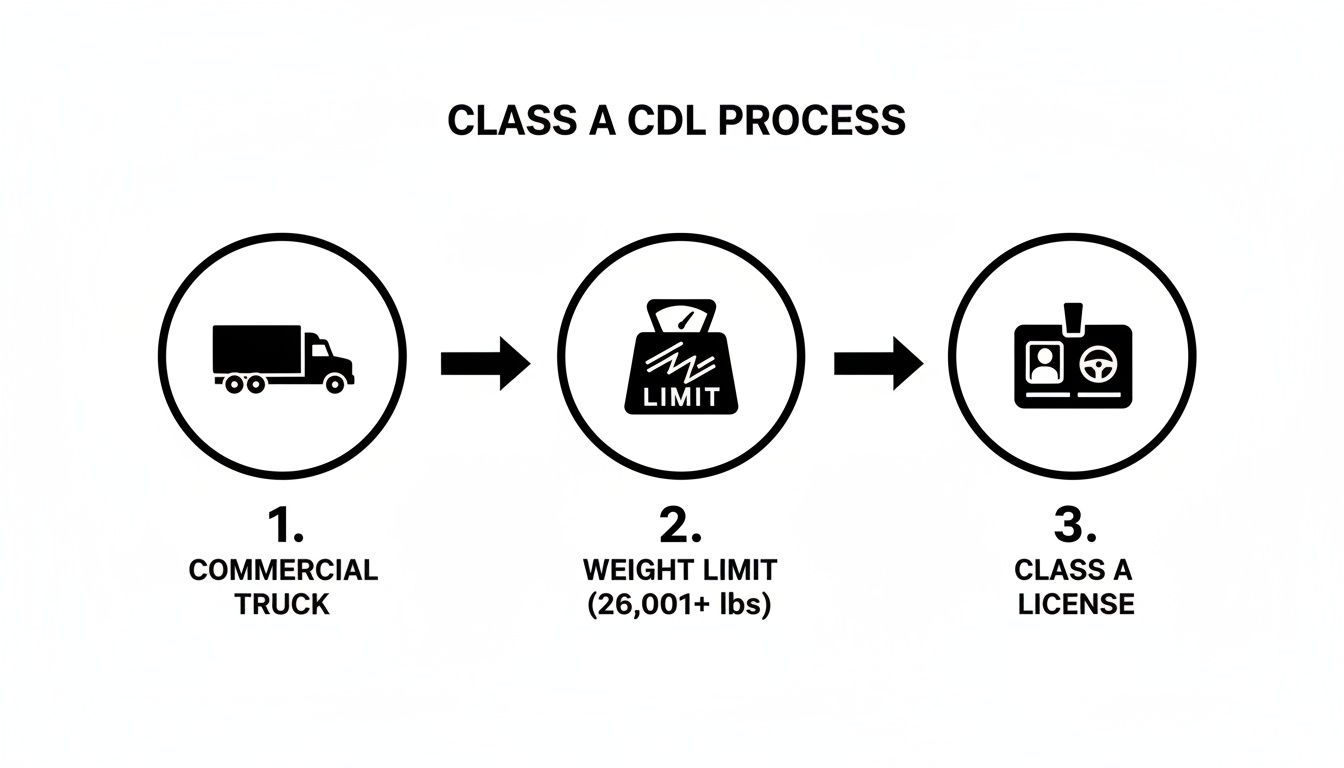
As you can see, each step logically builds on the one before it, leading you straight to your goal.
The Final Stretch: Medical and Skills Tests
Before you can take your final driving test, you need to get the green light on your health. This involves passing a Department of Transportation (DOT) medical exam. A certified medical examiner will give you a physical to make sure you're healthy enough to safely handle the demands of driving a commercial vehicle. Once you pass, you get a medical certificate that you must have with you anytime you're driving.
The final hurdle is the CDL skills test itself. This is the big one—a comprehensive, three-part exam that puts your practical abilities to the test.
The CDL skills test has three make-or-break parts: the pre-trip inspection, basic vehicle control skills, and the on-road driving test. You have to pass all three to earn your Class A CDL.
First up is the pre-trip inspection. You'll walk around the truck with an examiner and prove you can identify key parts and confirm they're in safe working order. Next, you’ll tackle basic control skills, which are a series of parking lot maneuvers like straight-line backing, offset backing, and alley docking. Finally, you’ll take the truck out on the road with the examiner to demonstrate you can drive safely and confidently in real traffic.
Understanding Federal and State CDL Requirements
Getting your Class A CDL means you'll be dealing with rules set at both the national and state levels. It’s a lot like building a house: the federal government provides the universal building code everyone has to follow, but your state and local authorities have their own specific permits and inspections you need to pass. You have to satisfy both to get the job done right.
The Federal Motor Carrier Safety Administration (FMCSA) sets the baseline for every commercial driver in the United States. These are the non-negotiable standards that apply whether you're in California or Maine, creating a consistent level of safety and skill across the country.
These federal rules cover the big stuff. For example, the FMCSA now requires all new drivers to complete Entry-Level Driver Training (ELDT). This ensures everyone gets a solid foundation in both classroom theory and hands-on, behind-the-wheel instruction before they can even take their CDL test.
The Federal Foundation of CDL Rules
Federal rules are all about safety, especially for drivers crossing state lines (interstate commerce). The goal is to make sure every driver on America's highways is physically and mentally up for the challenge of handling a big rig.
A few of the key federal mandates include:
- Minimum Age: You have to be at least 21 years old to drive a commercial truck from one state to another.
- Medical Fitness Standards: Every driver has to pass a Department of Transportation (DOT) physical exam to prove they're healthy enough for the job.
- Drug and Alcohol Testing: The FMCSA enforces a zero-tolerance policy, backed by a national Clearinghouse database, to keep our roads safe from impaired driving.
No matter where you live, these federal standards are the bedrock of your CDL journey.
How State Requirements Add Another Layer
While the feds create the framework, it's your state’s DMV (or equivalent agency) that actually issues your license. States can, and do, add their own rules on top of the federal ones—as long as they meet or exceed the national minimum. This is where you'll see some differences from one state to the next.
For example, while the federal age for interstate driving is 21, many states allow drivers as young as 18 to get a CDL for intrastate work, meaning they can only operate a commercial vehicle within that state's borders. It's a great way for younger drivers to get their foot in the door and gain experience.
States also have specific documentation requirements. When you head to the DMV for your Commercial Learner's Permit (CLP), you'll need to bring proof of identity, residency, and legal status. The exact documents vary, so it’s always a good idea to check your local CDL requirements to make sure you have all your paperwork in order.
The Purpose of the DOT Physical and Medical Card
Passing the DOT physical is a critical step that satisfies both federal and state mandates. This isn't just a quick check-up; it's a thorough health screening designed to confirm you can handle the unique physical and mental stresses of professional driving.
The DOT physical is a non-negotiable safety measure. It’s there to catch any medical conditions that could make it unsafe to operate an 80,000-pound vehicle, protecting you and everyone else on the road.
A certified medical examiner will check several key areas:
- Vision and Hearing: You have to meet minimum standards, with or without glasses or hearing aids.
- Blood Pressure and Pulse: They'll check for conditions like high blood pressure or an irregular heartbeat that could be risky on the road.
- Urinalysis: This quick test screens for underlying health issues, like diabetes.
- Overall Physical Health: The doctor will also assess your neurological health, heart condition, and look for any physical impairments.
Once you pass, you'll be issued a DOT Medical Certificate, often called a "Med Card." You are legally required to have this card with you anytime you're behind the wheel of a commercial truck. It's the final piece of the puzzle, proving you're medically qualified and fully compliant.
How to Pass the Class A CDL Exam
The final hurdle on your path to a Class A CDL is the exam itself. This is where all your training comes together, proving you’ve got both the book smarts and the real-world skills to safely handle a commercial vehicle. The test is broken down into two main parts: a series of written knowledge tests and a hands-on skills test.
Passing these exams can feel like a monumental task, but the right preparation turns that anxiety into pure confidence. The secret is knowing exactly what each part of the test covers and what the examiners are really looking for.
Conquering the Written Knowledge Tests
Before you even climb into the cab for training, your journey starts at a computer at the DMV. You have to pass these written exams to get your Commercial Learner's Permit (CLP), which is your ticket to start behind-the-wheel practice.
For a Class A license, there are three tests you absolutely must pass:
- General Knowledge: This is the big one. It covers a huge range of topics from vehicle control and safety protocols to handling cargo and knowing the federal rules of the road.
- Combination Vehicles: This exam is all about what makes a Class A rig unique. It dives into the specifics of driving a tractor-trailer, like coupling and uncoupling, managing air lines, and avoiding rollovers.
- Air Brakes: Every Class A truck relies on an air brake system. You'll need to prove you know how they work, how to check them, and how to use them safely and effectively.
A deep understanding here is non-negotiable. For an extra edge, check out our guide on how to ace the General Knowledge Test.
Mastering the Three-Part Skills Test
Once you have your CLP and have logged your training hours, it’s time for the main event: the practical skills test. This is where you show the examiner you can actually handle the rig. It's split into three distinct sections, and you have to pass each one to move on.
1. The Pre-Trip Vehicle Inspection
This isn't just a test—it's the most critical safety routine you'll perform every single day of your career. An examiner will follow you around the truck as you point out and name key components, explaining what you’re checking and why it’s important. You'll cover everything from the engine compartment and coupling system to the tires, brakes, and lights, proving the vehicle is 100% safe for the road.
2. Basic Control Skills (Maneuvers)
Next up, you'll head to a closed course to show off your low-speed precision. These maneuvers are designed to test your control and your spatial awareness of the truck and its massive trailer.
Think of this part as the driver's equivalent of an obstacle course. You'll be asked to perform specific backing maneuvers that prove you can place a 53-foot trailer exactly where it needs to go—a fundamental skill for any professional driver.
You can expect to tackle maneuvers like these:
- Straight-Line Backing: Just what it sounds like—backing the rig in a straight line for about 100 feet.
- Offset Backing (Left or Right): Backing the trailer into an adjacent lane without hitting any cones.
- Alley Dock: Often considered the toughest one, this requires you to back the trailer into a space perpendicular to your truck, simulating a real loading dock.
3. The On-Road Driving Test
For the grand finale, you'll take the truck out onto public roads with the examiner in the passenger seat. They’ll be evaluating your ability to operate safely in real-world traffic. They'll watch how you handle intersections, manage your speed, use your signals, and maintain lane control. This is your moment to prove you're a defensive, competent, and road-ready professional.
Boost Your Career with CDL Endorsements
Think of your brand-new Class A CDL as the solid foundation for your trucking career. It gets you in the driver's seat and qualifies you for a ton of great jobs. But endorsements? They’re like adding a turbocharger. They unlock specialized, higher-paying opportunities that a standard license simply can't touch. Adding these qualifications is the single best way to maximize your earning potential right out of the gate.
A standard Class A is a fantastic start, but companies are always on the lookout for drivers who can handle more specialized loads. When you earn endorsements, you instantly become a more valuable asset to any fleet. This opens doors to niche markets where demand for skilled drivers is high and the paychecks show it.
Unlocking High-Value Freight With Key Endorsements
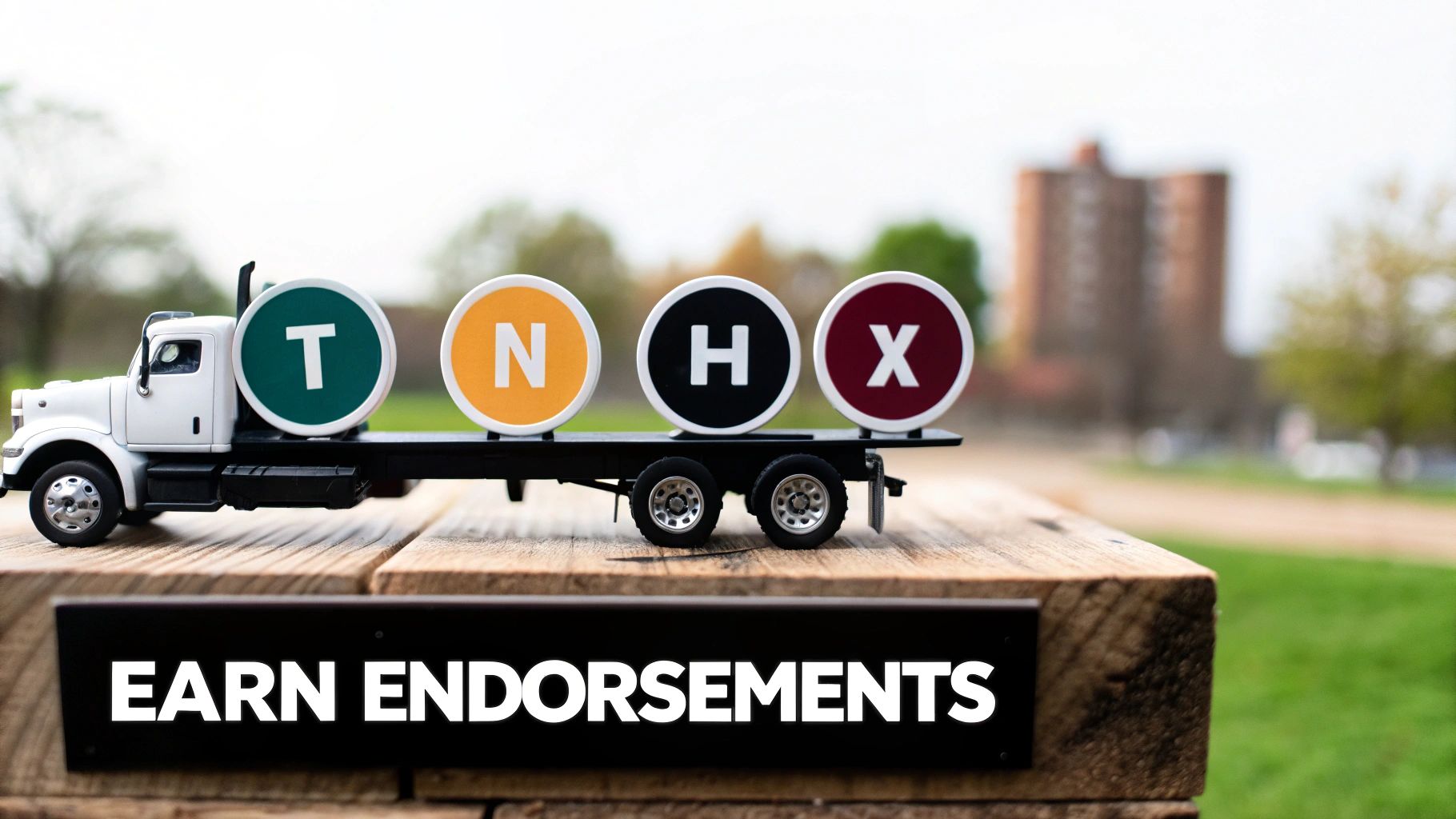
Not all endorsements are created equal. A few stand out for their ability to seriously level up your career. Each one requires passing a specific written knowledge test, and some, like HazMat, involve a background check. Let’s break down the most common and valuable ones you can add to your Class A license.
The table below connects these endorsements to the real-world jobs they unlock, helping you map out your future career.
Common Class A Endorsements and Career Paths
| Endorsement Letter | What It Allows | Typical Career Examples |
|---|---|---|
| T | Hauling double or triple trailers (Long Combination Vehicles or LCVs) | Less-Than-Truckload (LTL) linehaul, parcel delivery (FedEx, UPS), long-haul freight networks |
| N | Operating a tank vehicle to transport bulk non-hazardous liquids or gasses | Food-grade transport (milk, juice), water hauling, non-hazardous industrial chemical transport |
| H | Transporting loads classified as hazardous materials (requires a TSA background check) | Chemical transport, medical waste hauling, fuel delivery, transporting industrial materials |
| X | Combination of N and H; hauling hazardous materials in a tank vehicle (e.g., gasoline) | Fuel tanker driver (gas station delivery), industrial chemical hauler, specialized HazMat liquid transport |
These endorsements are more than just letters on your license; they are direct pathways to better pay and more job security. It's not just about what you can do—it's also about removing limitations. For example, some drivers have a restriction that prevents them from operating a truck with a manual transmission. Learning more about our E restriction removal course can open up even more job opportunities.
The Power of Combined Endorsements
You may have noticed the X endorsement in the table. This isn't a separate test but a powerful combination of the Tank (N) and Hazardous Materials (H) endorsements. It certifies you to transport hazardous liquids in a tanker—think gasoline, industrial chemicals, and other high-value, high-risk materials.
The X endorsement is one of the most sought-after qualifications in the trucking industry. Drivers holding it are in constant demand for jobs that are often among the highest-paying in the entire sector.
The industry is facing a massive driver shortage, which is expected to get even more critical by 2026. This creates a golden opportunity for new drivers who are properly qualified. While there are about 3.06 million truck drivers on U.S. roads in 2024, it’s not enough to meet the demand.
Making matters worse, the federal Drug & Alcohol Clearinghouse has sidelined over 180,000 drivers since 2020. With many of them unable to return to work, the need for qualified, endorsed professionals is more intense than ever.
By planning to get these endorsements during or right after your CDL training, you position yourself for success from day one. Each one you add makes you a more versatile and indispensable driver in a rapidly growing industry.
What's the Career Outlook for Class A Truck Drivers?
Getting your Class A CDL isn't just about passing a test; it’s about making a smart investment in a stable, rewarding career. This license is your ticket into the industry that literally moves America, offering incredible job security and real opportunities to advance. The demand for qualified drivers is always high, which means it’s a great market to jump into.
This demand isn't going away anytime soon. A persistent driver shortage means companies are constantly looking for skilled professionals. With a Class A license in hand, you instantly become a valuable candidate in an industry that needs talent to keep the country's supply chain running.
Earning Potential and Room to Grow
Let's talk money, because it's one of the best parts of a Class A career. While your starting salary will depend on where you live and who you drive for, new drivers earn a solid income from day one. Unlike a lot of other jobs, the path to making more money is straightforward and happens fast.
Your pay isn't set in stone. It grows as you get more miles under your belt and, crucially, when you add endorsements to your license. As you learn to handle specialized cargo—like hazardous materials or oversized loads—your value as a driver goes through the roof. That translates directly to bigger paychecks and better job opportunities.
A Class A CDL is more than a license—it's your launchpad into a booming, resilient industry. Trucking is responsible for hauling 72.6% of U.S. freight by weight, with 2.97 million tractor-trailers needing skilled Class A drivers. While 3.54 million drivers were employed in 2023, a significant shortage remains due to factors like an aging workforce and industry-wide training gaps.
Finding the Career Path That Fits You
A common myth is that all trucking jobs are the same long, lonely hauls. The reality is that a Class A license unlocks a surprising variety of career paths, so you can find a job that fits your life. You really get to decide what kind of work you want to do. For more industry insights and career tips, explore our Patriot CDL blog.
Here are a few of the main routes you can take:
- Over-the-Road (OTR): This is the classic long-haul lifestyle. You'll be on the road for extended stretches, crossing state lines and seeing the country. OTR jobs often come with the highest paychecks, especially right out of school.
- Regional Driving: Regional drivers stick to a specific part of the country, like the Southeast or the Midwest. This is a great balance, giving you more home time—often every weekend—while still letting you rack up miles.
- Local Driving: Want to sleep in your own bed every night? A local driving job is what you’re looking for. These jobs involve making pickups and deliveries in a set metro area, giving you a predictable schedule and maximum time at home.
This kind of flexibility means you can build a sustainable, well-paid career that can change as your life does—and it all starts with just a few weeks of focused training.
Your Top Class A CDL Questions Answered
It's completely normal to have a few lingering questions as you get serious about earning your Class A CDL. Let's clear up some of the most common ones so you can move forward with confidence.
How Long Does It Take to Get a Class A CDL?
Believe it or not, you can be fully licensed and ready for the road much faster than you might think. Many accelerated training programs, like the ones we offer, are designed to get you from beginner to licensed professional in just three to seven weeks.
These intensive courses are built to efficiently cover everything you need—from the required classroom theory to the essential hands-on driving skills. Of course, the exact timeline also depends on how quickly you can schedule your permit and skills tests at the local DMV.
Can I Get a Class A CDL with a Bad Driving Record?
Your driving history is definitely a big piece of the puzzle. A minor speeding ticket from five years ago probably won't hold you back, but recent or serious violations are another story. Things like DUIs, reckless driving convictions, or a suspended license can be major roadblocks.
Both federal regulations and individual company hiring policies are very strict on this. The best first step is to get a current copy of your Motor Vehicle Record (MVR) to see exactly where you stand before you even think about enrolling.
What Is the Difference Between a Class A and Class B CDL?
It all boils down to the weight and type of vehicle you can drive.
A Class A license is the king of the road, letting you operate combination vehicles—think a semi-truck pulling a heavy trailer. Specifically, it's for rigs with a combined weight of 26,001+ lbs., where the trailer alone weighs more than 10,000 lbs.
A Class B license, on the other hand, is for heavy single vehicles like dump trucks or city buses that weigh over 26,001+ lbs. With a Class B, you can only tow smaller trailers that are under 10,000 lbs.
The real advantage? A Class A CDL automatically qualifies you to drive Class B and Class C vehicles, too. This versatility opens up way more job opportunities and makes you a much more attractive hire.
Ready to shift gears and build a stable, high-paying career on the open road? At Patriot CDL, we provide the expert training and dedicated support to get you licensed quickly and confidently. Explore our programs and enroll today.