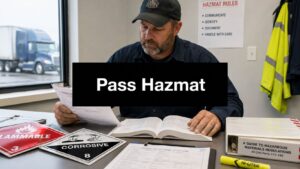
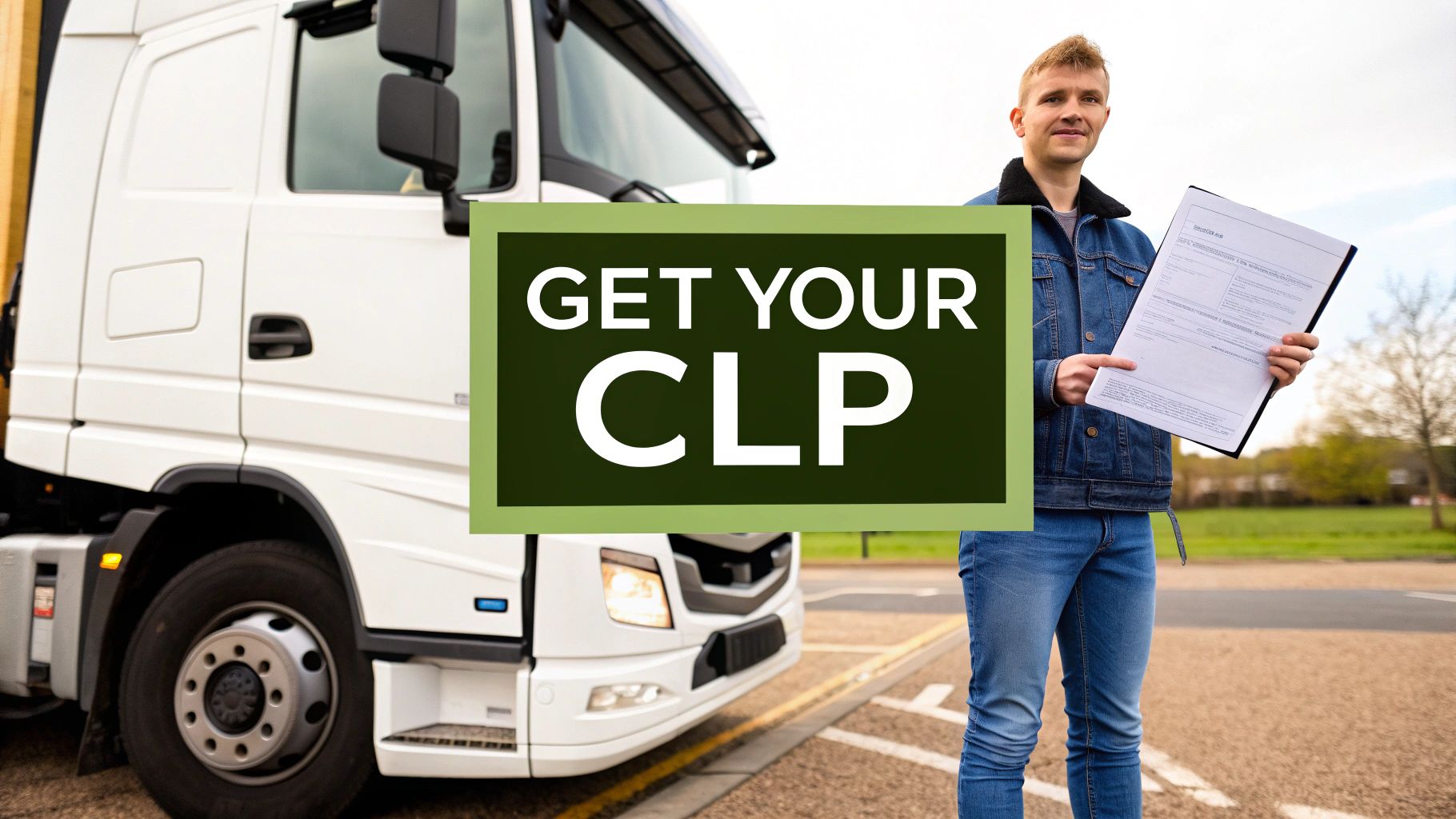
So, what exactly is a Commercial Learner's Permit, or CLP? Think of it as your "student driver" license, but for the big leagues—the world of semi-trucks and other large commercial vehicles. This permit is the official green light that lets you move from the classroom to the driver's seat and start your behind-the-wheel training on public roads.
The CLP: Your Starting Line for a Trucking Career
Before you can even think about getting your full Commercial Driver's License (CDL), you have to get your CLP first. It's a non-negotiable step, and for good reason. The whole system is set up to create a safe, structured environment for you to learn the ropes.
The CLP isn't just another piece of plastic for your wallet; it's your key to real-world, hands-on experience, but with a crucial safety net. While you're driving with a CLP, you are legally required to have a fully licensed CDL holder in the passenger seat with you at all times. This isn't just a suggestion—it's the law.
This setup ensures you get immediate, expert feedback on everything from shifting gears in traffic to backing into a tight spot, all under the watchful eye of someone who has been there and done that.
Why Start with a CLP?
The CLP process is all about building a solid foundation, one skill at a time. Rather than throwing you into the deep end, it lets you ease into the complexities of handling an 80,000-pound vehicle, building your confidence and competence in a controlled way. This training period is absolutely essential for mastering the fundamentals before you face the final CDL skills test.
And what an industry to get into. The demand for skilled, professional drivers is through the roof. The global freight trucking market is already a massive $2.2 trillion industry and is expected to hit $3.4 trillion by 2030. Right now, there are about 3.54 million truck drivers working in the United States, making the CLP your official ticket into a stable, rewarding career with plenty of room to grow.
A Commercial Learner's Permit isn't just a box to check; it's the bridge that connects what you learn in a book to what you actually do on the road. It's the structured path you need to safely build the skills for a long and successful career in trucking.
Getting your CLP is the moment your trucking career officially begins. It proves you've passed the initial knowledge tests and are ready to put that theory into practice. It’s the first, most important milestone on your journey to becoming a fully licensed professional driver.
Understanding the Key Differences Between a CLP and a CDL
It’s easy to get the Commercial Learner’s Permit (CLP) and the Commercial Driver’s License (CDL) mixed up, but they mark two completely different points in your trucking journey.
Here's the simplest way to think about it: a CLP is your license to learn, while a CDL is your license to earn. This isn't just a catchy phrase; it's the core of how each credential works and what it allows you to do.
The Supervision Rule: Learning vs. Earning
The biggest single difference between the two is the supervision requirement. When you have a CLP, you can never operate a commercial vehicle by yourself. A fully licensed CDL holder must always be right there in the front passenger seat with you, acting as your guide and mentor. It’s a built-in safety net designed to give you real-world experience under expert supervision.
Once you pass your skills test and earn that full CDL, the game changes completely. You’re now legally qualified to drive solo. This is the moment you gain the freedom to operate your rig independently and take full responsibility for your vehicle and its cargo.
To make these distinctions crystal clear, here’s a quick breakdown.
CLP vs CDL: A Quick Comparison
| Feature | Commercial Learner's Permit (CLP) | Commercial Driver's License (CDL) |
|---|---|---|
| Primary Purpose | Supervised training on public roads | Professional, unsupervised operation of a commercial vehicle |
| Driving Solo | Strictly prohibited | Permitted |
| Supervision | Required: A CDL holder must be in the front seat | Not required |
| Passengers | Generally not allowed (except for the supervisor) | Allowed, depending on vehicle type and company policy |
| Cargo | Restrictions apply; no hazardous materials allowed | Permitted, including specialized loads with proper endorsements |
| Duration | Temporary, typically valid for 180 days with a renewal option | Long-term license, typically renewed every 4-8 years |
As you can see, the CLP is a temporary credential focused entirely on training, while the CDL is the final qualification that certifies you’re ready to hit the road as a professional.
From Permit Holder to Professional Driver
This difference in freedom comes with a major difference in responsibility. A CLP holder operates with significant limitations. For instance, you’re absolutely forbidden from transporting hazardous materials, no matter who is in the passenger seat.
A CDL, however, is your ticket to the full spectrum of trucking jobs. With the right endorsements, you can haul anything from tankers to hazardous materials, opening up more specialized and often higher-paying opportunities. This career path is all about progressive steps, starting with the permit.
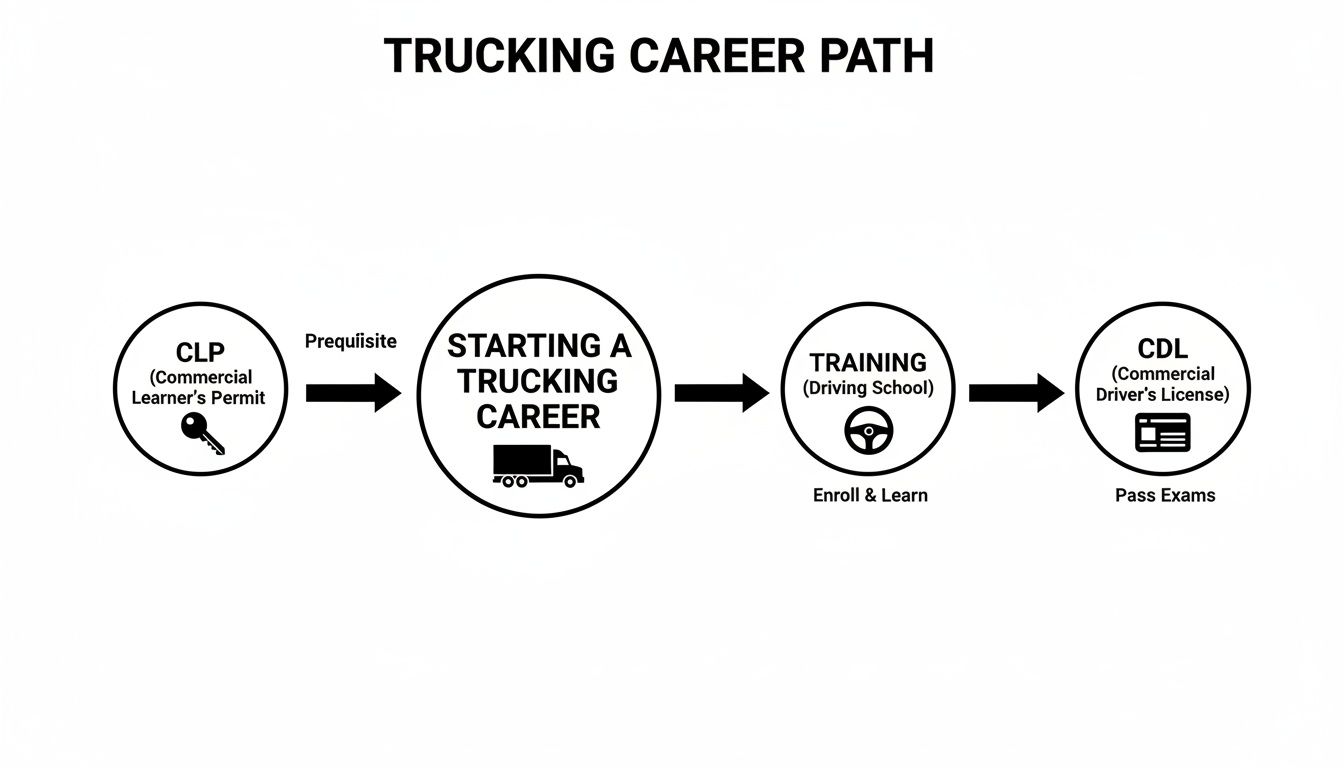
This graphic lays it out perfectly: the CLP is the essential first step. It’s followed by hands-on training, which prepares you to meet all federal and state CDL requirements and earn your full license.
How to Get Your Commercial Learner's Permit Step by Step
Getting your Commercial Learner's Permit can feel like a mountain of paperwork and tests, but it's really just a series of manageable steps. Think of it as a roadmap. Let's walk through the four key milestones you'll need to hit to get that CLP in your hand.
Step 1: Confirm You Meet the Basic Requirements
Before you crack open a study guide, the very first thing to do is make sure you're eligible. This simple check saves you a ton of time and potential headaches down the road.
- Age: You have to be at least 18 years old for an intrastate CLP (which lets you drive within your state’s borders). To cross state lines, you’ll need an interstate CLP, and for that, you must be 21 years old.
- Residency: You’ll need to prove you live in the state where you’re applying. A recent utility bill or a rental agreement usually does the trick.
- Driving Record: A valid, standard driver's license is a must, along with a clean driving history.
Step 2: Pass Your DOT Physical Exam
Next up, you have to show you're medically cleared to handle the demands of driving a commercial vehicle. This isn’t just any physical; it has to be done by a certified medical examiner who is listed on the National Registry.
When you pass, you'll be given a Medical Examiner's Certificate (MEC), which most people just call a DOT medical card. This isn't optional—it's a critical piece of your CLP application. My advice? Get this done early on.
Step 3: Ace the Written Knowledge Exams
This is where the studying pays off. You'll head to your local DMV to take a few written tests that prove you know the rules of the road and the mechanics of these big rigs. For a Class A license, you're typically looking at three core exams:
- General Knowledge: This is the big one. It covers everything from vehicle inspection and control to federal safety rules.
- Air Brakes: This test is all about the complex air brake systems on commercial trucks—how they work, how to test them, and how to use them safely.
- Combination Vehicles: This exam focuses on the unique physics of driving a tractor-trailer, like managing the "crack-the-whip" effect and properly coupling and uncoupling.
To make sure you're ready, you need a solid study plan. A great place to start is by learning everything you can about the General Knowledge test.
Remember, passing these written exams is what qualifies you to receive the permit. Your performance directly determines your eligibility to start behind-the-wheel training.
Step 4: Gather Your Documents and Submit Your Application
Once you've passed your exams and have your medical certificate, it's time for the final sprint. Gather up all your paperwork and make a trip to the DMV. The exact list can vary a bit from state to state, but you'll almost always need:
- Your current, valid driver's license
- Proof of U.S. citizenship or lawful permanent residency
- Your Social Security card
- The DOT Medical Examiner's Certificate
- Proof that you passed all the required knowledge tests
After you’ve submitted everything and paid the fees, you'll be issued your CLP. This is the moment you've been working for—it's your official green light to start training on public roads with a qualified CDL holder in the passenger seat.
Understanding CLP Rules of the Road and Restrictions
Once you have your CLP in hand, you’re not just handed the keys and wished good luck. Think of it as a guided learning experience with built-in safety measures. These rules aren't meant to be a hassle; they create a safe, controlled environment for you to master the fundamentals of handling a big rig.
The golden rule is that you can never drive alone. A fully licensed CDL holder must be in the front passenger seat at all times, acting as your co-pilot. They’re there to guide you, provide real-time feedback, and step in if necessary.
Key On-the-Road Restrictions
Beyond the co-pilot rule, there are a few other non-negotiable restrictions you need to stick to while you're learning. These are federal mandates designed to keep everyone safe.
- Public Roads Only: All your practice driving must happen on public roads. You can't just take the truck for a spin in a private lot or a company yard without your supervising CDL holder beside you.
- No Cell Phones: The Federal Motor Carrier Safety Administration (FMCSA) has a zero-tolerance policy for handheld cell phone use, and this is especially true for new drivers. Put it away and focus on the road.
- No Hazardous Materials: You're strictly forbidden from hauling any kind of hazardous material. That requires a special endorsement on a full CDL.
It's also worth noting that if you test in an automatic truck, your permit will come with an “E” restriction, limiting you to automatic transmissions. But don't worry, that's not a permanent roadblock. Our E-Restriction Removal Course can help you get that lifted, opening up far more job opportunities down the road.
These restrictions aren't designed to hold you back. They are guardrails that guide you as you learn to handle the immense responsibility of operating a commercial vehicle, ensuring you are fully prepared for a successful career.
From Permit Holder to Pro Driver: Your Training Journey
Getting your Commercial Learner's Permit is a huge step, but now the real work—and the fun—begins. This is where the book smarts you gained for the written tests meet the pavement.
There's a federally mandated 14-day waiting period that kicks in the moment you get your CLP. You can't just get the permit one day and take the final road test the next. This isn't just a waiting game; it's your designated training time to get comfortable behind the wheel.
Think of these two weeks as your hands-on bootcamp. You'll be in the driver's seat with a licensed professional, turning all that theoretical knowledge into real-world driving skills. It’s your chance to practice everything from parking and backing up to navigating busy roads under expert guidance.
Understanding Your CLP Timeline
While the waiting period is a strict 14-day minimum, your CLP itself has a much longer shelf life. Most permits are valid for 180 days, giving you a solid six-month window to get your training done and pass the final skills test.
This flexibility is great because everyone learns at a different pace. If life gets in the way or you need more practice, you can usually renew your CLP once for another 180 days, though you should always check your specific state's rules.
The CLP holding period is your training ground. It's designed to transform you from someone who can pass a test into a confident, capable driver ready for the massive responsibility of operating a commercial vehicle.
During this phase, you'll be diving deep into the practical side of trucking. A huge part of this is mastering the pre-trip inspection. You need to know that truck inside and out, not just to pass the test, but to stay safe on the road every single day.
With good, focused training, you can go from a fresh permit holder to a licensed professional in just a matter of weeks, fully equipped and ready to start your career.
From Learner's Permit to Professional Driver
Getting your Commercial Learner's Permit isn't the finish line—it's the starting pistol for your entire trucking career. This is where the real work begins, and having the right support system can be the difference between just passing the test and building a successful, long-term profession on the road.
Think of it this way: a quality training program is designed to take that freshly-printed permit and turn it into real-world skill. You need a solid foundation from day one, with expert instructors and study materials that help you breeze through the knowledge tests and get your CLP in hand without any unnecessary delays.
Making the Most of Your Training Time
That mandatory holding period for your CLP? It’s not a waiting game. It's a golden opportunity for focused, hands-on training. This is when you'll move from reading the manual to actually mastering the machine—from perfecting pre-trip inspections to nailing tricky backing maneuvers, all with an experienced instructor right there beside you. This isn't just about learning the ropes; it's about building the confidence to own the road.
A CLP is your license to learn, but a quality training program is what ensures you’re ready to earn. It provides a clear, supportive path from your first day to your final road test.
For newcomers, figuring out how to showcase your skills and land that first job can feel daunting. Resources that explain how to get hired with no experience can give you a major advantage. When you pick the right school, you're not just a student—you're a future professional they're invested in. They’ll make sure you have everything you need to pass your CDL exam and start your career with confidence.
Want more insights into the industry? Check out our trucking industry blog.
At Patriot CDL, we're here to guide you on a clear, efficient, and supportive path to launch your trucking career. Get the expert training you need to turn that permit into a profession. Learn more about our CDL programs.