

A DOT medical card is, quite simply, your official green light from a medical professional, confirming you're healthy enough to be behind the wheel of a big rig. Think of it less like a license and more like a driver's health passport. It's a non-negotiable federal requirement that proves you can safely handle the physical and mental demands of operating heavy machinery on our nation's highways.
The Foundation of Driver Safety
At its heart, the whole point of the card is to prevent accidents. Imagine the chaos that could unfold if a driver had a sudden, severe medical emergency while hauling 80,000 pounds down the interstate. This card is a key safety measure put in place by the Federal Motor Carrier Safety Administration (FMCSA), the federal agency that makes the rules for the trucking industry.
This certification, officially called the Medical Examiner’s Certificate (MEC), is a must-have for any driver operating a commercial vehicle that fits certain criteria. The FMCSA draws a clear line: if your truck has a gross weight rating over 10,000 pounds or if you're hauling certain hazardous materials, you need this medical clearance. Period.
This isn't just bureaucratic red tape. It’s a formal declaration from a specially certified medical examiner stating that you don't have any health conditions—physical or mental—that could get in the way of you driving safely. Getting ready for this exam is one of the very first hurdles on your path to getting a commercial license, so it pays to know what's expected before you even think about your CDL permit. For more on those crucial first steps, check out our guide on obtaining your commercial learner's permit.
To give you a quick rundown, here are the essential details about the DOT medical card.
DOT Medical Card At a Glance
| Aspect | Details |
|---|---|
| Official Name | Medical Examiner’s Certificate (MEC) |
| Governing Body | Federal Motor Carrier Safety Administration (FMCSA) |
| Purpose | To certify a driver is medically fit to operate a commercial motor vehicle safely. |
| Issued By | A certified medical examiner listed on the FMCSA National Registry. |
| Key Trigger | Required for operating vehicles with a GVWR over 10,000 lbs in interstate commerce. |
This table boils it down, but the real question is—does this apply to you? Let's get into the specifics.
Who Needs a DOT Medical Card?
The regulations are very clear, all in the name of keeping the roads safe for everyone. The rules are designed to ensure that anyone driving the largest and heaviest vehicles is medically up to the task.
Generally speaking, you’re required to have a valid DOT medical card if you operate a commercial motor vehicle for interstate commerce and your situation matches any of these criteria:
- Vehicle Weight: Your truck has a gross vehicle weight rating (GVWR) or gross combination weight rating of 10,001 pounds or more.
- Passenger Transport: The vehicle is designed to carry more than 15 passengers (including you, the driver), but not for pay.
- Paid Passenger Transport: The vehicle is designed to carry 9 to 15 passengers (including the driver) for direct compensation.
- Hazardous Materials: You're transporting hazardous materials in a quantity that legally requires placards on the vehicle.
So, Who Actually Needs a DOT Medical Card?
Figuring out if you need a DOT medical card can feel a bit murky. The short answer is, it depends on what you drive and where you drive it. The rules hinge on whether you’re engaged in interstate commerce (crossing state lines) or intrastate commerce (driving only within your home state). While states can have their own specific rules, the federal standards are the foundation for nearly all commercial drivers.
The Federal Motor Carrier Safety Administration (FMCSA) set these rules to cover drivers operating vehicles that, due to their size, weight, or the type of cargo they carry, pose a greater risk on the road. The classic example is a long-haul trucker hauling freight from Florida to Maine—that’s a clear case of interstate commerce, and a medical card is non-negotiable.
But it’s not just about the big rigs. Many local drivers fall under these rules, too. Take a local delivery driver, for instance. If their box truck has a gross vehicle weight rating of over 10,000 pounds, they’re typically required to meet the same federal safety standards, even if they never cross a state line.
Real-World Scenarios and Who Fits the Bill
Let’s break this down with some real-world jobs to clear up any confusion. The key is figuring out how your driving duties fit into the federal definition of commercial driving.
Here are a few common examples:
- Long-Haul Truckers: This one's a no-brainer. Anyone behind the wheel of a Class A semi-truck crossing state lines absolutely must have a current DOT medical card.
- Local Box Truck Drivers: If you drive a truck for a local business and its Gross Vehicle Weight Rating (GVWR) is 10,001 pounds or more, you need a medical card—even if you stay within your city limits.
- Passenger Van Operators: Driving a vehicle designed to transport more than 15 people, like for a church group or shuttle service? You need to be medically certified, even if it's not a for-profit operation.
A lot of people think only CDL holders need a medical card, but that's a myth. The requirement is tied to the vehicle's specs and the type of commerce, not just the class of license you hold.
This means you might need to pass a DOT physical even if you don't have a Commercial Driver's License. It’s crucial to get the full picture of what it takes to qualify, as medical fitness is just one piece of the puzzle. For a deeper dive, you can learn more about the complete CDL requirements right here.
Keeping Everyone Safe and Accountable
To make sure everyone stays on the same page, every state reports medical certification statuses to a central database called the Commercial Driver’s License Information System (CDLIS). This system is a game-changer; it lets law enforcement and employers instantly verify if a driver’s medical card is active and when it expires.
For any driver required to carry a DOT medical card, staying compliant is everything. This goes beyond just the physical. Things like CDL speeding tickets can put your license at risk. Keeping a clean record across the board is the only way to keep your license—and your career—secure.
What to Expect During Your DOT Physical Exam
The thought of a DOT physical can be a little intimidating, but it helps to know what’s coming. Think of it less like a pass/fail test and more like a standard health check-up specifically designed to make sure you're fit and safe behind the wheel of a commercial vehicle. When you break it down, the whole process is pretty straightforward.
First things first, you can't just go to any doctor. The exam has to be done by a certified medical examiner (CME) who is officially listed on the FMCSA's National Registry. These folks have specific training on DOT health standards, making them the only professionals authorized to sign off on your medical card.
Once you have your appointment booked, the next step is simply showing up prepared. A little bit of organization can make the whole visit go smoothly and prevent any frustrating delays.
Preparing for Your Appointment
To keep your exam day as quick and painless as possible, you’ll want to gather a few things ahead of time. Having everything ready not only helps the examiner get an accurate picture of your health but also shows you're serious about your professional responsibilities.
- A Valid Photo ID: Your driver’s license is the easiest option.
- Your Medication List: Write down everything you take, including dosages and the name of the prescribing doctor. Don't forget over-the-counter stuff.
- Corrective Lenses or Hearing Aids: If you use glasses, contacts, or hearing aids, you absolutely must bring them. Your vision and hearing will be tested while you're using them.
- Relevant Medical Records: If you have a condition like diabetes, sleep apnea, or a heart issue, bring recent notes or a clearance letter from your specialist. This is a big one for CPAP users—make sure to bring your recent compliance report.
This infographic is a great visual reminder of who needs a DOT medical card, based on what they're driving and hauling.
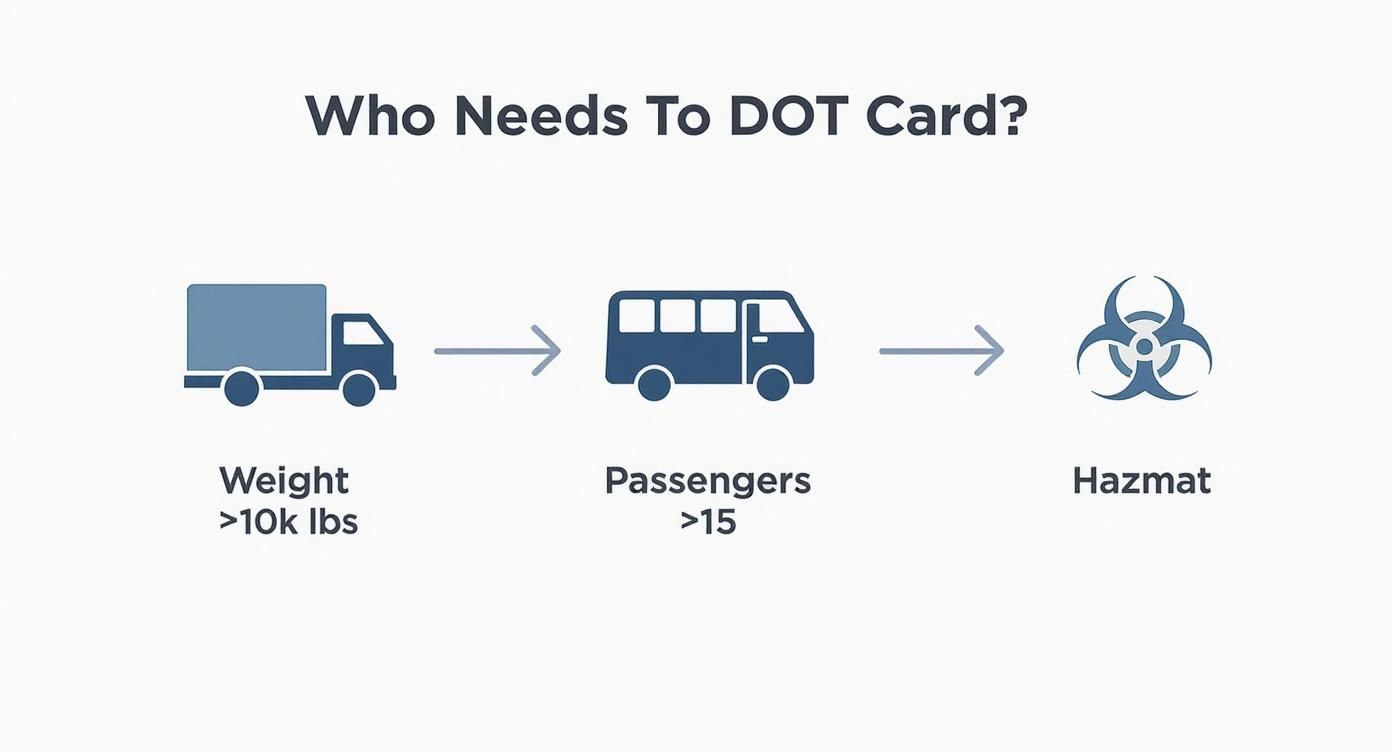
As you can see, it's not just about massive semi-trucks. The rules also cover drivers transporting a certain number of passengers or any hazardous materials, which really underscores how much these regulations focus on public safety.
The Examination Process Step-by-Step
The exam itself is a series of checks covering the key health metrics that matter most for a commercial driver. Every part of the physical has a clear purpose tied directly to your ability to safely handle a large vehicle.
- Health History Review: You'll kick things off by filling out a medical history form. It's crucial to be honest and complete here, as this gives the examiner the full context for your physical health.
- Vision and Hearing Tests: The standards are pretty clear: you need at least 20/40 vision in both eyes (with or without glasses/contacts) and the ability to hear a "forced whisper" from five feet away.
- Blood Pressure and Pulse Check: The examiner will look for signs of high blood pressure or an irregular heartbeat, both of which are critical indicators of your cardiovascular health.
- Urinalysis: This is a simple urine screening that checks for underlying health issues like diabetes or kidney problems. A common misconception is that this is a drug test, but it is not a drug test.
- Physical Evaluation: Finally, the examiner will do a hands-on check of your heart, lungs, reflexes, and overall physical condition to ensure everything is in good working order.
The goal of the DOT physical isn’t to find reasons to disqualify drivers. It’s to ensure that any medical conditions you might have are managed properly so they don’t create a risk on the road for you or anyone else.
Getting your medical card is a huge milestone on your path to a new career. It's a foundational piece of the puzzle, and having the right support through the whole process makes all the difference. To see how this one step fits into the bigger picture, you can learn more about our comprehensive CDL training program that's designed to guide you from day one.
Navigating Health Standards and Potential Disqualifiers
Passing your DOT physical isn't about being in perfect health—it's about proving you're healthy enough to safely operate a massive commercial vehicle. The Federal Motor Carrier Safety Administration (FMCSA) has set specific health standards that every driver must meet. Think of these not as arbitrary hoops to jump through, but as critical safety measures designed to protect you, your cargo, and everyone else on the road.
Knowing these benchmarks before you walk into the exam room can make all the difference. Many of the most common reasons for a failed test or a shorter-than-expected certification period are tied to completely manageable health conditions. A little proactive effort with your primary doctor can help you get ahead of any potential problems, so you can show up for your physical prepared and confident.
Common Health Conditions and FMCSA Rules
During the physical, the medical examiner will pay close attention to any health issue that could directly impact your ability to drive. This means your vision, hearing, heart health, and conditions like diabetes are under the microscope. The examiner's main goal is to verify that any existing conditions are well-managed and won't create a risk behind the wheel.
Let's look at some of the most critical standards:
- Vision and Hearing: You’ll need to have at least 20/40 vision in both eyes, either with or without glasses or contacts. For hearing, the test is simple: you must be able to hear a "forced whisper" from a distance of five feet.
- Insulin-Dependent Diabetes: This used to be an automatic disqualifier, but the rules have changed for the better. If you have insulin-treated diabetes mellitus (ITDM), you can get certified as long as you provide documentation from your doctor showing your blood sugar is stable and well-controlled.
- Sleep Apnea: If the examiner suspects you might have moderate to severe sleep apnea—often based on factors like daytime sleepiness or a large neck size—they can’t just fail you. Instead, they'll likely require you to get a sleep study done. If diagnosed, you'll need to show proof that you're consistently using a CPAP machine before they can issue your medical card.
For drivers managing ongoing health issues, staying on top of your condition between DOT physicals is key. Resources like online doctor consultations can be a huge help for getting quick advice and ensuring you remain compliant.
The Impact of Blood Pressure on Certification
Of all the tests you'll undergo, your blood pressure reading carries some of the most weight. High blood pressure (hypertension) significantly increases the risk of a heart attack or stroke, which would be catastrophic on the road. Because of this, the FMCSA has a clear, tiered system that ties your blood pressure directly to how long your medical card is valid.
Health conditions related to cardiovascular issues, vision, hearing, and metabolic disorders are key factors assessed during a DOT physical exam, directly affecting certification duration and driver qualification.
A great blood pressure reading gets you the full certification period, while a higher one means you'll need more frequent check-ins. It's a straightforward way for the FMCSA to ensure your condition is being properly monitored.
Here's a simple breakdown of how your numbers affect your card's validity.
How Blood Pressure Affects Your Certification Period
| Blood Pressure Reading | FMCSA Stage | Certification Outcome |
|---|---|---|
| Below 140/90 mmHg | Normal | Standard 2-year certification. |
| 140/90 to 159/99 mmHg | Stage 1 Hypertension | A shorter 1-year certification to monitor the condition. |
| 160/100 to 179/109 mmHg | Stage 2 Hypertension | A temporary 3-month certification. You must lower it to <140/90 to get a 1-year card. |
| 180/110 mmHg or higher | Stage 3 Hypertension | This is a disqualification. You cannot be certified until your blood pressure is treated and lowered into the acceptable range. |
As you can see, a reading of 180/110 or higher is an automatic disqualification until you get it under control. The goal isn't to punish drivers, but to ensure a serious medical event doesn't happen behind the wheel.
Finally, some medical conditions might result in a license restriction, such as needing to drive a truck with an automatic transmission. If you end up with that limitation but want to expand your job prospects, looking into an E-restriction removal course can give you the skills and freedom to drive any rig.
Keeping Your Medical Card Current and Staying Compliant
Getting your DOT medical card is a huge first step, but it's not a "set it and forget it" kind of deal. Think of it less like a one-time achievement and more like an ongoing commitment. Staying on top of your certification is absolutely essential for keeping your CDL active and your career in motion.
A standard Medical Examiner's Certificate is generally good for up to 24 months. This two-year green light is for drivers who sail through the FMCSA health standards without any red flags.
However, that's not the case for everyone. The examiner has the discretion to issue a card for a shorter period—say, one year, six months, or even just three months. This usually happens if you have a condition like high blood pressure that needs closer observation to make sure it's managed properly and you're safe to drive.
The Renewal Process and State Reporting
Mark your calendar, set a reminder, do whatever it takes—staying ahead of your expiration date is critical. Letting that card lapse means you’re legally parked until you get it renewed. It’s entirely on you to schedule your next DOT physical before the current one expires.
Once you pass the exam, you’ll walk out with a fresh Medical Examiner's Certificate (MEC). But you're not done yet. Your next move is to get that new certificate over to your state's driver licensing agency (the DMV, SDLA, or whatever they call it where you live).
A word of caution: if you don't submit your new medical certificate to the state licensing agency on time, the consequences can be severe. Many states will automatically downgrade your CDL to a regular driver's license, effectively pulling you off the road.
This is all part of the medical self-certification process that links your health status directly to your CDL. To keep things running smoothly and avoid any headaches, here's a simple game plan:
- Schedule Early: Don't wait until the last minute. Book your renewal exam at least 30-45 days before your current card expires.
- Submit Promptly: The moment you have that new MEC in hand, get it submitted to your state. Check their website—most offer online portals, but some may still require mail-in or in-person drop-offs.
- Confirm Receipt: A quick follow-up call or email to make sure your state has received and processed your new medical info can save you a world of trouble down the line.
Being proactive is the name of the game. It ensures you stay compliant, keep your CDL in good standing, and avoid any costly downtime. If you're feeling unsure about prepping for your exam or want to talk about what’s next in your trucking journey, reach out to our expert team for assistance. We’re here to help.
Answering Your Top Questions About the DOT Medical Card
Even with a good grasp of the basics, most drivers run into specific "what if" scenarios when it comes to their medical card. These are the practical, real-world questions we hear all the time. Let's clear up the confusion with some straightforward answers so you can stay on the road with confidence.
Can I Get a DOT Medical Card if I Take Prescription Medication?
Absolutely. Taking prescription medication doesn't automatically mean you'll be disqualified. The real question the medical examiner needs to answer is simple: could your medication, or the condition it's treating, interfere with your ability to safely operate a massive commercial vehicle?
You have to be upfront about every single medication you take. The examiner is trained to look for potential side effects that are red flags for drivers—things like drowsiness, dizziness, or anything that could cloud your judgment. If you're taking medication for conditions like anxiety, chronic pain, or ADHD, expect a few more questions.
Pro Tip: The best thing you can do is show up prepared. Bring a note from the doctor who prescribed the medication. It should explain why you need it, confirm your dosage, and—this is the most important part—state that it doesn't prevent you from safely driving a truck.
What Happens if I Fail My DOT Physical Exam?
Failing a DOT physical isn't necessarily the end of the road, but it does mean you're medically benched for the time being. Legally, you cannot operate a commercial motor vehicle until you meet the required health standards. The examiner is required to tell you exactly why you didn't pass.
Often, the reason for a failure is something you can fix. Maybe your blood pressure was too high on exam day, or your vision didn't meet the 20/40 standard without a new pair of glasses. Your immediate next step is to see your regular doctor or a specialist to get the issue addressed.
Once that condition is managed and you have documentation to prove it—like a log of healthy blood pressure readings or a new prescription for your glasses—you can go back and take the DOT physical again. Just remember, you can't get behind the wheel of a CMV until you have a valid medical certificate in hand.
Is the Urinalysis During the DOT Physical a Drug Test?
This is easily one of the biggest points of confusion, so let's be crystal clear: the urinalysis performed during your DOT physical is not a drug test. It's a basic health screening. The examiner is looking for signs of underlying medical issues, like sugar in the urine (which could indicate diabetes) or protein (which can point to kidney problems).
The mandatory DOT drug test is a completely separate process. That’s something your employer will handle, usually before you’re hired, as part of a random testing program, or after an accident. Now, there is one exception: if the medical examiner sees something during the physical that raises a reasonable suspicion of drug use, they can require you to take a separate drug test.
How Do I Submit My New Medical Card to the DMV?
Once you pass your physical, the examiner will hand you your Medical Examiner's Certificate (MEC). Getting this certificate is step one; step two is getting it to your state's driver licensing agency (SDLA), which for most people is just the DMV. This is your responsibility.
Most states give you a pretty tight window, usually around 10 to 15 days, to get this done. How you submit it depends on your state, but you usually have a few options:
- Online Portal: This is the fastest and easiest way. Many SDLAs let you upload a picture or scan of your certificate directly.
- In Person: You can always just walk into a local DMV office and hand it over.
- Fax or Mail: A bit old-school, but some states still allow you to send it in via fax or mail.
Don't drag your feet on this. If you don't submit your new MEC before the old one expires, the consequences are serious. Your state will automatically downgrade your CDL to a regular driver's license, and you'll be legally barred from operating any commercial vehicle until you get it sorted out.
Navigating the path to getting your commercial driver's license can feel complex, but you don't have to do it alone. At Patriot CDL, we provide expert guidance on every step, from preparing for your DOT medical exam to acing your road test. Start your journey toward a rewarding career on the open road with a team that has your back. Learn more about our comprehensive CDL training programs at https://patriotcdl.com.