Think of the DOT physical as a comprehensive health check-up, but one specifically designed for the rigors of life on the road. It’s a federally mandated medical exam that every commercial driver must pass to prove they are physically, mentally, and emotionally fit to safely operate a large vehicle.
At its core, this exam is all about safety—for you, your cargo, and everyone sharing the highway with you.
What’s the Point of a DOT Physical?
It’s easy to think of the DOT physical as just another box to check, but its purpose is crucial. Picture a pilot running through a pre-flight checklist before takeoff. The DOT physical serves the same function, only the "machine" being inspected is you, the driver.
The Federal Motor Carrier Safety Administration (FMCSA) sets the rules for this exam to make sure a driver can handle the intense demands of the job without putting the public at risk. It’s designed to catch any underlying health issues—like poor vision, dangerously high blood pressure, or hearing loss—that could interfere with your ability to control an 80,000-pound rig.
Who Needs to Get One?
The regulations are pretty straightforward. You’ll need to pass a DOT physical if you plan to:
- Operate a vehicle with a gross vehicle weight rating (GVWR) of 10,001 pounds or more.
- Drive a vehicle built to carry more than 8 passengers (including yourself) for pay.
- Operate a vehicle designed for more than 15 passengers (including yourself), even if you aren't being paid.
- Transport hazardous materials that require a placard.
These medical standards are a key piece of the overall CDL requirements puzzle, ensuring every driver on the road is truly qualified.
Did you know that over 6 million drivers operate commercial motor vehicles across the country? The vast majority of them must pass a DOT physical at least every two years. This single requirement plays a massive role in keeping our highways safe and our professional drivers healthy.
The exam can't be done by just any doctor. It has to be performed by a licensed medical professional who is listed on the FMCSA's National Registry. Once you pass, you'll be issued a Medical Examiner's Certificate (MEC), also known as your "med card," which you have to keep with you anytime you're driving professionally.
Navigating Each Step Of The DOT Physical Exam
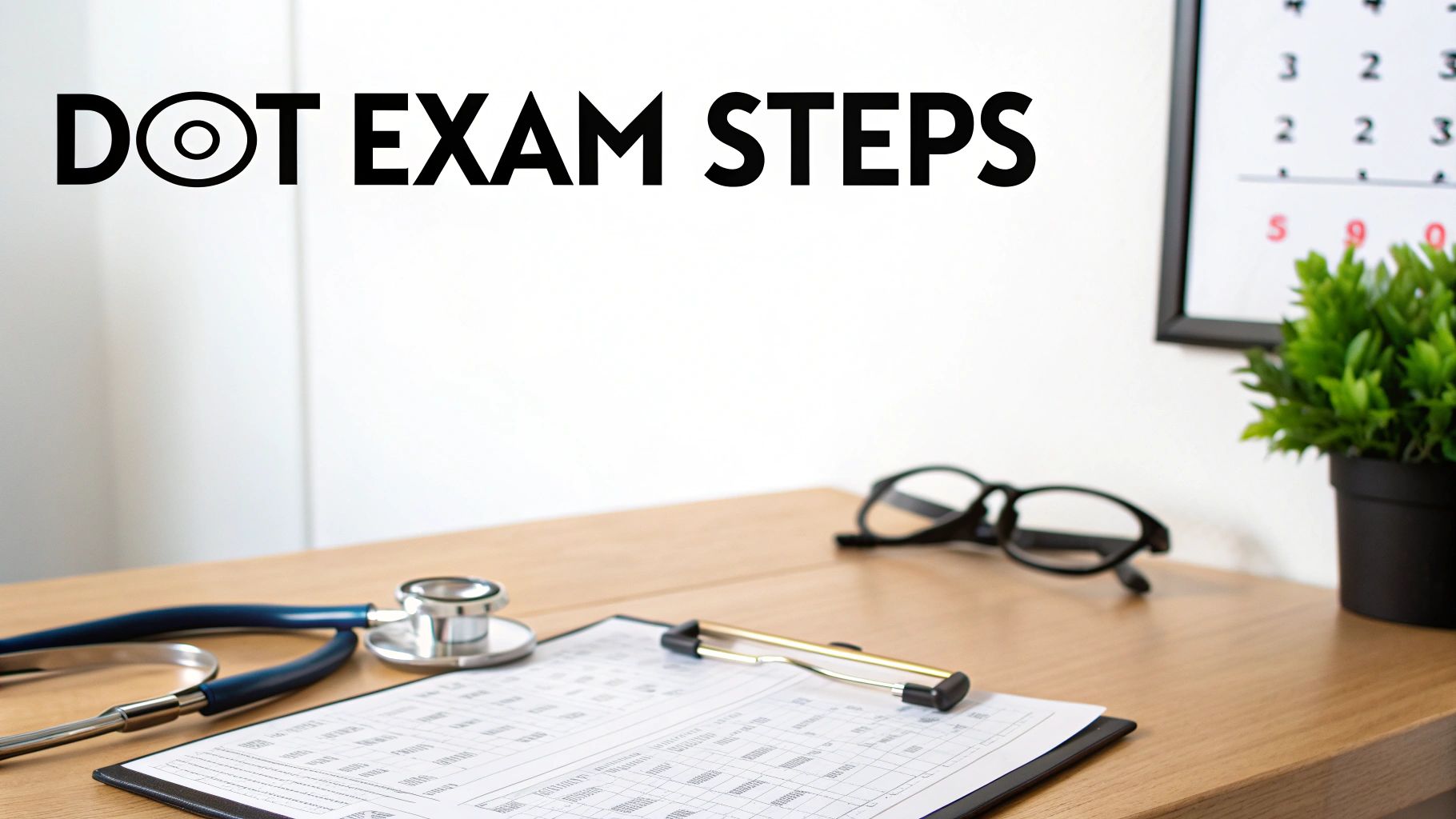
Walking into your DOT physical can feel like stepping onto a stage without a script. In reality, it’s more like a multi-point safety check—each station confirms you’re ready for the road. Knowing what’s ahead lets you focus on doing your best.
At its core, the exam is a full health review, designed to catch any hidden issues that might put you or others at risk. Let’s unpack each step so you can arrive prepared, confident, and clear on what’s coming.
Vision And Hearing Acuity
Your eyes and ears are your first line of defense behind the wheel. The examiner will start with simple, straightforward tests to make sure you meet federal standards.
For vision, you need at least 20/40 acuity in each eye, with or without glasses. Peripheral vision must span at least 70 degrees on both sides. Imagine you’re scanning for road signs or spotting a deer at dusk—these numbers guarantee you won’t be caught off guard.
Hearing is just as vital. The “forced whisper” test checks your ability to hear a quiet voice from five feet away, with or without a hearing aid. It’s like making sure you can catch a siren or a horn blast in heavy traffic.
Cardiovascular Health Assessment
Your heart handles plenty of strain during long drives: tight turns, heavy loads, sleep deprivation. That’s why blood pressure and pulse rate are non-negotiable checks.
First up, blood pressure must be 140/90 mmHg or lower. Anything above that may lead to a shorter certification period or require extra follow-up. Next, the examiner will feel your pulse, listening for irregular rhythms. A steady beat signals your ticker is up to the task.
The heart doesn’t get a break on the highway. FMCSA standards exist to prevent sudden medical episodes that can turn a routine route into a crisis.
Urinalysis And Physical Examination
The final stretch combines a lab test and a hands-on inspection. Don’t confuse the urinalysis with a drug screen—this is about spotting medical conditions, not substance use.
Your sample will be checked for:
- Specific Gravity (hydration and kidney function)
- Protein, Blood, Sugar (early warning signs for diabetes or kidney disease)
Once labs are done, the physical exam kicks in. The examiner will:
- Observe Your General Appearance for any obvious health flags
- Listen to Your Lungs and Heart with a stethoscope
- Assess Spine and Posture to confirm you can sit comfortably for hours
- Test Neurological Responses, such as reflexes and balance
- Check Limb Mobility to ensure nothing hinders pedal and steering control
This thorough process is as important as studying for the written test for your commercial learner’s permit. By understanding each checkpoint, you’ll walk in ready to show you’re fit for the long haul.
How to Prepare for a Successful Exam
Walking into your DOT physical exam prepared can make all the difference. It turns a potentially stressful appointment into a routine check-up, letting you get through the process quickly and get back to what matters.
First things first, get your paperwork in order. You'll need your valid driver's license, of course, but also a complete list of any medications you take. Be specific—write down the name, dosage, and how often you take it. If you have any specific medical conditions that require special documentation, like a vision exemption or records for your CPAP machine, bring those along too.
Essential Documents Checklist
- Driver’s License: A valid, government-issued photo ID is a must.
- Medication List: Jot down every prescription, over-the-counter drug, and supplement you take.
- Condition-Specific Paperwork: This includes things like vision exemption letters, diabetes reports, or sleep apnea treatment records.
In the 24 hours leading up to your exam, a few small lifestyle tweaks can have a big impact. Try to skip the coffee and avoid overly salty foods, as both can temporarily bump up your blood pressure. Drink plenty of water and try to get a good night's sleep before your appointment—it really helps.
Blood pressure is a major focus of the DOT physical, so it’s smart to understand what affects your numbers. For more in-depth tips, it's worth reading up on managing blood pressure.
When you fill out your medical history form, be completely honest. Hiding a condition won't do you any favors and can cause major headaches down the road. In fact, one study of 1,603 DOT exams found that nearly 39% of drivers underreported their health history, and 30% of the medical forms were filled out incorrectly. Full disclosure helps the examiner make an accurate and fair assessment.
Day Of Exam Tips
- Arrive Early: Get there about 15 minutes ahead of time to handle any last-minute paperwork without feeling rushed.
- Dress Smart: Comfortable, loose-fitting clothes make the physical part of the exam much smoother.
- Bring Your Aids: If you wear glasses, contacts, or hearing aids, make sure you have them with you.
- Pack a Snack: A bottle of water and a light snack can help you stay sharp and comfortable if there's a wait.
A little bit of prep work goes a long way. Having your documents organized and ready to go is the easiest way to cut down on exam-day stress.
Following these simple steps doesn't just help you pass; it shows the examiner you're a professional who takes safety and fitness for duty seriously. This proactive mindset is exactly what we instill in our students at Patriot CDL.
If you're curious about how we prepare our drivers for every aspect of the job, including DOT medical requirements, check out our program page.
Being prepared gives you confidence on exam day and sets the foundation for a long, successful career on the road.
Understanding Medical Conditions And Waivers
One of the biggest worries for any driver is wondering, "Will this health issue put the brakes on my career?" It's a valid concern. The Federal Motor Carrier Safety Administration (FMCSA) has specific health standards for a reason, but getting a certain diagnosis is rarely an automatic disqualification.
The real key is understanding the rules so you can be proactive about both your health and your career. At the end of the day, the goal is simple: make sure every driver on the road can safely handle their rig without being a danger to themselves or anyone else.
This chart can help you figure out where you stand and what your next move should be.
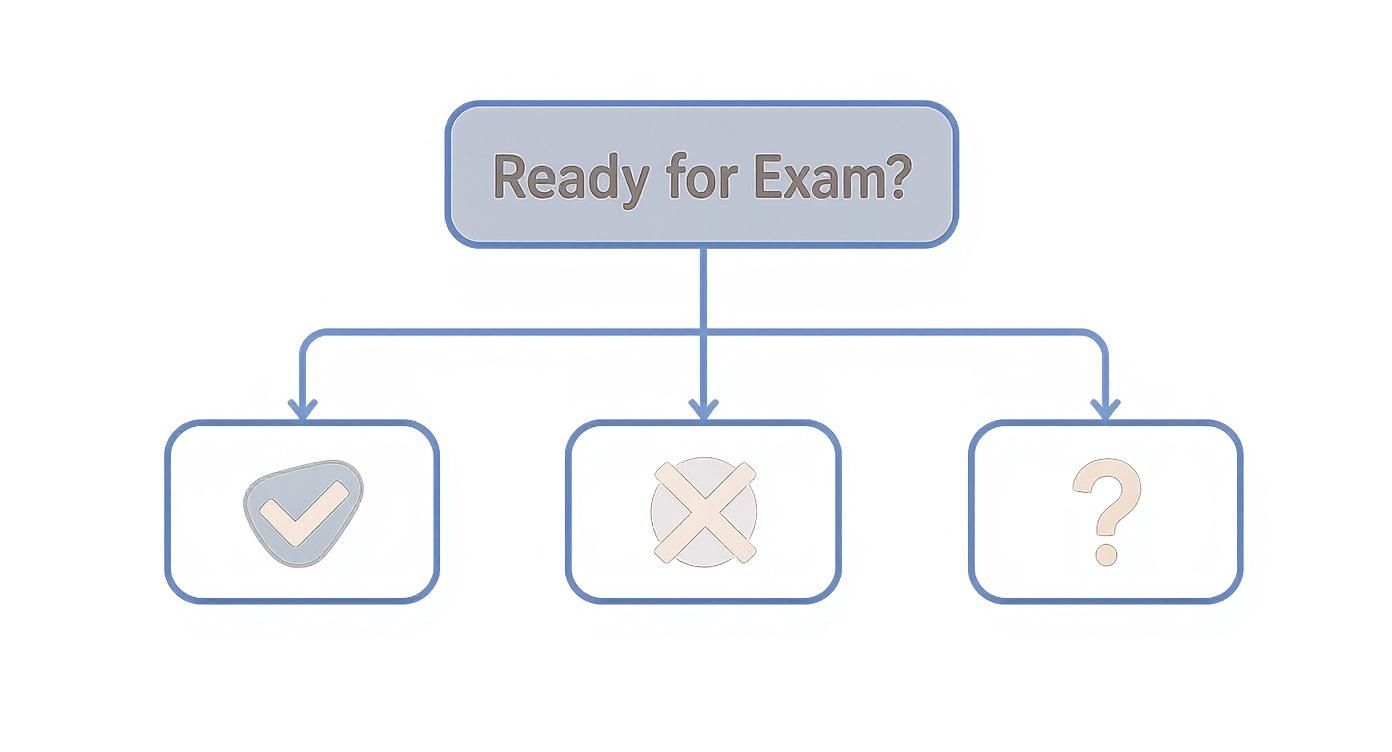
Use it as a quick reference to see if you're ready to go, need to get some paperwork in order, or should probably talk to your doctor before scheduling the exam.
Common Conditions And DOT Certification Status
So, how do specific health problems factor into the DOT physical? Below is a quick rundown of some common conditions and what you can generally expect. It shows that having a condition is one thing, but how it's managed is what truly matters.
| Medical Condition | Potential Outcome | Possible Next Steps |
|---|---|---|
| High Blood Pressure | Can lead to a shortened certification (3 months to 1 year) or temporary disqualification if it's too high. | Start a treatment plan with your doctor; may need to show that your blood pressure is under control before getting a full certification. |
| Diabetes | If managed with diet or oral medication, you can often get a full certification. Insulin use requires a federal exemption. | For insulin users, you'll need to work with your endocrinologist and apply for the FMCSA exemption, which involves tracking your blood sugar. |
| Sleep Apnea | Untreated, severe sleep apnea is disqualifying. A diagnosis isn't the problem—the risk of falling asleep at the wheel is. | Get a sleep study done. If you're diagnosed, you'll likely need to show consistent use of a CPAP machine to prove the condition is managed. |
| Heart Conditions | A recent heart attack, certain arrhythmias, or heart surgery will require a thorough evaluation. | You'll need a clearance letter from your cardiologist, often including results from a recent stress test, to show your heart is stable. |
| Seizure Disorders | A history of seizures is a major concern and often involves a mandatory waiting period without any seizure activity. | This almost always requires a detailed evaluation and clearance from a neurologist before an examiner can even consider certification. |
This table isn't exhaustive, but it gives you a good idea of how the process works. The medical examiner's job is to assess risk, and your job is to show that your condition is well-managed and poses no threat to public safety.
What About Waivers And Exemptions?
What happens if you have a condition that falls outside the standard guidelines? Don't panic—there are official pathways that can keep you on the road. These aren't just loopholes; they're structured programs for drivers in specific situations.
A federal waiver or exemption is one such path. It's often available for conditions like vision or hearing loss in one eye/ear or for drivers with insulin-treated diabetes. It’s a formal process that involves getting detailed reports from your specialists and having the FMCSA review your case to confirm you can still drive safely.
For drivers with a missing or impaired limb, there's the Skill Performance Evaluation (SPE) Certificate. Instead of just looking at a checklist, an examiner will actually evaluate your ability to safely operate a commercial vehicle with your specific condition. It’s about what you can do, not what a textbook says you can’t. On a related note, drivers who need to operate an automatic transmission due to a physical limitation can check out Patriot CDL’s E-restriction removal course.
Think of a waiver as a formal acknowledgment that, while your health profile is unique, you have taken the necessary steps to manage your condition effectively and can operate a commercial vehicle just as safely as any other driver.
Getting through these processes takes good documentation, complete honesty with the examiner, and a real commitment to managing your health. If you work closely with your own doctors and the medical examiner, you can provide a full, accurate picture of your fitness to drive and keep your career moving forward.
What Happens After Your DOT Physical
So, you’ve made it through the exam. What’s next? The outcome of your DOT physical really boils down to a few possibilities, and it all depends on your current health status.
For most healthy drivers, the result is a standard Medical Examiner’s Certificate (MEC), which is good for 2 years. This is your official green light from the FMCSA, confirming you’re fit to be on the road.
Sometimes, the examiner might notice a condition that needs a closer look, like high blood pressure that’s borderline. In that case, they might issue a shorter-term certificate for 3 or 12 months. This isn't a failure; it’s more like a "check-in" to ensure the condition is being managed before they'll sign off on a full two-year card. Of course, if you don't meet the minimum health standards, you could be temporarily disqualified until you get the issue addressed with a doctor.
Since 2012, the whole process has become much more standardized. The FMCSA created the National Registry of Certified Medical Examiners, and now all examiners use specific forms (like the MER Form, MCSA-5875) and have to submit your results electronically. This keeps everything consistent and trackable.
Understanding the Certification Outcomes
Think of the result as a snapshot of your current health and how it impacts your ability to drive safely.
- Full 24-Month Certificate: You've passed with flying colors and meet all the health requirements.
- Short-Term Certificate (3-12 months): You're cleared to drive, but you have a condition that needs monitoring.
- Disqualification: You don't meet the minimum health standards and will need medical treatment before you can be certified.
It's crucial to take any short-term certificate seriously. If you don't follow up on the specific health concern, you risk losing your driving privileges altogether. The good news is that most drivers use that time to get the issue under control and have no problem getting a full two-year certificate at their next physical.
Submitting Your Medical Examiner’s Certificate
Once that MEC is in your hands, the job isn’t quite done. You are responsible for getting a copy to your state’s driver licensing agency (like the DMV or RMV). This is the critical step that officially links your medical clearance to your CDL, keeping it active and valid.
“Your medical card connects your fitness exam directly to your driving privileges. Keep it current to avoid unexpected downtime.”
Don't drag your feet on this! Forgetting to submit it can lead to hefty fines or even a license suspension, which is a headache no one needs.
Staying Vigilant Between Exams
Just because you have a two-year certificate doesn't mean you can ignore your health until the next exam. The best drivers stay on top of their well-being year-round.
- Keep an eye on any changes in your health, especially things like blood pressure or blood sugar levels.
- Don't skip regular check-ups with your primary care doctor.
- For state-specific details, learn more about California DOT medical requirements in our guide.
Staying proactive not only makes your life easier come exam time but also shows a level of professionalism and responsibility. It’s the best way to ensure you walk out with another two-year certificate without any surprises.
Got More Questions? Here Are Some Quick Answers
Even after walking through the whole process, you might still have a few questions rattling around. That's perfectly normal. Let's tackle some of the most common things drivers ask about the DOT physical.
Think of this as the last once-over before you get behind the wheel—making sure you’re completely clear on what to expect.
How Much Is This Going to Cost Me?
You can expect to pay somewhere between $85 and $150 for a DOT physical. The exact price tag really depends on where you live and which clinic you go to. It's a good idea to call a few places to compare.
A key thing to remember is that your regular health insurance probably won't pick up the tab. These exams are considered a job requirement, not a standard medical visit. Before you pull out your wallet, check with your employer—many trucking companies will cover this cost for their drivers.
How Long Is the Medical Card Good For?
If you pass with flying colors and have no underlying health concerns, your Medical Examiner's Certificate (MEC) is valid for a full 24 months (or 2 years). That's the standard for a healthy driver.
However, if you're managing a condition that needs to be kept in check, like high blood pressure, the examiner might issue a certificate for a shorter period. It could be for a year, six months, or even just three months. They do this to ensure your condition remains stable and doesn't pose a risk on the road.
Is the Urine Sample for a Drug Test?
This is probably one of the biggest points of confusion, so let's clear it up: No, the urinalysis in a DOT physical is not a drug test. Its only purpose is to screen for potential medical problems. The examiner is looking for things like sugar, protein, or blood in your urine, which can be early signs of diabetes or kidney issues.
The DOT physical's urinalysis is strictly a health check. It's completely separate from the mandatory DOT drug and alcohol tests your employer will have you take.
The FMCSA does require a separate 5-panel drug screen for all commercial drivers, but that's a different test scheduled at a different time, usually as a pre-employment requirement.
What Happens if I Don't Pass?
Finding out you didn't pass your DOT physical can feel like a major roadblock, but it’s not necessarily the end of your driving career. The first thing to do is get a clear answer from the medical examiner on why you were disqualified. It's usually a specific health metric that fell outside the FMCSA's strict limits.
From there, you've got a few paths forward:
- Fix the Problem: The most direct route is to work with your regular doctor to get the health issue under control. Once it's managed, you can go back for a re-examination.
- Try a Second Opinion: You're absolutely allowed to see a different certified medical examiner from the National Registry to get their take.
- Look into Waivers: As we covered earlier, some conditions might make you eligible for a federal waiver or exemption from the FMCSA, allowing you to drive legally.
From acing the permit test to clearing the DOT physical, getting your CDL is a multi-step journey. At Patriot CDL, we're here to guide you through every single one. Our instructors don't just teach you how to pass the road test; they prepare you for the real-world demands of a professional trucking career.