
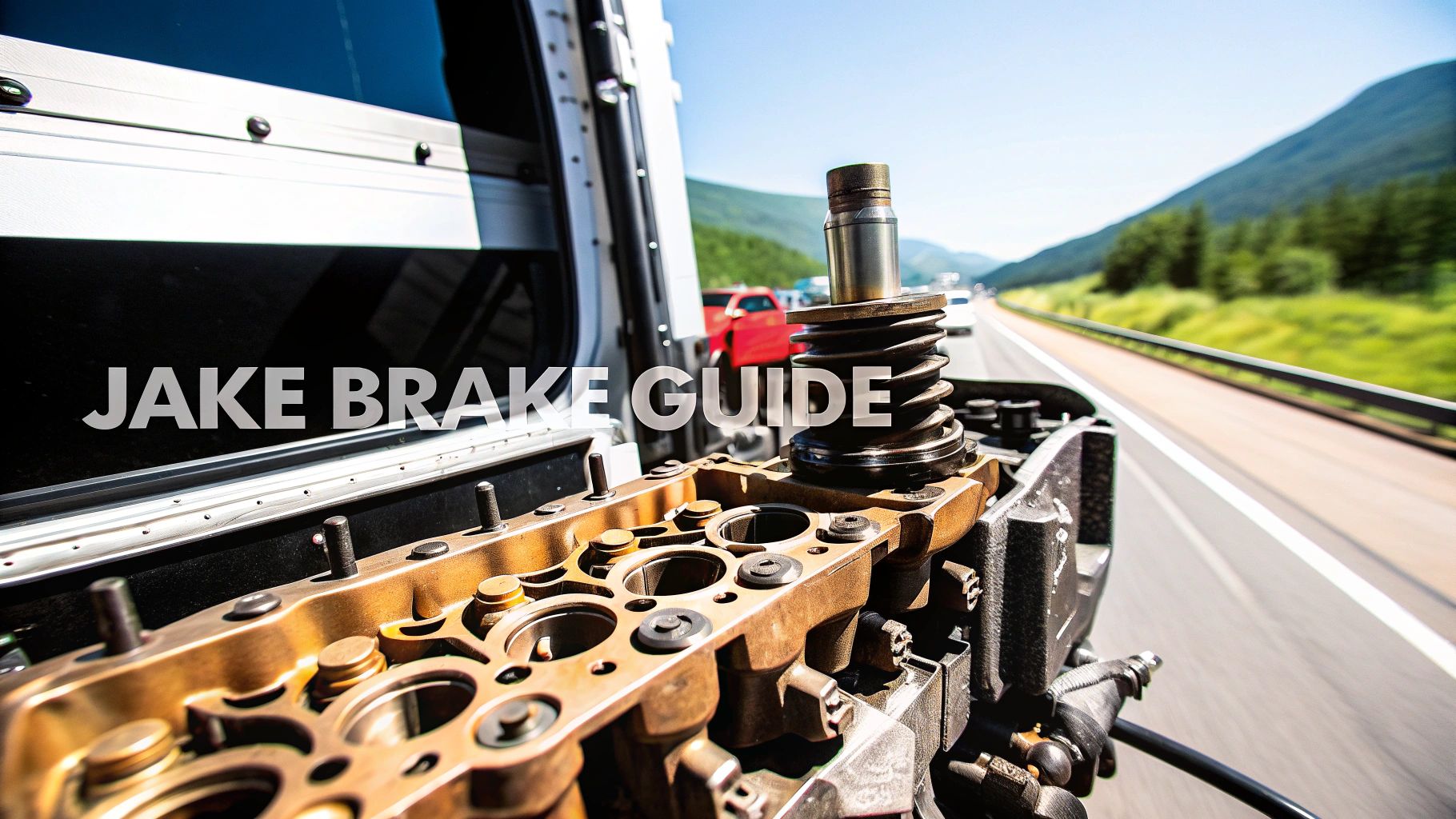
A Jake Brake, known in the technical manuals as a compression release engine brake, is a lifesaver for professional truck drivers. In simple terms, it's a clever system that transforms a truck's powerful engine into a giant air compressor, using that power to slow the vehicle down instead of speeding it up.
This lets a driver maintain a safe, controlled speed on long, steep downgrades without ever having to ride the service brakes. This is critical because it prevents the primary brakes from overheating and potentially failing when you need them most.
What Is a Jake Brake and How Does It Help Drivers
Think about riding a bike down a steep hill. If you just stop pedaling, you'll coast and pick up speed fast. But what if you could somehow make the pedals push back against your feet? You’d slow right down without even touching your hand brakes. That’s a pretty good way to picture what a Jake Brake does for a truck's engine.
The system completely changes the engine's normal operating cycle. Instead of burning fuel to create power that pushes the truck forward, the Jake Brake flips the script, turning the engine into a power-absorbing machine. This process creates a massive retarding force that slows the entire rig.
The Primary Role in Trucking Safety
The number one job of a Jake Brake is to safely manage a truck's immense momentum, especially when you're loaded down and heading down a long mountain pass. It's not just a feature; it's a cornerstone of modern trucking safety.
Here’s where it really shines:
- Preserving Service Brakes: The Jake Brake does the heavy lifting on long descents, which keeps your primary friction brakes cool and ready for an emergency stop.
- Enhancing Vehicle Control: It gives you incredible control over your speed, making descents smoother and far more predictable than relying on service brakes alone.
- Reducing Maintenance Costs: When you're not constantly standing on your brake pedal, your brake pads, rotors, and drums last a whole lot longer. That translates to real savings in the shop.
By taking on most of the braking effort, a properly used Jake Brake can dramatically extend the life of your foundation brake components. This isn't just about saving money—it's a vital part of your personal safety toolkit.
More Than Just a Switch on the Dash
Understanding the Jake Brake is about more than just knowing its name; it’s about appreciating its role in a professional driver's day-to-day work. It’s an essential tool that demands skill and judgment to use correctly.
For new drivers, getting a feel for this system is just as fundamental as learning to scan your mirrors or perform a detailed pre-trip inspection. Knowing how to use your Jake Brake effectively means you’re operating your vehicle with the highest regard for safety—for yourself and everyone else on the road.
The Story Behind the Jake Brake
Every great invention has an origin story, and the Jake Brake's is a real nail-biter. This legendary piece of trucking hardware wasn't dreamt up in a comfortable boardroom. It was born out of a moment of pure survival on a treacherous mountain road.
The story starts with Clessie Lyle Cummins, the genius founder of the Cummins Engine Company. His name is practically synonymous with the diesel engines that keep America moving. But it was a heart-stopping drive in August 1931 that sparked one of his most important safety innovations.
A Desperate Descent on Cajon Pass
Cummins was on a coast-to-coast promotional run, piloting a truck powered by his own engine from New York to L.A. The final stretch took him down California's notorious Cajon Pass—a steep, winding gravel nightmare for any driver. As they started down the grade, the unthinkable happened: the service brakes overheated and gave out completely.
The truck was now a runaway, picking up terrifying speed. Thinking on his feet, Cummins told his companion to slam it into a lower gear. At the same time, he cut the fuel and used a hand pump to force water into the engine cylinders. This last-ditch effort to use the engine's own compression as a brake actually worked. It saved their lives and planted the seed for a revolutionary idea.
That near-death experience on a remote mountain pass was the direct inspiration for the Jake Brake. It proved that a diesel engine's immense power could be used not just to go, but to slow.
From Terrifying Experience to Market Reality
While the incident took place in 1931, the idea needed time to mature. After retiring from Cummins Inc., Clessie finally had the time to focus on perfecting his concept. By 1955, he was deep into developing a device that could reliably turn a power-producing engine into a power-absorbing air compressor, officially inventing the system in 1957.
The Jacobs Manufacturing Company, then famous for making drill chucks, recognized the brilliance of his design and acquired the patent. After a bit more refinement, the very first commercial compression release engine brake hit the market in 1961. It was quickly nicknamed the "Jake Brake," and it was the solution to the exact problem Clessie Cummins had faced down thirty years earlier.
This incredible piece of engineering would go on to protect countless drivers from the same fate. You can dive into more trucking history and modern driver topics on our Patriot CDL blog.
How a Jake Brake Actually Works
To really get how a Jake Brake does its job, you have to first picture what's happening inside a normal four-stroke diesel engine. It's a constant cycle: intake, compression, power, and exhaust. In the power stroke, burning fuel creates an explosion of energy that shoves the piston down. That's what makes the truck go.
The Jake Brake is a clever bit of engineering that flips this entire process on its head, turning your powerful engine into an equally powerful brake.
When you hit that switch on the dash, you're not adding anything new. You're just changing the timing of the engine's own parts. The system essentially creates a new link between the injector camshaft and the exhaust valves, and that simple (but brilliant) change is where all the stopping power comes from.
Rewriting the Rules of the Engine Cycle
The real magic happens right at the peak of the compression stroke. Normally, all that super-compressed air in the cylinder acts like a loaded spring. It wants to expand, and in doing so, it pushes the piston back down, returning energy to the crankshaft and keeping everything turning smoothly.
The Jake Brake throws a wrench in that plan. Just as the piston hits the very top, the system cracks open the exhaust valves for a split second. All that pent-up air—we're talking over 2,000 psi—is suddenly released with a massive bang through the exhaust. That loud, signature BRAP-BRAP-BRAP is literally the sound of high-pressure air making a run for it.
With the compressed air gone, there's no "spring effect" left to push the piston down. The engine is now forced to fight against the truck's momentum just to keep turning. Every single cylinder becomes a drag on the system, slowing the whole rig down.
This happens over and over in each cylinder, creating a steady and powerful braking force without you ever having to touch the service brakes. It’s an elegant trick, using the engine's own immense power against itself.
The Mechanical Process Step-by-Step
Let's break it down into the rapid-fire sequence of events happening inside your engine hundreds of times a minute. Getting this down is a big part of mastering the complete air brakes test.
- You Flip the Switch: The driver turns on the Jake Brake, usually selecting a low, medium, or high setting. This tells the system how many of the engine's cylinders to use for braking.
- The Squeeze Is On: The piston travels up, squeezing the air in the cylinder to incredibly high pressures and storing a massive amount of potential energy.
- The Release: At the last possible moment—what mechanics call "top dead center"—the Jake Brake system forces the exhaust valve to pop open.
- Energy Gets Dumped: All that stored energy (the compressed air) is vented straight out the exhaust pipe instead of being used to push the piston back down.
- The Drag Effect: Since that energy is gone, the truck's own rolling momentum has to do all the work of turning the engine over, which puts a major drag on the drivetrain and slows you down.
The infographic below really brings the story to life, showing how a terrifying near-miss for Clessie Cummins led directly to the invention of the Jake Brake.
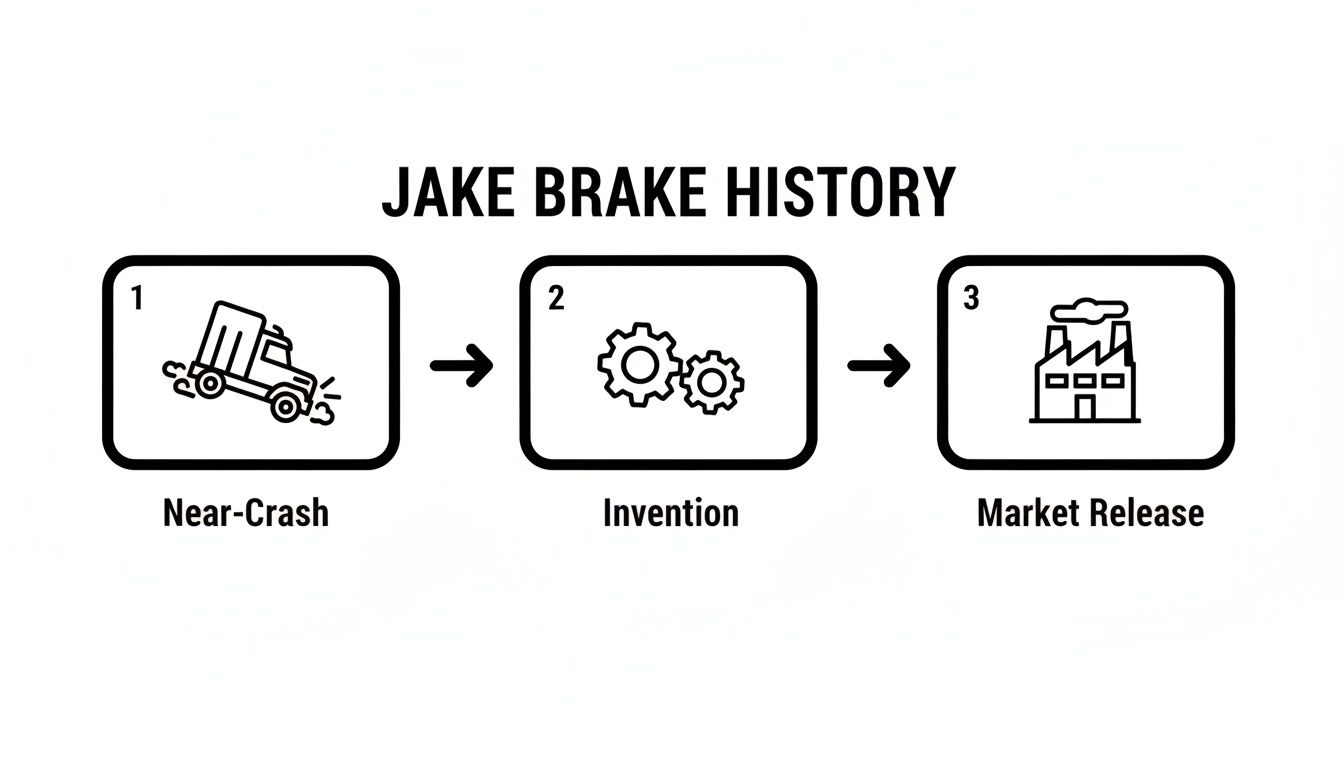
It's a perfect example of how a real-world problem sparked an engineering solution that keeps drivers safe to this day.
The Real-World Pros and Cons of Using a Jake Brake
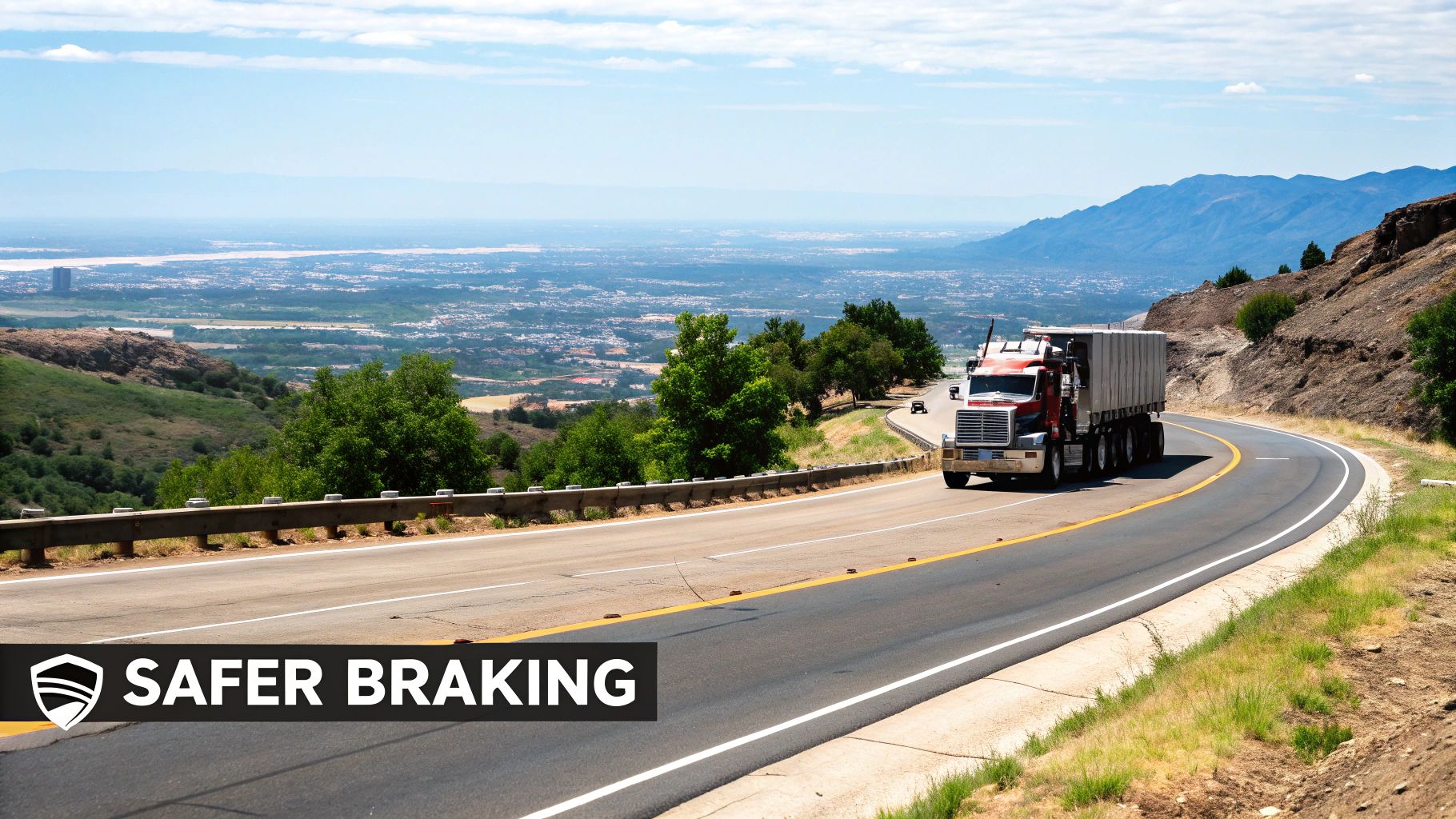
A Jake brake is a fantastic tool in any professional driver's kit, but becoming a true pro means understanding its strengths just as well as its weaknesses. The upside is huge, hitting both your safety and your wallet in a good way.
When you know how to use it right, the benefits are immediate and powerful. The biggest one? A massive reduction in wear and tear on your primary service brakes.
The Clear Advantages of Engine Braking
By letting the engine do the heavy lifting to slow you down on a long grade, your friction brakes stay cool and ready for when you really need them in an emergency. This gives you a level of control over a massive rig on a steep descent that is truly priceless. That kind of peace of mind is hard to put a number on.
This saved wear and tear also translates directly into some serious cost savings. Talk to any old-timer in the industry, and they'll tell you stories about how much longer their brakes last. Some experienced drivers report that it can take on 90% of the braking work on long descents, effectively doubling the life of their foundation brakes.
To really see how this fits into the bigger picture of operational costs, it helps to have a solid preventive maintenance checklist for trucks.
The core benefits of using a Jake Brake are simple but profound: enhanced safety through better vehicle control, significantly longer service brake life, and lower overall maintenance expenses.
Understanding the Downsides and Risks
Of course, no tool is perfect, and the Jake brake has one very famous drawback: the noise. That distinct, loud BRAP-BRAP-BRAP is exactly why you see "No Engine Brake" signs posted near towns and residential areas. Being a courteous professional means respecting those local rules.
But beyond the noise, there are situations where using a Jake is downright dangerous. The intense braking force it creates is only applied to the drive wheels. This is a critical detail.
On slick roads—think ice, snow, or even just a heavy downpour—hitting that Jake brake can cause your drive wheels to lock up in an instant. That sudden loss of traction is a fast track to a skid or a terrifying jackknife. When the grip is gone, you have to rely on the steady, careful application of your service brakes to stay in control.
Knowing when not to use the Jake brake is every bit as important as knowing when to use it.
Understanding Jake Brake Laws and Noise Restrictions
Being a professional driver is about more than just getting from Point A to Point B. It’s about being a responsible member of every community you travel through. If you’ve ever rolled past a sign that says "Engine Brake Prohibited" or "No Jake Brakes," you've seen a perfect example of this in action.
Those signs are a direct response to the Jake brake's most famous—or infamous—characteristic: its sound. The loud, rumbling noise is an unavoidable part of how the system works, and it's led to a patchwork of local noise ordinances all over the country. This is especially true in quiet residential areas. Think of these rules less as a hassle and more as a request for professional courtesy.
Why the Noise Leads to Rules
There's a reason people compare the sound of a Jake brake to a jackhammer. When the system rapidly releases that highly compressed air from the cylinders, the noise can hit 110-120 decibels. For perspective, that's louder than a chainsaw. It's this sharp, sudden blast of sound that prompts towns to put up those signs.
This isn't a new issue, either. The push for these regulations has been going on for decades. By the early 2000s, over 50 U.S. cities had already banned their use, with fines reaching as high as $500 for using an unmuffled engine brake near residential areas.
Adhering to these local ordinances is a mark of a skilled and respectful driver. It shows you understand your vehicle's impact on the environment around you and prioritize community safety and comfort alongside your operational duties.
Professionalism on the Road
At the end of the day, following these laws is all about being a good neighbor on the highway. A true professional knows when to engage the Jake brake for safety on a steep mountain pass and when to flip it off to avoid rattling the windows of a quiet little town. Following the rules helps maintain a positive image for the entire trucking industry.
Ignoring these signs can lead to some hefty fines and put a dent in your professional reputation. For drivers working in states with a huge variety of local communities, like those getting their CDL in California, this awareness is absolutely critical. To learn more about state-specific guidelines, you can check out our California CDL guide.
Mastering the Jake Brake During CDL Training
Book smarts are one thing, but truly mastering the Jake brake happens out on the road. This is where the theory you learned in the classroom gets real, and during your CDL training, your instructor will be right there to guide you from just understanding the concept to actually feeling its power through the driver’s seat.
The first big lesson is learning when to flip that switch. As you approach a long, steep downgrade, you want to engage the Jake brake early. This lets you set a safe, controlled speed right from the get-go, instead of waiting until the truck is already building dangerous momentum and then trying to rein it in.
Progressive Braking and Control
Most modern rigs don't just have a simple on/off switch for the engine brake. You'll typically find a low, medium, and high setting, and learning how to use these stages is a game-changer for smooth, professional driving.
- Low Setting: Think of this as your gentle helper. It's perfect for slight slopes or when you just need to shave off a few miles per hour without ever touching the service brakes.
- Medium Setting: This is your everyday workhorse. For most standard downgrades, the medium setting gives you a solid, reliable braking force that keeps your speed right where you want it.
- High Setting: Save this one for the big stuff. The steepest, most challenging hills demand maximum retarding power, and that’s when you’ll be glad you have the high setting to keep everything under control.
Learning to feather these settings gives you incredible command over your truck. A huge part of your on-road training will focus on blending the Jake brake with your service brakes. The proper technique is to let the engine brake do the heavy lifting—slowing the truck from highway speeds—and then use your service brakes for the last little bit to come to a full, smooth stop.
The single most important rule your instructor will drill into you is this: never, ever use the Jake brake on wet, icy, or snowy roads. That powerful braking force is applied only to the drive wheels, which can make them lock up instantly on a slick surface and send your rig into a terrifying jackknife skid.
This kind of hands-on, practical experience is what turns a nervous student into a confident professional driver. Understanding these critical details is just as important as acing the written parts of your CDL exam, like the general knowledge test. Your training will hammer home one simple truth: your best tools are always safety and good judgment.
Got Questions About the Jake Brake? We’ve Got Answers.
Let's wrap this up by tackling some of the most common questions new drivers have about the Jake brake. Getting these practical details straight will help you feel much more confident using this essential piece of equipment out on the road.
Will Using the Jake Brake Mess Up My Engine?
Straight up, no. When you use it correctly, a Jake brake is perfectly safe for your engine. The whole system was designed from the ground up to work in harmony with your engine's components. It’s just changing when the valves open; it’s not adding any crazy, new stress.
Just keep up with your regular maintenance, and both your engine and the Jake brake will keep running strong.
If you have any doubts, consider this: Jacobs Vehicle Systems, the original manufacturer, has produced over 9 million of these units since 1961. That’s a whole lot of trust from fleets and drivers all over the world.
Jake Brake vs. Exhaust Brake: What’s the Real Difference?
It's easy to get these two mixed up since they both help slow you down, but they work in completely different ways. The Jake brake is a true compression release brake, and it’s the far more powerful of the two. It cleverly opens the exhaust valves right at the top of the compression stroke, releasing all that built-up pressure and killing the power stroke.
An exhaust brake, on the other hand, is a much simpler setup. It’s basically a butterfly valve in your exhaust pipe. When you activate it, the valve closes and creates backpressure, which slows down the engine. Because of its raw stopping power, the Jake brake is the go-to for pretty much every Class 8 truck on the highway.
Think of it like this: A Jake brake is like an "off switch" for your engine's power cycle. An exhaust brake is more like stuffing a potato in the tailpipe—it creates a blockage to slow things down.
Can I Use the Jake Brake in Rain or Snow?
This is a big one: Never use your Jake brake on slick surfaces like wet, icy, or snow-covered roads.
The reason is simple. The Jake brake only applies its powerful braking force to your drive wheels. On a low-traction surface, that sudden force can easily cause those wheels to lock up, sending you into a dangerous skid or a full-on jackknife. When the weather gets nasty, stick to a gentle, steady application of your service brakes to stay in control.
At Patriot CDL, we believe in hands-on training that prepares you for the real world. Our instructors teach you how to master every part of your rig, from engine brakes to tricky backing maneuvers. If you're ready to start a rewarding career on the open road with a school that’s truly invested in your success, we're here to help. Learn more about our CDL programs.