A Commercial Driver's License, or CDL, is your professional ticket to operating large, heavy-duty vehicles for a living. It’s a world away from the standard license in your wallet. That license lets you drive your car; a CDL proves you have the specialized skills and knowledge to safely command a tractor-trailer, dump truck, or passenger bus.
Simply put, a CDL is the essential credential for anyone looking to build a career on the open road.
The Foundation of Professional Driving
Think about your personal driver's license—it’s your key to running errands and taking road trips. A CDL, on the other hand, is a completely different beast. It’s more like a pilot's license for the highway, a credential that shows you’ve met a much higher standard of training and carry a greater level of responsibility.
This distinction isn't just paperwork; it's about safety. Commercial vehicles are massive, heavy, and operate very differently from a passenger car. The risks are greater, which is why getting a CDL is a far more demanding process. You'll need to pass in-depth written exams and a rigorous, hands-on skills test that goes well beyond what’s required for a standard license.
Why a CDL Is So Important
The American economy quite literally runs on the wheels of trucks driven by CDL holders. These professionals are the lifeblood of our supply chain, moving goods from coast to coast. In fact, the trucking industry in the United States is powered by millions of drivers.
These drivers are responsible for moving an incredible percentage of the nation's freight by weight. Without them, store shelves would go bare, construction projects would grind to a halt, and public transport would stop. The CDL system is what ensures the people behind the wheel of these vital vehicles are safe, competent, and ready for the job.
A CDL is more than just a piece of plastic; it's your entry into a career that keeps the country moving. It’s a confirmation that you’ve met strict federal and state standards designed to protect everyone on the road.
Your journey starts with the first critical step: getting your commercial learner's permit. Nailing this part of the process sets you up for success. To get a clear roadmap, check out our guide on how to get your commercial learner's permit. From there, we'll walk you through the different classes of CDLs, the endorsements you can add to open up more job opportunities, and every step you need to take to earn your license.
Breaking Down the Different CDL Classes
Deciding on a commercial driver's license isn't a one-size-fits-all situation. The type of CDL you go for directly maps out your career, dictating the kind of rig you can handle and the jobs you can land. It helps to think of these classes less as license types and more as doorways to very different driving professions.
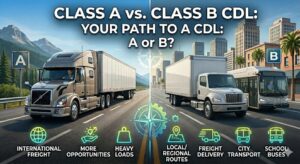
The federal government breaks CDLs down into three main categories: Class A, Class B, and Class C. The key difference between them is the Gross Vehicle Weight Rating (GVWR)—basically, how heavy a vehicle you're allowed to drive. Getting a handle on these distinctions is the first real step in matching your training to where you want to go in your career.
This image gives you a great visual breakdown of the license hierarchy and the kinds of vehicles that fall into each category.
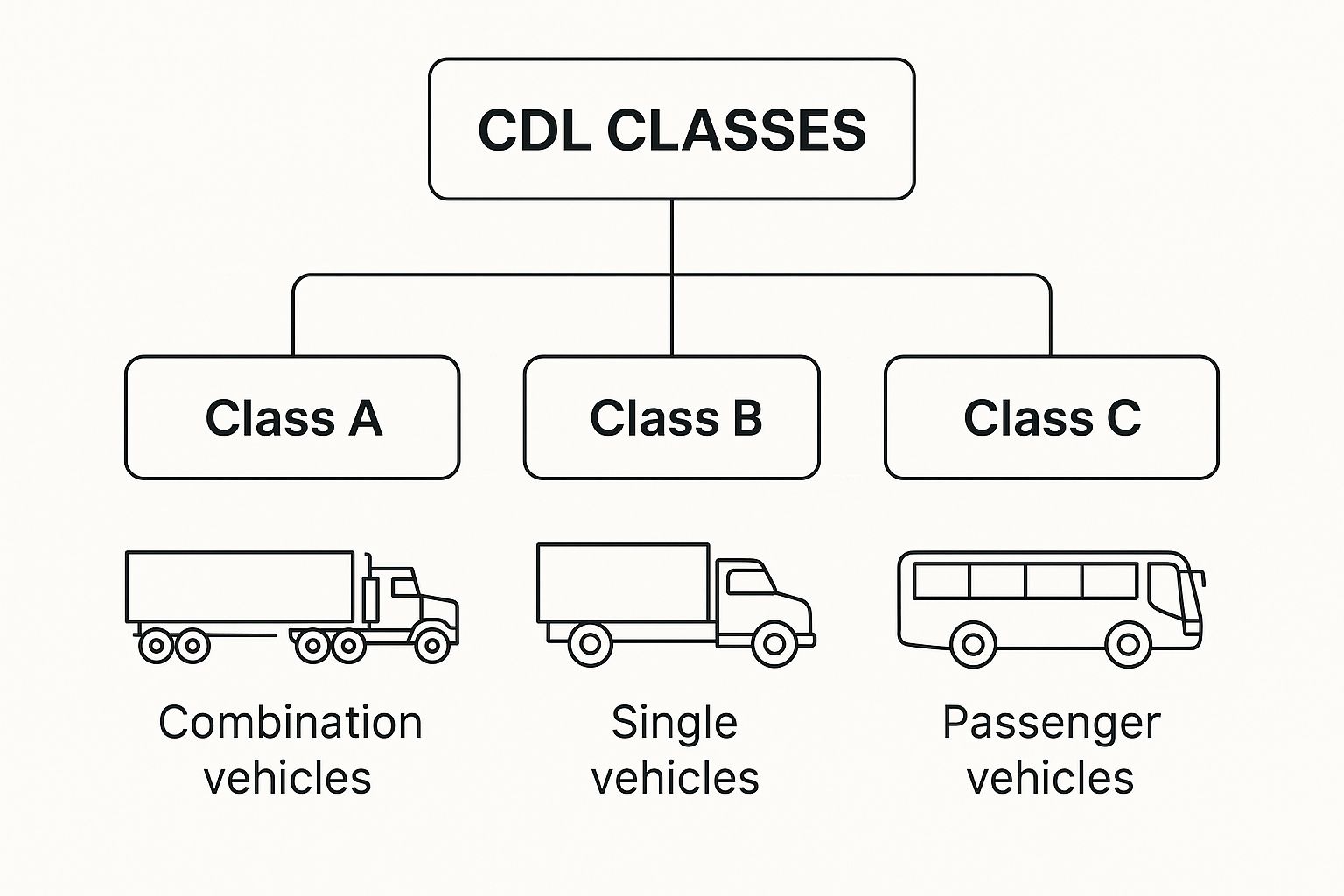
As you can see, a Class A license is the top tier. If you have one, you're also qualified to operate Class B and Class C vehicles, which makes it the most flexible and valuable license you can get.
Class A: The King of the Road
The Class A license is the gold standard of commercial driving. It’s the one you absolutely need to operate any combination vehicle—think of the classic tractor-trailer or "big rig"—with a Gross Combination Weight Rating (GCWR) of 26,001 pounds or more. This also covers situations where the trailer you're pulling weighs over 10,000 pounds on its own.
A Class A license is your all-access pass to the world of long-haul trucking, moving freight across the country. Plus, it automatically qualifies you to drive most Class B and Class C vehicles, giving you the biggest menu of job opportunities to choose from.
Vehicles you'll drive with a Class A license include:
- Tractor-trailers (semis, 18-wheelers)
- Tanker trucks
- Flatbeds
- Livestock haulers
Class B: The Local Powerhouse
Next up is the Class B license. This is for drivers who operate a single, heavy vehicle with a GVWR of 26,001 pounds or more, or one that’s towing a much smaller trailer that doesn't top 10,000 pounds. Class B jobs are often local routes, which is a huge plus for drivers who want to be home every night.
Picture the heavy-duty vehicles that keep a city running—that’s the world of the Class B driver. From construction sites to public transportation, these roles are the backbone of local communities.
A Class B license is a perfect fit if you want a stable, hands-on career driving serious machinery but aren't drawn to the over-the-road lifestyle. It's a way to make a great living while serving your own community.
Common Class B vehicles include:
- Straight trucks (like box trucks for delivery)
- Dump trucks
- City buses, school buses, and tour buses
- Cement mixers
Class C: The Specialist's License
Last but not least is the Class C license. This one is a bit more specialized, covering vehicles that don't quite fit the Class A or B mold but still require professional certification. It’s primarily for vehicles designed to transport 16 or more passengers (yourself included) or any vehicle used to haul hazardous materials (HAZMAT) that legally requires a placard.
Class C drivers are often in roles centered around moving people or specific types of cargo. Think airport shuttle drivers, limousine operators, or technicians making small-scale HAZMAT deliveries. While it’s the most specific of the three, it unlocks doors to some really essential, niche careers.
To make it easier to see the differences, here’s a quick comparison of the three main CDL classes.
CDL Classes at a Glance
| CDL Class | Vehicle Type | Typical Examples | GVWR / GCWR |
|---|---|---|---|
| Class A | Combination Vehicles | Tractor-trailers, tanker trucks, flatbeds | 26,001 lbs. or more (with a trailer over 10,000 lbs.) |
| Class B | Single Heavy Vehicles | Straight trucks, buses, dump trucks | 26,001 lbs. or more (with a trailer under 10,000 lbs.) |
| Class C | Passenger & Hazmat | Shuttle buses, some Hazmat vehicles | Generally under 26,001 lbs. |
This table should give you a clear, side-by-side view to help you figure out which license lines up with the driving career you have in mind.
Opening More Doors With CDL Endorsements
Think of your CDL class as the foundation of your driving career. Endorsements are the specialized skills you build on top of it, turning you from a general truck driver into an in-demand expert.
These are more than just extra letters stamped on your license. They’re proof that you've passed additional tests and have the specific knowledge to handle certain types of cargo or vehicles, like hazardous materials or massive tanker trucks. Adding the right endorsements is one of the smartest moves you can make—it opens up better jobs and seriously boosts your earning potential.
For many of the highest-paying trucking gigs, having specific endorsements isn't just a "nice-to-have," it's a non-negotiable requirement. Each one you earn unlocks a new world of opportunity.

A Closer Look at Key Endorsements
While there are quite a few endorsements you can get, several stand out as the most valuable and frequently required by employers. Each one involves passing another written test, and a couple even require an extra skills test behind the wheel.
Before you can even apply for some of these, you'll need to complete federally mandated training. We cover this critical first step in our guide to Entry-Level Driver Training (ELDT).
Here are the endorsements that will make your CDL shine:
H Endorsement (Hazardous Materials): This one is a big deal. It gives you the green light to haul materials deemed hazardous—think flammable liquids, chemicals, or certain gases. Getting this endorsement requires a thorough background check from a federal agency.
T Endorsement (Tanker Vehicles): Ever seen those big cylindrical trucks on the highway? To drive one, you need the T endorsement. Hauling thousands of gallons of liquid that can slosh and shift requires a unique skill set, and this endorsement proves you know how to manage that weight safely.
P Endorsement (Passenger Transport): If you’d rather transport people than cargo, this is the one for you. It’s required for operating any vehicle built to carry 16 or more people (including you, the driver). This is your ticket to a career driving city buses, tour coaches, or shuttle vans.
S Endorsement (School Bus): This is a highly specialized credential for anyone who wants to transport children to and from school. It builds on the P endorsement but adds extra layers of safety training and background checks specific to protecting young passengers.
Adding endorsements to your CDL isn't just about collecting certifications—it's a strategic career move. Each one makes you more versatile and valuable, instantly qualifying you for a wider range of high-quality jobs.
Meeting the Requirements to Get Your CDL
Before you can even think about hitting the road in a big rig, there are a few boxes you have to check. These aren't just suggestions; they’re firm requirements designed to make sure every driver on the road is safe, responsible, and capable. Getting through this initial checklist is the first real step on your journey to a CDL.
It all starts with the basics. First, you need a standard, non-commercial driver's license from the state you live in. Age is the next big factor. While you can often get a CDL at 18 for driving within your state (intrastate), federal rules kick in for bigger jobs. If you want to drive across state lines (interstate) or haul hazardous materials, you must be at least 21 years old.
Passing Your Medical and Background Checks
Your health is just as critical as your ability to shift gears. Every single person who wants to drive commercially has to pass a Department of Transportation (DOT) medical examination. A certified medical examiner will run you through a physical to make sure you’re fit for the long hours and physical demands of the job.
Your driving history is also under the microscope. A clean record is key. Minor speeding tickets from years ago probably won't be an issue, but serious offenses like a DUI or reckless driving convictions can absolutely stop you in your tracks. For a complete rundown of everything you'll need, check out the full list of CDL requirements to see where you stand.
The Mandate for Entry-Level Driver Training
One of the biggest requirements is the Entry-Level Driver Training (ELDT) mandate. This is a federal rule that's non-negotiable for anyone getting their Class A or Class B CDL for the first time. It also applies if you’re upgrading your current CDL or adding specific endorsements like those for a School Bus (S), Passenger (P), or Hazardous Materials (H).
The whole point of ELDT is to make sure every new driver gets the same high-quality, standardized training from a registered provider. It covers both classroom theory and behind-the-wheel practice.
ELDT isn't just another box to check—it's a critical safety standard designed to give every new driver a strong, consistent foundation in vehicle operation, safety protocols, and road awareness before they even take their final skills test.
It's also interesting to see how the industry is changing. To give you an idea of the workforce dynamics, thousands of CDLs have been issued to non-domiciled drivers, including many non-citizens with temporary work authorizations, showing just how complex the licensing world has become.
Your Step-by-Step Guide to the CDL Process
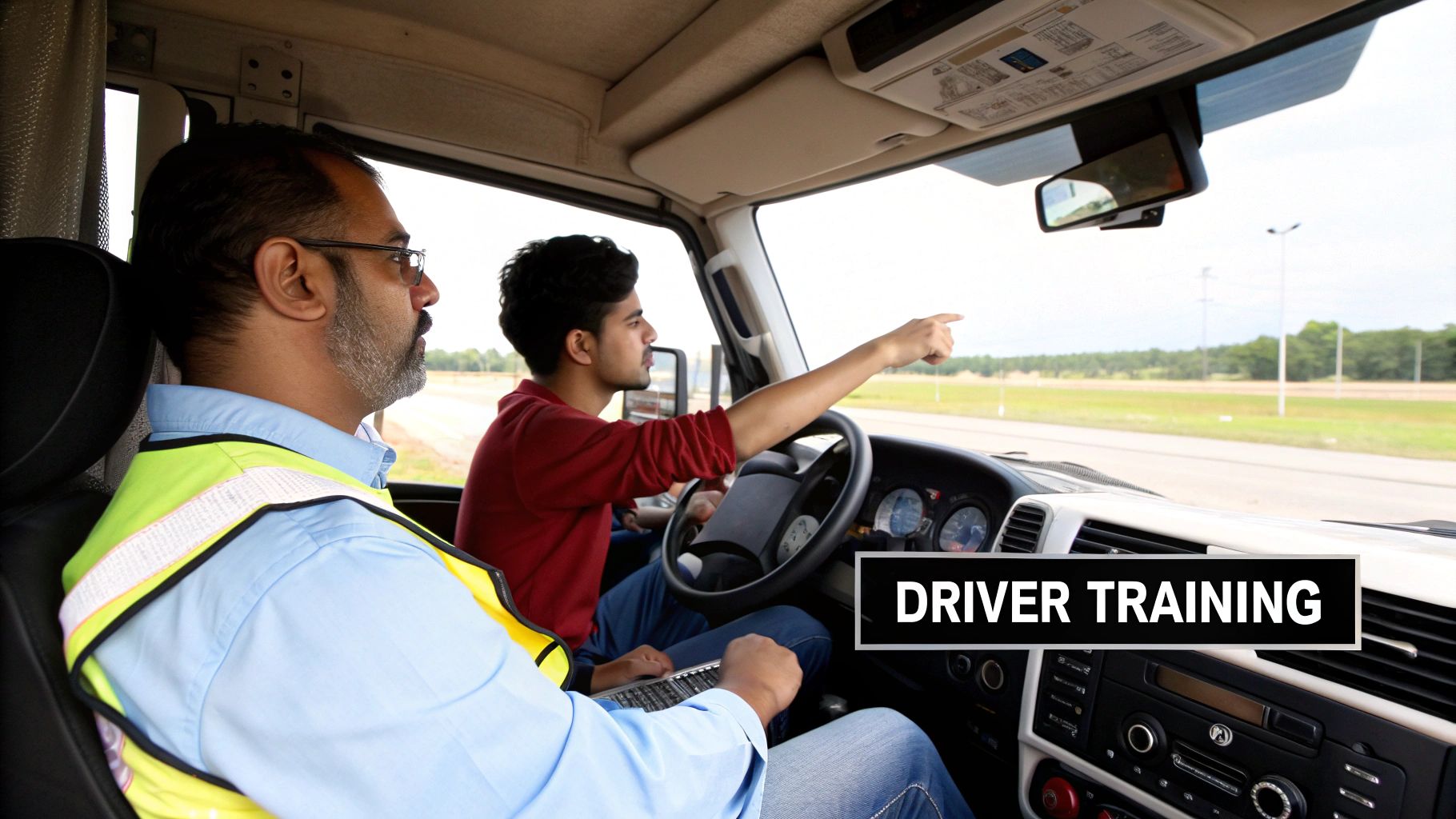
Looking at the road to getting your commercial driver’s license can feel a little overwhelming at first, but it’s really just a series of logical steps. Think of it like a roadmap: each stop gets you closer to your destination, moving you from studying in a classroom to actually getting behind the wheel. The whole process is built to make sure you have the knowledge and the real-world skills to handle a big rig safely and with confidence.
Starting Your Engine: The Commercial Learner's Permit (CLP)
Your journey kicks off with one of the most important first steps: getting your Commercial Learner's Permit (CLP). This isn't just another piece of paper. It’s your official ticket to start practicing in a commercial vehicle—provided you have a licensed CDL holder sitting right there with you in the passenger seat.
To earn that CLP, you’ll need to pass a few written knowledge exams at your local DMV. These tests cover a lot of ground, from the rules of the road to the nitty-gritty of systems like air brakes. This is where hitting the books really counts. To get a better idea of what to expect, you can dig into the details of the general knowledge test and get a jump on your studies.
Putting Your Skills to the Test
After you’ve got your CLP and spent enough time training behind the wheel, it’s time for the main event: the hands-on skills test. This is where the rubber meets the road, and you get to prove you can put all that book knowledge into practice. The test is the same no matter where you take it, broken down into three key parts that assess different areas of your driving ability.
The Pre-Trip Vehicle Inspection: Before you even think about starting the engine, you have to show an examiner you can inspect your vehicle from top to bottom. You'll literally walk them around the truck, pointing out critical components and explaining what you’re looking for—things like tire condition, brake functionality, and fluid levels. It’s all about proving you know how to make sure your rig is safe to drive.
Basic Control Skills: Next up, you'll head to a closed course to show off your maneuvering skills. This part is all about precision and having complete control of the vehicle at low speeds. You'll likely be asked to do things like straight-line backing, offset backing, and even parallel parking to show you can handle a large truck in tight quarters.
The On-Road Driving Test: The grand finale. For this part, an examiner will join you in the cab as you drive on public roads. This is your moment to demonstrate that you can operate the truck safely and responsibly in actual traffic, dealing with other cars, intersections, and all the variables of a real driving environment.
The skills test isn't about driving flawlessly; it's about showing you are consistently safe and in control. Examiners want to see that you can manage the vehicle's size and weight, follow traffic laws, and react appropriately to other drivers on the road.
Once you’ve successfully passed all three sections, you're over the finish line. You’ve officially earned your commercial driver's license and can get started in your new career.
Why a CDL Is Your Ticket to a Stable Career
Getting your commercial driver's license isn't just about passing a test. Think of it as investing in a secure career that's always in demand. While other industries might ride the waves of economic ups and downs, the need for skilled truck drivers never really goes away.
Trucking is the lifeblood of our economy, making sure goods get from point A to point B. This constant need means one thing: job security. The industry often talks about a nationwide driver shortage, which puts qualified drivers in a powerful position. You’ll find competitive pay, solid benefits, and plenty of opportunities no matter where you are in the country.
You're Joining the Backbone of the Economy
It's hard to overstate just how critical CDL holders are. We're not just talking about individual jobs; we're talking about a global freight trucking industry valued in the trillions. Right here in the U.S., there are millions of large trucks on the road, and every single one needs a skilled, licensed driver behind the wheel.
The numbers tell a powerful story. The trucking industry moves billions of tons of freight annually, generating hundreds of billions in revenue. When you earn your CDL, you become an essential part of this massive, indispensable machine.
A CDL isn't just another piece of plastic in your wallet. It's your entry pass into a profession that offers stability, growth, and the chance to play a vital role in keeping the country running. It’s a skill set that will always be needed.
Build Your Future on Solid Ground
With a CDL, you're not just landing a job—you're kicking off a real career with a clear road ahead for growth. You can add endorsements to specialize in hauling different types of cargo, become your own boss as an owner-operator, or even move into management or logistics down the line.
The training you put in upfront pays you back for years. The best first step is finding a program that gives you the right skills to get started quickly and safely. To see what that training looks like, you can explore a dedicated CDL training program that lays out a clear path from the classroom to a successful career on the open road.
Your Top CDL Questions, Answered
Thinking about getting your commercial driver's license is a big step, and it’s natural to have questions. You're not just learning to drive a new vehicle; you're starting a whole new career. Let's tackle some of the most common questions we hear from aspiring drivers.
How Long Does It Take to Get a CDL?
You can get on the road faster than you might think. A typical full-time CDL training program will have you ready for your test in about three to seven weeks.
Of course, this can change. If you need a more flexible schedule, a part-time program might be a better fit, though it will naturally take a bit longer. This time covers everything—from learning the rules of the road in the classroom to getting behind the wheel for that critical hands-on practice.
Do I Have to Go to a Truck Driving School?
Yes, you do. This isn't just a suggestion anymore; it's a federal requirement. The Entry-Level Driver Training (ELDT) regulations now mandate that all new drivers must graduate from a registered training provider before they can even take their CDL skills test.
This rule ensures everyone starts with the same high standard of knowledge and safety. It's not just about learning to pass a test—it's about building the safe driving habits that will protect you, and everyone else on the road, for your entire career.
Can I Get a CDL with a Bad Driving Record?
This is a big one, and the answer is: it depends on what's on your record.
A minor ticket from years ago probably won't stop you. But federal regulations take serious offenses very seriously. Things like a DUI, a hit-and-run, or a reckless driving conviction can disqualify you from getting a CDL, either for a set period or permanently.
Ready to take the next step toward a stable and rewarding career? At Patriot CDL, we provide the hands-on training and expert guidance you need to get on the road quickly and safely. Learn more about our programs and get started today.