The Gross Vehicle Weight Rating (GVWR) is the single most important number when it comes to your truck's weight. It’s the absolute maximum your vehicle is designed to weigh when fully loaded, as determined by the manufacturer.
Think of it as the vehicle's "do not exceed" line. This rating includes everything—the truck itself, fuel, passengers, and every last pound of cargo. Sticking to the GVWR isn't a suggestion; it’s a hard-and-fast rule for keeping your truck safe and stable on the road.
Decoding Your Truck's Maximum Weight Limit
So, what really goes into that GVWR number? It’s the total weight that the truck's core components—the frame, axles, suspension, and tires—can safely handle. Pushing past this limit puts immense stress on every part of your vehicle, seriously compromising braking, steering, and overall control.
For any professional driver, understanding the GVWR isn't just about avoiding a ticket. It's about knowing your vehicle’s fundamental capabilities and limitations.
What Counts Toward GVWR?
When we talk about the total weight, we're talking about more than just the freight in the trailer. Every single pound adds up. Let's break down the key components that contribute to your vehicle's gross weight.
Before you can determine if you're under the GVWR, you need to account for everything on board. The table below outlines each element that adds to your truck's total weight.
Key Components of Gross Vehicle Weight Rating (GVWR)
| Weight Component | Description | Example |
|---|---|---|
| Curb Weight | The weight of the vehicle when it's completely empty but ready to roll with all necessary fluids and a full tank of fuel. | A brand new semi-truck sitting on the lot, fueled up and ready for its first driver. |
| Cargo (Payload) | This is the weight of whatever you're hauling. It's the "working" part of the total weight. | Pallets of building materials, crates of produce, or a container full of consumer goods. |
| Driver & Passengers | The weight of every person in the cab. Even a co-driver or a passenger counts toward the total. | You and your co-driver, plus your personal gear for a long-haul trip. |
| Equipment & Accessories | Any additional items you have on board, from essential gear to personal belongings. | Chains, tarps, tools, a pallet jack, or even your lunchbox and luggage. |
By adding all these components together, you get your actual Gross Vehicle Weight (GVW). That number must always be less than or equal to the manufacturer's GVWR.
This all-inclusive approach ensures nothing gets overlooked. For drivers aiming for their CDL, mastering these weight calculations is a core skill. You can learn more about what's expected by checking out our guide on the general knowledge test.
The Gross Vehicle Weight Rating is the ultimate safety threshold established by the vehicle's engineers. Treating this limit as a guideline rather than a strict rule is a direct path to mechanical failures, legal trouble, and dangerous situations on the road.
The significance of GVWR isn't just a local concern; it’s a global standard. In the European Union, for example, trucks are categorized by their maximum weight limits. In 2023, vehicles rated between 30.1 and 40 tonnes were responsible for a staggering 92.7% of freight transport in Poland and 91.1% in Spain. This shows just how central these ratings are to keeping major economies moving safely.
Finding and Reading Your Vehicle's Weight Placard
Every commercial vehicle has its own rulebook for weight, and it's your job as a professional driver to know how to read it. This critical info isn't buried in some thick manual; it's right there on a label, often called the Federal Motor Vehicle Safety Standard (FMVSS) certification label or, more simply, the vehicle placard. Being able to read this is non-negotiable.
Think of the placard as the truck's birth certificate. It spells out its identity and, most importantly, its limitations. You'll almost always find it on the driver-side door jamb, a spot that's easy to check during any walk-around. Open the door, and that little sticker gives you the essential data you need to operate safely and legally.
Ignoring this label is like a pilot skipping the pre-flight checklist. The numbers printed on it aren't suggestions—they are hard limits set by the engineers who designed and built the truck.
Decoding the Information on the Placard
Once you've found the placard, you'll see a bunch of acronyms and numbers. It might look like technical jargon at first, but each piece of information is there for a reason. Learning what they mean is fundamental to loading your vehicle correctly and is a key part of any driver's daily routine.
Here are the most common ratings you'll find on that certification label:
- GVWR (Gross Vehicle Weight Rating): This is the big one. It's the absolute maximum a fully loaded vehicle can weigh, including the truck itself, all cargo, fuel, passengers, and gear.
- GAWR (Gross Axle Weight Rating): This number tells you the maximum weight that can be put on a single axle. You'll see separate ratings for the front (FR) and rear (RR) axles.
- Curb Weight: While not always listed right on the placard, this is a crucial number. It's the weight of the vehicle when it's completely empty, except for a full tank of fuel and all standard equipment.
- Payload Capacity: This is what you can actually haul. It’s the total weight of everything you add to the truck—cargo, passengers, and any other equipment.
Understanding how these numbers work together is what separates a true professional from a novice. The most important calculation you'll do is figuring out how much you can actually haul based on the GVWR.
The core formula for a safe load is simple but powerful: GVWR – Curb Weight = Payload Capacity. This little bit of math ensures you never have to guess about your load limits; you know them, precisely.
This diagram breaks down that simple but critical formula for staying within your Gross Vehicle Weight Rating.
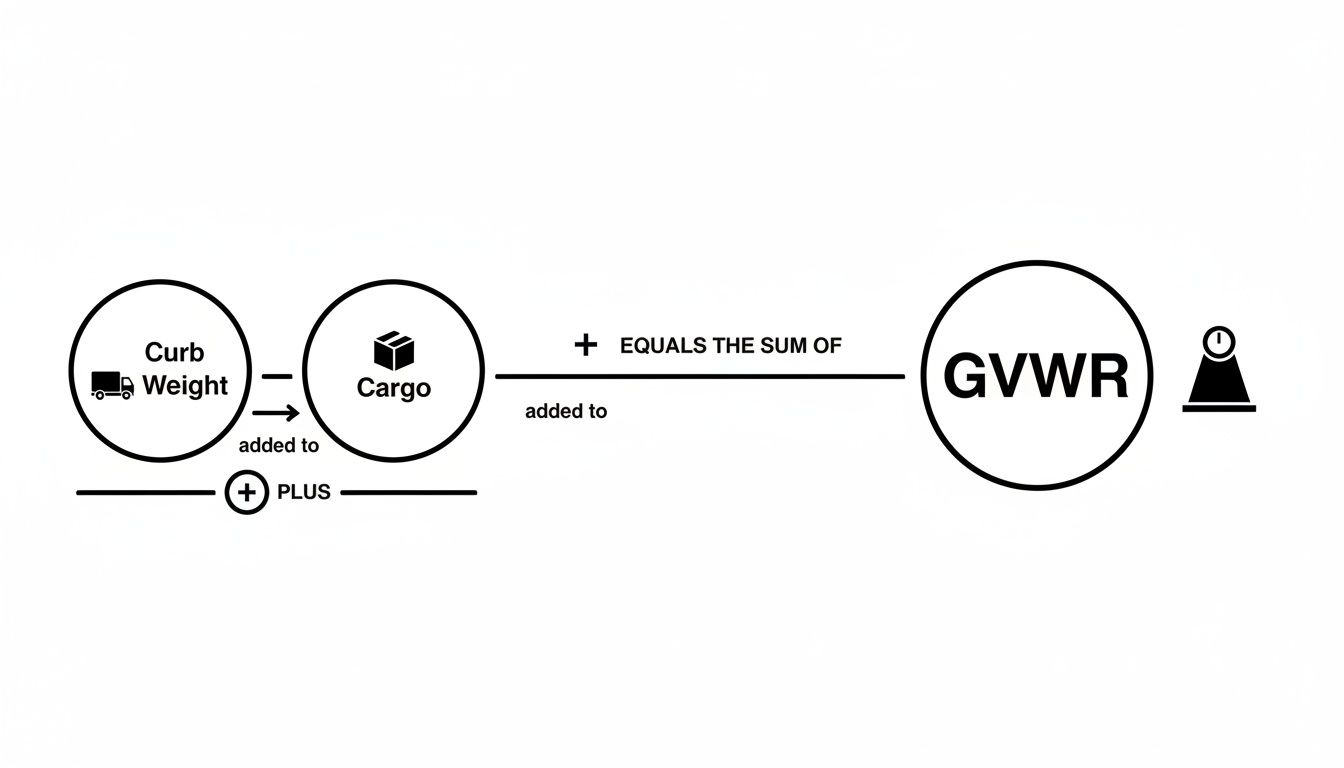
As you can see, the Gross Vehicle Weight Rating is just the total of the truck's empty weight and everything you put inside it. It's that straightforward.
Practical Application During Inspections
Checking the vehicle placard isn't a one-time thing; it's a fundamental step in your daily routine. It's a critical part of a thorough driver vehicle inspection report (DVIR), and knowing how to find and read this data quickly is a skill that keeps you, your cargo, and everyone else on the road safe.
With a little practice, this becomes second nature. A driver knows their truck has a curb weight of 15,000 lbs and a GVWR of 33,000 lbs. With a quick glance at the placard and some simple mental math, they instantly know their maximum payload is 18,000 lbs.
This is about more than just avoiding fines; it's about operational integrity. This knowledge is especially vital when you're taking your practical skills test and is a major focus in any hands-on training. To really master the inspection process, check out our complete guide to the pre-trip inspection. Staying within these weight ratings ensures your vehicle's brakes, suspension, and tires can do their job exactly as the manufacturer intended.
Why Overloading Your Truck Is a Career-Ending Mistake
It’s one thing to read the numbers on your vehicle’s placard, but it's another thing entirely to understand the real-world consequences of ignoring them. Exceeding your truck’s Gross Vehicle Weight Rating isn't some minor oversight. It's a high-stakes gamble with your career, your rig, and the lives of everyone on the road.
This isn't about just blindly following the rules. Pro drivers treat GVWR as an unbreakable law of physics because they've seen or heard what happens when you don't. The risks are severe, and they generally fall into three buckets: safety, legal and financial penalties, and the mechanical destruction of your truck.
The Critical Safety Risks of an Overloaded Vehicle
The most immediate danger of an overloaded truck is the loss of control. When you push a vehicle past its design limits, it becomes unpredictable and sluggish, turning a routine trip into a white-knuckle ride.
Every extra pound you add makes that truck harder to stop. A rig that's too heavy can take a terrifyingly long distance to come to a complete halt, and that extra space could be the difference between a close call and a catastrophic collision.
On top of that, the excess weight destroys your handling and stability. Turns become dicey as the vehicle’s center of gravity shifts, dramatically increasing the risk of a rollover, especially on curves or during a sudden evasive maneuver. The stress on your tires also skyrockets, which significantly raises the chances of a blowout at highway speeds—a disaster scenario for any driver.
When a vehicle is operated beyond its GVWR, its fundamental safety systems—braking, steering, and suspension—are compromised. It’s no longer the vehicle the manufacturer engineered; it’s an unstable and dangerous machine.
The Legal and Financial Fallout
Ignoring your GVWR can bring your career to a dead stop. Law enforcement and Department of Transportation (DOT) officers take weight violations very seriously, and the penalties are designed to hit you where it hurts: your wallet and your license.
If you’re caught overweight at a weigh station or during a roadside inspection, the consequences are immediate. You’re looking at steep fines that can range from hundreds to thousands of dollars, depending on just how far over the limit you are.
But these violations aren’t just a one-time penalty. They tack points onto your Commercial Driver’s License (CDL), which can send your insurance premiums through the roof or even make you uninsurable. A single major violation, or a string of smaller ones, can lead to the suspension or revocation of your CDL. That effectively ends your ability to make a living on the road. This is why knowing all the specific CDL requirements is so critical for keeping your record clean.
The Brutal Mechanical Toll on Your Truck
Beyond the instant safety and legal risks, overloading your truck is a slow, brutal form of mechanical torture. Every single component is forced to work harder than it was ever designed to, leading to premature wear and tear that ends in catastrophic (and expensive) failures.
Here’s a look at how excess weight tears a truck apart from the inside out:
- Engine and Transmission: Your powertrain strains to move all that extra mass, causing it to overheat and wear out far quicker than it should. This can lead to a completely fried transmission or a blown engine.
- Brakes: Your brakes are engineered to stop a specific amount of weight. Overload them, and they create excessive heat, leading to brake fade—a terrifying situation where they simply stop working effectively. It also grinds down pads and rotors at an alarming rate.
- Suspension and Frame: The suspension system is built to absorb bumps in the road, but it has its limits. Too much weight can crack leaf springs, blow out shocks, and even bend or crack the vehicle’s actual frame, causing permanent, irreparable damage.
Each one of these problems means serious downtime and repair bills that can demolish your profits. Professional drivers know that respecting the GVWR isn’t just about safety and the law; it’s about protecting their single most important asset—their truck.
Putting GVWR Into Practice With Real-World Calculations

Knowing the theory behind Gross Vehicle Weight Rating is great, but putting it to work on the road is what separates the pros from the rookies. This is where the numbers on that door jamb placard meet the real world. Let’s get practical and run through the kind of day-to-day math every professional driver needs to master.
At its heart, this is all about one critical skill: calculating your maximum legal payload. This isn't just a helpful tip; it's a non-negotiable step every time you load up. Get it right, and you’re running a safe, legal haul. Get it wrong, and you’re looking at a costly, and potentially dangerous, mistake.
Let’s break it down with a couple of common truck types you’ll likely encounter.
H3: Calculating Maximum Payload: A Class 7 Box Truck
First up is a Class 7 box truck, a true workhorse for local and regional deliveries. These things are built tough, but they have their limits. Let’s say you’ve got a truck with these specs listed on the door sticker:
- Gross Vehicle Weight Rating (GVWR): 33,000 lbs
- Curb Weight (from registration or manual): 14,500 lbs
To figure out how much you can legally load, you need to use the fundamental payload formula. It’s simple but crucial.
Payload Capacity = GVWR – Curb Weight
33,000 lbs (GVWR) – 14,500 lbs (Curb Weight) = 18,500 lbs
That means your maximum legal payload is exactly 18,500 pounds. Remember, that number has to cover everything you add to the truck—your cargo, your own weight, any co-drivers, and all your gear like a pallet jack or hand truck. If your load of pallets hits 18,000 pounds, you’ve only got 500 pounds left for yourself and your equipment. It adds up fast.
H3: Calculating Maximum Payload: A Class 8 Tractor-Trailer
Now, let's look at a Class 8 tractor, the absolute backbone of the long-haul industry. The math is identical, but the numbers get bigger, and so do the consequences of getting it wrong.
- Gross Vehicle Weight Rating (GVWR): 52,000 lbs (for the tractor only)
- Curb Weight (tractor only): 19,000 lbs
Applying the same formula, we get the tractor's payload capacity.
- Calculation: 52,000 lbs (GVWR) – 19,000 lbs (Curb Weight) = 33,000 lbs
This 33,000 pounds is the total weight the tractor itself can handle. This includes you, your fuel, your personal gear, and most importantly, the kingpin weight (or tongue weight) being pushed down onto the tractor from your loaded trailer. Misjudge this, and you could easily overload your drive axles. This concept is a major focus when you're preparing for exams on combination vehicles.
H3: Factoring in Tongue Weight From a Trailer
Towing adds another layer to the calculation. A trailer’s tongue weight is the downward force it applies to the tow vehicle's hitch, and that weight counts directly against your truck’s payload capacity because the truck’s frame is carrying it.
Imagine a heavy-duty pickup towing a loaded flatbed trailer.
- Truck GVWR: 14,000 lbs
- Truck Curb Weight: 8,500 lbs
- Truck Payload Capacity: 14,000 – 8,500 = 5,500 lbs
- Trailer Tongue Weight: 1,500 lbs
That 1,500 pounds from the trailer has to be subtracted from the truck’s payload.
- Remaining Payload: 5,500 lbs – 1,500 lbs = 4,000 lbs
You are now left with 4,000 pounds for any cargo you put in the truck bed, plus passengers and other equipment. For any CDL holder, mastering these calculations is essential. It's the difference between being in compliance and facing fines that can reach up to $10,000 for a single overload incident in the U.S.
To help you visualize where different trucks fall, here’s a quick guide to the Federal Highway Administration’s truck classifications based on GVWR.
FHWA Truck Classes by Gross Vehicle Weight Rating
This table provides a handy reference for understanding how the FHWA categorizes vehicles. As you can see, your CDL class directly corresponds to these weight ratings.
| Truck Class | GVWR Range (in pounds) | Common Vehicle Examples |
|---|---|---|
| Class 1-3 | 0 – 14,000 lbs | Pickup trucks, vans, SUVs |
| Class 4 | 14,001 – 16,000 lbs | City delivery trucks, larger walk-in vans |
| Class 5 | 16,001 – 19,500 lbs | Bucket trucks, larger delivery trucks |
| Class 6 | 19,501 – 26,000 lbs | Single-axle trucks, school buses, beverage trucks |
| Class 7 | 26,001 – 33,000 lbs | Box trucks, city buses, street sweepers |
| Class 8 | 33,001 lbs and over | Tractor-trailers, cement trucks, dump trucks |
Understanding this chart helps you instantly recognize which vehicles fall under strict CDL regulations, especially Class 7 and Class 8, which are the bread and butter of the commercial trucking world.
How Mastering GVWR Defines Your Professional Career
So far, we've unpacked what Gross Vehicle Weight Rating means, where to find it on your truck, and the serious consequences of getting it wrong. Now, let’s tie all of that to what really matters: your future as a professional driver. Getting a handle on GVWR isn't just about acing your CDL test—it's about laying the foundation for a long, safe, and successful career out on the road.
This knowledge isn't just theory; it directly shapes your day-to-day work in ways that scream "professional." From securing a load the right way to running a sharp pre-trip inspection, your understanding of GVWR is always in play. Think of it as the bedrock of a solid, respectable career that gives you the independence and stability you’re aiming for.
From Test Knowledge to Road Professionalism
Passing your CDL exam is just the first hurdle. Truly mastering GVWR is what turns you into a genuine professional behind the wheel. Companies aren't just looking for someone who can check a box on a test; they need drivers who live and breathe safety and operational excellence every single day.
When you respect GVWR limits, you're actively protecting your own driving record, the company's expensive equipment, and everyone else on the road. That level of responsibility is exactly what the best trucking companies are looking for. It shows you’re not just another driver, but a reliable professional they can trust with their most valuable assets.
Your expertise in managing vehicle weight is a direct reflection of your professional integrity. It’s a skill that speaks volumes about your commitment to being a safe and dependable operator, which is the foundation of a successful trucking career.
Understanding GVWR empowers you to match the right truck to the right load, a crucial skill that directly impacts safety and efficiency—the very skills Patriot CDL helps you build. Just look at international standards: Germany, a massive freight hub, strictly enforces a maximum GVWR of 40 tonnes for truck-trailer combos. The Netherlands pushes that to 50 tonnes for certain five-axle rigs. These strict rules show just how critical this rating is in the global supply chain. For any logistics pro, mastering GVWR is just as important as understanding the ins and outs of a modern import and export business.
The Bedrock of a Secure and Stable Career
In the trucking world, your reputation is gold. A driver known for being meticulous about weight limits is a driver who gets trusted, respected, and is always in demand. That expertise becomes your professional calling card.
Getting these principles down is your first major step toward becoming not just a truck driver, but a true professional of the road. It gives you the confidence to handle any load, knowing you're operating safely and legally. This knowledge is what keeps your CDL clean and your career moving in the right direction.
Here’s how this expertise translates into real career stability:
- Reduced Risk of Violations: You steer clear of the costly fines and damaging points that can put your CDL—and your job—on the line.
- Enhanced Vehicle Longevity: By preventing overload strain on the truck, you help minimize downtime and expensive repairs, making you a more valuable and profitable operator.
- Increased Employer Trust: Companies love drivers who protect their equipment and their reputation. Your diligence makes you a go-to employee.
- Improved Safety Record: A clean safety record is your most valuable career asset, opening doors to better jobs with better pay.
This commitment to the fundamentals is what separates a short-term gig from a long-term, fulfilling profession. If you're just starting out, our guide on Entry-Level Driver Training (ELDT) requirements can help you build this professional foundation from day one. Your journey to becoming a respected professional starts right here, by mastering the numbers that keep everyone safe.
Common Questions About Gross Vehicle Weight Rating
To really nail down this topic, let's go through some of the most common questions that come up about Gross Vehicle Weight Rating. Getting these straight will clear up any confusion and give you the practical know-how every professional driver needs.
What’s the Difference Between GVWR and Towing Capacity?
This is a big one, and it's easy to mix them up. The distinction is simple but absolutely critical for any driver.
Think of it this way: GVWR is about what your truck can carry, while towing capacity is about what it can pull.
The Gross Vehicle Weight Rating (GVWR) is the absolute maximum weight of the truck itself, plus everything on it. That includes the cab, engine, fuel, you, your passengers, and any cargo you've loaded onto the chassis or into the bed. It's all about what the truck's own frame, suspension, and tires can safely handle.
Towing capacity, on the other hand, is the maximum weight of a separate trailer your vehicle is engineered to pull. This number depends on things like engine power, the strength of the frame, and whether the brakes are up to the task of stopping both the truck and a heavy trailer. It’s entirely possible for a truck to have a massive towing capacity but a more modest GVWR—don't get them confused.
What Are the Penalties for Exceeding GVWR?
Driving a vehicle over its GVWR isn't just a minor mistake; it's a serious offense with real, immediate consequences. The penalties are harsh for a reason—they’re meant to stop drivers from putting people at risk.
While the specifics can change from state to state, the penalties usually hit you in three main areas:
- Hefty Fines: Overweight fines are no joke. They’re often calculated per pound, and the further over you are, the more it costs. A single violation can easily set you back thousands of dollars.
- CDL Points and Violations: An overweight ticket does more than drain your bank account. It puts points on your CDL and becomes a permanent part of your driving record. Rack up enough points, and you could be looking at a suspended or even revoked license.
- Forced to Unload: If a DOT officer finds you're significantly overweight, they can order you to park the truck until the excess cargo is removed. This means expensive downtime, missed deadlines, and the logistical headache of getting another truck to come get the extra load.
The legal system doesn't see exceeding GVWR as a simple traffic ticket. It's treated as a major safety violation because an overloaded truck is a danger to everyone on the road.
Can I Increase My Vehicle's GVWR?
The answer to this is a hard no. The Gross Vehicle Weight Rating is a permanent number set by the manufacturer when the vehicle was designed and built. It's based on the engineered limits of the original frame, axles, suspension, and braking system.
You can add aftermarket parts like heavy-duty springs or beefier brakes, but none of that changes the official GVWR on the vehicle's placard. Legally and for safety purposes, that original number is the only one that counts.
Trying to "re-rate" a vehicle yourself isn't just against federal rules; it's incredibly dangerous. Upgrading one part doesn't magically strengthen all the others. A stronger suspension won't save a frame that's about to buckle under stress it was never designed for. For any professional driver, the manufacturer's GVWR is the final word. Period.
Understanding and respecting the Gross Vehicle Weight Rating is what separates the amateurs from the true professionals. It's a cornerstone of a safe, legal, and successful career behind the wheel. If you're ready to build that foundation and get your career moving, Patriot CDL provides the expert, hands-on training you need to master these skills and more. Visit us at https://patriotcdl.com to get started.