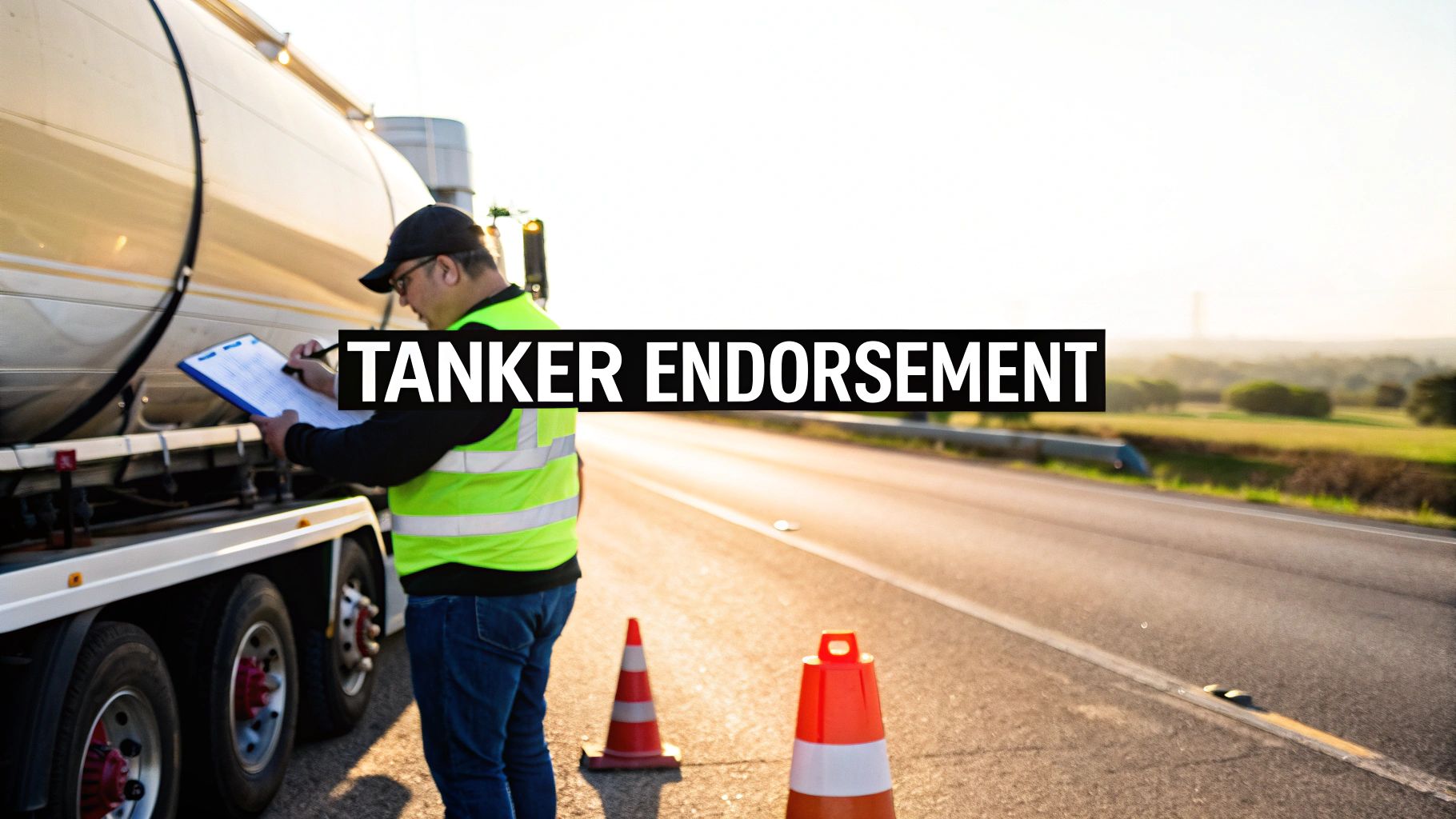
So, you're thinking about expanding your trucking career and have your eye on those big tanker trucks. Smart move. But before you can get behind the wheel, you'll need a special certification on your CDL called a tanker endorsement, or more officially, the 'N' endorsement.
Think of your standard CDL as a general passport for professional driving. The 'N' endorsement is like a special visa that opens up a whole new world of opportunities, specifically for hauling bulk liquids and gases. It's the key to jobs involving fuel, milk, chemicals, and pretty much any other liquid cargo you see on the road.
What's a Tanker Endorsement All About?
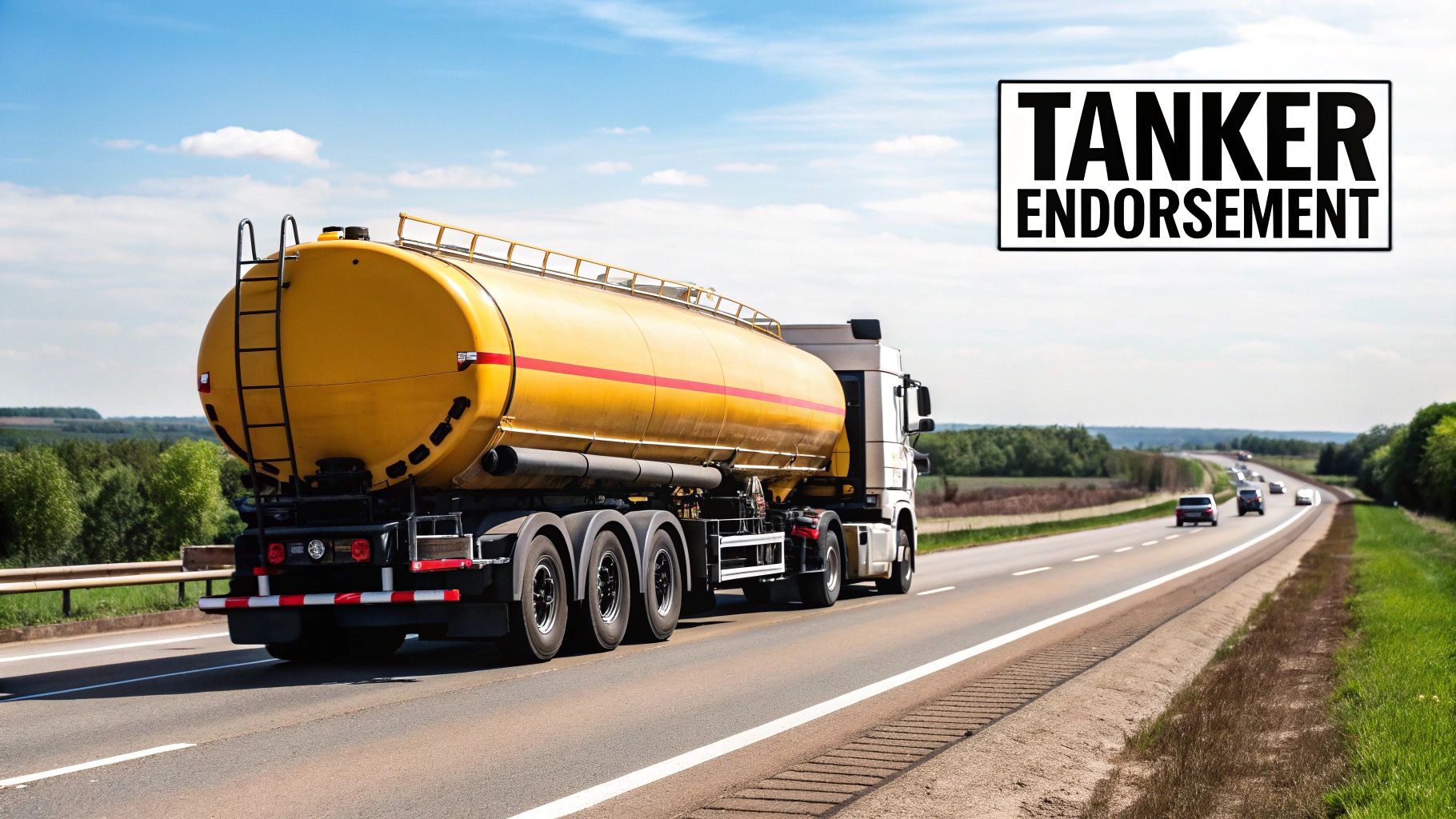
At its heart, a tanker endorsement proves you have the specialized skills to handle the unique physics of hauling liquids. It’s not like hauling a solid, stationary load.
Ever tried to carry a shallow pan full of water without spilling? Every time you speed up, slow down, or take a turn, that water sloshes around, creating a wave that can easily throw you off balance. Now, imagine that on a massive scale—thousands of gallons of liquid surging inside a giant tank. That's what tanker drivers deal with every day, and it's why this endorsement is so critical.
This certification on your CDL, marked with the letter 'N', is your official qualification to safely manage a vehicle with a high center of gravity and the powerful forces of liquid surge.
When Is the 'N' Endorsement Mandatory?
The Federal Motor Carrier Safety Administration (FMCSA) has very specific rules about when a tanker endorsement is required. It all comes down to the size of the container and the total volume you're hauling.
Here’s a quick guide to help you figure it out.
When You Need a Tanker Endorsement
| Hauling Scenario | Is an N Endorsement Required? | Key Consideration |
|---|---|---|
| Hauling a single tank rated at 200 gallons. | Yes | The individual container capacity is over 119 gallons. |
| Transporting multiple IBC totes, each 100 gallons, for a total of 800 gallons. | No | Individual containers are under 119 gallons, and the total volume is under 1,000 gallons. |
| Hauling a dozen 100-gallon totes on a flatbed (total 1,200 gallons). | Yes | The aggregate (total) volume exceeds 1,000 gallons, even though each container is small. |
This table shows it's not just about classic tanker trucks. A common mistake is thinking you're in the clear with smaller containers like IBC totes on a flatbed. But if their combined capacity crosses that 1,000-gallon threshold, you absolutely need the endorsement. It’s a detail you can’t afford to miss.
Getting this endorsement is a fantastic way to boost your career, but first, you have to make sure you've mastered the fundamental CDL requirements. That’s always your starting point.
Getting Your Ducks in a Row for the Application
Before you even think about walking into the DMV, you need to make sure you've got all your bases covered. Think of it like a pre-trip inspection for your career—getting everything sorted out now will save you a world of headaches down the road.
First things first, you can't add an endorsement to something you don't have. The absolute starting point is holding a valid Class A or Class B CDL. This is the foundation, and the 'N' endorsement is a specialization you build on top of it.
Age is another big one. While some states let you drive commercially within their borders at 18, the federal government has stricter rules. For any driving that crosses state lines or involves hauling hazardous materials, you must be at least 21 years old.
Key Milestones on Your Checklist
Beyond your license and age, there are a few other critical pieces to the puzzle. Getting these lined up is what separates a smooth process from a frustrating one.
- State-Specific Rules: Federal regulations set the minimum standard, but your state’s DMV has the final say on procedures and fees. It's always a good idea to check their website or give them a call to get the latest, most accurate info.
- Medical Certification: You’ll need a current DOT medical card. This is your proof that you're physically qualified to handle the demands of driving a large commercial vehicle safely.
- Background Checks: Thinking bigger? If you want to combine the tanker endorsement with a hazmat (H) endorsement to get the coveted 'X' endorsement, you'll have to pass a TSA threat assessment first.
One of the most important first steps is getting your commercial learner's permit. This is what legally allows you to get behind the wheel and practice driving a tanker with a qualified supervisor before you take the official tests.
Getting a solid handle on the requirements for your commercial learner's permit is the best way to start, as it paves the way for every endorsement you'll earn later.
How to Get Your Tanker Endorsement: Application and Testing
So, you've decided you meet the requirements and you're ready to get that N endorsement. Great. The path forward is pretty straightforward, and it all starts with a trip to your local DMV.
You'll officially apply for the endorsement there. This can usually be handled when you're getting your commercial learner's permit (CLP) for the first time, or you can add it to your existing CDL later on.
After the paperwork is done, your entire focus shifts to one thing: the written knowledge test. Don't take this lightly. It’s a specialized exam that dives deep into the unique physics of hauling thousands of gallons of liquid. The test, which is administered by your state's DMV, is a written exam that about 70–80% of drivers pass on their first try. The technical nature of the material means plenty of folks have to retake it, so solid preparation is key.
This infographic lays out the core steps you'll need to follow.
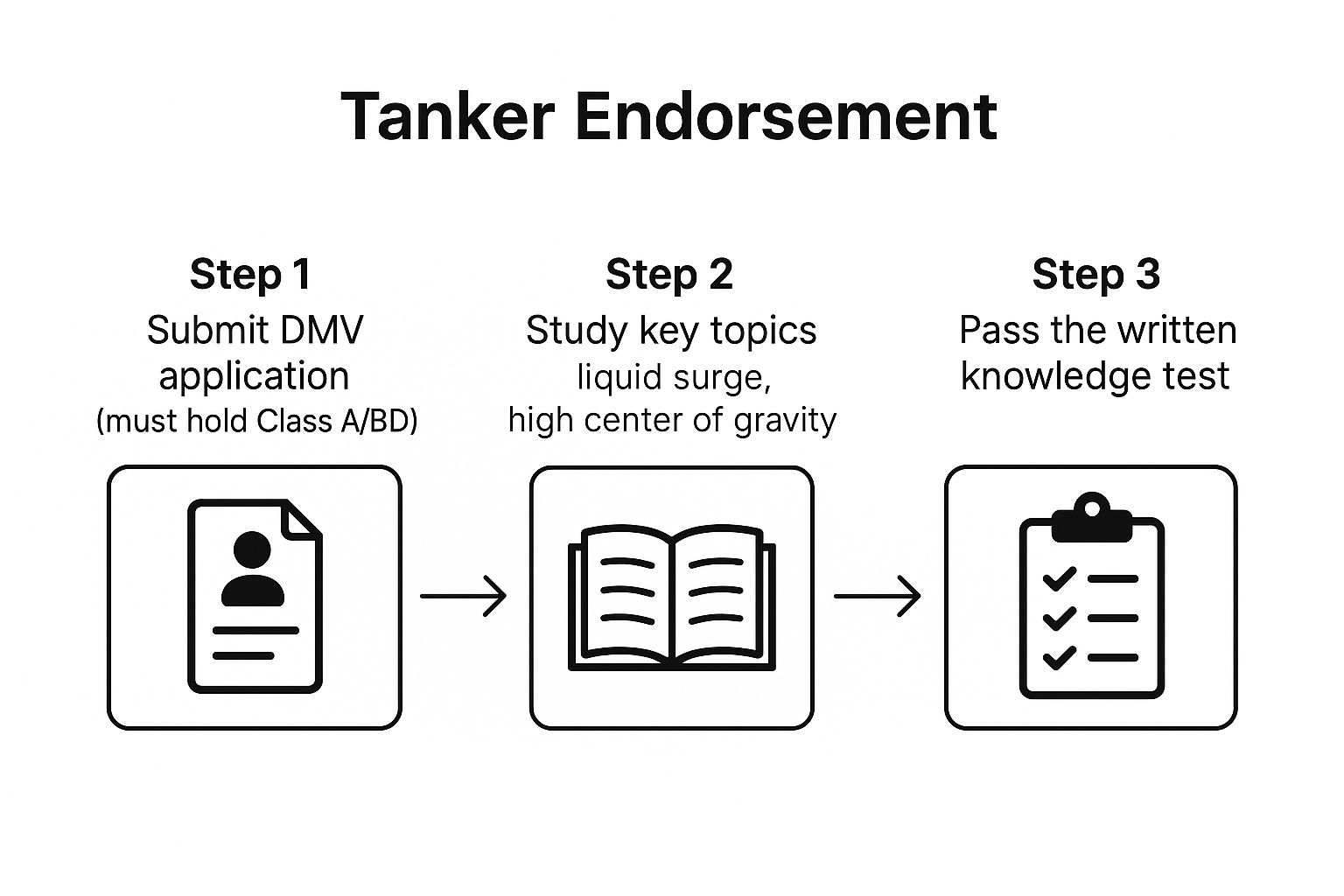
As you can see, it’s a clear progression from filing your application to acing that final test.
What to Focus On for the Test
To pass, you need to be strategic with your studying. The exam zeroes in on several critical areas unique to tanker trucks. This isn't about memorizing rules; it's about truly understanding the forces sloshing around behind you.
Here are the topics you absolutely have to nail:
- Liquid Surge: This is the big one. It's the powerful, wave-like movement of liquid in a partially filled tank. You must know how that surge impacts your truck during acceleration, braking, and especially when taking a turn.
- High Center of Gravity: Tanker trucks are top-heavy, plain and simple. That makes them much more prone to rollovers. The test will grill you on how to manage this risk, particularly on curves and uneven surfaces.
- Safe Driving Procedures: This covers everything from proper braking techniques to avoid skids, managing the much longer stopping distances caused by surge, and understanding the importance of "outage" (the empty space left for liquid to expand).
A common mistake is underestimating this test. The drivers who succeed are the ones who dedicate serious study time to the tanker section of their state's official CDL manual. Taking plenty of practice tests is also a huge confidence builder.
In many ways, preparing for this endorsement is a lot like studying for the CDL general knowledge test. Both demand a rock-solid understanding of safety above all else.
Mastering the Unique Challenges of Hauling Liquids
Getting behind the wheel of a tanker is a whole different ballgame compared to pulling a standard dry van or flatbed. You're not just dealing with more weight; you’re managing a living, breathing force inside your trailer. Grasping this concept is the first step to understanding why a tanker endorsement isn't just a piece of paper—it's essential for survival on the road.
The single biggest challenge is something called liquid surge. Think about it: every time you hit the brakes, accelerate, or take a turn, thousands of gallons of liquid slosh around. This isn't like a neatly stacked pallet of goods. It's a massive wave of energy that can shove your truck forward when you’re trying to stop or throw you off balance in a curve.
This constant movement demands a completely different approach to driving, one built on smooth, deliberate actions. A sudden stop or a sharp turn can cause a violent surge, creating the perfect conditions for a jackknife or, even worse, a rollover.
Handling a Top-Heavy Load
On top of the surge, you have to contend with a high center of gravity. Tanker trucks are naturally top-heavy, which makes them much more likely to roll over than other commercial vehicles. A simple misjudgment on an off-ramp or a curve can quickly turn disastrous.
To stay safe, tanker drivers have to master a set of specialized skills until they become pure instinct. These techniques are the bedrock of safe operation and are exactly what the endorsement test is designed to evaluate.
- Smooth Acceleration and Braking: You have to ease into your starts and stops. Being gentle is the only way to keep that liquid surge from taking control of your rig.
- Anticipatory Driving: Looking way down the road is non-negotiable. You need to see traffic changes coming from a mile away to give yourself plenty of room for gradual speed adjustments and long, slow stops.
- Careful Turning: Taking curves and corners at a crawl isn't just a suggestion; it's critical for keeping all your wheels on the pavement and preventing a rollover.
The physics of a tanker are unforgiving. A driver must learn to work with the momentum of the liquid, not against it. It's a skill that blends precision with a deep respect for the forces at play.
These real-world dangers are exactly why the written exam hammers on surge dynamics and vehicle stability. The knowledge you gain isn't just for passing the test; it's what you'll use every single day to manage these powerful forces. It’s just as fundamental as knowing your routine inside and out, which you can brush up on with our guide to the CDL pre-trip inspection.
Why a Tanker Endorsement Is a Smart Career Move
So, is getting the N endorsement really worth the extra time and study? I can tell you from experience: absolutely. Earning this certification is one of the best investments you can make in your driving career, and it pays off in both your wallet and your job security.
The first thing you’ll notice is a serious bump in your paycheck. Hauling liquids is a specialized skill—you're dealing with surge, a high center of gravity, and often sensitive materials. That expertise is in high demand, and companies are willing to pay a premium for it.
On average, a driver with a tanker endorsement can pull in $10,000 to $15,000 more per year than someone hauling standard dry van or flatbed freight. For drivers just starting out, this can mean a starting salary between $65,000 and $75,000, and it's not uncommon for seasoned tanker haulers to clear six figures.
Unlocking More Stable Industries
Beyond the immediate pay increase, the N endorsement opens doors to some of the most stable, recession-proof corners of the trucking world. While general freight can slow down when the economy gets shaky, the need for bulk liquids never really stops.
Think about the kind of cargo you'll be hauling. It's the stuff that keeps the country running, day in and day out.
- Fuel and Energy: The world runs on gasoline, diesel, and natural gas. These products are always on the move from refineries to distributors.
- Agriculture and Food Production: From milk and juice to cooking oils and sweeteners, the food industry relies on a constant flow of liquid ingredients.
- Industrial Chemicals: Manufacturing plants need a steady supply of chemicals to produce everything from plastics and paint to medicine.
By getting qualified to haul these loads, you become an indispensable part of the nation’s supply chain. This makes you a far more versatile and valuable driver, with plenty of opportunities for steady work, no matter the season.
Ultimately, adding a tanker endorsement to your CDL is about much more than just learning to haul liquids. It’s about securing better pay, opening up a wider range of job prospects, and building a more resilient career in an industry that's always on the move.
Common Questions About the Tanker Endorsement
As you think about adding a tanker endorsement to your CDL, a few questions probably pop into your head. Getting straight answers will help you figure out if this is the right move for your career and what to expect.
Let's tackle the big one first: How long does the tanker endorsement process take? There's no single answer, but most drivers can get it done in about one to three weeks. This timeframe gives you enough room for studying, booking and taking your written test at the DMV, and waiting for any state-specific paperwork to clear.
Another question that comes up a lot has to do with those square plastic containers you see. Do I need an N endorsement for IBC totes? The short answer is, it depends on how much you're hauling. The federal 1,000-gallon aggregate rule is what matters. If you have a bunch of smaller totes that each hold less than 119 gallons, you still need the N endorsement if their combined total capacity adds up to more than 1,000 gallons.
N vs. H vs. X Endorsements: What's the Difference?
The world of CDL endorsements can feel a bit like alphabet soup. Knowing what each letter means is key to mapping out where you want to go in your trucking career. Think of them as specializations that open doors to different kinds of freight.
N Endorsement (Tanker): This is your bread and butter for hauling bulk liquids or gases that are non-hazardous. It's all about mastering the unique challenges of liquid surge and a high center of gravity. Think milk, water, or food-grade oils.
H Endorsement (Hazmat): This one lets you transport hazardous materials, but not necessarily in a tanker. You could be hauling drums of chemicals on a flatbed or flammable supplies in a standard dry van.
X Endorsement (Tanker/Hazmat Combo): This is the top-tier combination. An 'X' on your license means you're certified to haul hazardous materials inside a tanker truck. It combines the skills of both the N and H endorsements, putting you in the running for some of the best-paying jobs out there, like hauling gasoline or potent industrial chemicals.
The 'X' endorsement is a big deal. It requires you to pass not only the tanker knowledge test but also the tougher hazmat exam, which includes a full TSA background check.
Deciding which endorsement is right for you really comes down to your career goals. Starting with an 'N' is a fantastic way to specialize and boost your income. You can always add the 'H' endorsement down the road to earn the highly versatile 'X'.
If you're ready to explore your options, see what's possible in our CDL training program.
At Patriot CDL, we provide the expert training and hands-on experience you need to launch a successful trucking career. Learn more about our accelerated programs and get on the road to higher earnings.