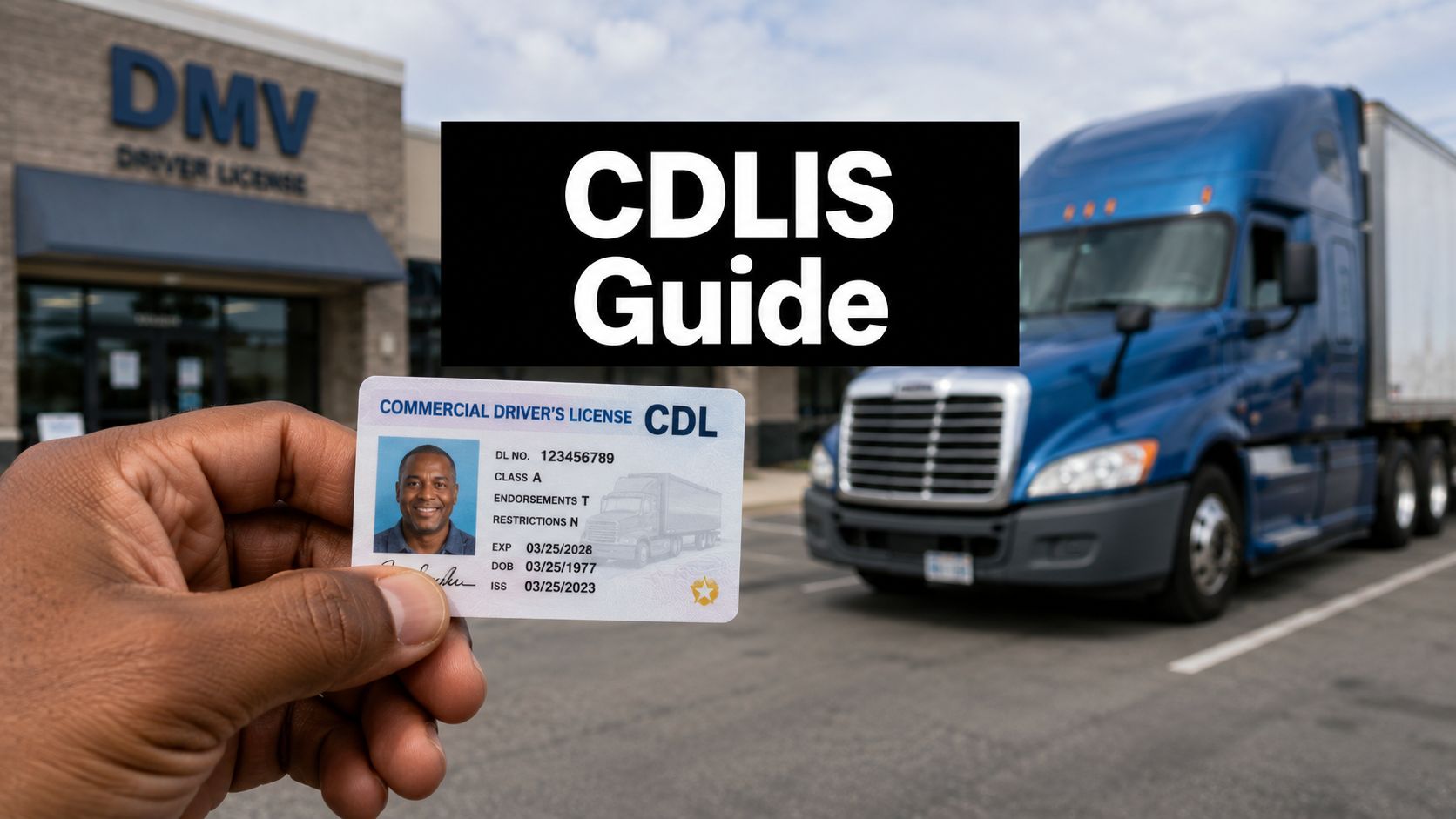
You've probably had this thought at some point: “If I move, switch companies, or get a ticket in another state, how does any of that follow my CDL?”
That question matters more than most new drivers realize. A commercial driving career doesn't stay neatly inside one state line. Drivers relocate. Companies hire across regions. Courts and licensing agencies have to know whether the person in front of them has a clean record, a suspension, an endorsement, or a disqualification somewhere else.
That's where the Commercial Driver License Information System, usually called CDLIS, comes in. If you understand what it does, you'll make better decisions about your license, your record, and your long-term career.
Your CDL Is Your Career and CDLIS Protects It
Say you earned your CDL in one state, spent a few years driving safely, and then moved for a better route or a better home base. You walk into the new state's licensing office and ask to transfer your commercial license. The question behind the counter isn't just who you are. It's whether your record is complete, accurate, and real.
That's the practical reason CDLIS matters.

A lot of people hear the name and tune out because it sounds like pure bureaucracy. On the road, though, CDLIS works more like a national switchboard for commercial licenses. It helps states confirm that a driver has one license and one professional history instead of a scattered trail of records in different places.
That protects the public, but it also protects you. If you've built a solid record, you want that record to transfer correctly. You want the next state, the next employer, and the next enforcement check to see the full truth, not missing pieces.
Why new drivers should care early
Many students focus on passing the permit test, the pre-trip, backing, and road skills. Those are the right priorities. But once you start working, your CDL record becomes part of your livelihood in the same way your tools matter to a mechanic.
A few career moves bring this into focus fast:
- Moving to another state: Your new licensing agency needs to find your record and verify your status.
- Applying to a new carrier: The company wants a clear picture of your professional driving history.
- Adding endorsements later: Your record has to stay consistent and current.
If you're still deciding where trucking can take you, this overview of a truck driver career path helps put the licensing side into a larger career picture. And if you're comparing business opportunities, this guide to FedEx Ground eligibility and financials gives useful context on the business side of transportation work.
Practical rule: Treat your CDL record like a paycheck file. If something on it is wrong, it can cost you work.
What Is the Commercial Driver License Information System
The easiest way to understand the commercial driver license information system is to stop thinking of it as one giant filing cabinet.
It resembles a master card catalog in a library system.
Each state has its own shelves and records. CDLIS helps the states find the right shelf for the right driver, so one person doesn't end up with multiple commercial licenses and multiple separate histories.

The official description matters here because it tells you the system's purpose in plain terms. The American Association of Motor Vehicle Administrators explains that CDLIS was established under the Commercial Motor Vehicle Safety Act of 1986 and is implemented through 49 CFR 383 and 384. It says CDLIS is a nationwide system used by state driver licensing agencies to make sure each commercial driver has only one license and one complete driver record, including record transfers when a driver moves and reporting of out-of-state convictions and withdrawals through AAMVA's CDLIS overview.
The one-license idea in plain English
This is the heart of the system. A commercial driver shouldn't be able to hold one CDL in State A, another in State B, and keep problems hidden by bouncing between them.
That's why CDLIS exists.
If you boil the system down, it supports three practical goals:
- One driver
- One commercial license
- One complete record
For a working driver, that means your history is supposed to stay attached to you, not to whatever state line you crossed last week.
What drivers often confuse
A lot of new drivers assume CDLIS is something they'll log into one day, like an app or online portal. It isn't that kind of tool for drivers.
It's a system used by licensing agencies to verify and exchange commercial-driver information. That sounds technical, but the effect is simple. When a state looks at your CDL status, it's trying to confirm that your record is complete and that no other state already has an active claim on your commercial license history.
If you're still getting the basics down, this plain-language guide on what a commercial driver's license is pairs well with understanding CDLIS.
CDLIS matters because your CDL isn't just permission to drive. It's your verified professional identity.
How Driver Data Flows Between States and FMCSA
Here's where many drivers get mixed up. They assume CDLIS stores every detail of every CDL record in one big national database.
That isn't the right mental model.
The U.S. Department of Transportation's privacy documentation says CDLIS functions as a clearinghouse and depository for commercial-driver licensing and disqualification information under Section 12007 of the 1986 law, codified in 49 U.S.C. 31309. The same documentation explains that state databases are the authoritative source for CDL records, meaning CDLIS is the national network connecting state-level data rather than the original owner of the records through the U.S. DOT CDLIS Gateway privacy documentation.

A simple road example
Let's say your CDL is issued by Texas, but you get cited and convicted for an offense in California. What happens next is less mysterious when you think of CDLIS as a pointer system.
The flow works like this:
- California records the action through its own systems.
- The information is tied to your commercial-driver identity so the right state can be identified.
- Your state of record is alerted through the national framework.
- Texas updates the official driver history it maintains.
So the out-of-state event doesn't just stay in California. It follows the record back to the state that owns your CDL history.
Why this design matters
This setup does two important jobs at the same time.
First, it helps states avoid duplicate licenses. Second, it lets your record travel with you even when your work doesn't stay in one state.
That matters to drivers because trucking is interstate by nature. You might fuel in one state, deliver in another, and face enforcement in a third. Your record can't be useful if it stops at the border.
A similar lesson shows up in other compliance tools. If you've been studying hours-of-service issues, these electronic logging device requirements are another example of how national compliance rules affect daily driving.
| What people think | What's closer to reality |
|---|---|
| CDLIS is your full record | Your state holds the official record |
| A ticket stays where it happened | The action can be reported back to your state of record |
| Drivers use CDLIS directly | State agencies use it to verify and exchange information |
If you remember one thing, remember this: CDLIS directs traffic between record owners. It isn't the same as the state file itself.
How CDLIS Affects Your License Endorsements and Job
A CDL record isn't just an administrative file. It affects whether you can get hired, keep endorsements, transfer your license, or recover from a mistake.
That's why CDLIS has real career consequences even though most drivers never see it directly.
Licensing problems don't stay local
One of the biggest misunderstandings among newer drivers is the belief that a problem in one state can somehow be left behind by moving or reapplying somewhere else. CDLIS is part of what stops that.
If a state checks your commercial-driver history and sees a conflict, suspension, withdrawal, or disqualifying issue tied to your license status, that issue can block or complicate a new credential. In practical terms, CDLIS helps states verify whether you're eligible to hold the CDL you're applying for.
That matters for endorsements too. A clean, correctly maintained record supports your ability to add and keep the qualifications employers want.
If you're sorting out the endorsement side of your CDL, this guide on what CDL endorsements are is a useful companion.
Hiring managers care about record consistency
When a carrier reviews applicants, they're not only asking whether the driver has experience. They're also asking whether the driver's record is stable, complete, and free of issues that create risk.
A violation in another state can still affect a job application because the commercial-driver record follows the driver. That's one reason experienced drivers get almost obsessive about protecting their MVR. They know a “small” problem doesn't stay small once it reaches a hiring desk.
Here's how employers usually think about your record:
- Can this driver legally operate the equipment needed for the job?
- Are the endorsements current and correctly shown?
- Is there a suspension, withdrawal, or disqualification issue anywhere in the record trail?
- Does the driver's history suggest professionalism or avoidable risk?
Insurance, endorsements, and risk all connect
Drivers sometimes hear the word “endorsement” in different contexts and get confused. On the license side, endorsements are qualifications like the ones needed for certain types of cargo or vehicles. On the insurance side, an endorsement changes or adds terms to a policy.
If that insurance term has ever sounded fuzzy, this explanation of a commercial auto insurance endorsement helps separate policy language from CDL license endorsements. They aren't the same thing, but both affect whether a truck can operate legally and profitably.
A good driving job doesn't just go to the person who can shift and back. It goes to the person whose record holds up under review.
The career lesson
The commercial driver license information system makes it harder to hide a bad record, but it also makes it easier to carry a good one from state to state. That's good news for drivers who do things right.
A clean record becomes portable. So does a damaged one.
How to Check and Correct Your Driving Record
Most drivers eventually ask, “How do I check CDLIS myself?” The practical answer is that you usually don't check CDLIS directly as a driver. You check the official records held by the state or states tied to your licensing history.
Typically, that starts with your Motor Vehicle Record, often called your MVR.

Start with the record you can actually request
Your home state DMV or licensing agency is usually the first place to request your MVR. If you've held a CDL in more than one state, it's smart to review the records tied to those jurisdictions as well when the state allows you to request them.
When you get the record, don't just glance at it. Read it the way a safety director would read it.
Check for items like these:
- Personal details: Name, date of birth, license number, and current state of record.
- License class and status: Make sure the class is correct and the status is active if it should be.
- Endorsements and restrictions: Confirm they match what you hold.
- Violations or withdrawals: Look for anything that appears inaccurate, unresolved, or out of date.
A DUI-related issue is one area where record accuracy matters a lot, so this overview of a CDL license with DUI can help you understand how serious these entries can be.
Before you go further, this video gives a helpful overview of record management concerns for CDL holders.
How to challenge a mistake
Drivers frequently waste time. They argue with the wrong office.
If a violation, conviction, or status entry is wrong, the fix usually has to begin with the original court, agency, or reporting state that created the problem. Your home-state licensing office generally can't just erase another agency's reporting decision because you say it's wrong.
A practical correction path looks like this:
- Request the MVR.
- Identify the exact error.
- Gather paperwork that proves the mistake.
- Contact the court, DMV, or agency that reported the item.
- Follow that agency's correction process.
- Confirm the corrected information reaches your state of record.
Important habit: Keep copies of dismissal paperwork, court receipts, correction letters, and any DMV correspondence. If the same issue resurfaces later, those papers matter.
Don't wait until you're applying for a job
The worst time to discover a record problem is when an employer is already reviewing you.
Check your record before major career steps, such as:
- Before changing states
- Before applying to a new fleet
- Before adding specialized work
- After resolving a ticket or court case
If you're in training or just starting out, some schools and training providers can help you understand where to request records and how to read them. Patriot CDL, for example, provides CDL training and practical test preparation, and drivers in training often benefit from asking instructors how state record checks fit into the licensing process.
Understanding Privacy Security and Disqualification Rules
Drivers are right to ask who can see their CDL information. Your record affects work, licensing, and enforcement, so privacy matters.
In practice, access to CDL-related information is generally limited to authorized users such as state licensing agencies, law enforcement, courts, and others with a lawful reason to review the record. Employers don't wander into the system because they're curious. They usually obtain record information through legal and regulated hiring or compliance processes.
Who sees what
For a driver, the simplest way to think about privacy is this: your CDL record is not public gossip, but it is not private in the same way as your personal diary either.
The people most likely to access pieces of your commercial-driver history are:
- State licensing agencies that issue, transfer, renew, or correct licenses
- Law enforcement officers during enforcement and roadside situations
- Courts and government agencies handling violations or legal status questions
- Motor carriers and screening providers when they're lawfully checking your driving background
That's one reason accuracy matters so much. The record doesn't just sit there. It gets used.
Disqualification is where the stakes get real
Every CDL holder should understand this early. Some offenses affect your record as a warning sign. Others can remove your ability to drive commercially for a period of time or much longer.
The exact legal consequences depend on the offense, the jurisdiction, and the governing rules, but the broad categories are what drivers need to respect:
| Type of issue | What it can mean for your career |
|---|---|
| Administrative problems | Delays, transfer issues, or licensing complications |
| Serious violations | Temporary loss of driving privileges or major employment trouble |
| Major offenses | Long-term career damage and possible permanent loss of CDL driving eligibility |
A common mistake is thinking only crash-related conduct matters. In reality, decisions made off the road and in personal vehicles can also have major consequences for a CDL holder.
One careless decision can become a multi-state licensing problem, an employment problem, and an income problem at the same time.
The professional mindset
Safe drivers don't just avoid crashes. They avoid situations that put their license status at risk.
That means paying attention to court deadlines, license notices, medical requirements, renewal rules, and violation handling. A professional driver doesn't separate “driving” from “paperwork.” Both affect the same career.
Taking Control of Your Professional Driving Record
A CDL is more than a card in your wallet. It's a professional credential backed by a record that follows you through jobs, states, and enforcement systems.
That's why the commercial driver license information system matters even if you never touch it directly. It helps states keep your commercial identity tied to one license and one history, and that has direct consequences for your livelihood.
What responsible drivers actually do
The best habit is simple. Don't wait for a problem to force you into learning your own record.
Drivers who stay ahead of trouble usually do a few things consistently:
- They check their MVR periodically
- They keep copies of legal and licensing documents
- They resolve tickets and court matters promptly
- They verify endorsements, restrictions, and status after major changes
- They ask questions early instead of guessing
If you need official instructions, the fastest route is often to search for your state and the exact service you need. Phrases like “Pennsylvania DMV driver record request” or “Texas CDL record correction” usually point you toward the correct state forms and agency pages faster than broad internet searches.
A clean record is built, not wished for
Some drivers talk about a clean record as if it's mostly luck. It isn't.
It comes from hundreds of ordinary professional decisions. Showing up prepared. Following safety rules. Handling violations correctly. Reading every notice. Keeping your paperwork straight when you move, upgrade, or change employers.
That mindset starts in training and carries into every year after you get licensed.
The drivers who last in this business treat their record like equipment. They inspect it, maintain it, and fix problems before failure costs them a load or a job.
A long trucking career depends on skill behind the wheel, but it also depends on record discipline. If your paperwork, status, and history stay in order, you give yourself more options when it's time to switch carriers, add endorsements, relocate, or move up.
If you're preparing for a CDL career and want hands-on instruction that covers both the road test skills and the professional responsibilities that come after licensing, Patriot CDL offers CDL training designed to help students move from first steps to workforce readiness.