You're sitting in the driver's seat, hands a little tighter on the wheel than usual, eyes bouncing from one mirror to the other. The examiner is quiet. The lane looks narrow. The trailer suddenly feels longer than it did in practice. Often, students in this situation begin to think the whole maneuver comes down to steering.
It doesn't.
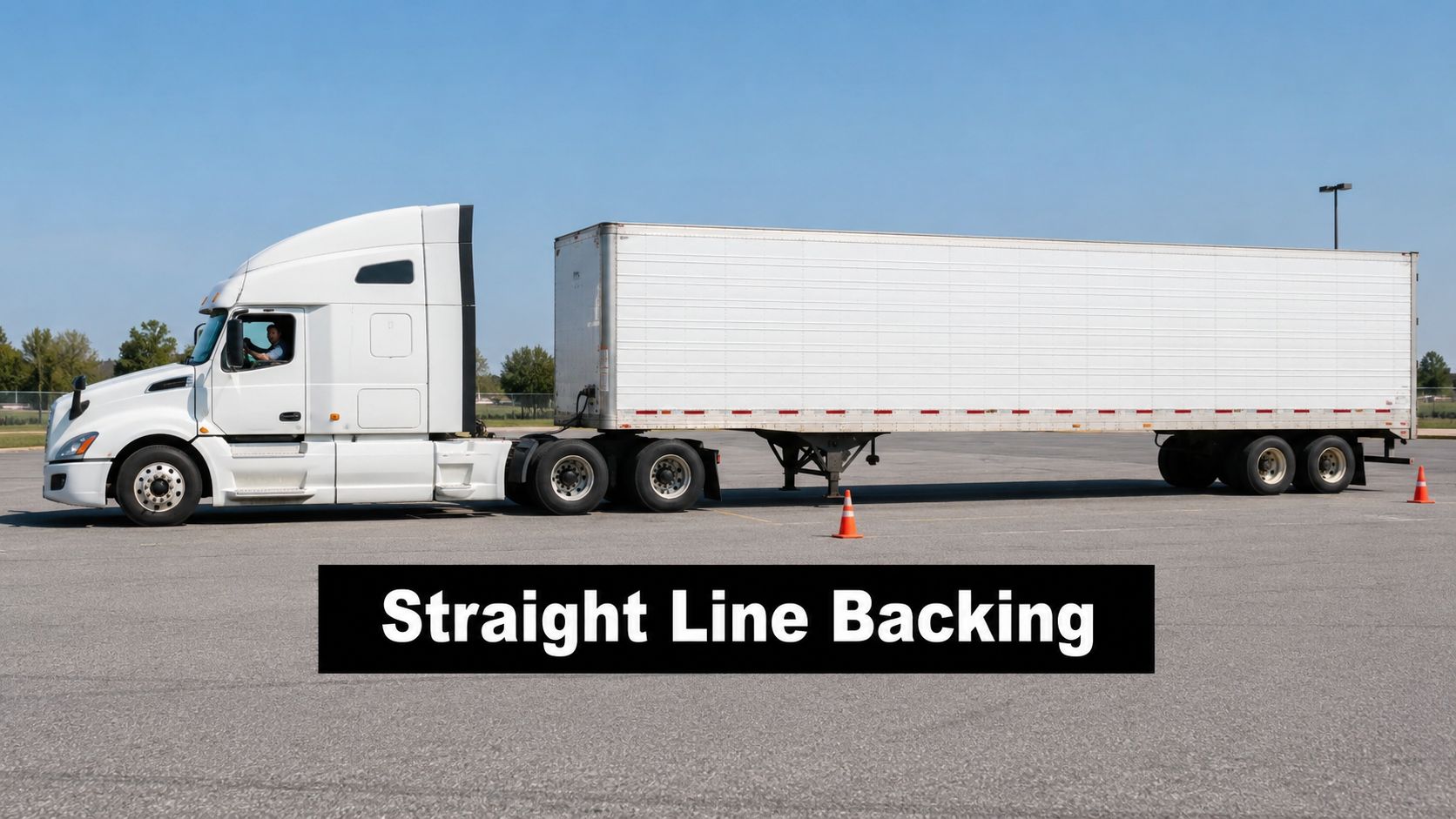
Straight line backing is one of the most teachable skills on the CDL test because it rewards discipline more than talent. Students who struggle usually aren't missing some secret gift. They're starting crooked, backing too fast, or trying to save a bad setup with busy hands. Students who pass tend to look calm because they've learned something simple. If the setup is right, the backing gets easier. If the setup is sloppy, every correction comes late.
The part often skipped is the mirror setup before the truck even starts rolling backward. That's where this maneuver is won more often than people realize. Good drivers don't wait to react. They build a view that lets them catch drift early, then make small corrections before the trailer wanders far enough to become a problem.
The Moment of Truth in Your Mirrors
A student can practice for days and still get rattled when the test starts. That's normal. Straight line backing puts all your mistakes where you can see them. Every little drift shows up in the mirrors, and when nerves kick in, drivers often do one of two things. They freeze and stop correcting, or they overcorrect and create the familiar side-to-side snake.
I've watched students climb into the truck convinced they're bad at backing, when the core issue was that nobody had taught them what they were supposed to be seeing. They were told to “watch your mirrors” and “make small corrections,” which is true, but incomplete. Watching mirrors only helps if those mirrors are giving you a clean, reliable picture.
Why this maneuver feels harder than it is
Straight line backing feels unforgiving because the trailer doesn't need much space to get off center. A tiny problem at the start becomes a bigger problem by the end. That's why students often think the truck suddenly “takes off” to one side. Usually it didn't. They just saw the drift too late.
Practical rule: If you catch drift early, the correction is small. If you catch it late, the correction gets ugly.
A lot of generic advice treats straight line backing like a purely reactive skill. See drift, turn wheel, fix drift. That's only half the job. The better half happens before reverse is engaged. You need the tractor and trailer straight, centered, and visible in both mirrors in a way that lets you judge movement quickly.
What success actually looks like
A clean straight line back doesn't look dramatic. It looks boring. The truck eases back at idle speed. Your eyes keep a steady mirror rhythm. The wheel moves a little, returns to center, then stays quiet. The trailer stays between the lines because you never let a small error grow teeth.
That's the approach that gives students control. Not guesswork. Not panic corrections. A setup-first method that turns the maneuver from a stressful mystery into a repeatable routine.
Your Foundation The Pre-Backing Setup
A straight line back is usually decided before the truck ever starts rolling in reverse.
If the rig is even slightly crooked at the start, the mirrors give you a distorted picture. Then the driver chases a problem that was built into the setup. That is why I spend more time teaching pre-backing alignment and mirror calibration than steering. Steering fixes drift after it starts. A clean setup helps you catch drift while it is still small.

Set the truck before you trust the mirrors
Mirrors only help if the truck is giving them an honest picture.
A trailer that is offset by a few inches can still look acceptable in the glass, especially to a nervous student. The problem shows up ten feet later, when one side starts disappearing faster than the other and the driver reacts late. Examiners see that pattern all the time. So do instructors.
Use this routine before reverse:
- Pull up straight: The tractor and trailer should be in one clean line.
- Center the rig with the lane: Do not settle for being close.
- Stop at a useful point: Both mirrors should show the trailer edge and lane boundary clearly enough to compare side to side.
- Pause and verify: A five-second check here saves a twenty-second correction later.
Drivers usually improve faster when they treat backing prep with the same discipline they use in a CDL Class A pre-trip inspection routine.
The mirror calibration problem students overlook
This is the part many schools rush through.
Instructors often find that mirror calibration causes more first-time backing trouble than steering technique. That matches what I see on the range. Students blame the wheel because that is what they feel in their hands, but the actual problem often starts in what they can and cannot see.
A mirror that shows too little trailer edge leaves you guessing about drift. A mirror aimed too far inward makes small movement look bigger than it is. A mirror aimed too far outward delays the moment when drift becomes obvious. In all three cases, the correction comes either too soon, too late, or too large.
The goal is simple. Each mirror should give you an early warning system.
Do not set mirrors just to see the trailer. Set them so you can judge change.
A repeatable mirror setup routine
You do not need a fancy process. You need one you can repeat under test pressure.
| What to check | What you want to see | Why it matters |
|---|---|---|
| Trailer edge | Visible and steady in each mirror | Gives you a fixed reference |
| Lane boundary | Clear enough on both sides to compare | Helps you spot drift early |
| Left and right balance | Similar amount of useful view on each side | Reduces hesitation and overcorrection |
| Driver posture | Same seat position every time | Keeps the mirror picture consistent |
Then do the check the same way every time:
- Sit in your normal driving posture: If you sit taller or lean forward, the mirror picture changes.
- Confirm equal reference on both sides: You should be able to compare trailer position to each lane line without guessing.
- Make sure you see more than a sliver of trailer: A tiny glimpse is not enough to judge movement well.
- Recheck after the final pull-up: Any change in alignment changes what the mirrors are telling you.
That is the overlooked science in straight line backing. Good drivers are not just reacting well. They start with a mirror picture that lets them read the trailer early and accurately.
Executing the Perfect Straight Line Back
Once the setup is clean, the backing itself should feel slow and organized. The examiner isn't looking for speed. They're looking for control. This maneuver starts with patience, stays alive through mirror discipline, and ends with a smooth stop.
A visual walk-through helps fix the sequence in your head.

The initial roll
The correct start is simple. Put the truck in reverse and begin backing at idle speed. That matters because speed cuts down your reaction time, and in this maneuver reaction time is everything.
If a student asks me what the biggest enemy is during straight line backing, the answer is speed. Not because fast backing looks reckless, though it does. Because even a small drift becomes harder to recognize and fix when the truck is moving faster than your eyes can process.
The middle of the maneuver
In this maneuver, drivers either stay ahead of the trailer or fall behind it. Your eyes should move in a steady rhythm from left mirror to right mirror and back again. You're not staring at one side. You're comparing both sides constantly.
A lot of people do better when they think in terms of phases:
- Early phase: Confirm the trailer starts straight.
- Middle phase: Catch the first hint of drift, not the full mistake.
- Late phase: Keep the trailer centered and prepare for the final stop.
If you want another practical breakdown of low-speed trailer control, this guide on how to back a semi-trailer like a pro covers the same kind of mirror discipline that helps during the skills test.
Later in the maneuver, use this video as a study aid for visual timing and control:
The finish matters too
A good back can still lose points with a sloppy ending. Don't rush the stop. As you approach the end of the box, keep the same crawl and bring the vehicle to a smooth, controlled stop. No stabbing the brake. No surprise lurch.
Slow all the way through. Students often back the first part carefully, then speed up when they realize they're close to finishing.
That last few feet should look just like the first few feet. Quiet hands. Constant mirror checks. A clean stop where you intended to place the trailer.
Mastering Your Mirrors and Steering Corrections
You start backing, glance at the left mirror, and the trailer looks fine. Half a second later the right mirror shows it easing off center. That is the moment students either stay ahead of the truck or start chasing a mistake that was already building.

Mirror work during a straight line back starts before the wheel moves. If your mirrors were set so each side gives you a clean, repeatable reference on the trailer and lane lines, your corrections stay calm. If the mirrors are uneven, too wide, or aimed differently side to side, you will steer based on a distorted picture. I see that problem all the time with new drivers. They blame their hands when the actual issue started with mirror calibration.
Read equal changes, not just obvious drift
Good backing drivers do not wait for the trailer to look crooked. They watch for one side changing faster than the other. A little more trailer showing in one mirror, or a lane line starting to open up on one side, is often the first useful warning.
That matters because steering corrections work best when they start early and stay small.
If the trailer begins to move left, steer left. If it begins to move right, steer right. Keep the input short and measured, then bring the wheel back as soon as the trailer answers. Students who struggle usually do one of two things. They either freeze and wait too long, or they hold the correction too long after the trailer starts coming back.
Put a physical limit on your hands
For straight line backing, the wheel should not travel far. A quarter turn is often plenty. Sometimes less.
I coach students to keep their hand movement on a short leash and return to the same home position every time. Consistent driving hand position helps because your hands stop guessing where center is. You feel center sooner, and that cuts down on the S-pattern that shows up after overcorrection.
A clean correction has three parts:
- Spot the first change in the mirror picture.
- Turn slightly toward the drift.
- Straighten the wheel as soon as the trailer starts recovering.
The third part decides whether the back stays clean.
What the right correction feels like
The truck should feel quiet. Your hands should feel patient. The trailer should respond gradually, not snap back.
That is why many students miss good corrections. Small inputs feel like they are not enough, so they add more wheel before the first input has time to work. Then the trailer crosses center, and now they are fixing their own correction instead of the original drift.
Watch for these signs that you got it right:
- The trailer starts easing back without a sudden swing
- Both mirrors still give you a clear, balanced picture
- Your hands come back to center quickly instead of hanging in the turn
- The truck keeps a steady pace while the trailer settles
I tell students this all the time. Straight line backing is less about fast hands and more about a clean visual picture. If the mirrors were set right before the maneuver, the steering usually gets simpler. If the mirrors were set poorly, every correction feels late and oversized.
Small, early, centered corrections win this skill test.
Troubleshooting Common Backing Mistakes
Students often think mistakes mean they're not cut out for backing. That's the wrong way to read practice. A backing mistake is usually a diagnosis. It tells you whether the problem is setup, mirror reading, speed, or hand control.

Four problems that show up again and again
| Mistake | What it usually means | Better response |
|---|---|---|
| S-pattern backing | Oversteering and late returns to center | Make one small input, then straighten sooner |
| Losing the trailer in mirrors | Poor setup or inconsistent scanning | Stop, reset your visual rhythm, and clean up your alignment in practice |
| Backing too fast | Trying to finish instead of control | Let the truck idle and slow your eyes down |
| Waiting too long to correct | You're reacting to a large drift instead of a small one | Start correcting at the first hint of movement |
Practice drills that actually help
The fastest way to fix oversteering isn't more complicated advice. It's one narrow drill. In a safe practice setting, let the trailer drift slightly on purpose, make a very small correction, then focus only on returning the wheel to straight at the right moment. Don't worry about the full back. Build the return-to-center habit first.
If you keep “getting lost” in the mirrors, shorten the task. Back only a short distance and call out what you see left, then right, then left again. Students improve when they stop treating mirror checks like random glances and start treating them like a rhythm.
The same mindset carries into other backing maneuvers. Drivers who sharpen this process usually have an easier time when they move on to parallel parking a truck, because the control problem is different but the visual discipline is similar.
A short do and don't list
- Do back at a crawl: Slow speed gives your eyes time to work.
- Do correct early: Early corrections are small and clean.
- Don't chase panic with more steering: That usually creates a second drift.
- Don't treat a bad rep like failure: Treat it like information.
Most students don't need more courage. They need a cleaner routine.
When you diagnose mistakes instead of taking them personally, progress gets faster.
How Examiners Score Your Straight Line Backing
On test day, the examiner wants to see control, awareness, and accuracy. That means staying inside the boundaries, managing the vehicle smoothly, and finishing in the designated space without looking rattled. Even when the scoring sheet focuses on concrete errors, your pace and mirror discipline still shape the examiner's impression of your competence.
Know the terms your school uses. Encroachments generally refer to touching or crossing a boundary line. Pull-ups are when you stop and pull forward to reset your position before backing again. The exact allowance can vary by state and testing site, so review the standard you'll be tested on through your local training program and the CDL road test preparation guide.
What helps you look test-ready
A good test performance usually has the same visible traits:
- Controlled pace: No rushing in reverse
- Consistent mirror scanning: The examiner can see you're checking both sides
- Smooth final stop: No hard brake at the end
- Composure after a small error: Calm drivers recover better
Drivers also benefit from practical maintenance awareness outside the test yard. If you're trying to understand parts support and repair realities around commercial vehicles, the Woolpit Truck Repairs guide is a useful general reference for thinking about vehicle upkeep and sourcing.
Patriot CDL trains students on core backing maneuvers, including straight line backing, with hands-on practice that matches the kind of control examiners expect on test day.
If you want structured practice on straight line backing, pre-trip inspection, and the full skills test sequence, Patriot CDL offers accelerated CDL training built around hands-on yard work and road test preparation.