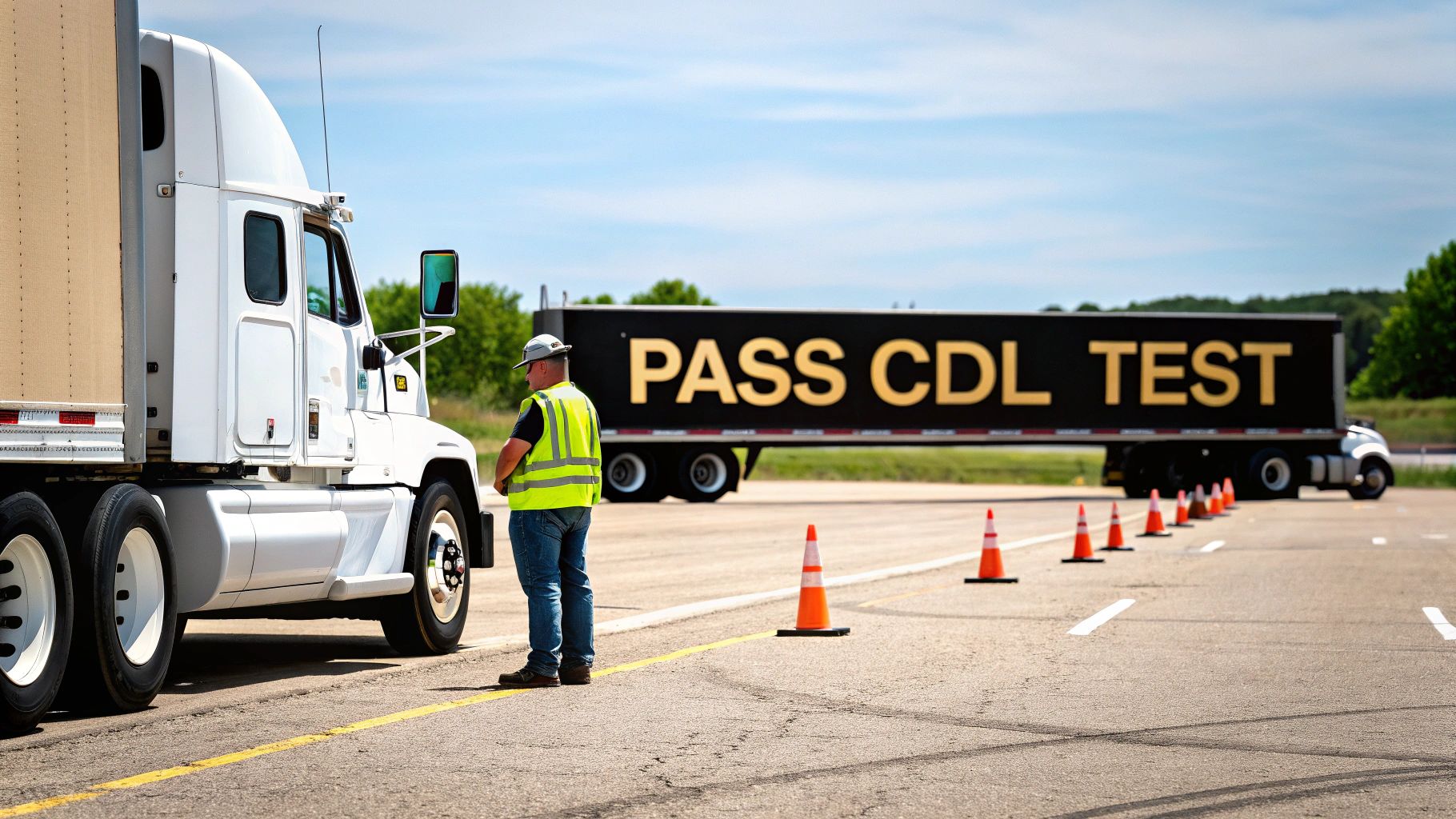
Passing your CDL road test is the last major step before you can officially call yourself a professional truck driver. It's not just about proving you can steer a big rig; it’s a comprehensive skills test designed to show you can operate a commercial vehicle safely and confidently.
Let's be clear: the examiner isn't just watching you drive. They’re evaluating your entire approach—your safety habits, your attention to detail, and how you handle the vehicle when the pressure is on. Think of it as your final interview for a career on the road.
What the CDL Road Test Truly Measures
This isn't your average driving test. The entire exam is structured to see if you have what it takes to be a professional. It's broken down into three distinct parts: the pre-trip inspection, basic control skills, and the on-road driving test itself.
It's also worth noting that things have changed recently. As of August 28, 2023, the official Commercial Driver License Manual was updated, bringing some modern tweaks to the Vehicle Inspection (VI) and Basic Control Skills (BCS) sections. The on-road portion, however, remains the same.
The Three Pillars of the Exam
To earn your CDL, you have to nail all three parts. Each one tests a different, but equally critical, skill set. Messing up one section can mean failing the whole thing, so you need to be prepared for everything.
Pre-Trip Vehicle Inspection: This is your very first chance to make a good impression. You'll walk the examiner through a complete vehicle inspection, calling out every component you check. They need to see that you can spot a potential safety problem before you even turn the key.
Basic Control Skills: You'll often hear this called the "backing" or "maneuvering" test. This is all about precision. In a closed course, away from traffic, you'll have to perform specific maneuvers like straight-line backing, offset backing, or even parallel parking. It’s all about showing you have absolute command of your truck and trailer.
On-Road Driving Test: Finally, you'll take the truck out into the real world. This is where it all comes together. The examiner will be watching how you handle traffic, navigate intersections, merge, change lanes, and deal with other drivers. It's your chance to prove you can operate safely and legally on public roads.
CDL Road Test Components at a Glance
To put it all into perspective, here's a quick breakdown of what each part of the CDL skills test is designed to measure.
| Test Component | Primary Purpose | What Examiners Look For |
|---|---|---|
| Pre-Trip Vehicle Inspection | To ensure you can identify and verbalize potential safety hazards on the vehicle before driving. | Thoroughness, knowledge of vehicle components, systematic approach, and clear communication. |
| Basic Control Skills | To assess your ability to precisely maneuver the vehicle in a controlled, off-road environment. | Vehicle control, accurate judgment of space, ability to follow instructions, and avoiding encroachments. |
| On-Road Driving | To evaluate your performance in real-world traffic situations, following all laws and safety protocols. | Safe following distance, proper lane control, use of turn signals, speed management, and awareness of surroundings. |
Seeing how these pieces fit together helps you understand the bigger picture. The test is a complete evaluation of your readiness to be a professional driver.
The goal isn't perfection; it's demonstrating consistent safety and control. Examiners understand you might be nervous, but they need to see that your core skills are solid and your decision-making is sound, even under stress.
Ultimately, how you perform on your road test comes down to the quality of your training. While passing the skills test is the final hurdle, a strong foundation starts way back with the written exams. Before you can even think about scheduling your road test, you’ve got to master the knowledge-based material, which you can learn all about in our guide on the general knowledge test.
Acing the Pre-Trip Vehicle Inspection
Think of the pre-trip inspection as your opening statement to the examiner. It’s your first chance to prove you’re a competent, safety-conscious professional, and it really sets the tone for the rest of your CDL road test. Get this part wrong, and your test is over before you even turn the key.
A lot of students get bogged down trying to memorize a massive list of parts. The real secret isn't just memorization; it's about building a solid, repeatable routine you can do in your sleep. When you have a logical flow, you show the examiner you actually understand the truck as a complete system, not just a collection of random parts.
Developing a Systematic Flow
The easiest way to make sure you don't miss anything is to create a consistent path around the truck. I always tell my students to start at the front, work your way down one side, go across the back, and then come up the other side. This simple pattern keeps you on track and ensures everything from the engine to the trailer lights gets checked.
Remember, you have to verbalize every single check you make. Don't just point at a part and grunt. You need to be specific and clear. For example, instead of just pointing at a tire, you should say something like, "I'm checking this steer tire for proper inflation. I'm looking for any cuts, bulges, or abrasions, and I'm making sure the tread depth is at least 4/32 of an inch."
This is a hands-on test. The examiner needs to see you physically inspecting the vehicle.
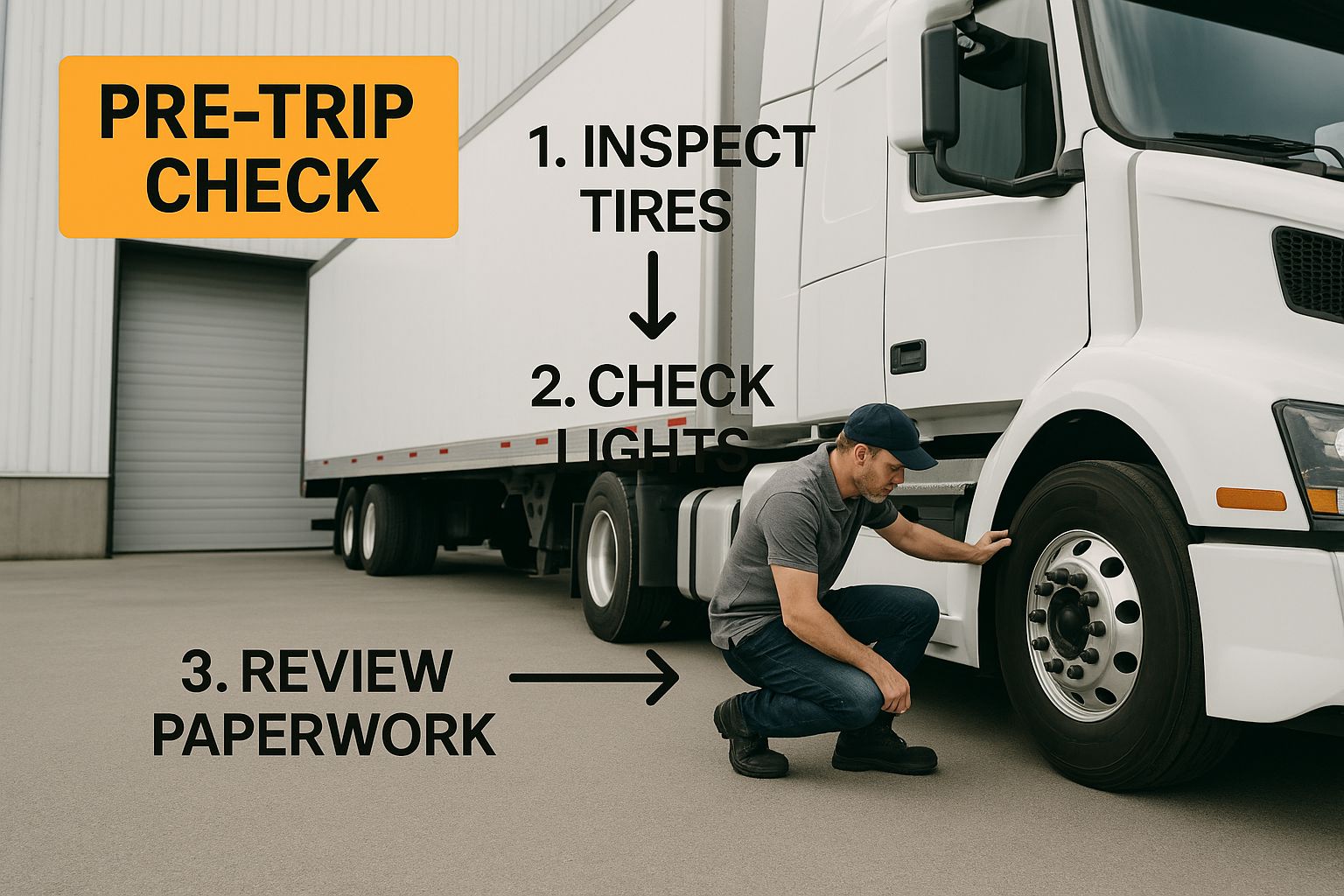
As you can see, it’s all about getting up close with the equipment. They want to see you touching and pointing to components, not just reciting a script from memory.
Key Inspection Zones and What to Say
Breaking the inspection down into smaller, manageable zones makes it far less intimidating. You're basically guiding the examiner on a tour of the truck, explaining its condition along the way.
Engine Compartment: Pop the hood and get ready to identify key components. You'll check fluid levels (oil, coolant, power steering) and inspect all the belts and hoses for any visible cracks, frays, or leaks. You have to be able to point to each part and explain what it is and that it's in good working order.
Cab and Brakes: Once you climb into the cab, the focus shifts to the air brake system. This is a critical sequence where you'll test for leaks, check that the low-pressure warning alarm works, and then perform a full test of the parking brake and service brake.
Exterior Walk-Around: This is the longest part of the inspection. Starting at the front wheels, you'll methodically work your way to the back, checking every tire, wheel, suspension component, and brake assembly on both the tractor and the trailer. You'll also need to verify that every single light and reflector is clean, secure, and working properly.
The examiner is watching you just as much as they're listening to you. Make a point to physically touch or point to every component you name. This keeps you focused and proves you know exactly what you're looking at.
For a really detailed, component-by-component guide to help you build out your routine, check out our complete pre-trip inspection checklist.
Pro Tips for Inspection Success
Confidence on test day comes directly from practice. You should be running through your inspection flow over and over until it feels completely natural.
- Use the Right Lingo: Learn the correct terminology. Saying things like "properly mounted and secure" or "not cracked, bent, or broken" for structural parts shows the examiner you’ve done your homework.
- Slow Down: Don't rush it. When you hurry, you make silly mistakes and come across as nervous. A calm, methodical pace screams confidence and competence.
- Explain the 'Why': Don't just name the part; briefly explain its importance. For example, when checking the fifth wheel, you can add, "…and I'm making sure the jaws are securely locked around the kingpin to ensure a safe connection between the tractor and trailer." It shows a deeper level of understanding.
By mastering a systematic and well-spoken inspection, you're proving right from the start that you're a safe, knowledgeable driver who's ready to hit the road.
Mastering Your Backing and Control Skills
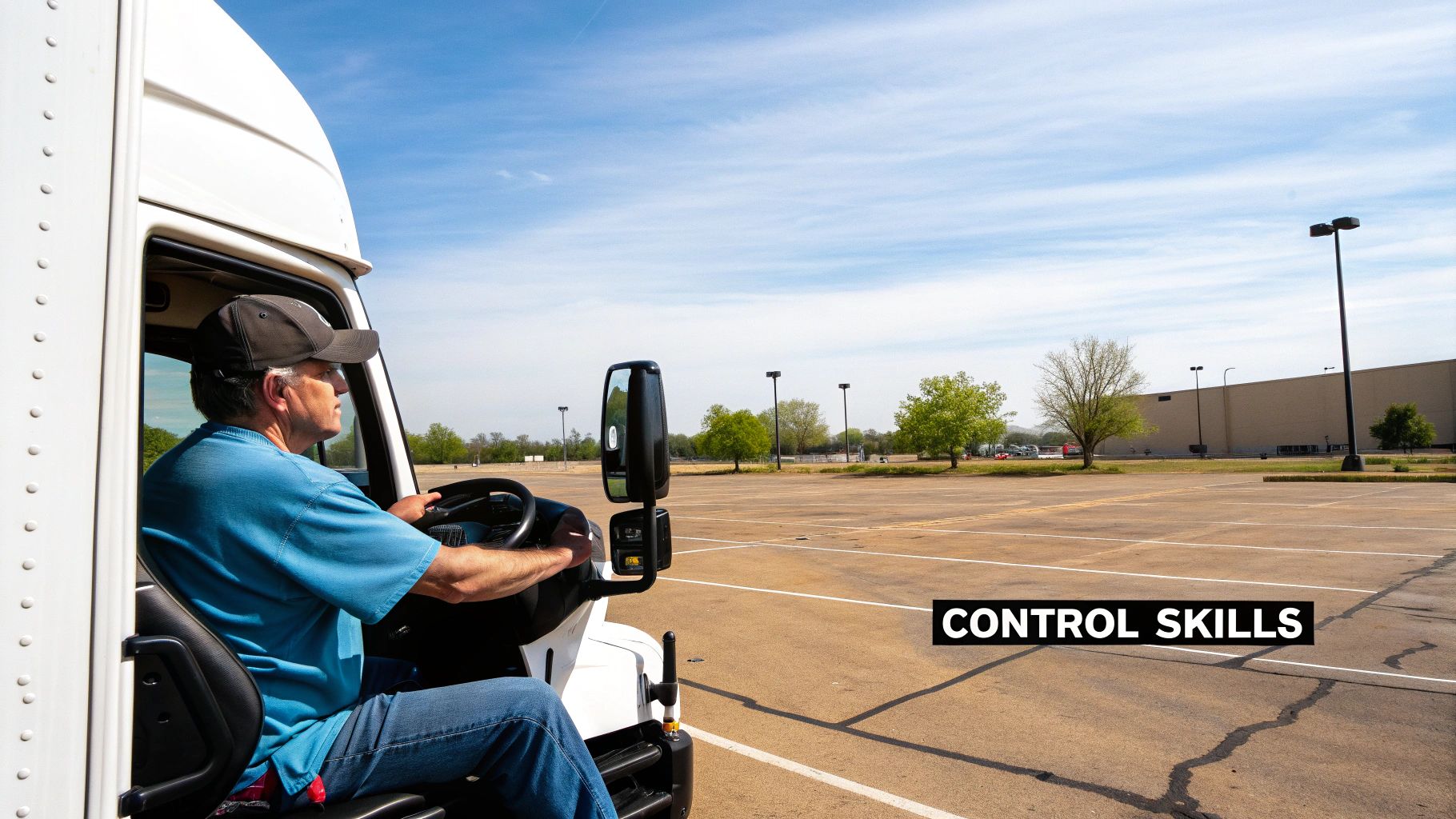
Alright, you’ve nailed the pre-trip inspection. Now it’s time to show the examiner you can actually handle the rig. This is where we get into the Basic Control Skills (BCS) part of the test, and it's all about precision behind the wheel.
Forget about speed. This part of the test is purely about finesse—proving you can maneuver a massive vehicle in tight spaces and truly understand its pivot points. I’ve seen a lot of students get nervous here, but it really just boils down to a series of slow, deliberate movements. Practice is what builds confidence, and soon you'll know exactly how that trailer will react to every little turn of the wheel.
Breaking Down the Maneuvers
The exact set of maneuvers you'll perform can differ a bit from state to state, but they all test the same core skills. You can bet you'll be asked to back up in a straight line and do some form of offset or angled backing.
Straight-Line Backing: This is your foundation. The examiner wants to see you back the truck and trailer straight for about 100 feet without wandering outside the lines. The secret here is making small corrections early, not big ones late.
Offset Backing (Left or Right): This one has you backing from one lane into an adjacent one. It’s a real test of your ability to judge space and control the trailer as it swings over.
Parallel Parking (Conventional or Sight-Side): It’s just like parking a car, except your vehicle is a whole lot longer. You’ll have to back the trailer into a spot parallel to a curb, which demands complete control and serious spatial awareness.
Alley Dock: This is the one that trips up most new drivers. You’ll be backing the trailer at a 90-degree angle into what looks like a loading dock. Your setup and knowing your pivot point are everything for the alley dock.
If there’s one piece of advice I can give, it’s this: stop over-steering. So many students make huge, jerky movements with the steering wheel, which sends the trailer way off course. Think small, smooth adjustments, and give the trailer a moment to respond.
Using Your Mirrors and Making Corrections
During the backing portion of your test, your mirrors are your absolute best friends. You need to be constantly scanning them, watching how the trailer is tracking, and trying to see a problem developing before it gets out of hand.
Let's say you're doing a straight-line back and see the trailer start to creep toward your driver's side mirror. To fix it, you make a slight turn of the steering wheel in the same direction as the drift—a little turn to the left. Once it straightens out, bring the wheel back to center. Easy does it.
Understanding How You're Scored
It really helps to know what the examiner is looking for. They have a scoresheet, and every mistake costs you points. Your job is to get through the maneuvers with as few errors as possible.
Here are the most common things that will cost you points:
| Error Type | Description |
|---|---|
| Encroachments | This happens when any part of your truck or trailer touches or crosses a boundary line or cone. |
| Pull-Ups | This is when you pull forward to reset your position. You get a limited number of these, so use them wisely. |
| Looks | You're allowed to get out of the truck to check your position, but this is also limited. |
| Final Position | They'll score you on how accurately you place the vehicle inside the designated box at the end of the maneuver. |
The examiner is also watching your overall control and whether you’re following safety protocols. It all ties together. They’re not just testing one skill; they’re confirming you have what it takes to operate a commercial vehicle safely in the real world.
Ultimately, performing these maneuvers like a seasoned pro comes down to one thing: practice. The more time you spend behind the wheel running these drills, the more they become muscle memory. When test day comes, your calm nerves and practiced hands will be your greatest assets.
Hitting the Road: What to Expect During the On-Road Driving Test
Once you've aced the backing maneuvers, it's time for the main event: driving in live traffic. This is where the rubber truly meets the road. The examiner isn't just looking to see if you can keep the truck between the lines; they're evaluating your decision-making and your ability to operate like a professional in the real world.
This is your moment to prove you can handle the unpredictable nature of public roads—from other drivers and pedestrians to changing road conditions. They want to see that you can anticipate potential problems, manage the space around your rig, and make the kind of smooth, confident decisions that define a seasoned driver.
Nailing Your Turns and Intersections
Nothing screams "rookie" louder than a botched turn. When you're pulling a long trailer, you have to completely rethink how you navigate corners to avoid running over curbs or, even worse, drifting into another lane.
- Right Turns: The key here is to go wide. Drive your tractor straight into the intersection a bit before you even start turning the wheel. This technique, sometimes called a "button hook," lets your trailer follow you around the corner instead of cutting it short and climbing the curb.
- Left Turns: For left turns, you need to pull up and "claim" your space. Don't start your turn until your cab is about a third of the way into the intersection. If you turn too early, the back end of your trailer will slice across the corner, putting it right in the path of oncoming traffic.
Your mirrors are your best friends during any turn. You need to be constantly glancing back and forth to know exactly where your trailer tires are. In many states, hitting a curb is an automatic fail, so there's simply no room for error here.
Keeping Your Space Cushion
At its core, defensive driving is all about managing the space around you. In a big rig, that gap in front of you is your most important safety tool. The examiner will be paying close attention to your following distance.
A solid rule of thumb is to keep a gap of at least seven seconds between you and the vehicle ahead when the weather is good. If it's raining or slick, you need to add even more time. This buffer gives you the space you need to slow down and stop smoothly, without a panic brake. This kind of proactive safety thinking is a huge part of the Entry-Level Driver Training (ELDT) every new driver has to complete. You can learn more about how ELDT prepares you for real-world driving.
The on-road test isn't about being perfect—it's about proving you have a consistent, safety-first mindset. Examiners know you'll be nervous, but they need to see that your fundamental habits, like checking your mirrors and managing your space, are ingrained and automatic.
Handling Special Scenarios on the Road
Your test route isn't random. It’s specifically designed to include challenges that test your awareness and knowledge of the rules.
- Railroad Crossings: This is a non-negotiable safety check. As you get close, slow down, look both ways down the tracks, and listen for an approaching train. If you’re driving a vehicle like a passenger bus or hauling hazardous materials, you're required to make a full stop between 15 and 50 feet from the nearest rail.
- Bridges and Overpasses: You absolutely must know your truck's height. The examiner will guide you on a route where you'll have to spot clearance signs and confirm you can safely pass underneath. Getting this wrong is a huge red flag.
- Lane Changes and Merging: Don't be timid, but don't be reckless. Signal your intentions well in advance, check your mirrors multiple times to find a safe gap, and then make a smooth, deliberate move. Once you're fully in the new lane, remember to cancel your signal.
While the U.S. has a pretty standard approach, it's fascinating to see how different these tests are around the world. In places like China and Hungary, the practical driving tests are known for being incredibly difficult. In Japan, for example, going over 19 mph at any point during the test is an instant fail, showing a completely different emphasis on slow, precise control.
Your Game Plan for Test Day
All the practice in the world won't do you much good if nerves take over on the big day. Skill is only half the battle; your mental game is what gets you across the finish line and earns you that pass on the CDL road test. The secret is walking into the testing center feeling prepared, calm, and ready for anything.
That preparation starts the night before. Don't scramble for paperwork in the morning. Get everything together—your driver's license, medical card, test receipts, you name it—and have it ready to go. A solid night's sleep is non-negotiable, as being tired will absolutely tank your judgment and slow your reactions.
On test day, eat a decent breakfast and get to the site early. Rushing will only spike your stress levels before you even get in the truck.
Interacting With Your Examiner
First things first: your examiner isn't out to get you. They're a professional whose job is to make sure you can operate a commercial vehicle safely according to federal standards. Simple respect goes a long way.
Listen closely to every instruction. If something isn't clear, don't guess—just ask them to repeat or clarify it. Speak clearly, act professionally, and show them you're taking this seriously.
A professional and calm demeanor makes a huge difference. Examiners are observing your attitude just as much as your driving skills. They want to see someone who can handle the pressures of the road with a level head.
This isn't just about making a good impression; it's about upholding a professional standard that authorities take very seriously. Between 2005 and 2008, the FMCSA actually investigated around 15,032 people suspected of getting their licenses fraudulently. That really underscores why legitimate, by-the-book testing is so critical.
Recovering From a Mistake
Let's be realistic: you might make a small mistake. Maybe you take a turn a little wide or one of your shifts isn't as smooth as you'd like. It happens. The worst thing you can possibly do is fixate on it.
When you dwell on one little error, you're setting yourself up to make more.
Instead, just acknowledge it, take a deep breath, and get your head back in the game. Examiners often want to see how you recover. A driver who can correct a minor slip-up and keep driving safely is far more impressive than one who gets flustered and falls apart. Showing you can reset under pressure proves you have the composure of a true professional.
Building that confidence starts way before test day. Acing your initial written exams will give you the foundation you need, which you can read all about in our guide to the CDL permit test.
Answering Your Top CDL Road Test Questions
It’s totally normal to have some last-minute questions, even after you’ve spent weeks preparing. Getting these nagging uncertainties cleared up can be a real confidence booster on test day. Let's tackle some of the most common questions I hear from students.
A big one is always, "What will make me fail instantly?" Think safety, safety, safety. Automatic fails are almost always linked to a major safety mistake. Running a red light, hitting a curb while maneuvering, or causing an accident (even a minor one) will end your test right there. The specifics can vary a little from state to state, but any serious safety violation is a non-starter.
Can I Use My Own Truck? What if I Fail?
Lots of drivers ask if they can bring their own rig or a company truck to the test. Usually, the answer is yes. But—and this is a big but—it has to be the right class for the license you're testing for. It also needs to pass a full safety inspection on the spot and have all its insurance and registration paperwork in perfect order. Honestly, it's often much easier just to use the truck you trained in at your school.
And what about the dreaded "what if I don't pass?" question? Don't sweat it too much. Most states will let you try again, but you'll likely have a waiting period before your next attempt. Fail a few times, and you might have to go back for some extra training. Your best bet is to check the specific retake rules at your local DMV.
The entire CDL process, from start to finish, is built around safety and following the rules. This isn't just about your skills behind the wheel; it's also about having all your paperwork, like your medical certificate, squared away.
Speaking of paperwork, that medical card is absolutely crucial. Federal regulators are tightening up the system, with new compliance rules for medical certification being integrated in 2024 and 2025. This is all about making sure every driver on the road is medically fit to be there. Getting a handle on all the documentation is a huge part of becoming a professional driver, and you can see exactly what's needed by checking out the full list of CDL requirements.
At Patriot CDL, we make sure our students walk into the test ready for anything—from the pre-trip to the final road skills evaluation. If you're ready to kickstart a rewarding career with real confidence, learn more about our training programs.