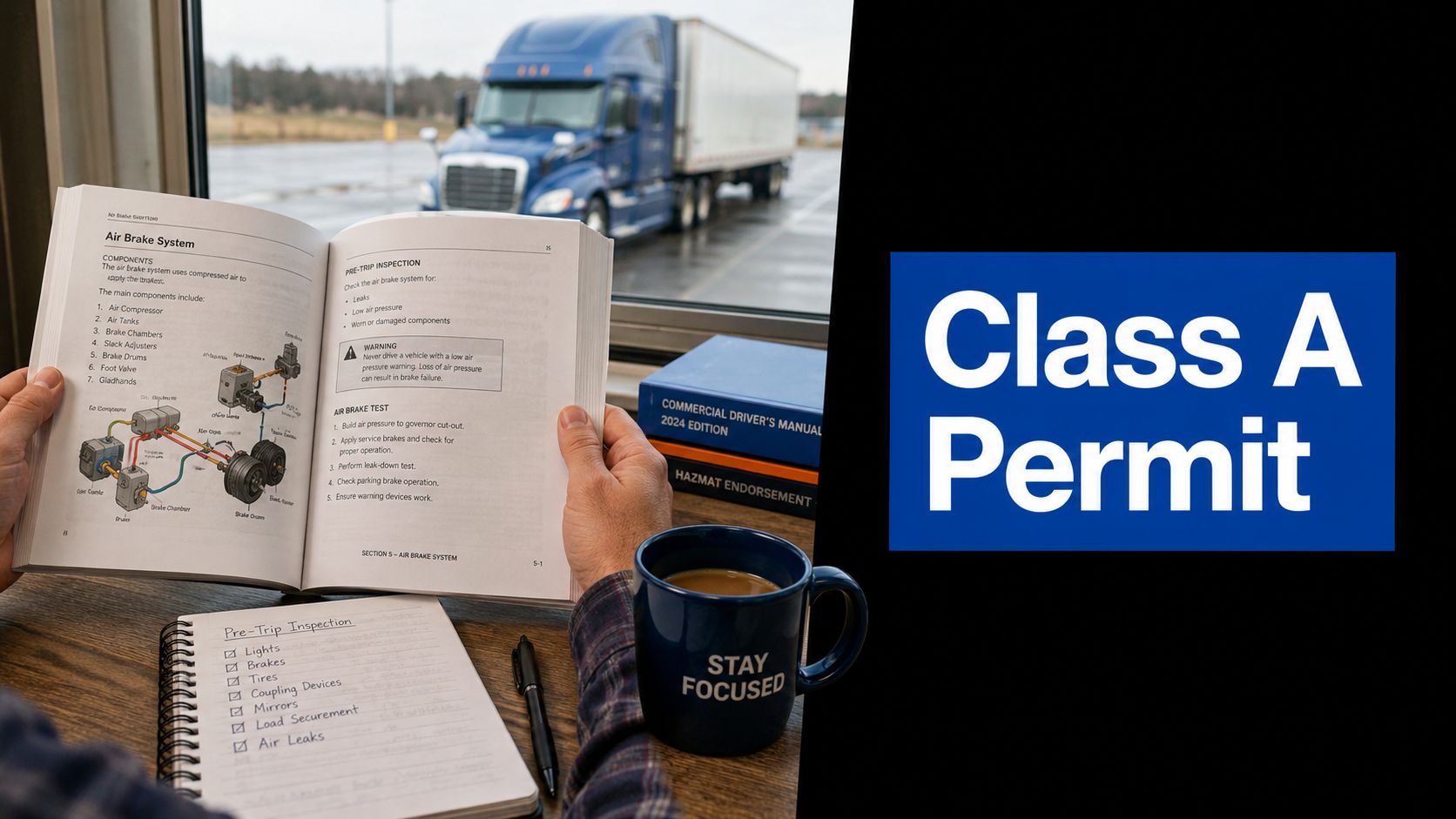
You're probably in one of two places right now. Either you've already decided trucking is your next move and you're staring at the CDL manual wondering where to begin, or you're still testing the idea and asking yourself if the Class A permit test is going to be a brick wall.
I've seen that moment many times. A person wants a career with more independence, steadier work, and a clearer path forward, but the written test feels bigger than it should. That's normal. The good news is that the Class A permit test isn't there to trip you up for no reason. It's there to make sure you start with the right habits before you ever sit behind the wheel of a combination vehicle.
A lot of new students make the same mistake. They treat the permit like paperwork. Professional drivers don't think that way for long. The permit is your first real checkpoint. It's where you learn the language of trucking, the safety logic behind inspections, and the foundation that everything else sits on.
Your First Step to the Open Road
A future driver usually doesn't wake up one morning already knowing how to read air brake questions, understand trailer swing, or sort through CDL paperwork. Many aspiring drivers start with a simple thought: “I need a career change,” or “I want work that leads somewhere.”
That first step often happens at a kitchen table. The CDL manual is open. A phone has a few tabs up. One tab explains what a CLP is. Another has local DMV requirements. Another is something practical, because once people get serious about driving, they start thinking beyond the test and into the job itself, including issues like coverage and risk on the road. That's why resources like Find Orlando trucking insurance can be useful context early on, even before your career is fully underway.
The permit test belongs in that same practical category. It's not abstract. It connects directly to the work.
If you're still fuzzy on the permit itself, this plain-English guide on what a CLP is is a good starting point. Think of the CLP as your learner stage for commercial driving. It says you've demonstrated enough knowledge to begin supervised progress toward the full Class A CDL.
The right way to think about the test
Students get calmer when they stop calling it a “hurdle” and start calling it a “starting line.” That one mindset shift changes how you study.
Here's why:
- It introduces the language of the industry so terms like combination vehicle, air pressure warning, and coupling stop sounding foreign.
- It teaches safety before motion because a driver who understands systems makes better decisions in the cab.
- It gives your training structure so later lessons on pre-trip, backing, and road driving make sense.
The permit test feels hard when the words are unfamiliar. Once the vocabulary clicks, the questions stop looking like traps and start looking like common sense.
A Class A path can lead to long-haul work, regional work, local freight, and specialty lanes depending on the route you choose later. But none of that matters until you get through this first checkpoint with confidence.
That's why I tell students to slow down at the beginning. Not to delay. To build clean understanding. When you do that, the road ahead gets much simpler.
What Is the Class A Permit Test
The Class A permit test is the written knowledge step required before you can move into the hands-on side of commercial driver training. In CDL language, this is the Commercial Learner's Permit, or CLP. It allows you to begin the supervised phase that leads to the skills test and, eventually, a full Class A CDL.

What the permit is actually checking
This isn't a casual quiz. Most states require applicants to pass a written knowledge exam with a minimum score of 80%, and first-time pass rates can be as low as 50 to 60% for people who self-study, according to the Virginia DMV CDL testing information.
That tells you two important things. First, the standard is clear. Second, many people underestimate the exam.
The permit test checks whether you understand the basics needed to operate a commercial vehicle safely. For Class A applicants, that usually means not just general commercial driving rules, but also the special knowledge needed for combination vehicles and air brake systems.
What you usually need before testing
The exact checklist depends on your state, but the process usually includes a few required elements:
- A valid driver's license because you're adding commercial privileges, not starting from scratch.
- A medical qualification step because commercial driving has physical standards tied to safety.
- State paperwork and identity documents required by your DMV.
- The correct test selection so you're taking the sections that match Class A vehicles and the equipment you plan to operate.
A beginner often gets confused here and asks, “Why so much before I've even driven a truck?” The answer is simple. A Class A vehicle is larger, heavier, and less forgiving than a passenger car. The permit stage is where the state confirms you're ready to begin learning in a supervised, structured way.
Why your study material matters
Don't study the permit test like it exists in a vacuum. The written material connects to the truck itself. If you want a visual sense of the machine you're working toward, a practical Class 8 truck owner's guide helps make the terminology feel more real.
Practical rule: If a term in the manual feels abstract, attach it to a real truck part or real driving situation. Students remember what they can picture.
That's the big shift. Once you understand the purpose of the Class A permit test, the questions stop feeling random. They start looking like the operating language of your next profession.
Decoding the Three Core Written Exams
For most Class A applicants, the permit process includes three written knowledge areas that matter most. General Knowledge, Air Brakes, and Combination Vehicles. When students say, “I failed the permit test,” they're often lumping these together. It helps to split them apart and study each one for what it is.
Class A permit written test breakdown
| Test Section | Typical # of Questions | Core Topics Covered |
|---|---|---|
| General Knowledge | 50 | Driving safely, vehicle inspection, hazard awareness, space management, speed control |
| Air Brakes | Varies by state | Air brake components, pressure loss, warning devices, brake lag, safe operation |
| Combination Vehicles | Varies by state | Coupling and uncoupling, rollover risk, trailer swing, offtracking, braking in combinations |
The General Knowledge test typically has 50 questions and requires an 80% passing score, and success on it, along with Air Brakes and Combination Vehicles, is linked to better performance on the hands-on skills test because the same cognitive frameworks carry over, according to the Connecticut CDL permit guidance.
If you want extra practice built around that logic, this guide on passing your CDL written test on the first try is a useful companion.
General Knowledge is your base layer
General Knowledge is where you learn how commercial driving works at street level. This section covers broad safety concepts like seeing hazards early, controlling speed, handling space around the vehicle, and understanding what a proper inspection should catch.
Students sometimes think this is the “easy” part because the title sounds broad. That's backwards. General Knowledge is the foundation. If you don't understand why a commercial vehicle needs more stopping distance, or how weight changes control, later sections get harder fast.
A good way to think about General Knowledge is this: it teaches you how a professional driver thinks before the truck moves.
Air Brakes are easier when you stop treating them like magic
Air brakes intimidate beginners because the system sounds mechanical and technical. It is technical, but it isn't mysterious.
Think of the air brake system like a reserve tank of controlled pressure. You're not just pressing a pedal and hoping the truck stops. You're managing stored air that has to stay within a safe operating range. If pressure drops too low, that's not a minor detail. That's a major safety problem.
Students usually get tripped up by these ideas:
- Warning signs matter because pressure loss isn't something you ignore.
- Brake lag matters because air systems don't respond exactly like a passenger car.
- System checks matter because you need to know what normal operation sounds and feels like.
If you can explain the system in simple words, you usually know it well enough to answer test questions on it.
Combination Vehicles is where Class A becomes Class A
This section is what separates a tractor-trailer mindset from regular driving. Combination Vehicles covers the relationship between the tractor and trailer. That includes coupling, uncoupling, trailer movement, rollover risk, and the unique handling that comes from pulling a second unit.
Here's where many readers get confused. They think the trailer just “follows.” It doesn't follow the way a shopping cart follows. It has its own momentum, pivot point, and swing path. That's why a turn that feels normal in a car can become a problem in a combination vehicle.
Three ideas deserve extra attention:
- Coupling errors are serious because a bad connection can create immediate danger.
- Offtracking is real because the trailer doesn't take the same path as the tractor.
- Rollovers develop from bad choices like entering curves too fast or steering abruptly.
Once these three written areas click, your later training makes more sense. The permit test isn't separate from driving skill. It's the language and logic underneath it.
Your Two-Week Class A Permit Study Plan
Passing the Class A permit test usually comes down to one thing. Consistent, focused study beats random cramming. Students who bounce around the manual, skim a few questions, and hope for the best usually feel overwhelmed. Students who follow a simple plan feel in control.
This timeline works well because the federal system already builds around a minimum 14-day waiting period between CLP issuance and the skills test, and that window is meant for supervised practice. New York's CDL guidance notes that drivers who log at least 40 hours of training during this period have lower first-year collision rates, which is why the waiting period matters as more than just a scheduling rule. You can read that in the New York CDL licensing information.
Use that same two-week logic before your permit exam too. It creates rhythm.

Days 1 through 5
Start with the big picture. Read the sections tied to General Knowledge first, then shift into Air Brakes.
- Days 1 and 2. Read your state CDL manual's General Knowledge material. Don't race. Focus on definitions, safety rules, inspections, and basic vehicle control.
- Days 3 through 5. Move into Air Brakes. Draw simple notes by hand. Label parts. Write down what low pressure warnings mean and what safe operation requires.
Students often ask if they should start taking practice tests on day one. My answer is yes, but lightly. Use short quizzes to check understanding, not to replace reading.
A lot of people learn well by hearing an explanation out loud. This walkthrough can help reinforce the basics before you go back to the manual.
Days 6 through 10
Now narrow your focus. Here, you build your Class A-specific understanding.
- Days 6 through 8. Study Combination Vehicles. Spend time on coupling, uncoupling, trailer swing, and rollover prevention.
- Days 9 and 10. Take full practice sets covering all tested areas. Review every wrong answer. Not just the ones you guessed on.
Here's the rule I teach: don't say “I got that wrong because the test was tricky.” Say “I missed the clue in the wording.” That mindset makes you sharper.
Study habit: Keep one notebook page called “Questions I almost missed.” Near-misses teach you as much as wrong answers do.
If you want a more detailed routine for building that habit, this article on the best way to study for permit test success lays out practical review methods.
Days 11 through 14
This is not the time to learn everything again. It's the time to tighten loose bolts.
What to do in the final stretch
- Days 11 and 12. Target weak spots only. If Air Brakes still feels shaky, stay there until the system makes sense in plain language.
- Day 13. Review notes, skip heavy cramming, and get proper rest.
- Day 14. Test day. Read slowly. Trust the work you've done.
A calm student usually outperforms a frantic one. The goal isn't to memorize every sentence in the manual. The goal is to understand enough that the right answer feels logical.
Common Traps and Sample Test Questions
The hardest part of the Class A permit test often isn't the topic itself. It's the wording. Modernized computerized tests can subtly change how questions are weighted and timed, and students scoring in the 70 to 79% range on practice exams are often the most affected, according to the Pennsylvania CDL skills testing update page.
That's why test strategy matters. Content knowledge gets you close. Reading discipline gets you across the line.

If you want extra examples after this section, these CDL test questions explained in plain language are worth reviewing.
Three traps that catch good students
- Almost-right answers. Two answers may look safe, but one is more complete or more accurate.
- Keyword misses. Words like always, first, best, or most likely change the whole question.
- Familiar wording with a new twist. A question may look like one you've seen before but ask for a different part of the idea.
Sample question logic
General Knowledge example
Question: Why should a commercial driver look far ahead in traffic?
A. To drive faster
B. To spot hazards early
C. To reduce mirror use
D. To avoid using turn signals
Best answer: B
This works because hazard awareness is a core commercial driving skill. Looking far ahead gives you time to adjust speed and position. The wrong answers either remove safe habits or suggest behavior that has nothing to do with professional driving.
Air Brakes example
Question: What makes low air pressure a serious issue?
A. The horn becomes louder
B. The truck may not brake normally
C. Fuel use increases
D. The trailer lights dim
Best answer: B
Air pressure is part of the braking system's safe operation. If pressure drops too low, braking performance becomes a safety concern. The other choices sound mechanical, but they don't address the danger.
Combination Vehicles example
Question: Why does a trailer need extra attention during turns?
A. It cuts the corner differently than the tractor
B. It always tracks wider than every vehicle on the road
C. It eliminates blind spots
D. It stops faster than the tractor
Best answer: A
This gets at offtracking. The trailer doesn't follow the exact same path as the tractor. Choice B uses broad wording that makes it unreliable. Choices C and D are false.
Read the answer choices like an inspector. You're not looking for the nicest sounding answer. You're looking for the one that stays true under real road conditions.
When students learn to slow down and challenge each option, scores rise fast.
Navigating Test Day and Next Steps
Test day goes better when you treat it like a workday, not a guessing game. Lay out your documents the night before, confirm your appointment details, and give yourself extra time so you're not walking in stressed.
Your test-day checklist
Bring what your state requires, which often includes:
- Your identification documents that match DMV requirements
- Your current driver's license
- Medical paperwork if your state requires it at this stage
- Any required forms or confirmation records
- Payment for testing or processing fees if applicable in your state
Always verify your own state manual before you go. The federal structure is consistent, but local procedures can vary.
If you don't pass the first time
A failed section doesn't mean you're done. In many states like Pennsylvania, a CLP is valid for one year, and an applicant typically has three attempts to pass each required knowledge test within that period, according to the Pennsylvania CDL learner's permit FAQ.
That matters because it should lower your panic, not your standards. You have room to recover, but you don't want to waste attempts by retesting without changing your study method.
A smart retake plan looks like this:
- Review the exact area you missed, not the whole manual at random
- Go back to definitions and safety logic
- Take fresh practice questions only after the concept is clear
The goal on test day is simple. Stay organized, read slowly, and answer what's being asked.
How Patriot CDL Accelerates Your Success
Self-study works for some people, but it often breaks down in predictable places. The manual feels dense. Air brake wording gets muddy. Combination vehicle questions stay abstract. Then motivation drops because there's no structure and no one correcting your misunderstandings in real time.
That's where organized training has value. A school like Patriot CDL provides structured preparation for the written permit phase and the hands-on skills that follow, including pre-trip inspection, backing maneuvers, and road-test readiness.

Why structure helps
A strong training environment does three things that solo studying usually doesn't:
- It puts topics in the right order so the permit material builds naturally instead of feeling scattered.
- It ties written concepts to truck skills so pre-trip, backing, and road procedures feel connected.
- It shortens confusion because an instructor can fix a bad assumption before it becomes a repeated mistake.
The Class A permit test is the beginning of professional driver thinking. When you approach it that way, your confidence goes up because you're not memorizing random facts. You're learning how the job works.
Pass the permit with clean understanding, and everything after that gets more manageable.
If you're ready to move from reading about the Class A permit test to training for it, Patriot CDL offers a direct path into CDL preparation with guidance on permit study, hands-on skills, and the next steps toward a driving career.