You cross a state line, settle into the lane, and the first thing that matters isn't the scenery. It's whether the rule you were following ten minutes ago still applies to your truck.
That catches new drivers all the time. A speed limit by state guide looks simple until you're in a commercial vehicle, moving from one road class to another, entering an urban interstate segment, or passing into a state that treats trucks differently from cars. Then "the speed limit" stops being one number and becomes a compliance problem.
For a CDL driver, speed isn't just about tickets. It affects stopping distance, trip planning, fatigue, inspection exposure, and how your record looks when the next employer pulls it. If you're also trying to stay legal under your logbook, the wrong assumption about speed can throw off your whole day. That's one reason drivers who are learning truck driving hours of service rules need to treat speed management as part of the same discipline.
Navigating America's Patchwork of Speed Laws
A new driver leaving one state and entering another usually expects one change. Maybe the posted maximum goes up or down a little. What actually happens is more complicated. The legal answer can depend on the state, the exact road, whether you're in a passenger vehicle or a heavy truck, and whether the limit is posted or applies by statute when no sign is present.

That patchwork is real. As of 2026, posted maximum limits vary sharply across the country, with Texas at 85 mph on one highway, 23 states at a maximum of 70 mph, and 9 states below 70 mph, according to this 2026 state speed limit summary. For a commercial driver, that means you can't treat the speed limit by state as a trivia chart. You have to treat it as operating knowledge.
What new drivers get wrong
The first mistake is assuming the highest number listed for a state applies everywhere.
The second is assuming the car limit applies to the truck.
The third is assuming a missing sign means you're free to hold whatever pace traffic is running.
Practical rule: When you enter a new state, reset your assumptions. Confirm the posted limit for your vehicle class and watch for lower limits on urban interstates, work zones, school areas, and truck-restricted corridors.
That's the habit professionals build early. It keeps you safer, and it keeps small misunderstandings from turning into expensive problems later.
State by State Speed Limit Reference Table 2026
Use this table as a route-planning quick check, not as a substitute for posted signs. The passenger column reflects the state's maximum posted passenger-vehicle limit on rural interstates when available from the verified state-level guidance. The heavy-truck column reflects truck-specific maximums only where the verified data explicitly identifies them. Where the verified material doesn't provide a truck-specific statewide maximum, the safest way to read the table is "confirm by route and posted sign."
If you're building a multistate plan, that's the right mindset for any speed limit by state reference. New drivers often want a single number. Real compliance usually lives in the notes column.
For drivers training in dense traffic and mixed road classes, the same caution applies in states with a lot of statutory and modified limits, including places like New York. If you're preparing for that environment, this overview of earning a CDL in New York gives useful context on why road-type awareness matters.
US Speed Limits by State for Passenger and Commercial Vehicles 2026
| State | Max Passenger Vehicle Limit (mph) | Max Heavy Truck Limit (mph) | Notes |
|---|---|---|---|
| Alabama | 70 | Confirm by posted sign | Road type matters. Confirm truck postings on the exact route. |
| Alaska | 65 | Confirm by posted sign | Statewide maximums vary by facility and posting. |
| Arizona | 75 | Confirm by posted sign | Verified data shows 75 on rural interstates and 65 on urban interstates and other roads in some cases. |
| Arkansas | 75 | Confirm by posted sign | Check for lower truck or urban limits. |
| California | 70 | 55 | Verified split speed example. Cars may be at 70 on rural interstates while trucks are limited to 55. |
| Colorado | 75 | Confirm by posted sign | Watch for mountain, weather, and corridor-specific reductions. |
| Connecticut | 65 | Confirm by posted sign | Eastern states often post lower ceilings than western states. |
| Delaware | 65 | Confirm by posted sign | Verify by facility class. |
| Florida | 70 | Confirm by posted sign | Turnpikes, interstates, and work zones may differ. |
| Georgia | 70 | Confirm by posted sign | Urban segments may post lower limits. |
| Hawaii | 60 | Confirm by posted sign | Among the lowest maximums in the national survey. |
| Idaho | 80 | Confirm by posted sign | Western-state higher ceilings don't eliminate truck-specific checks. |
| Illinois | 70 | Confirm by posted sign | Confirm posted truck limits and urban interstate limits. |
| Indiana | 70 | Confirm by posted sign | Route-level confirmation matters. |
| Iowa | 70 | Confirm by posted sign | Watch for lower limits off rural interstates. |
| Kansas | 75 | Confirm by posted sign | Confirm by road type and signage. |
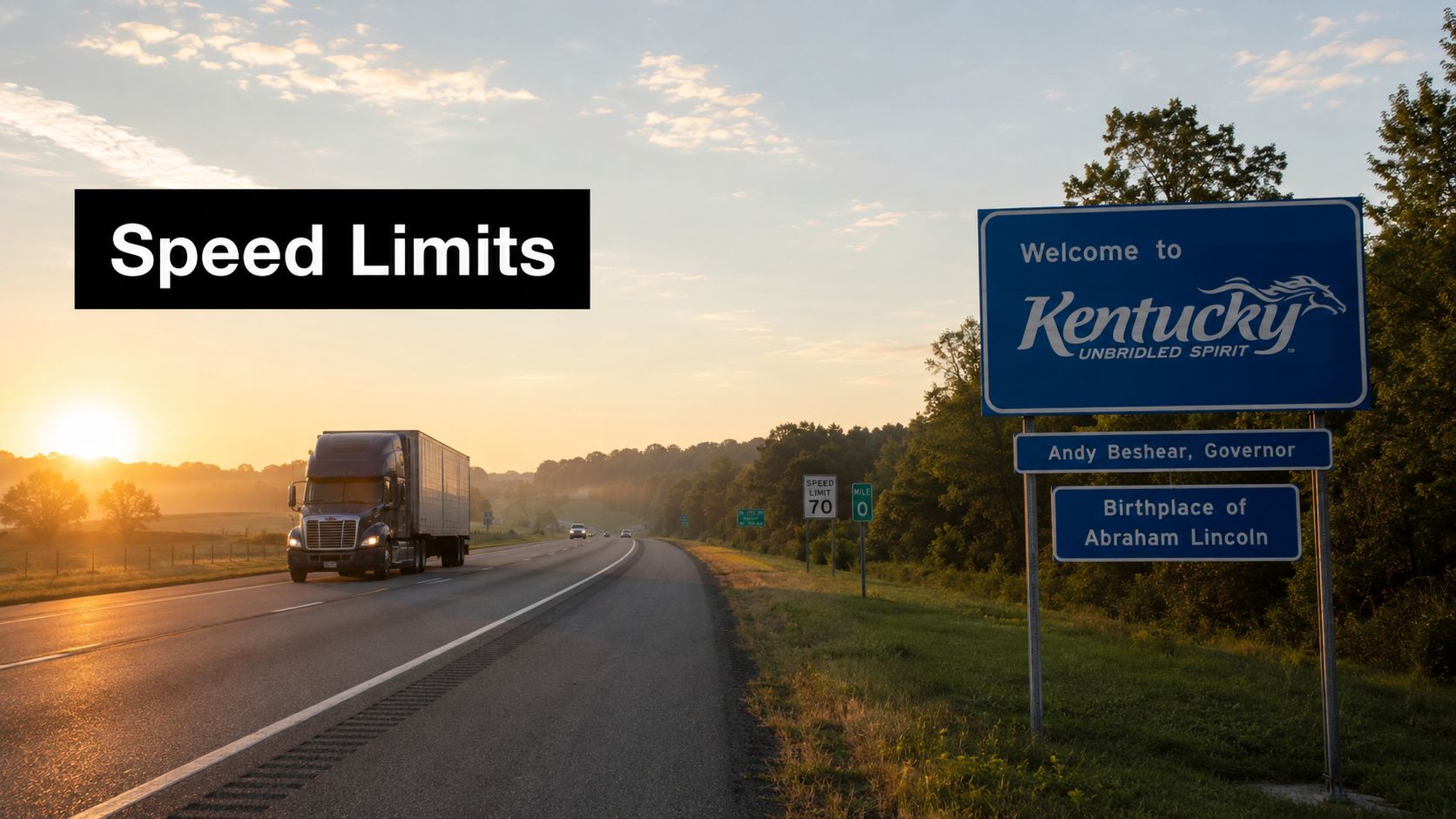
| Kentucky | 70 | Confirm by posted sign | Lower limits may apply by road class. |
| Louisiana | 75 | Confirm by posted sign | Check posted truck restrictions. |
| Maine | 75 | Confirm by posted sign | Verify by corridor and road type. |
| Maryland | 70 | Confirm by posted sign | Urban and suburban segments may be lower. |
| Massachusetts | 65 | Confirm by posted sign | Expect tighter limits in dense traffic areas. |
| Michigan | 75 | Confirm by posted sign | State uses statutory and modified limits. Engineering-based changes matter. |
| Minnesota | 70 | Confirm by posted sign | Confirm exact segment and posted truck speed. |
| Mississippi | 70 | Confirm by posted sign | State maximum doesn't answer every route question. |
| Missouri | 70 | Confirm by posted sign | Watch for work-zone and urban reductions. |
| Montana | 80 | Confirm by posted sign | High rural maximums still require posted-sign discipline. |
| Nebraska | 75 | Confirm by posted sign | Confirm urban interstate and truck postings. |
| Nevada | 80 | Confirm by posted sign | Desert corridors can differ by segment. |
| New Hampshire | 70 | Confirm by posted sign | Verify by facility class. |
| New Jersey | 65 | Confirm by posted sign | Dense traffic and urban design keep many segments lower. |
| New Mexico | 75 | Confirm by posted sign | Confirm route-specific truck restrictions. |
| New York | 65 | Confirm by posted sign | Mixed statutory and posted environments require attention. |
| North Carolina | 70 | Confirm by posted sign | Watch for urban and local reductions. |
| North Dakota | 75 | Confirm by posted sign | Confirm by route and roadway class. |
| Ohio | 70 | Confirm by posted sign | Lower urban limits are common. |
| Oklahoma | 75 | Confirm by posted sign | Verify posted truck speeds. |
| Oregon | 70 | Confirm by posted sign | Pay close attention to truck-specific signs and corridor rules. |
| Pennsylvania | 70 | Confirm by posted sign | Work-zone enforcement is a serious concern. |
| Rhode Island | 65 | Confirm by posted sign | Smaller state, but not simpler. Watch local postings. |
| South Carolina | 70 | Confirm by posted sign | Urban interstate speeds may differ. |
| South Dakota | 80 | Confirm by posted sign | High rural ceiling. Confirm exact facility and vehicle class. |
| Tennessee | 70 | Confirm by posted sign | Check posted truck and metro-area limits. |
| Texas | 85 | Confirm by posted sign | Highest posted limit is on a 41-mile stretch of State Highway 130, not the whole state. |
| Utah | 80 | Confirm by posted sign | High ceiling on some roads. Confirm exact roadway. |
| Vermont | 65 | Confirm by posted sign | Rural roads and local statutory limits matter. |
| Virginia | 70 | Confirm by posted sign | Don't assume one statewide practical limit. |
| Washington | 70 | Confirm by posted sign | Confirm truck-specific signs and corridor changes. |
| West Virginia | 70 | Confirm by posted sign | Mountain grades often demand lower safe speeds than the sign. |
| Wisconsin | 70 | Confirm by posted sign | Check facility-specific postings. |
| Wyoming | 80 | Confirm by posted sign | Open-road conditions don't change your duty to match conditions. |
How to use the table without getting burned
- Start with the notes: They tell you where a state is known for split speeds, urban reductions, or modified limits.
- Treat "confirm by posted sign" strictly: If the verified data doesn't give a statewide truck maximum, don't invent one in your trip plan.
- Read the exact roadway: Rural interstate, urban interstate, and "other roads" can carry different legal maximums in the same state.
Understanding the Different Types of Speed Limits
Most confusion around speed comes from one problem. Drivers hear one phrase, "speed limit," and use it to describe several different legal rules.

If you drive a commercial vehicle, you need cleaner definitions than that. A posted sign is one thing. A default rule with no sign is another. A temporary work-zone reduction is something else again.
Posted and statutory limits
A posted limit is the number shown on the sign for that stretch of road.
A statutory limit is the default number that applies under state law when no sign is present, a situation that often traps drivers. FHWA notes that many drivers miss the distinction between posted and statutory limits, including examples such as 25 mph in residential districts and 55 mph on unmarked rural highways, as explained in FHWA speed limit basics.
If you don't see a sign, that doesn't mean there isn't a limit. It means the state may already have supplied one by law.
For a truck driver, that matters in industrial areas, secondary roads, delivery approaches, local detours, and any route where the sign spacing is poor or visibility is limited.
Other terms that matter on the road
A few more categories show up in training, enforcement, and courtroom language:
- Absolute limits: If the limit is absolute, exceeding it is a violation by itself.
- Prima facie limits: In those systems, the posted number creates a presumption that faster travel is unlawful, but the legal treatment can depend on conditions and local law.
- Minimum limits: Going too slow can also create a problem if you're impeding traffic where a minimum speed is posted.
- Conditional limits: School zones, construction areas, and weather-related reductions can change what is legal even though the normal sign is still standing.
- Variable limits: Some roads use dynamic signs that change with traffic, weather, or road conditions.
- Truck limits: A separate legal ceiling may apply to your vehicle class, even when cars are allowed to run faster.
A quick visual helps lock those categories in:
What works in practice
The safest habit is simple. Read every speed sign as if it might be speaking to a narrower condition than the one you were just in. A new road class, a work crew, a school beacon, or a truck-specific panel changes the legal answer immediately.
What doesn't work is relying on memory from a car trip, old advice from another driver, or your GPS map layer alone.
Navigating Truck Specific Limits and Split Speeds
Passenger-car assumptions will get a CDL driver in trouble faster than almost anything else in this subject. The truck in your hands may be governed, loaded, downgraded by road conditions, or legally capped below surrounding traffic. That's why split-speed states deserve more attention than they usually get in general consumer guides.
Where split speeds show up
The cleanest verified example is California. IIHS shows 70 mph for cars on rural interstates and 55 mph for trucks in California, and also shows that Arizona posts 75 mph on rural interstates but 65 mph on urban interstates and other roads in some cases, which is outlined in the IIHS speed limit law chart. The lesson isn't limited to those two states. It's that one state can hold several legal ceilings at once, depending on road class and vehicle type.
That matters operationally in ways new drivers don't always see at first:
- Trip timing changes: If your truck's legal speed is lower than the car flow, your ETA has to reflect that.
- Lane discipline becomes critical: In split-speed states, a professional driver has to resist getting pulled by traffic pace.
- Urban transitions are easy places to miss reductions: A rural interstate number doesn't follow you automatically into city segments.
- Enforcement often notices trucks first: A marked company vehicle or tractor-trailer tends to draw closer review than a random passenger car.
Why fleets care about split-speed compliance
A fleet manager doesn't look at speed only as a safety issue. It's also a planning issue. If dispatch builds a schedule around passenger-car assumptions, the pressure lands on the driver. That's where bad decisions start. Proper planning accounts for lower truck speeds, slower merges, heavier stopping distances, and time lost in metro areas where limits drop.
Drivers also need to understand where speed overlaps with equipment and insurance. A truck's weight class, configuration, and duty cycle affect more than road handling. They affect the whole compliance profile. That's why it helps to know your vehicle category cold and review related resources such as gross vehicle weight rating basics and practical risk-management information like Florida All Risk truck insurance, especially if you're comparing how carriers and owner-operators manage exposure.
On the road rule: If cars are flowing faster than your legal truck speed, let them go. Your job is to stay legal, predictable, and hard to hit.
What works and what doesn't
What works is checking for three things every time you enter a new state or metro area: the road class, the posted truck sign, and any urban reduction.
What doesn't work is asking, "What's the state limit?" as if the whole state has one answer. For CDL operation, that question is too broad to be useful.
Rules for Special Speed Zones and Conditions
The hardest speed decisions usually aren't made on open interstate. They happen where the normal pattern breaks. Work zones, school zones, weather events, heavy congestion, and local detours all demand a different level of discipline.
Work zones and school zones
Construction areas catch drivers because the road still looks familiar. You may be on the same interstate, same lane alignment, same direction of travel, but the legal speed can be lower and the safe speed can be lower still. Narrowed lanes, workers near traffic, temporary barriers, uneven pavement, and abrupt merges all change your stopping margin.
School zones require the same respect for a different reason. Visibility can collapse quickly around buses, crosswalks, parked vehicles, and children who move unpredictably. For a commercial driver, the right response isn't to hunt for the maximum legal interpretation. It's to slow early and create space.
Use a short mental routine when entering either zone:
- Scan farther ahead: Look beyond the nearest sign for flashing beacons, workers, cones, pedestrians, or lane shifts.
- Brake early, not late: Heavy vehicles punish abrupt corrections.
- Stay off the pack: If traffic behind you wants to push, hold your legal speed and keep your lane position steady.
Weather and basic safe speed
A posted maximum is not a promise that the road will support that speed today. Rain, fog, snow, ice, standing water, smoke, low visibility, and traffic waves can all make the legal maximum unsafe in practice. That's especially true in a loaded truck, where tire condition, braking performance, cargo securement, and downhill momentum all change the safe answer.
Slow enough that you can stop in the distance you can actually see and control, not the distance you hope stays clear.
A common mistake made by inexperienced drivers is treating speed signs as targets instead of ceilings. In dry daylight on a clear rural segment, the ceiling may be workable. In rain, darkness, or stop-and-go traffic, the professional move is often well below the sign.
Conditional limits require active attention
Temporary and conditional reductions don't excuse a commercial driver just because the regular sign remains visible. If the zone is active, if weather has changed the road, or if local controls are in force, your legal and safe speed may be lower than what you remember from the last trip.
What works is driving the conditions in front of you.
What fails is chasing a schedule through a zone that has already told you to slow down.
How State Speed Limits Are Actually Determined
A lot of drivers assume speed limits are mostly political. Legislatures do set statutory limits, but posted numbers on many roads also come from engineering practice. If you understand that process, the variation across states starts to make more sense.
The 85th percentile principle
The key benchmark is the 85th-percentile speed principle. In simple terms, traffic engineers study free-flow traffic and identify the speed at or below which 85% of drivers travel. That benchmark is used as part of the process for setting modified limits, along with roadway characteristics and other safety factors.
Michigan gives a clear example. MDOT explains that objective traffic analysis tied to the 85th percentile is part of the method, and a 2016 law raised limits to 75 mph on at least 600 miles of limited-access freeway and 65 mph on at least 900 miles of trunkline highways, as described by Michigan speed limit guidance.
Why one state can have many answers
This is why a speed limit by state list can only take you so far. States don't just pick one number and post it everywhere. They use a legal hierarchy by facility class. Rural interstates, urban interstates, other limited-access roads, and ordinary roads can all be treated differently. Some states also use modified corridors where engineering study supports a change from the statutory baseline.
For drivers, the practical takeaway is straightforward:
- Signs reflect road context: Geometry, access points, traffic patterns, and roadside development matter.
- Road classes matter as much as state lines: A limit can drop without you leaving the state.
- Truckers need segment-specific awareness: Your route can move across several legal environments in one shift.
Why this matters in the cab
Once you know the limit wasn't pulled out of thin air, it's easier to respect the reason behind it. Curves, access density, ramp frequency, merge behavior, shoulder width, and sight distance all show up in the number on the sign, even when the road feels fast enough to run harder.
That doesn't mean every driver agrees with every posted limit. It means a professional knows disagreement isn't a defense.
Enforcement Trends and Consequences for Your CDL
A speeding ticket in your own car is one thing. A speeding violation in a commercial vehicle is different because employers, insurers, and enforcement agencies read it as a professional performance issue.
How enforcement shows up in the real world
Officers use familiar tools such as moving patrol observation, stationary monitoring, radar, lidar, pacing, aircraft support in some jurisdictions, and targeted enforcement in work zones or truck-heavy corridors. You won't always see the enforcement point before it sees you.
The bigger issue is that speed laws don't stand still. Several states are actively pursuing revisions, including proposals that would create or expand differences between passenger-car and heavy-truck limits, according to Land Line reporting on state speed limit revisions. For a CDL holder, that means old assumptions age badly.
Why one violation matters more in a CMV
A commercial speeding citation can affect far more than the fine. It can raise questions inside the company, trigger review during hiring, and become part of the safety picture attached to your driving history. Carriers also have to think about fleet-level compliance, maintenance, and DOT exposure. If you're trying to understand that broader operating environment, Florida DOT regulations for fleets is a useful reference for how companies approach compliance systems outside the cab.
For drivers, the professional consequences usually show up in three places:
- Hiring friction: Future employers often care less about excuses and more about patterns.
- Internal discipline: Carriers may assign coaching, probation, or route restrictions.
- Record visibility: Safety-related history follows you more than many new drivers expect. If you're learning how that record-sharing system works, review the Commercial Driver License Information System overview.
A good CDL record is easier to keep than to repair.
The trade-off every new driver has to understand
Trying to "make up time" with speed usually doesn't solve the actual trip problem. Delays come from shipping windows, congestion, loading docks, weather, lane closures, and poor planning. Speeding adds risk without fixing those root causes. A disciplined driver protects the record first and lets dispatch adjust the schedule second.
That's one of the clearest differences between a rookie mindset and a professional one.
Actionable Speed Management Tips for New Drivers
A new driver leaves a shipper in one state, crosses into the next, and settles into the same pace used all morning. Ten miles later, that driver passes a sign showing a lower limit for trucks than for passenger cars. That mistake is common, and it is expensive. Speed management starts with one rule. Drive by the sign in front of you, not by the last state, your memory, or the flow of car traffic.

Seven habits worth keeping
- Study the route before departure: Check state lines, major cities, mountain corridors, work zones, and the final miles into the receiver. Those are the places where posted limits and truck restrictions change fast.
- Read the first posted signs after every state change: Statutory limits and posted limits are not the same thing. The first signs after the border settle the question.
- Watch for truck-specific limits: In split-speed states, the car beside you may be legal at a speed that would put your CDL at risk.
- Use GPS for awareness, not authority: Truck navigation helps with planning, but roadside signs, weather, traffic, weight, and grade determine the speed you can hold.
- Plan the trip at legal truck speed: If the schedule only works when you drive at passenger-car pace, the schedule needs to change.
- Keep more following distance than you think you need: Extra space gives you time to react when traffic compresses, a work zone appears, or a downgrade builds speed.
- Match speed to the truck you have today: Gross weight, brake condition, tire condition, cargo balance, and weather all change how much stopping room you need.
The strongest habit is simple. Keep checking whether the safe speed and the legal speed are still the same number. Sometimes they are not.
The mindset that keeps you out of trouble
New CDL drivers often want one safe cruising number they can trust all day. Professional driving does not work that way. Your legal limit can change by state, by road class, by posted truck restriction, and by special zone. Your safe speed can drop even lower because of rain, wind, darkness, curves, traffic, or cargo movement.
That is why speed control belongs in the same daily routine as mirror checks, lane management, and pre-trip inspection. It affects compliance, stopping distance, fuel use, and how your carrier evaluates your judgment. Drivers who last in this business do not chase every open gap. They protect the record first and arrive under control.
Training helps build that judgment early. Patriot CDL provides CDL training focused on road observation, sign recognition, pre-trip habits, and behind-the-wheel decisions. Keep reviewing practical guidance, including these safety tips for new commercial truck drivers.
What to do on your next trip
Before the next run, mark every state on the route and note any state where trucks may run a different speed than cars. At each border crossing, look for the first posted signs and reset your pace there. If the weather, grade, traffic, or load condition says back it down, do it early.
Good speed management looks boring from the outside.
That is usually what professional driving looks like.