The journey to a rewarding career as a commercial driver starts with a single, crucial step: passing the CDL written exam. This isn't just a formality; it's a comprehensive test of the knowledge required to operate a large, powerful vehicle safely and legally. The sheer volume of information, from federal regulations to intricate vehicle systems, can feel overwhelming, especially when faced with a long list of potential cdl test questions.
That's why we've created this definitive guide. We're breaking down the most common and critical categories of questions you'll encounter on the exam. This article moves beyond simple memorization, offering a structured approach to help you build a foundational understanding that will serve you on test day and throughout your career. Think of this as your strategic study partner, designed to cut through the noise and focus on what truly matters.
Here, you will find a thorough roundup of the most common topics, complete with:
- Sample Questions: Get a feel for the format and wording you'll see on the actual test.
- Correct Answers: Quickly check your knowledge and identify areas for improvement.
- Detailed Explanations: Understand the "why" behind each answer to solidify your learning.
- Actionable Study Tips: Learn effective strategies for mastering each specific subject area.
Whether you're aiming for a Class A, B, or pursuing a specialized endorsement like HazMat, this comprehensive list will prepare you for the challenge ahead. We'll cover everything from pre-trip inspections and air brake systems to hours-of-service rules and safe driving practices, giving you the confidence to ace the test and unlock the road to your new profession.
1. Pre-Trip Vehicle Inspection Questions
The pre-trip vehicle inspection is arguably the most critical responsibility a commercial driver has before starting any journey. It's a comprehensive, systematic check of the vehicle's key components to ensure it is safe to operate on public roads. These cdl test questions are designed to verify your understanding of this vital process, covering not just what to inspect, but how to identify potential defects that could lead to catastrophic failures. Mastering this section is fundamental to passing your CDL exam and, more importantly, to a long and safe career.

During the test, you'll need to demonstrate your knowledge verbally and, for the skills test, physically. You'll be asked to point out specific parts, explain their function, and describe what you are looking for. The inspection covers everything from the engine compartment to the coupling system and ensures every safety-critical system is in proper working order.
Example Pre-Trip Inspection Questions & Answers
Question: What is the minimum legal tread depth for front (steering) tires?
- Answer: The minimum legal tread depth for front tires on a commercial motor vehicle is 4/32 of an inch. For all other tires, it is 2/32 of an inch.
Question: Name at least three components of the steering system you must check during a pre-trip inspection.
- Answer: Three key components are the steering box (securely mounted, not leaking), the steering linkage (pitman arm, drag link, tie rods – not bent or cracked, joints are secure), and the power steering fluid level (ensure it's adequate).
Question: What is a critical defect in the brake system that would immediately place the vehicle "out of service"?
- Answer: An audible air leak in the brake lines or chambers, cracked brake drums, or brake pads with lining thinner than 1/4 inch are all considered out-of-service violations.
Actionable Study Tips
To excel at these cdl test questions, you need both book knowledge and practical familiarity.
- Develop a Routine: Always conduct your practice inspections in the same order, such as starting at the front of the truck, working down one side, checking the coupling and rear, and then moving up the other side. This builds muscle memory and prevents you from missing steps.
- Use Memory Aids: Create acronyms or phrases to remember lists of components. For example, for in-cab checks, think "Safe Start" and list all the gauges, lights, and controls you need to verify.
- Focus on Safety-Critical Items: Pay special attention to the "big five": brakes, tires, steering, suspension, and coupling. These systems are most likely to cause an accident if they fail, and examiners focus heavily on them.
- Get Hands-On Practice: The CDL manual is essential, but nothing replaces seeing and touching the actual parts on a truck. If you are in a training school, maximize your time with the vehicles.
2. Hours of Service (HOS) Regulations Questions
Understanding Hours of Service (HOS) regulations is non-negotiable for any commercial driver. These federal rules, enforced by the FMCSA, are designed to prevent fatigue-related accidents by strictly limiting driving and working hours. These cdl test questions will challenge your knowledge of the 11-hour driving limit, the 14-hour duty window, and mandatory rest periods. Failing to master HOS rules can lead to fines, penalties, and being placed "out of service" during a roadside inspection, making this a critical area of study.
The test will present various scenarios to ensure you can apply these rules correctly in real-world situations. You'll need to know the difference between on-duty time, off-duty time, and driving time, and how they interact within a work shift. These questions are not just about memorizing numbers; they are about applying complex regulations to maintain safety on the road for yourself and the public.
Example Hours of Service Questions & Answers
Question: What is the maximum number of hours a property-carrying driver can drive after 10 consecutive hours off duty?
- Answer: A driver may drive a maximum of 11 hours after having 10 consecutive hours off duty.
Question: When must a driver take a 30-minute break?
- Answer: A driver must take a 30-minute break after accumulating 8 hours of driving time without at least a 30-minute interruption. This break can be on-duty (not driving), off-duty, or sleeper berth time.
Question: What is the 14-hour "driving window" rule?
- Answer: A driver cannot drive beyond the 14th consecutive hour after coming on duty, following 10 consecutive hours off duty. All driving must be completed within this 14-hour period, which includes driving time, on-duty time, and off-duty breaks.
Actionable Study Tips
Excelling at HOS questions requires more than rote memorization; it demands practical application.
- Create Timeline Diagrams: Draw out a 24-hour timeline and plot different work and rest scenarios. Visualizing how the 11-hour, 14-hour, and 30-minute break rules interact makes them much easier to understand.
- Practice with Scenarios: Work through practice problems that ask you to calculate remaining driving time or determine if a driver is in violation. For example: "If a driver starts at 6 AM, drives for 4 hours, takes a 1-hour lunch, and drives another 4 hours, must they take a 30-minute break?" (Answer: No, the 1-hour lunch break satisfied the requirement).
- Understand the Difference: Clearly distinguish between driving time (wheels are turning) and on-duty time (pre-trip inspections, waiting to load, fueling). The 11-hour limit applies only to driving, while the 14-hour window includes all on-duty activities.
- Learn Key Exceptions: Be aware of exceptions like the short-haul provision or adverse driving conditions, as these are common topics for tricky cdl test questions.
3. Air Brake System Questions
Acing the air brake endorsement section is a non-negotiable step for anyone planning to operate the most common types of heavy commercial vehicles like tractor-trailers or large straight trucks. Air brake systems are powerful but complex, relying on compressed air to activate the braking mechanisms. These specific cdl test questions are designed to ensure you have a deep understanding of the system's components, proper operation, and crucial safety checks. Failing to grasp these concepts can lead to serious safety hazards on the road.
The air brake test portion of the exam involves both written questions and a practical, in-cab demonstration. You must be able to articulate how the system builds, stores, and uses air, and you'll need to perform a series of checks to test for leaks, verify warning signals, and confirm the proper function of the entire system. Mastery of this section demonstrates your ability to safely manage one of the most critical safety systems on your vehicle.
Example Air Brake System Questions & Answers
Question: At what PSI (pounds per square inch) should the air compressor governor "cut out"?
- Answer: The air compressor governor should stop the compressor from pumping air, or "cut out," at approximately 120-140 PSI. This prevents the air tanks from being over-pressurized.
Question: What happens when air pressure drops to approximately 60 PSI in the air brake system?
- Answer: At around 60 PSI (or the manufacturer's specification), the low air pressure warning light and/or buzzer should activate, alerting the driver to a critical loss of air pressure. On some vehicles, the spring brakes may also begin to engage.
Question: How do you perform a static leakage test on your air brake system?
- Answer: To perform a static leak test, you must ensure the vehicle is secured, release the parking brakes, and turn off the engine. With a fully charged air system, you should not lose more than 2 PSI in one minute for a single vehicle.
Actionable Study Tips
Excelling at the air brake portion of the CDL test requires dedicated practice and a thorough understanding of the mechanics.
- Study Air Brake Diagrams: Familiarize yourself with diagrams of the air brake system. Learn to identify the air compressor, governor, air tanks, brake chambers, slack adjusters, and all the lines and valves that connect them.
- Practice the Inspection Sequence: The in-cab air brake check has a specific, multi-step sequence. Practice it repeatedly until it becomes second nature. This includes testing the service brakes, parking brakes, and emergency (spring) brakes.
- Understand Pressure and Braking: Grasp the direct relationship between air pressure and braking force. Know the normal operating ranges (90-140 PSI) and the critical thresholds for the low-pressure warning (around 60 PSI) and spring brake application (20-45 PSI). For additional practice, you can find helpful air brake system quizzes online.
- Verbalize Everything: During your practice sessions, say out loud what you are checking and why, just as you will for the examiner. This helps commit the steps and their reasons to memory.
4. Hazardous Materials (HazMat) Questions
Transporting hazardous materials is a specialized field that demands an extremely high level of knowledge and responsibility. The HazMat endorsement (H) is required for any driver hauling materials that are considered hazardous by the government, and the related cdl test questions are designed to ensure you understand the immense risks and precise procedures involved. These questions focus on your ability to identify, handle, and transport these materials safely, following strict federal regulations. Passing the HazMat test not only adds a valuable endorsement to your CDL but also demonstrates your commitment to protecting yourself, the public, and the environment.
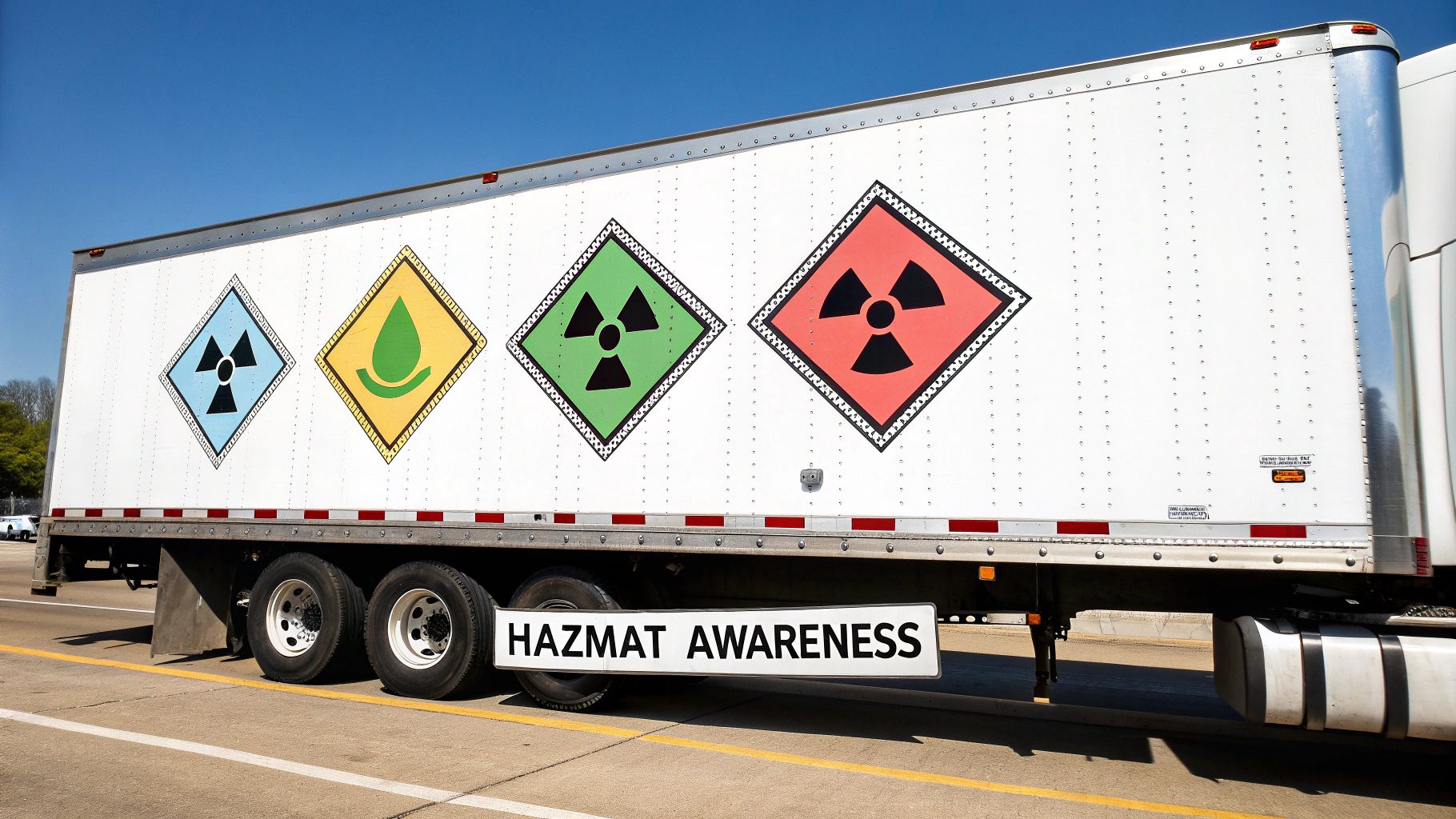
The HazMat test covers a wide range of topics, including the nine hazard classes, placarding rules, shipping paper requirements, loading/unloading procedures, and emergency response actions. Because this endorsement involves national security, you must also pass a Transportation Security Administration (TSA) background check. The questions on the written exam are specific and require careful study of the official regulations.
Example HazMat Questions & Answers
Question: Which of the nine hazard classes includes explosives?
- Answer: Class 1 is the hazard class for explosives. This class includes items like dynamite, fireworks, and ammunition.
Question: What is a key piece of information that must be included on hazardous material shipping papers?
- Answer: The shipping papers must include the material's proper shipping name, hazard class, identification number (UN/NA number), and packing group. An emergency response telephone number is also required.
Question: You are hauling 1,500 pounds of a "Table 2" material. Do you need to placard your vehicle?
- Answer: Yes. Placards are required for any "Table 2" material when the aggregate gross weight of the shipment is 1,001 pounds or more. For "Table 1" materials, placards are required for any amount.
Actionable Study Tips
Excelling on the HazMat portion of the CDL test requires dedicated memorization and a thorough understanding of the rules.
- Memorize the Hazard Classes: Learn the nine hazard classes in order. Create a mnemonic device to help you recall them, as this is fundamental knowledge for many other questions.
- Study the Placard Table: You must be able to identify placards and know what they represent. Focus on the differences between Table 1 and Table 2 materials and their placarding weight thresholds.
- Understand Segregation Rules: The HazMat regulations include a Segregation Table that specifies which hazard classes cannot be loaded, transported, or stored together. You will be tested on these compatibility rules.
- Review Emergency Procedures: Be prepared to answer questions about what to do in case of a leak, spill, or accident. Know your role as the driver and the immediate steps to take to mitigate danger.
5. Combination Vehicle Coupling/Uncoupling Questions
The process of connecting and disconnecting a tractor and trailer is a fundamental skill for any combination vehicle driver, and it's heavily scrutinized on the CDL exam. These cdl test questions assess your understanding of the precise, step-by-step procedures required for safe coupling and uncoupling. A mistake in this process can lead to dropped trailers, damaged equipment, or severe accidents like a "high hook." Demonstrating mastery here shows an examiner you have the discipline and attention to detail necessary for safe operation.
This infographic outlines the three critical stages of the coupling process.
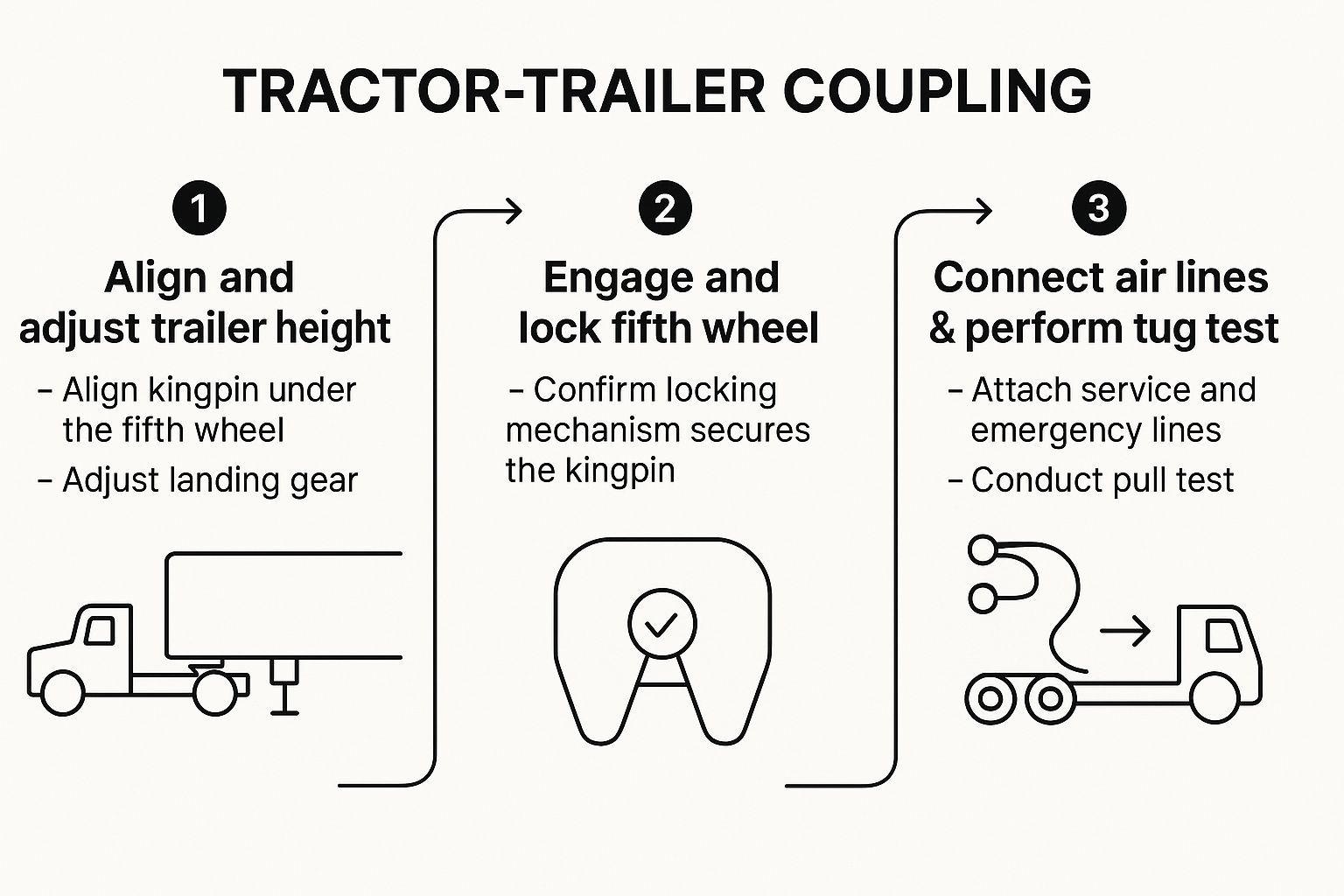
Following this sequence ensures that each critical safety check, from alignment to the final tug test, is performed correctly and in the right order.
During the test, you will be expected to recite the steps from memory and explain the safety reasons behind each action. This includes knowing how to inspect the fifth wheel, align the vehicles properly, connect air and electrical lines, and verify a secure connection before moving the vehicle.
Example Coupling/Uncoupling Questions & Answers
Question: Before backing under the trailer, what should you check about the trailer's height?
- Answer: The trailer should be low enough that the tractor’s fifth wheel will lift the front of the trailer as you back under it. The fifth wheel should make contact with the trailer's apron, not ram into the kingpin.
Question: After coupling, how do you test that the trailer is properly secured to the tractor?
- Answer: You perform a tug test. With the trailer brakes engaged and the tractor brakes released, gently try to pull forward. The tractor should strain against the trailer brakes, confirming the kingpin is locked in the fifth wheel.
Question: After coupling is complete and you are ready to drive, in what position should you leave the trailer's landing gear?
- Answer: The landing gear must be fully raised and the crank handle must be secured. A low-hanging landing gear can catch on railroad tracks, uneven ground, or other obstacles, causing significant damage.
Actionable Study Tips
Excelling at these cdl test questions requires memorizing a strict procedure and understanding the "why" behind each step.
- Memorize the Sequence: Treat the coupling and uncoupling procedures as non-negotiable checklists. Recite the steps in order every time you practice until it becomes second nature.
- Always Perform the Tug Test: This is a critical safety verification step. In both practice and real-world application, never skip the tug test to confirm the kingpin is securely locked.
- Verbalize Your Actions: As you practice, say each step out loud, just as you would for the examiner. For example, say "I am now visually inspecting the fifth wheel jaws to ensure they are locked around the kingpin shank."
- Never Rush the Process: Coupling and uncoupling are procedures where speed leads to dangerous errors. Take your time, get out and look (G.O.A.L.), and double-check your work, especially the fifth wheel connection and the airline attachments.
6. Vehicle Weight and Balance Questions
Understanding how to properly manage a commercial vehicle's weight and balance is a non-negotiable skill for any professional driver. Overloading or improperly distributing weight can lead to severe safety hazards, including tire blowouts, brake failure, and rollovers. These cdl test questions are designed to ensure you comprehend federal and state weight limits, the principles of weight distribution, and how these factors critically impact vehicle stability and handling.
On the written exam, you will encounter questions about specific weight limits for axles, gross vehicle weight, and combination weights. The core purpose is to verify your ability to load a truck legally and safely, protecting the infrastructure like roads and bridges, as well as ensuring your vehicle remains controllable under all driving conditions. A poorly balanced load can make a truck difficult to steer and stop, especially in adverse weather.
Example Vehicle Weight and Balance Questions & Answers
Question: What are the federal maximum legal weight limits for a single axle and a tandem axle?
- Answer: The federal maximum weight limit is 20,000 pounds on a single axle and 34,000 pounds on a tandem axle group.
Question: How does a high center of gravity affect a commercial vehicle's handling?
- Answer: A high center of gravity makes the vehicle less stable and increases the risk of rolling over, especially when turning, driving on a curve, or encountering strong crosswinds. It requires the driver to slow down significantly for turns and ramps.
Question: What should you do if your vehicle is found to be overweight at a weigh station?
- Answer: If you are overweight, you will likely be cited and not allowed to proceed until the vehicle is made legal. This may require re-distributing the load (e.g., by sliding the fifth wheel or tandem axles) or, in more severe cases, off-loading a portion of the cargo.
Actionable Study Tips
Excelling at these weight and balance cdl test questions requires memorization and an understanding of physics.
- Learn Federal Limits by Heart: The federal limits (20,000 lbs single axle, 34,000 lbs tandem, 80,000 lbs GVW) are the foundation. Memorize these numbers as they are almost guaranteed to appear on the test.
- Understand Weight Distribution Effects: Don't just learn the numbers; understand why they matter. Comprehend how shifting weight forward or backward with the fifth wheel and tandem axles affects the weight on each axle group and impacts steering and traction.
- Study State-Specific Regulations: While federal limits are standard, many states have their own specific regulations, such as "bridge laws" that dictate the spacing between axles. Be sure to study the CDL manual for the state in which you are testing.
- Practice Cargo Calculations: Learn to calculate your available legal payload. Start with the truck's empty (curb) weight and subtract it from the maximum legal GVW (e.g., 80,000 lbs) to determine how much cargo you can legally haul.
7. Traffic Laws and Safe Driving Questions
Operating a commercial motor vehicle (CMV) involves more than just knowing how to steer and shift gears; it requires a deep understanding of traffic laws and safe driving principles specific to large vehicles. These cdl test questions are designed to ensure you know how to manage a CMV's unique characteristics, such as its extended stopping distance, wide turning radius, and significant blind spots. Answering them correctly demonstrates that you can make safe, legal, and responsible decisions on the road, protecting yourself and the public.
This category covers state and federal regulations, speed management in various conditions, and the critical concept of maintaining a safe space cushion around your vehicle. Unlike driving a car, a CMV's size and weight mean that common situations like railroad crossings, lane changes, and adverse weather demand a higher level of caution and adherence to specific rules. Mastering these principles is essential for passing the written exam and for a career free of accidents and violations.
Example Traffic Law and Safe Driving Questions & Answers
Question: What is the recommended following distance for a commercial motor vehicle traveling under 40 mph?
- Answer: The general rule is to maintain one second of following distance for every 10 feet of vehicle length, plus an additional second for safety. For example, a 60-foot truck should have at least 7 seconds of following distance under ideal conditions.
Question: When must a commercial vehicle driver stop at a railroad crossing?
- Answer: A CMV driver must stop at all railroad crossings if their vehicle is carrying passengers, placarded hazardous materials, or if the crossing is marked with a "stop" sign. You must stop between 15 and 50 feet from the nearest rail.
Question: What is the proper procedure for driving in heavy fog with limited visibility?
- Answer: When visibility is poor, you must reduce your speed significantly. If visibility becomes so limited that it is unsafe to continue, you should pull off the road to a safe location and stop, turning on your four-way emergency flashers.
Actionable Study Tips
Success in this area hinges on understanding that CMVs operate under a stricter set of rules than passenger cars.
- Think in Time and Space: Always remember that commercial vehicles need much more time and space to stop, turn, and maneuver. Your answers to situational questions should reflect this reality.
- Study the Differences: Focus specifically on the rules that differ from standard car driving, such as railroad crossing laws, lane restrictions for trucks, and weight limits on bridges. You can learn more about these topics by reviewing the general knowledge test materials provided by many training resources.
- Embrace Defensive Driving: The core principle is hazard perception and proactive maneuvers. Always think about "what if" scenarios. What if that car pulls out? What if the light turns yellow? This mindset is key to acing the test questions.
- Practice Calculations: Get comfortable with calculating total stopping distance (perception distance + reaction distance + braking distance) and applying the one-second-per-10-feet rule for following distance.
7 Key CDL Test Question Topics Compared
| Topic | Implementation Complexity 🔄 | Resource Requirements ⚡ | Expected Outcomes 📊 | Ideal Use Cases 💡 | Key Advantages ⭐ |
|---|---|---|---|---|---|
| Pre-Trip Vehicle Inspection Questions | Medium – requires memorization and practice | Moderate – access to vehicle recommended | Improved safety, accident prevention, test readiness | Daily CDL driving, pre-trip routines | Builds systematic habits; critical for safety |
| Hours of Service (HOS) Regulations Questions | High – complex rules with exceptions | Low – mostly knowledge based | Reduced driver fatigue, regulatory compliance | Driver log management, long-haul route planning | Prevents fatigue-related accidents; legal necessity |
| Air Brake System Questions | High – technical and theoretical | Moderate – study materials and practice | Enhanced safety with specialized vehicle operation | Operating heavy commercial vehicles with air brakes | Increases employability; critical for safety |
| Hazardous Materials (HazMat) Questions | High – requires detailed regulations and clearance | High – training, background checks required | Safer hazardous material transport, compliance | Transporting hazardous cargo with endorsements | Job market advantage; specialized safety knowledge |
| Combination Vehicle Coupling/Uncoupling Questions | Medium-High – multi-step physical process | Moderate – hands-on practice necessary | Safe vehicle connection, accident prevention | Class A CDL combination vehicle operation | Prevents equipment damage; required for CDL exam |
| Vehicle Weight and Balance Questions | Medium – involves calculations and legal limits | Low – mostly study based | Avoid overweight fines, improved vehicle handling | Legal commercial operations, cargo loading | Protects equipment; enhances safety |
| Traffic Laws and Safe Driving Questions | Medium – knowledge of commercial-specific laws | Low – knowledge based | Safer driving, compliance with commercial rules | Daily commercial vehicle operation across CDL types | Builds defensive driving skills; widely applicable |
From Study Guide to Steering Wheel: Your Next Steps
You've just navigated through a comprehensive roundup of the most critical CDL test questions, covering everything from the meticulous pre-trip inspection to the complex regulations surrounding hazardous materials. This journey through the core knowledge areas of commercial driving is the foundational step toward earning your license. By understanding the "why" behind each answer, you are not just memorizing facts; you are building the mental framework of a safe, competent, and professional driver.
Think of this article as your detailed blueprint. You now have a clear picture of the essential systems and rules that govern the trucking industry. The questions we've explored are designed to test more than just rote learning. They evaluate your ability to think critically under pressure, anticipate potential hazards, and make sound decisions on the road.
From Knowledge to Action: Bridging the Gap
Mastering the answers to these cdl test questions is a significant accomplishment, but it's only half the battle. The ultimate goal is to translate this theoretical knowledge into practical, real-world skill. Knowing the proper steps to couple a combination vehicle on paper is one thing; feeling the kingpin lock into the fifth wheel is another. Reciting the components of an air brake system is crucial, but hearing the hiss of a properly functioning system during a hands-on check is where true confidence is forged.
Your next objective is to connect these concepts to the physical vehicle. The information you've learned here provides the context for every action you will take behind the wheel.
- Pre-Trip Inspection: You no longer just see a list of parts. You see a system of interconnected components, understanding that a frayed belt or a low fluid level is a critical safety issue, not just a wrong answer on a test.
- Air Brakes: The abstract steps of the air brake check now have a tangible sequence. You'll perform the static leak test, the applied pressure test, and the low-pressure warning alarm test with a clear understanding of what you're looking for and why it matters.
- Hours of Service: These aren't just numbers to memorize. They are the rules that will dictate your daily schedule, protect you from fatigue, and ensure you are operating legally and safely. Your logbook or ELD becomes a tool for professional compliance.
The Value of Professional Mastery
Why is this level of deep understanding so important? Because professional truck driving is a career of immense responsibility. You are not just operating a large vehicle; you are a key operator in the nation's supply chain, entrusted with valuable cargo and the safety of everyone on the road.
Key Takeaway: Excelling on your CDL written test is the first signal to future employers that you are a serious, detail-oriented candidate. It demonstrates your commitment to safety and professionalism before you even climb into the cab.
The knowledge gained from studying these cdl test questions directly impacts your future career. A driver who truly understands weight distribution and balance will be more efficient and safer, preventing rollovers and equipment damage. A driver who has internalized traffic laws and safe driving principles will have a better safety record, leading to better job opportunities and lower insurance costs.
Your journey from aspiring driver to licensed professional is a process of building layers of competence. You've laid a strong foundation with this study guide. The next step is to build upon it with hands-on training and real-world experience. Embrace this final phase of your training with the same dedication you've applied to studying, and you will be well on your way to a successful and rewarding career on the open road.
Passing the exam is your entry ticket, but expert training makes you a professional. At Patriot CDL, we specialize in transforming your test knowledge into confident, road-ready skill with accelerated, hands-on instruction. If you are ready to get your career in gear quickly and affordably, visit Patriot CDL to learn how our programs can help you succeed.