Passing the air brakes section of the CDL exam is a non-negotiable for most drivers, and frankly, just reading the manual won't cut it. To truly prepare, you need to immerse yourself in air brakes practice tests. They're the closest you'll get to the real thing, helping you simulate exam pressure, pinpoint your weak spots, and build the confidence you need to walk out with a pass.
Think of practice tests as your training ground—the bridge between knowing the material and proving you know it.
Why Practice Tests Are Your Secret Weapon for the Air Brakes Endorsement
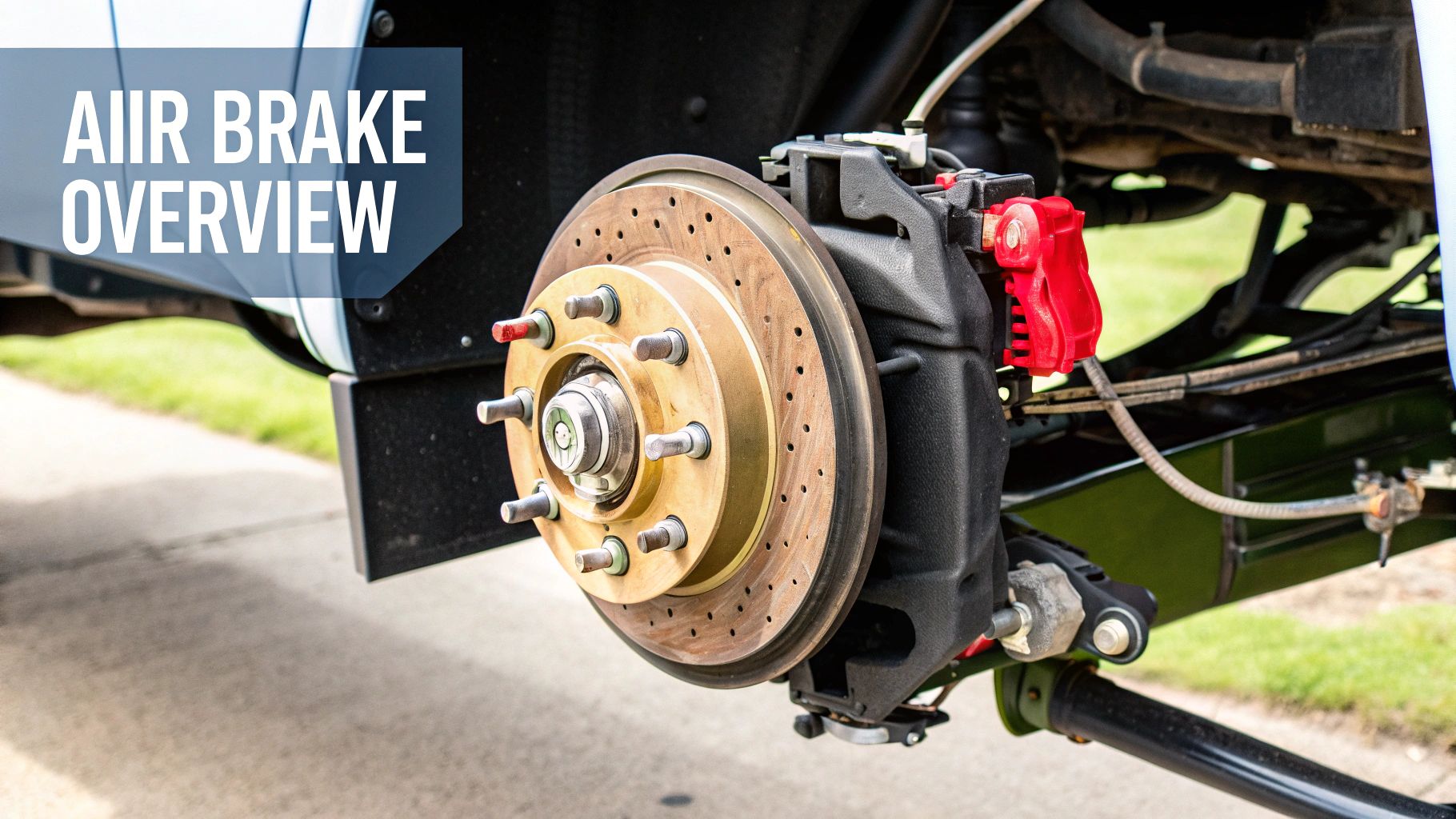
The Air Brakes endorsement is a notorious roadblock for a reason. This isn't just another chapter in the handbook; it’s a deep dive into a complex system where one small oversight can lead to serious trouble on the road. That’s why the exam is designed to be tough.
Trying to pass by just memorizing facts is a common mistake. The official test uses tricky, scenario-based questions that force you to apply what you've learned. This is exactly where a smart practice test strategy separates those who pass from those who have to retake.
From Theory to Test-Ready
A good practice test does more than just ask questions—it mimics the actual DMV exam environment. You get a feel for the unique phrasing of the questions, the types of scenarios they'll throw at you, and the time pressure you'll be under.
To give you a clearer picture of what you're up against, let's break down the typical structure of the air brakes exam.
Air Brakes Test At a Glance
The table below outlines the core components of the CDL Air Brakes endorsement test. While specifics can vary slightly by state, this gives you a solid idea of what to expect on exam day.
| Exam Component | Typical Format | Key Details |
|---|---|---|
| Number of Questions | 20 – 50 multiple-choice questions | Focuses on system operation, inspection procedures, and failure recognition. |
| Passing Score | 80% or higher is required to pass | This high threshold means you can only miss a few questions, making every answer count. |
| Topics Covered | System components, air pressure ranges, brake checks | Expect questions on slack adjusters, air compressors, governor cut-in/cut-out, and emergency braking. |
| Question Style | Scenario-based and knowledge-based | You'll be tested on both raw facts (e.g., pressure levels) and your ability to apply them to real situations. |
As you can see, there isn't much wiggle room for mistakes. This is why targeted practice is so critical for success.
A well-structured practice routine is your best tool for uncovering blind spots. It shows you exactly which concepts—like governor cut-in pressures or slack adjuster limits—you haven’t fully grasped yet.
Build Confidence, Crush Anxiety
Nothing fuels test anxiety like walking into the DMV feeling unprepared. The more you work through air brakes practice tests, the more familiar the material becomes. You start building a kind of mental muscle memory, turning a stressful exam into just another checklist to complete.
It’s about shifting your mindset from, "I think I know this," to "I definitely know this."
This confidence carries over. A solid pass on the Air Brakes section gives you momentum for the other parts of your CDL exam. To see how this fits into the bigger picture, check out our guide on the CDL general knowledge test. By making practice a core part of your study plan, you dramatically increase your chances of passing on the first try, saving you time, money, and a lot of frustration.
Finding Air Brakes Practice Tests That Actually Work

A quick search for air brakes practice tests throws a ton of options at you, and honestly, it can be a bit overwhelming. The problem is, a lot of what you'll find is junk—outdated, inaccurate, or just plain confusing. Your study time is valuable, and wasting it on a bad test is worse than not studying at all.
The real trick is learning to spot the good ones. A genuinely effective practice test isn't just a random list of questions. It's built to feel like the real CDL exam, pushing you to truly understand the material, not just memorize a few answers.
So, how do you sift through the noise? You have to know what to look for—the clear signs of a quality tool that will actually help you pass.
What a Top-Notch Practice Test Looks Like
When you're sizing up a practice test, don't get hung up on the number of questions. The details are what matter. A high-quality resource will always give you detailed explanations for every single answer, whether you got it right or wrong.
This is, without a doubt, the most important feature. Seeing a red "X" next to your answer doesn't teach you anything. You need to know why it was wrong. Did you mix up the governor cut-in and cut-out pressures? Did you confuse the function of the service brake with the parking brake? Good explanations break down the concepts so you actually learn.
The goal isn't just to pass the practice test—it's to master the material so you can pass the official CDL exam. Comprehensive answer explanations are the bridge that gets you there.
Look for a good mix of question types, especially ones that put you in a real-world scenario you might actually face on the road. For a great example of how these elements should come together, check out this well-designed air brakes practice test. It gives you a feel for what to expect.
Checking for Credibility and Up-to-Date Content
Before you dive into a practice test, take a minute to check if it's legit. This goes for both free and paid versions. Here’s a quick mental checklist to run through:
- Is it based on current manuals? The test material absolutely must reflect the latest version of your state's CDL manual. Air brake systems and regulations do get updated, so old info is a huge red flag.
- Does it feel like a real test? A good simulator will have features like a timer or a format that doesn’t just hand you the correct answer. This helps get you comfortable with the pressure of the real exam.
- Does it focus on what matters? The best practice tests will drill you on the core concepts: the pre-trip inspection, proper air pressure ranges, and identifying key system parts. These topics are the bread and butter of the official exam.
Spending a little time upfront to find a reliable resource is one of the smartest things you can do. By sourcing quality air brakes practice tests, you're making sure every minute you spend studying is a minute spent getting closer to that endorsement.
A Smarter Way to Approach Practice Sessions
Just clicking through questions on a practice test is one of the quickest ways to spin your wheels and waste valuable study time. To really make progress, you need a strategy. Think of your air brakes practice tests as a targeted workout session, not just a casual quiz. A smart approach is what separates a passing score from a failing one.
It all begins with getting a brutally honest look at where you're starting from. Before you even think about setting a timer, take your first practice test purely as a diagnostic. The goal here isn't a perfect score—it's to establish a baseline. This untimed, open-book run-through will show you exactly where your knowledge gaps are without the pressure of a ticking clock.
Once you have that baseline, you can build a study plan that hits your weak spots head-on. Did questions about slack adjusters or the governor cut-out pressure leave you guessing? Maybe the pre-trip inspection steps got jumbled in your head. That first test result is now your personalized roadmap for what to study next.
Simulating Real Exam Conditions
After you've shored up those weaker areas, it's time to turn up the heat. You need to get used to the pressure of the real DMV test, and the only way to do that is by simulating it. That means setting a strict timer for your practice sessions and getting rid of all distractions. Put your phone on silent and in another room, turn off the TV, and find a spot where you can really concentrate.
Most quality practice exams will have around 25 to 40 multiple-choice questions, mirroring the format and timing of the official test. This isn't just for fun; failure rates for the Air Brakes endorsement exam can be as high as 20-30% for first-timers who haven't prepared. Timed practice is non-negotiable.
This breakdown shows the key skills you'll build through this process.
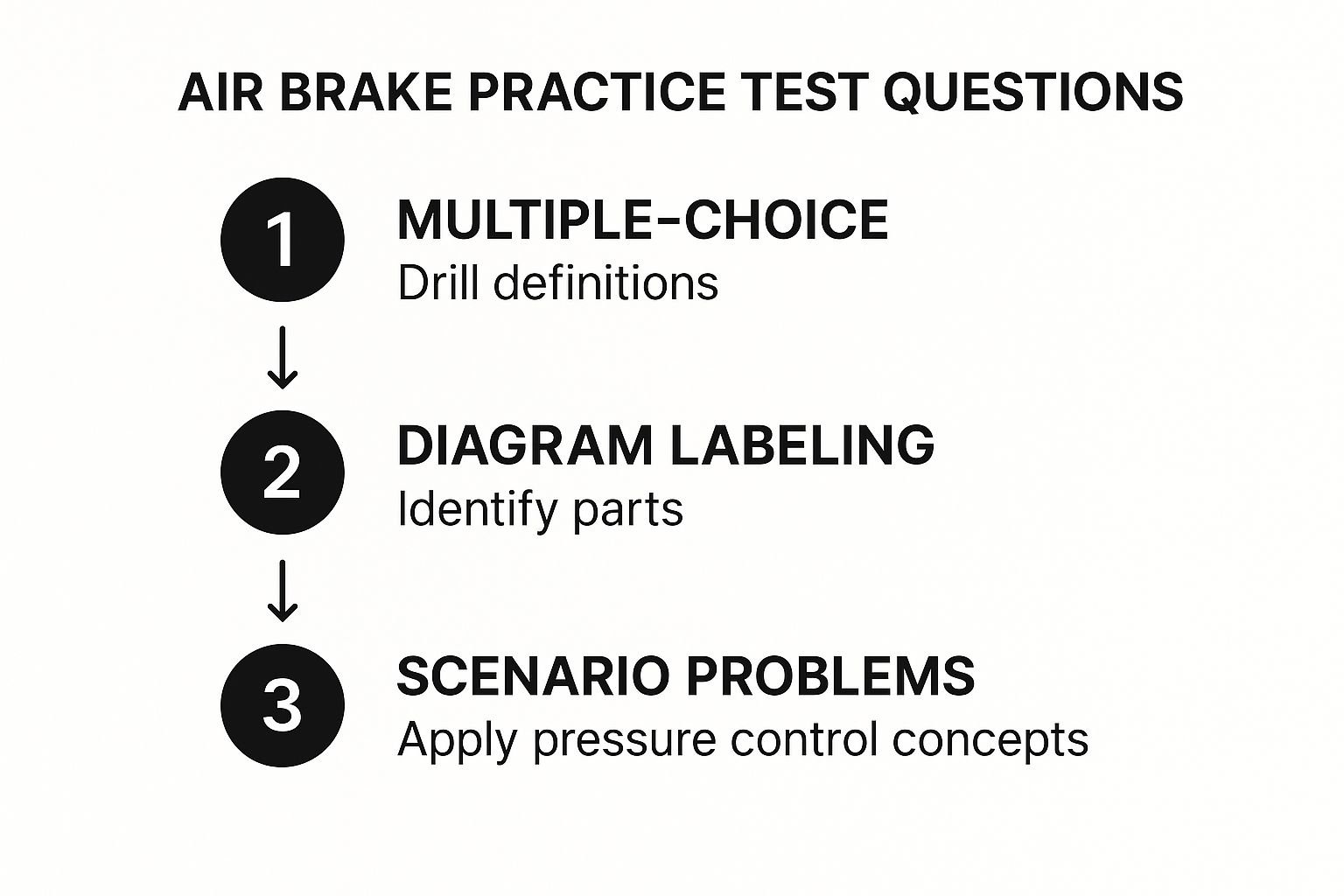
As you can see, success isn't just about knowing definitions. It's about being able to apply those concepts to the real-world scenarios you'll face on the road.
This kind of simulation does more than just test what you know—it trains your nerves. When you finally walk into the testing center, the environment will feel familiar and way less intimidating because you've put yourself through the paces already.
Focusing on Active Learning
The best study sessions are active, not passive. When you get a question wrong, don't just glance at the right answer and move on. Force yourself to explain the concept out loud, in your own words. Why does the air compressor governor cut out at around 125 psi? What are the consequences if it fails to do so?
Don't just memorize the correct answer. Understand the principle behind it. The official exam is designed to test your comprehension, not just your ability to recall facts.
This method forces your brain to truly engage with the material. It’s the difference between temporarily remembering a fact for a test and actually understanding how the air brake system works for the rest of your career. This is just one of many proven strategies for success in high-stakes exams that work just as well for the CDL as they do for any other professional test.
By being more deliberate, you can ensure that every minute you spend with air brakes practice tests is building real, lasting knowledge that will serve you on test day and every day after.
Turning Your Test Results into Real Knowledge

Let's be honest, the most important part of taking any of the air brakes practice tests isn't the final score—it's what you do after you see it. Sure, hitting that 80% mark feels good, but the real learning begins when you dive deep into the questions you got wrong. This is where you transform a simple score into a powerful, personalized study plan.
Don't fall into the trap of just glancing at the right answer and moving on. You have to figure out why you missed it. Was it a simple slip-up, like misreading the question under pressure? Or was it a genuine knowledge gap, maybe confusing the governor cut-in and cut-out pressures? Pinpointing the root cause is the only way to make sure that mistake doesn't show up again on the official exam.
Categorizing Your Mistakes
I’ve found that the best way to analyze your results is to sort your incorrect answers into a few basic categories. This simple framework helps you spot patterns in your performance and tells you exactly where to focus your study time for the biggest impact.
- Knowledge Gaps: These are the big ones—the concepts you just don't know cold. Maybe you couldn't remember the exact psi for the low-pressure warning signal, or you blanked on the proper steps for checking slack adjuster travel.
- Application Errors: This is when you know the rule but can't quite apply it to a real-world scenario. For example, you understand brake fade in theory, but you chose the wrong technique for managing it on a long, steep downgrade.
- Misinterpretation Errors: These are the frustrating ones. You knew the answer but misread the question or one of the choices. It's often a single word, like "not" or "except," that completely flips the meaning.
Once you’ve sorted your mistakes, a clear study priority list practically writes itself. Knowledge gaps should always be at the top, sending you straight back to the relevant section of your CDL manual.
The goal isn't just to see what you got wrong, but to understand the 'why' behind each mistake. This targeted review process is what transforms your study sessions from repetitive quizzing into real learning.
Creating a Targeted Study Plan
Think of your practice test analysis as a blueprint for your next study session. If you see that most of your errors were about the pre-trip inspection, that’s your sign. Go back and re-read that chapter, find a good video explaining the process step-by-step, and then look for another practice test that hits hard on inspection questions.
This approach is about actively patching up your weak spots instead of just passively hoping you’ll remember the right answer next time. To really get the most out of this, it's worth exploring different effective learning assessment strategies to help you measure your own progress accurately.
This strategy is especially critical for drivers trying to remove restrictions from an existing CDL. If that’s you, our specialized E restriction removal course is built around this kind of targeted learning.
By systematically picking apart your performance on air brakes practice tests, you build a rock-solid foundation of knowledge that will stick with you long after you’ve passed the exam and are out on the road.
Before you dive back into studying, it helps to have a clear picture of what the test covers. Here’s a breakdown of the critical topics you'll encounter and where drivers often get tripped up.
Common Air Brake System Knowledge Areas
| System Component/Concept | What You Need to Know | Common Mistake Area |
|---|---|---|
| Air Compressor & Governor | The cut-in and cut-out pressures (~100 psi and ~125 psi). Know its function. | Mixing up the cut-in and cut-out pressure values or their purpose. |
| Brake Drums, Shoes, & Linings | Their role in creating friction; signs of wear and tear; legal lining thickness. | Not knowing the minimum legal thickness (1/4 inch) for brake linings. |
| Foundation Brakes | Components like S-cams, slack adjusters, and pushrods. How to check for proper function. | Incorrectly measuring slack adjuster travel (should not exceed 1 inch). |
| Emergency & Parking Brakes | How the spring brake system works; when and how it activates automatically. | Confusing the function of the service brake system with the spring brake system. |
| Low-Pressure Warning | The pressure range (typically 55-75 psi) when the warning signal must activate. | Forgetting the exact psi range or what to do when the warning comes on. |
| Dual Air Brake Systems | The purpose of having two separate systems (primary and secondary). | Not understanding which system controls which axles. |
Use this table as a checklist during your review. If you see a topic here that makes you hesitate, that's a perfect place to focus your next study session. Getting these core concepts down is your ticket to passing with confidence.
Getting to Know the Air Brake System Inside and Out
Let's be real: trying to memorize answers from air brakes practice tests without understanding the why is a recipe for failure on the real CDL exam. True confidence comes from getting a solid grip on the mechanics behind the questions.
This is where we'll break down the most critical—and often confusing—air brake concepts into plain English. The official exam isn't just about naming a part; it's about knowing how that part functions under pressure in a real-world scenario. You need to internalize the system, not just repeat facts.
The Three Brake Systems
First things first, your truck has three braking systems working together, and mixing them up is a classic mistake. Think of them this way:
- Service Brakes: These are your everyday stoppers. Every time you hit that brake pedal, you're using the service brakes to slow the rig down. Simple as that.
- Parking Brakes: That yellow knob on your dash? That’s for your parking brakes. Pulling it releases air pressure, which lets a set of powerful springs clamp down and hold the truck still.
- Emergency Brakes: This isn't a separate button or pedal. It's a built-in safety net. If your air pressure tanks, those same powerful springs used for parking automatically engage to bring the vehicle to a halt. It’s the system's last line of defense.
Critical Pressure Ranges You Must Know Cold
Air pressure is everything. It's the lifeblood of your braking system, and you can bet the CDL exam will grill you on the numbers. You need to know these figures by heart.
An air brake system needs to maintain pressure somewhere between 85 to 100 psi. If the pressure drops, it should build back up to that range in about 45 seconds.
A warning light or buzzer is designed to go off when pressure dips too low, typically below 60 psi. That's your cue to pull over safely and figure out what’s wrong. If the situation gets critical and pressure plummets to around 20 psi, the spring brakes will engage automatically to stop you.
Mastering these pressure points is non-negotiable. The difference between 100 psi (normal operation) and 60 psi (low-pressure warning) is the difference between a safe stop and a potential disaster.
Connecting the Dots: From Theory to Practice
Knowing the numbers is only half the battle. You have to understand how they apply on the road and during your inspection. This is especially true for the pre-trip inspection, which is more than just a routine—it's a series of safety checks designed to catch a problem before it starts.
When you're testing the system, you aren't just pushing buttons and pulling levers. You're confirming that the compressor, governor, and brake chambers are all communicating and working as they should.
Understanding why you're performing each check is what separates the pros from the rookies. For a deep dive into this, our guide on the pre-trip inspection connects these practical steps to the mechanical systems they verify. This knowledge will prepare you for any curveball the exam throws, whether it’s a question about brake fade on a steep downgrade or identifying a leak during your checks.
Common Questions on the Air Brakes Test
As you get closer to exam day, it’s natural for a few questions to pop into your head. Happens to everyone. Let’s clear the air and knock out some of the most common things students worry about with the air brakes test.
Getting straight answers now helps you lock in your study plan and walk into the DMV ready to go.
How Many Questions Should I Expect
This is always one of the first questions I hear. While it can vary a bit from state to state, you should plan for a test with roughly 25 to 50 multiple-choice questions.
The key thing to remember isn't the exact number of questions, but the score you need to pass. Most states require you to get 80% or better. That doesn't leave much wiggle room, which is why drilling with practice tests is so critical. You can't just squeak by; you have to really know this stuff.
What Topics Are Most Important
You’ll need a solid understanding of the whole system, but some topics definitely get more attention on the exam. If you're trying to figure out where to focus your final study sessions, make sure you've mastered these three areas.
- Component Identification: You have to know the parts inside and out. Be able to name everything from the air compressor and governor to the brake chambers and slack adjusters, and know what each one does.
- The Pre-Trip Inspection: This is huge. Expect questions that make you walk through the entire air brake inspection procedure. They want to see that you know the sequence cold.
- Safe Operation: This covers everything from proper braking on steep downgrades (and how to avoid brake fade) to calculating total stopping distance and reacting correctly to warning lights and buzzers.
Think of it like this: Knowing the components is your foundation. The pre-trip inspection is the structure you build on that foundation. And safe operation is the roof that ties it all together. You need all three to pass.
Are Online Practice Tests Realistic
The quality of online air brakes practice tests is all over the map, but the good ones are incredibly accurate. A great practice test doesn’t just ask you questions; it mirrors the exact format, tricky wording, and real-world scenarios you’ll see on the official DMV exam.
Always hunt for practice tests based on the current year’s CDL manual. Most importantly, find resources that give you detailed explanations for every single answer—not just the ones you get wrong. Knowing you missed a question is useless. Understanding why you missed it is how you actually learn and make sure it doesn't happen again.
Do I Absolutely Need the Endorsement
Technically, no. You can get a CDL with an "L" restriction, which means you can't drive any vehicle with air brakes. But let me be blunt: going that route will seriously hamstring your career.
The overwhelming majority of Class A and Class B trucks out there are equipped with air brakes. Without that endorsement, you're immediately disqualified from most of the jobs on the market. You can read up on all the complete CDL requirements to see the full picture.
Bottom line: If you're serious about a career in trucking, the air brakes endorsement isn't optional. It's essential.
Ready to stop practicing and start your professional driving career? Patriot CDL offers accelerated, hands-on training to get you on the road fast. Learn more at https://patriotcdl.com.