A Class B CDL is your ticket to a solid, dependable career driving the vehicles that keep our communities running—think straight trucks, buses, and cement mixers. This license opens the door to a ton of local and regional jobs that often get you home every night, which is a huge plus for work-life balance.
Getting Started in Commercial Driving
Earning your Class B commercial driver's license isn't just about passing a test; it's a smart career move into an industry that's always hiring. Unlike a Class A license, which is all about long-haul trucking, a Class B is perfect for drivers who want to stick closer to home. It's a path that offers stability, good pay, and the chance to operate some seriously cool heavy equipment.
From dump trucks on a construction site to city buses running their daily routes, Class B drivers are the lifeblood of local economies. The whole process, from making sure you're eligible to nailing your final road test, is a clear, step-by-step progression. This guide will lay out the complete roadmap so you feel confident and ready to go.
Your Path to a Class B License
The road to getting your license really boils down to three main stages: checking your eligibility, getting prepared, and finally, the hands-on training. Each step builds on the one before it, making sure you have the knowledge and the practical skills to succeed.
This chart gives you a bird's-eye view of the entire Class B CDL journey.
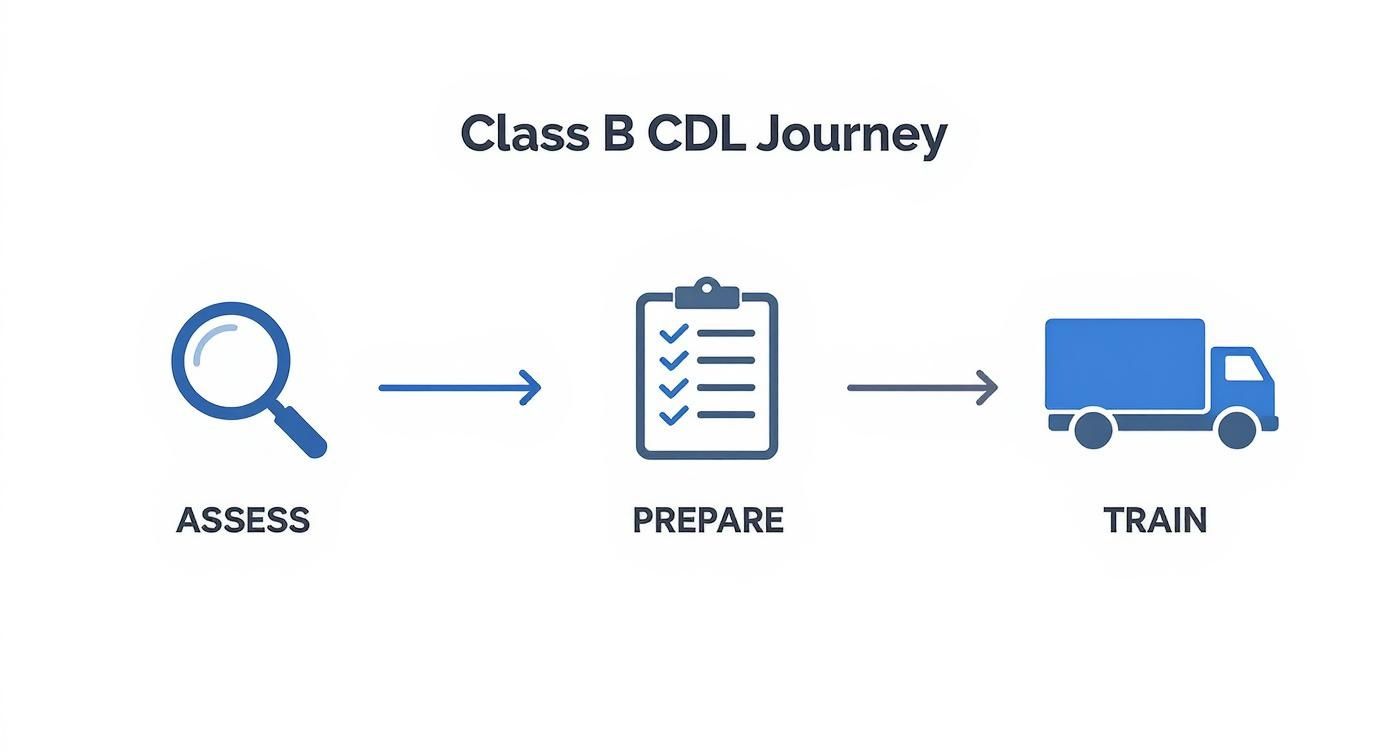
As you can see, foundational steps like confirming you meet the requirements and studying for your permit are what set you up for success when you finally get behind the wheel.
A Look at the Job Market
The demand for qualified Class B drivers has always been strong, which means a stable job market for people with the right license. There are over 661,446 Class B drivers currently employed in the United States, so this is a massive and essential profession.
While the industry has historically been male-dominated (90.1%), we're seeing more and more women get behind the wheel, now making up 9.9% of drivers.
The job security is real. The unemployment rate for Class B drivers shows just how resilient this field is, dipping to a low of 3.45% in 2019 and holding steady around 5.44% in 2021, even as the economy shifted. This stability makes class b cdl training a pretty solid investment in your future.
This constant need for drivers in construction, local delivery, and public transit means your new license is a key to long-term career security. Ready to get started? You can check out the program details and sign up for CDL training to take that first step.
Navigating Prerequisites and Securing Your Permit
Before you can even think about getting behind the wheel of a dump truck or city bus, there’s some foundational work to do. This first phase is all about proving you meet the basic standards and getting the key that unlocks your hands-on training: the Commercial Learner’s Permit (CLP).
The first hurdle is a simple one: your age. The federal rule is that you must be at least 18 years old to drive a commercial vehicle within your home state (intrastate). If you plan on crossing state lines (interstate), you’ll need to be 21. There's no getting around this.
Meeting the Initial Requirements
Once you've got the age requirement squared away, it’s time to gather your documents and pass a medical exam. I know it can feel like a lot of paperwork, but it's all in place to ensure every driver on the road is physically capable of handling their vehicle safely.
Here's a quick rundown of what you'll need to pull together:
- Proof of Residency: A recent utility bill or a lease agreement usually does the trick.
- Social Security Card: Make sure you have your original card, not a copy.
- Valid Driver's License: You need a standard, non-commercial license from the state you're applying in.
- Driving Record Check: The DMV will pull your driving history to check for any red flags or disqualifying offenses.
The Department of Transportation (DOT) physical is a big step. A certified medical examiner will check your vision, hearing, blood pressure, and overall fitness. They're making sure you're healthy enough to safely operate a large truck for long hours.
Getting through these initial checks shows you’re a serious candidate. For a really detailed look at everything involved, you can learn more about the complete list of CDL requirements to make sure you don't miss a thing.
Securing Your Commercial Learner's Permit
With your paperwork and DOT medical card in hand, the next target is your Commercial Learner's Permit (CLP). Think of the CLP as your ticket to start practicing on public roads, provided you have a licensed CDL holder sitting right there with you.
To get that permit, you have to pass a few written exams at the DMV. For a Class B license, you can count on facing these:
- The General Knowledge Test: This covers all the essentials—rules of the road, basic safety, and vehicle control.
- The Air Brakes Test: This one is non-negotiable. Most Class B vehicles use air brakes, and they're a whole different animal than the brakes in your car.
- The Combination Vehicles Test (Sometimes): While this is more of a Class A thing, some states might require it for certain Class B setups, so it’s good to be prepared.
Don’t just wing these tests. Seriously, study for them. The state CDL manual is your best friend here. Run through practice tests until you’re confident you understand things like proper braking distances and the pre-trip inspection process. Passing these on your first go saves you time and money, and gets you that much closer to starting your career.
Choosing the Right CDL Training Program
Picking where you get your Class B CDL training is easily one of the most critical decisions you'll make on this journey. A solid program can set you up for a long, successful career, while a subpar one can leave you feeling unprepared and struggling to find your footing. The quality of the instruction, the trucks you train on, and the overall support system make all the difference in your confidence and job prospects.
With a constant demand for qualified drivers, the truck driving school industry is booming. In 2024 alone, the market in the U.S. pulled in $509.8 million in revenue, marking a 1.5% growth over the last five years. This growth means you have more choices than ever, which is great, but it also means you need to do your homework.
What Makes a Quality School Stand Out?
Don't just listen to the sales pitch. When you visit a potential school, you need to be an investigator. The little details tell the real story.
One of the first things to ask about is their instructor-to-student ratio. You need quality one-on-one time behind the wheel, not just standing around watching other people drive. Then, take a walk around and look at their training fleet. Are the trucks well-maintained? Do they look like the vehicles you'll actually be operating on the job? A school that invests in modern, reliable equipment is a school that invests in its students' success.
Before you commit, make sure you get clear answers to these questions:
- How much real behind-the-wheel time is guaranteed? Don't settle for vague answers. You want a specific number of hours.
- What kind of job placement assistance do you offer? A good school will have strong ties to local employers and a track record of helping graduates land good jobs, not just handing you a list of websites.
- Is your curriculum fully compliant with the latest ELDT regulations? All training must meet the current federal Entry-Level Driver Training (ELDT) standards. No exceptions.
A top-tier training program does more than just teach you how to pass the test. It prepares you for the reality of the road, focusing on crucial skills like defensive driving, basic vehicle maintenance, and how to handle the unexpected.
Comparing Your Training Options
As you start your search, you'll see a few different paths you can take to get your license. The most common are private trucking schools, community college programs, and sometimes, training sponsored directly by a trucking company. Each has its pros and cons.
Here’s a quick breakdown to help you see how they stack up against each other.
Comparing Class B CDL Training Program Types
| Feature | Private Trucking School | Community College Program | Company-Sponsored Training |
|---|---|---|---|
| Program Length | Accelerated; often 2-6 weeks | Longer; typically a full semester (10-16 weeks) | Varies; often fast-paced (3-4 weeks) |
| Cost | Typically higher upfront, ranging from $3,000 to $5,000+ | Often more affordable, with financial aid options | Low or no upfront cost, but requires a work contract |
| Schedule | Full-time, intensive schedules with day/night options | More structured, part-time or full-time academic schedule | Very intensive, full-time commitment is usually required |
| Job Placement | Strong industry connections and active placement help | Career services available, but may be less specialized | Guaranteed job upon completion, but with one company |
| Flexibility | High flexibility with frequent start dates | Less flexible, follows a traditional academic calendar | Very little flexibility; you train and work for them |
Private schools are a fantastic option if you're eager to get on the road quickly. They often offer accelerated programs that can get you licensed and ready to work in just a few weeks. If that sounds like the right speed for you, it's worth exploring a complete CDL training program to see what's involved.
On the other hand, community colleges offer a more traditional academic pace. Their programs might be more affordable and dig deeper into the classroom side of things, but they'll take longer to complete. Ultimately, you need to weigh your personal timeline, budget, and how you learn best. Don't be afraid to ask about payment plans, grants, or other financing options that can make the investment a little easier to handle.
Mastering the Classroom and the Road
Getting your Class B CDL isn't just about learning to drive a big truck. It’s a two-part journey: you first build the foundation in the classroom, then you bring that knowledge to life behind the wheel. You absolutely can't have one without the other. Think of it this way—you have to understand why the rules exist before you can properly and safely execute maneuvers on the road.
This combined approach is what separates a professional driver from someone who just steers the vehicle. The classroom time is where you dig into complex vehicle systems and the federal regulations that keep everyone safe out there.
Building Your Foundation in the Classroom
Before you even think about starting the engine, you’ll spend some serious time getting the essential concepts of commercial driving down pat. This isn't just about cramming for a test; it’s about genuinely understanding the machine you're about to command and the laws that govern it.
You'll find the curriculum is packed with mission-critical information.
- Air Brake Systems: You'll get to know every component and procedure for testing and using air brakes. These are a completely different animal compared to the hydraulic brakes in your personal car.
- Vehicle Inspections: Get ready to master the pre-trip, en-route, and post-trip inspection process. A meticulous inspection is your absolute best defense against a breakdown on the highway.
- Hours-of-Service (HOS) Rules: You'll need to know exactly how to log your driving and rest time to comply with federal rules designed to keep tired drivers off the road.
- Safety Regulations: This is a broad but vital category, covering everything from securing your cargo to defensive driving tactics and handling emergencies.
For a lot of students, the biggest hurdle is getting ready for those written exams. If you feel like you could use a little extra help, our in-depth guide on passing the CDL general knowledge test is loaded with solid strategies.
Taking Your Knowledge to the Pavement
Once you've got the theory locked in, it's time for the fun part. The behind-the-wheel portion of your training is where it all clicks and your confidence really starts to soar. An instructor will take you from the very basics in a controlled, empty lot all the way to navigating the chaos of real-world traffic.
At first, the focus is purely on vehicle control. You'll log plenty of hours on the fundamentals until they feel like second nature.
- Straight-Line Backing: It’s the most basic backing maneuver, but you have to nail it to build proper control.
- Offset Backing: This is where you learn to back into a space that isn't directly behind you—a situation you’ll face constantly.
- Alley Docking: This simulates backing up to a loading dock, which is arguably one of the most important skills you’ll ever learn as a commercial driver.
An old-timer once gave me the best advice on backing: "Don't fight the trailer; guide it. Look where you want the trailer to go, not at your truck." That one little tip completely changes your perspective, turning you from someone who reacts to the truck into someone who proactively directs the trailer.
As you get better, you’ll graduate to public roads, learning to handle city streets, busy intersections, and highway driving. This is where all that classroom theory about speed management and spotting hazards comes alive.
There's a reason quality training programs work. Just look at the numbers from a place like U.S. Truck Driver Training School: in 2023, 97% of their students finished the program on time. Plus, with a student loan default rate of just 1.75%, it's clear that graduates are getting a strong return on their investment.
How to Pass Your CDL Skills Test
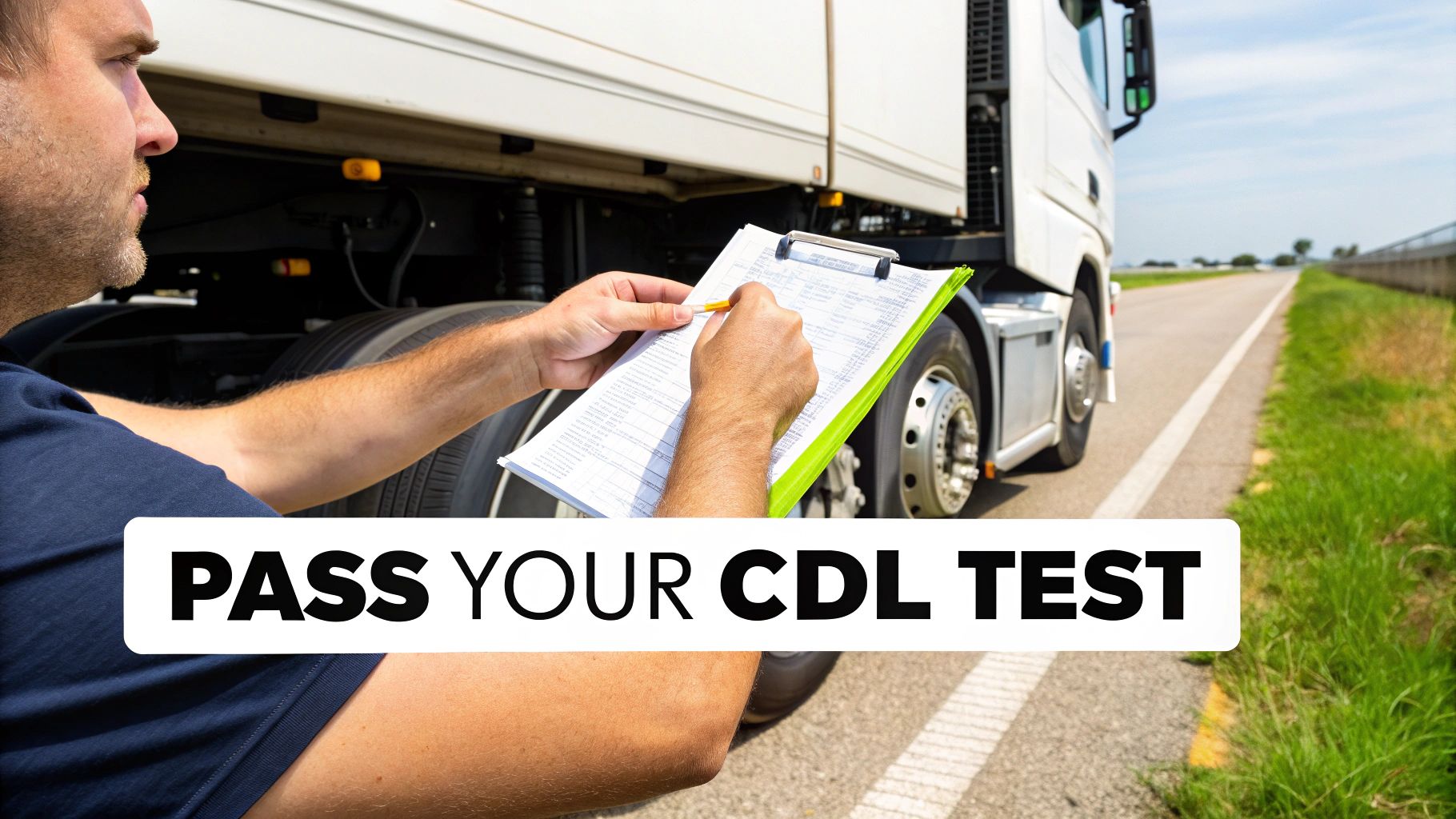
This is it. The final skills test is the last major hurdle between you and that Class B CDL. It’s where all the book smarts and hours behind the wheel get put to the test, with an examiner watching your every move. The test is broken down into three distinct parts, and you have to nail all of them to walk away with your license.
Feeling nervous is completely normal. The best way to beat those nerves is with solid preparation. The whole point of the exam is to prove you can handle a large vehicle safely and by the book. Knowing exactly what's coming will give you the confidence to perform when it counts.
Mastering the Pre-Trip Vehicle Inspection
First up is the pre-trip inspection. This is way more than just pointing at parts of the truck. You need to show the examiner you have a system and can explain why each component is critical for safety. They need to see that you actually understand what you're checking.
Forget just memorizing a list. The real pros develop a routine they can follow in their sleep. A great method is to start at the front bumper, work your way down the driver's side, circle around the back, and come up the passenger's side. This way, you physically can't miss anything important, like worn tire treads, cracked brake lines, or low fluid levels. For a rock-solid checklist, our guide to the CDL pre-trip inspection is an excellent resource to study.
Executing Basic Control Skills Flawlessly
After you pass the inspection, you’ll head to the "yard skills" or basic controls test. This part takes place on a closed course, far away from public roads, where you’ll be asked to perform a series of specific backing and parking maneuvers. It's all about demonstrating precise control over your vehicle.
You can almost always expect to be tested on these core skills:
- Straight-Line Backing: The foundation of all backing skills. You'll need to back your truck in a perfectly straight line without veering off course.
- Offset Backing: This simulates changing lanes in reverse. You’ll have to back the truck into a lane that’s slightly to the right or left of your starting point.
- Alley Docking: Just like it sounds, this tests your ability to back into a tight space, as if you were pulling up to a loading dock.
The secret to acing these maneuvers is to go slow. Slow, deliberate movements and constant checks of your mirrors are your best friends. Don’t be afraid to make tiny, corrective steering adjustments along the way. Rushing is how you make mistakes and lose points.
Excelling on the Road Test
The last piece of the puzzle is the road test itself. An examiner will ride shotgun as you navigate a specific route designed to include a mix of real-world driving scenarios—intersections, highways, tight turns, and urban traffic. They aren't just making sure you can stay in your lane; they’re evaluating your overall command of the truck and your defensive driving instincts.
Focus on being smooth with your acceleration and braking. Proper gear shifting and keeping a safe following distance are huge. Examiners pay close attention to how you handle turns, watching to see if you cut corners or swing too wide into other lanes.
Keep your cool, use your signals early, and never stop scanning your surroundings for potential hazards. This is your moment to prove you're not just a driver—you're a professional who's ready for the road.
Got Questions About Class B Training? We’ve Got Answers.
If you're thinking about getting your Class B CDL, you probably have a lot on your mind. That's completely normal. Getting straight answers helps you plan your next steps and feel confident you're making the right move.
Let's break down some of the most common questions we hear from new drivers.
How Long Will It Take to Get My Class B License?
One of the biggest advantages of going for a Class B license is how quickly you can get through the training. It’s a much faster track than the Class A route.
Most full-time programs will have you ready for your test in just a few weeks. You should plan for a commitment of roughly three to six weeks. Why the shorter timeframe? Because you’re focused on mastering single-unit vehicles—like dump trucks or box trucks—which are less complex than the massive tractor-trailers in Class A training. The entire process is designed to get you skilled and on the road earning a paycheck, fast.
What’s the Typical Cost for Class B School?
Financially, getting a Class B CDL is a much more accessible goal. While the final price tag always depends on the school you choose and where you're located, there's a general ballpark you can expect.
A quality Class B training program will typically run you between $3,000 and $5,000. This usually includes your classroom time, all your hours behind the wheel, and the use of the school's truck for your final exam.
My advice? Always ask for an itemized cost sheet before you sign anything. You'll want to know if there are extra fees for your DOT physical, permit applications, or state licensing. No one likes financial surprises.
If I Get a Class B, Can I Drive a Tractor-Trailer?
This is a really common question, and the answer is a firm "no." A Class B license has specific limitations. It qualifies you to operate single vehicles with a gross vehicle weight rating (GVWR) of 26,001 pounds or more.
Here's a simple breakdown:
- Class B License: Perfect for straight trucks, buses, dump trucks, and delivery box trucks.
- Class A License: This is what you need for combination vehicles, like a semi-truck pulling a trailer.
Think of it this way: a Class A license is the top tier and allows you to drive Class B (and C) vehicles, but it doesn't work the other way around. If you start with a Class B and later decide you want to hit the open road in a big rig, you'll have to go back for upgrade training.
At Patriot CDL, we provide the focused, hands-on training you need to start your driving career quickly and confidently. Explore our programs and get on the road to success. Learn more at https://patriotcdl.com.