
Before you even think about hitting the road with thousands of gallons of liquid sloshing behind you, you’ve got to prove you know what you’re doing. That proof starts with acing the written tanker endorsement test.
The test usually has around 20 multiple-choice questions. To get a passing grade, you need to nail at least 80% of them, which means getting 16 questions right. This isn't just about memorizing rules from a book; it’s about showing you truly understand the unique physics and dangers of hauling liquid cargo.
Your First Step to Passing the Tanker Endorsement Exam
Getting your tanker endorsement—the "N" on your CDL—is a game-changer. It unlocks the door to specialized, higher-paying gigs hauling everything from milk and fuel to industrial chemicals. But first, you have to pass that written knowledge test.
Think about it: a standard trailer is filled with solid, predictable cargo. A tanker is a whole different beast. The liquid inside is a living, moving force that can dramatically affect your truck’s stability. That's why the test hammers home concepts that might feel completely new, even for seasoned drivers. The absolute best way to get a feel for these questions is by working through a solid cdl tanker practice test. It’ll quickly show you what you know and, more importantly, what you don't.
Core Topics You Must Master
The official exam is built to test you on a few critical areas. Your study time should be focused on the "why" behind the rules, not just the rules themselves.
Here’s what you absolutely need to get down:
- Managing Liquid Surge: This is the big one. We're talking about that powerful sloshing motion in a half-empty tank that can shove your truck around without warning.
- High Center of Gravity: Tankers are famously top-heavy. This makes them much more likely to roll over, especially when you're navigating curves or on-ramps.
- Vehicle Inspection: You need to know the unique parts of a tanker like the back of your hand—valves, pipes, emergency shut-offs, the whole nine yards.
- Safe Driving Rules: This covers everything from braking correctly to calculating stopping distances, which are way longer when you have all that liquid momentum behind you.
A tanker truck is one of the most challenging commercial vehicles to operate safely. The constant movement of liquid cargo requires a level of skill and awareness that goes far beyond standard truck driving. Mastering these principles is essential for both passing the test and ensuring safety on the road.
Understanding the Test Structure
So, who needs this endorsement? The rule is pretty clear: if you’re transporting liquids in a tank vehicle with an individual capacity over 119 gallons, or a combined total of over 1,000 gallons, you need the "N" endorsement. The test is designed to make sure that anyone behind the wheel of one of these rigs has a deep understanding of the risks involved.
Let's break down the key details of the exam.
CDL Tanker Endorsement Test At a Glance
| Test Component | Typical Requirement | What It Means for You |
|---|---|---|
| Question Format | Multiple-Choice | No essay questions, but you'll need to pick the best answer from several options. |
| Number of Questions | 20 Questions | A relatively short test, but each question carries significant weight. |
| Passing Score | 80% (16 correct) | You have a very slim margin for error. Just four wrong answers and you fail. |
| Key Subjects Covered | Surge, High Center of Gravity, Vehicle Inspections, Safe Driving Rules | Focus your study time here. These are the core concepts that matter most. |
This table gives you a clear snapshot of what to expect on test day. Knowing the format and passing requirements helps you prepare mentally and strategically.
Getting a solid foundation is the key to it all. A comprehensive CDL training program will build that knowledge from the ground up, giving you the confidence you need to pass the test and launch a successful career in a critical part of the trucking industry.
Getting a Feel for Tanker Dynamics
To ace your tanker endorsement test, you need to go beyond just memorizing facts. You have to really understand the physics happening in the tank right behind your head. This is what makes a true professional—knowing why a tanker behaves the way it does, not just guessing at the answers on a test.
The single most important concept to wrap your head around is liquid surge. Think about carrying a shallow pan full of water. Every time you speed up, slow down, or take a corner, that water sloshes around, right? Now imagine that on a massive scale, with thousands of gallons of liquid. That "slosh" is a powerful force that can literally shove your truck forward when you brake or try to pull it backward when you accelerate.
This infographic lays out what you can expect on the test, giving you a clear roadmap of the knowledge areas you'll need to master.
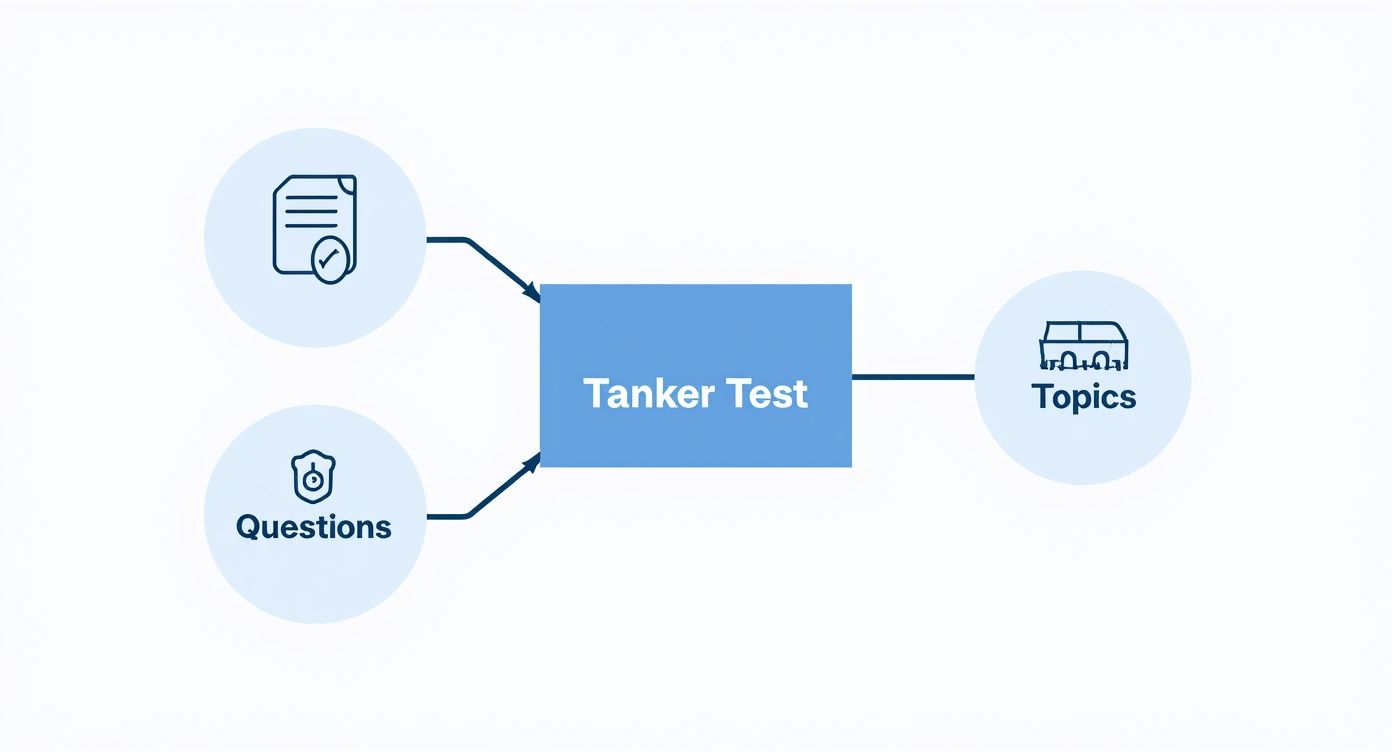
As you can see, the test isn't just one big block of information; it’s a combination of different topics, question types, and scoring requirements that all tie together.
The Real Dangers of Liquid Surge
Liquid surge isn't just some textbook term; it's a major reason tankers roll over. When you hit the brakes, the forward surge can actually push you right into an intersection. When you accelerate, the backward surge can kill your momentum. But the most dangerous of all is the side-to-side surge you get in a turn—it can easily tip a top-heavy rig right over.
Tanker design has come a long way to help manage these forces:
- Baffled Tanks: These have walls inside with holes in them. They’re great for slowing down the front-to-back movement of the liquid, but they do nothing for side-to-side surge. You still have to take those corners with extreme care.
- Smooth Bore Tanks: Also called "un-baffled" tanks, these are basically just one big open compartment inside. You'll often see them hauling food-grade liquids that need easy cleaning. The downside? You feel the full, raw power of liquid surge.
- Bulkheads: These are solid walls that divide the tank into several smaller, separate compartments. Each section acts like its own mini-tank.
Knowing exactly what kind of tank you're pulling is critical. A smooth bore tanker handles completely differently from a baffled one, and you'll need to adjust your driving accordingly. The skills for managing these forces go far beyond what you'd learn for a standard general knowledge test.
Why "Outage" Is a Hard and Fast Safety Rule
Another key concept is outage, sometimes called ullage. Simply put, this is the empty space you intentionally leave at the top of the tank when loading. It might look like you're not hauling a full load, but that space is one of the most important safety features you have.
Outage is absolutely necessary to give the liquid room to expand. When liquids get warmer, their volume increases. Without that empty space, the pressure inside the tank could build up to the point of rupturing the tank shell—a complete disaster.
Transporting liquids in a tanker is serious business and requires top-notch training. In the U.S., the CDL tanker test usually has 20 questions, and you need an 80% score to pass. This isn't arbitrary; it ensures drivers can handle the unique risks of hauling over 1,000 gallons of everything from gasoline to milk.
You never, ever fill a tanker to the brim. The specific amount of outage needed will depend on the liquid you’re carrying and how much it expands with temperature changes. Forgetting to leave enough outage isn't just a simple mistake; it's a major safety violation that puts everyone on the road in danger. Truly understanding these dynamics is your key to passing the exam and becoming a safe, professional tanker driver.
Essential Pre-Trip Inspections for Tanker Vehicles
Every safe haul starts well before you ever turn the key. While you're already familiar with a standard commercial vehicle inspection, tankers are a different breed entirely. They demand a far more detailed and rigorous check because of their unique components and the massive forces at play. A small oversight on a tanker isn't a minor issue; it can escalate into a major disaster on the road.
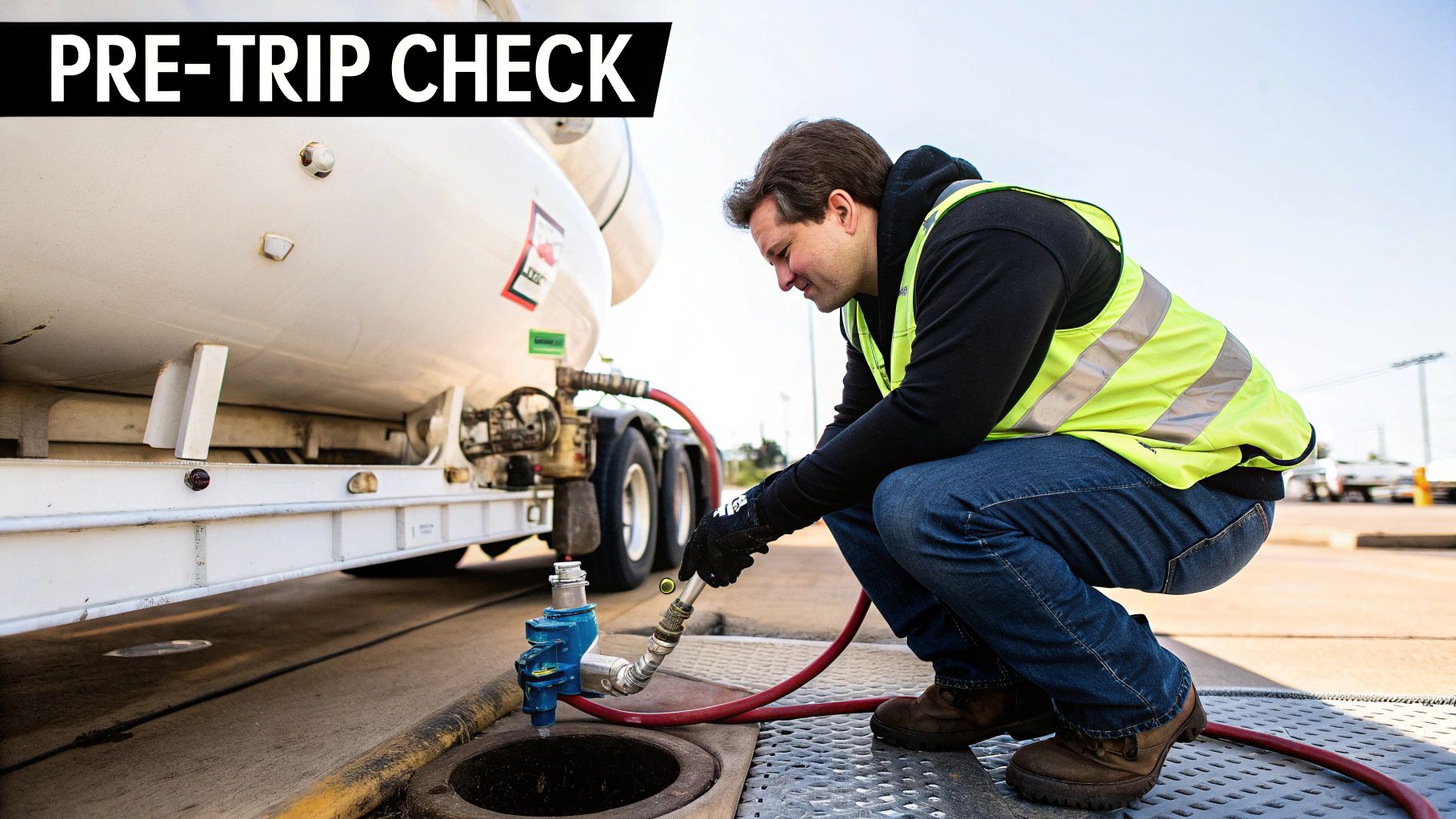
Your pre-trip inspection on a tanker needs to zoom in on the container itself. This isn't just a big metal box. It’s a complex system built to contain thousands of gallons of liquid, which might be hazardous. That means you have to be meticulous, checking every single valve, pipe, and seal like your life depends on it—because it does.
Beyond the Basics of Tanker Checks
When you walk up to a tanker, you need to switch your brain into a different gear. You're hunting for problems specific to hauling liquid, a critical skill you'll see hammered home on any good tanker endorsement practice test.
Your specialized checklist has to include:
- Valves, Pipes, and Hoses: Get up close and personal with every connection. You're looking for any sign of a leak. Even a tiny drip can signal a failing seal that’s about to give way under pressure.
- Manhole Covers: Don't just check that the covers are closed. You need to make sure they are securely latched and sealed tight. A loose cover can cause a spill or a dangerous pressure shift inside the tank.
- Emergency Shut-Off Systems: Test them all. The ones on the tanker, the one in the cab—every single one. You have to be absolutely certain you can stop the flow of product in a heartbeat if things go wrong.
Think of the tanker shell as the vehicle's heart. A failure here isn't like a flat tire; it's a catastrophic event. Your inspection is the first and most important line of defense against such failures.
It's no surprise that the bar is set high for getting this endorsement. Analysis of tanker practice tests shows a consistent standard: you need to correctly answer 80% of questions to pass. This isn't just a random number; it's the score required in many states to prove you grasp the unique dangers of these vehicles. The questions rightly focus on the big three: sloshing liquids (surge), the high center of gravity, and those much longer stopping distances.
Managing a High Center of Gravity
Once your inspection is done and you're ready to roll, your driving technique has to adapt. The single biggest difference between driving a tanker and a dry van is its high center of gravity. The tank's cylindrical shape puts the bulk of the weight way up high, making these rigs dangerously prone to rollovers.
This instability is at its worst on curves, highway ramps, and any kind of uneven road. You absolutely must slow down much more than you would in a standard truck before you even think about entering a turn. Smooth, deliberate movements are key. Any sudden jerk of the steering wheel can amplify the liquid surge and send you tipping over.
Knowing about common vehicle brake problems is crucial during any pre-trip, but it's even more vital for a tanker. Your stopping distances are already much longer because of the liquid's momentum, so your brakes have to be in perfect working order.
Finally, never forget about that liquid surge. It creates a powerful push-and-pull force that you can feel in the cab. You'll need a much longer stopping distance than you're used to, so keep a generous following distance at all times. Smooth braking and acceleration aren't just suggestions—they are non-negotiable rules for keeping that liquid surge under control.
For a deeper dive into the foundational checks for any commercial vehicle, check out our guide on the complete pre-trip inspection checklist.
Full CDL Tanker Practice Test and Answer Key
Alright, this is where the rubber meets the road. Reading about tanker dynamics and inspection points is one thing, but applying that knowledge when it counts is a whole different ball game. To help you make that leap, we’ve put together a comprehensive, 20-question cdl tanker practice test.
This isn't just a random assortment of questions. We designed each one to mirror the format, difficulty, and topics you'll face on the real DMV exam. It’s built to challenge your understanding of liquid surge, handling a vehicle with a high center of gravity, inspection must-dos, and emergency protocols.
After you've given it your best shot, you’ll find a detailed answer key. We don't just give you the right letter; we break down the "why" behind each answer. This helps solidify what you know and shines a light on any areas you might need to review.

Tanker Endorsement Practice Test
Take your time and read each question carefully. Treat this like the real deal—it's the best way to get an honest look at where you stand.
1. The primary danger associated with smooth bore tankers is:
a) They are more difficult to clean.
b) The uninhibited movement of liquid surge.
c) They are heavier than baffled tanks.
d) They cannot carry food-grade products.
2. What is the main purpose of baffles in a tanker?
a) To separate different types of liquid.
b) To strengthen the tank shell.
c) To slow down the front-to-back surge of the liquid.
d) To measure the amount of liquid in the tank.
3. When driving a tanker, your stopping distance will likely be:
a) Shorter due to the weight.
b) The same as a standard dry van.
c) Longer, especially with a partially full tank.
d) Shorter on wet roads.
4. "Outage" or "ullage" refers to:
a) A leak in the tank's piping.
b) The empty space left in a tank to allow for liquid expansion.
c) The emergency shut-off valve.
d) The total capacity of the tank.
5. A tanker with a high center of gravity is most likely to roll over when:
a) Driving on a straight, flat highway.
b) Going too fast around a curve or on-ramp.
c) Backing up in a straight line.
d) The tank is completely full.
6. When inspecting a tanker, you should pay special attention to:
a) The color of the paint.
b) The tire pressure only.
c) The engine oil level.
d) Valves, pipes, and all connections for leaks.
7. If you are driving a smooth bore tanker and need to make a quick stop, you should be prepared for:
a) The vehicle to pull to the right.
b) The liquid surge to push the vehicle forward.
c) The engine to stall.
d) The brakes to lock up easily.
8. When must you have a tanker endorsement?
a) When hauling any liquid, regardless of amount.
b) For any tank vehicle with an individual capacity of more than 119 gallons or a combined total of over 1,000 gallons.
c) Only when hauling hazardous materials.
d) For any vehicle with a cylindrical tank.
9. Baffles do NOT prevent what kind of liquid movement?
a) Forward surge.
b) Backward surge.
c) Side-to-side surge.
d) Up-and-down movement.
10. When loading a tanker with bulkheads, you should be careful not to:
a) Load the front and rear compartments first.
b) Load the middle compartments only.
c) Distribute the weight unevenly.
d) Fill any compartment completely.
11. The best way to take a curve in a tanker is to:
a) Accelerate through the curve.
b) Brake hard while in the curve.
c) Slow down to a safe speed before entering the curve, then accelerate gently through it.
d) Maintain your highway speed.
12. Liquid surge effects are most noticeable in a:
a) Fully loaded tank.
b) Tank with multiple compartments.
c) Partially loaded smooth bore tank.
d) Completely empty tank.
13. What is the function of a tanker's emergency shut-off system?
a) To shut down the truck's engine.
b) To apply the emergency brakes.
c) To quickly stop the flow of liquid from the tank.
d) To automatically call for help in an accident.
14. Forward surge can:
a) Help you stop faster.
b) Push your truck into an intersection if you stop suddenly.
c) Improve your vehicle's traction.
d) Make the steering lighter.
15. When driving a tanker, you should increase your following distance because:
a) You need more room to see around the tank.
b) Tankers are wider than other trucks.
c) Your stopping distance is longer.
d) It is required by law only in bad weather.
16. The term for the sloshing motion of liquid in a tank is:
a) Outage.
b) Baffling.
c) Surge.
d) Head rush.
17. Why must you be extra cautious on banked curves or on/off-ramps?
a) The high center of gravity increases the risk of a rollover.
b) These roads are often poorly maintained.
c) The liquid will get hotter.
d) Your radio signal will be weaker.
18. Which of these is a key difference between a baffled tank and a smooth bore tank?
a) Baffled tanks can carry more liquid.
b) Smooth bore tanks are only for non-hazardous materials.
c) Baffled tanks reduce front-to-back surge but not side-to-side surge.
d) Smooth bore tanks never experience surge.
19. When you unload the smaller compartments of a tank with bulkheads, what happens to your center of gravity?
a) It gets lower.
b) It stays the same.
c) It rises.
d) It shifts to the front.
20. A smooth, controlled stop is important with a tanker because:
a) It saves fuel.
b) It prevents wear and tear on the tires.
c) A hard stop can cause a powerful forward surge.
d) It is quieter for other drivers.
Answer Key and Explanations
Okay, let's see how you did. Remember, the real win here is understanding why an answer is correct, not just memorizing the letter.
Key Takeaway: You'll notice three themes pop up again and again: liquid surge, high center of gravity, and longer stopping distances. If you can get a solid grip on these three concepts, you're in great shape for the real exam.
B: The uninhibited movement of liquid surge. A smooth bore tank is just a big, open tube. With nothing inside to slow the liquid down, it can create some seriously powerful forces that can push your truck around.
C: To slow down the front-to-back surge of the liquid. Baffles are like walls with holes in them. They don't stop the liquid completely, but they disrupt its momentum, making the truck much more stable during stops and starts.
C: Longer, especially with a partially full tank. The momentum from thousands of pounds of sloshing liquid will literally push your truck forward as you try to brake, adding precious feet to your stopping distance.
B: The empty space left in a tank to allow for liquid expansion. This is a huge safety deal. As liquids warm up, they expand. "Outage" gives that liquid a place to go so it doesn't build up dangerous pressure and rupture the tank.
B: Going too fast around a curve or on-ramp. Speed is the enemy of a high center of gravity. Combine that with liquid sloshing to the side, and you've created the perfect recipe for a rollover.
D: Valves, pipes, and all connections for leaks. While a full pre-trip is always necessary, the most unique and critical danger of a tanker is the potential for a leak. Always check your connections.
B: The liquid surge to push the vehicle forward. In a smooth bore, that liquid has a long, clear runway. When you hit the brakes, the full force of that cargo slams into the front of the tank, giving you a powerful shove.
B: For any tank vehicle with an individual capacity of more than 119 gallons or a combined total of over 1,000 gallons. These are the specific numbers from the federal regulations. You need to know them cold.
C: Side-to-side surge. Baffles run across the width of the tank, so they're great at stopping front-to-back motion. But they do nothing to stop liquid from sloshing side-to-side in a turn.
C: Distribute the weight unevenly. Just like in a dry van, imbalanced weight makes for an unstable and unpredictable vehicle. Proper weight distribution is critical.
C: Slow down to a safe speed before entering the curve, then accelerate gently through it. This is the golden rule for any heavy vehicle, but it's especially true for tankers. Get your braking done before the turn to keep the truck stable.
C: Partially loaded smooth bore tank. This is the worst-case scenario for surge. You have a lot of heavy liquid with plenty of room to move, and absolutely nothing inside the tank to slow it down.
C: To quickly stop the flow of liquid from the tank. Think of it as a kill switch for the cargo. If a hose breaks or a leak appears during transfer, this system can prevent a small problem from becoming a disaster.
B: Push your truck into an intersection if you stop suddenly. It's a classic rookie mistake. You stop perfectly at the line, but a second later, the forward surge shoves you right out into cross-traffic.
C: Your stopping distance is longer. Plain and simple. You have to give yourself a bigger buffer zone to account for the extra push from the liquid and the overall weight of the vehicle. For many drivers, it takes a whole new mindset, similar to when they first had to master the CDL air brakes test.
C: Surge. This is the official term for that sloshing movement. You'll see it all over the official test.
A: The high center of gravity increases the risk of a rollover. On-ramps and banked curves are designed to push vehicles through the turn, but for a top-heavy tanker, they can easily become a tipping point if you're going too fast.
C: Baffled tanks reduce front-to-back surge but not side-to-side surge. This gets to the heart of what baffles do—and what they don't do. They help with stopping and starting but offer no help in turns.
C: It rises. As you drain liquid from the bottom of the compartments, the remaining liquid is now higher up. This raises the vehicle's overall center of gravity, making it less stable than when it was full.
C: A hard stop can cause a powerful forward surge. Smoothness is the name of the game. Every move you make—braking, accelerating, turning—should be deliberate and controlled to avoid upsetting the load.
Proven Strategies to Help You Pass the First Time
https://www.youtube.com/embed/CqgmozFr_GM
Knowing the material is one thing, but performing your best when the pressure is on? That's what really gets you a passing score. It's not just about memorizing facts; you need a solid game plan for tackling the test itself.
Let's be honest, many of the tanker test questions aren't straightforward definitions. They're designed to see if you can connect the dots in a real-world scenario. They want to know if you truly understand how things like liquid surge or a high center of gravity affect you on the road.
A great way to handle these is to break them down. First, figure out what they're really asking. Is this a question about braking? Turning? Maybe it's about loading procedures? Once you nail down the core topic, you can often knock out a couple of obviously wrong answers right away. That immediately boosts your chances of picking the right one.
Mastering Your Time and Nerves
You'll be facing around 20 questions, so keeping a steady pace is crucial. You don't want to feel rushed, but you also can't afford to get bogged down. My best advice? If a question has you stumped, don't sit there staring at it.
Flag it and move on. Go through and answer all the questions you're confident about first. This does two things: it banks the easy points and builds your momentum. Then, you can circle back to the tougher ones with the remaining time.
Don't let one tricky question derail your entire test. The key is to secure the points you know you can get first, then circle back to tackle the tougher ones. This builds confidence and momentum.
Keeping your nerves in check is just as important as knowing the material. The morning of your exam is not the time to cram. Your goal should be getting into the right headspace. A calm, focused mind recalls information far better than a stressed-out one.
The Day of the Exam
How you handle the morning of the test can make all the difference. Think of it as a pre-trip inspection for your brain.
- Eat a Good Breakfast: Your brain needs fuel. Opt for something that gives you steady energy, not a heavy meal that will make you feel tired.
- Do a Light Review: This isn't about learning new things. Just a quick scan of your notes on the big topics, like surge and weight distribution, is enough to get your mind warmed up.
- Arrive Early: Nothing amps up stress like running late. Give yourself plenty of buffer time to get there, check in, and take a deep breath before you start.
When you combine deep knowledge with smart test-taking skills, you're setting yourself up for success. You’ll be ready to read each question carefully, manage your time like a pro, and show them you truly know how to operate a tanker safely. It's the best way to walk out with a pass on your very first try.
What to Do After You Pass Your Tanker Test
So, you passed the tanker test. Congratulations! That's a huge accomplishment. All those hours spent studying and taking every cdl tanker practice test you could find have officially paid off. You’ve got the pass slip in hand, which is a fantastic feeling, but what comes next?
Think of this as the start of a whole new chapter in your driving career, not the finish line.
Your very first move is to make it official. You'll need to head down to your state's DMV or licensing agency to get the "N" endorsement added to your Commercial Driver's License. Typically, you'll just need to show them your passing results, pay a small fee, and they'll get a new, updated CDL in the mail for you. Don't put this off—you can't legally drive a tanker until that "N" is physically on your license.
Unlocking New Career Opportunities
With your new tanker endorsement, a whole new world of driving jobs just swung open. Tanker drivers are always in high demand because it's a specialized skill. You're not just hauling boxes; you're responsible for valuable, and sometimes tricky, liquid cargo.
The jobs are not only more interesting, but they often pay better than standard freight hauling. You'll find opportunities in all kinds of essential industries.
Some of the most common fields looking for qualified tanker drivers include:
- Fuel Hauling: This is the big one. You'll be the one keeping gas stations and airports running by transporting gasoline, diesel, and jet fuel.
- Chemical Transport: A critical role moving industrial chemicals between manufacturing plants, requiring a sharp focus on safety.
- Food-Grade Logistics: Think bigger than a grocery run. This involves hauling liquids like milk, juice, and corn syrup in massive, sanitary tankers.
Your tanker endorsement is more than just a letter on your license. It’s a credential that tells employers you have the specialized knowledge to handle some of the most challenging and valuable loads on the road.
Supercharge Your CDL with the X Endorsement
Ready to really maximize your earning potential? The next logical step is to combine your new Tanker (N) endorsement with the Hazardous Materials (H) endorsement. When you have both, they merge into the powerful "X" endorsement.
This is the gold standard for tanker drivers. It qualifies you to haul hazardous liquids like fuel and many industrial chemicals, making you one of the most sought-after drivers in the industry. It opens up the best routes and the highest-paying jobs.
Yes, it means another test and a federal background check, but the career boost is massive. Of course, getting any endorsement starts with the basics, and you can review the full CDL requirements in our detailed guide.
Got Questions? We've Got Answers
You've hit the books, you've run through the practice tests, but a few nagging questions might still be bouncing around in your head. That's completely normal. Let's tackle some of the most common things drivers ask right before they head out to get their tanker endorsement.
A big one is always, "What happens if I fail?" Don't panic. You can absolutely retake the test. The exact rules depend on your state, but you'll usually have to wait a bit—anywhere from one day to a full week—before you can give it another shot. Your best bet is to check with your local DMV to get their specific policy.
Retakes, Renewals, and the Nitty-Gritty
So, how many tries do you get? Most states will let you retake the test multiple times, but they'll likely charge you a new fee for each attempt. This is where using a solid cdl tanker practice test really pays off; it helps you pass on the first try, saving you both time and money.
Another question that comes up is about how long the endorsement lasts. Good news here: your tanker endorsement is generally valid for as long as your CDL is. When it's time to renew your license, the "N" endorsement just rolls over with it. No need to retest every few years.
The Big Questions on the Road
Knowing the rules is half the battle; the other half is understanding your rig. The biggest operational difference you'll face is between a smooth bore and a baffled tanker, and it all comes down to liquid surge.
- Smooth Bore Tankers: Think of these as a giant, open tube. With no internal dividers, you feel every bit of the liquid sloshing around. Driving one of these requires a delicate touch to manage the powerful surge that pushes and pulls on your truck.
- Baffled Tankers: These have internal walls with holes in them. They don't stop the liquid, but they do slow down the front-to-back surge, which makes starting and stopping feel a lot more stable. Just remember, they do next to nothing for the side-to-side slosh you'll feel in a turn.
Why is everyone so focused on the high center of gravity? Because it's the single biggest factor that can put you on your side. The weight of the liquid sits high up in the tank, making the entire vehicle much more top-heavy and unstable than a standard dry van.
This inherent instability is precisely why controlling your speed is the most important part of your job. Taking a curve or an off-ramp too fast is the number one cause of tanker rollovers. Period. When you respect the unique physics of your vehicle and show up prepared, you're not just passing a test—you're keeping yourself and everyone else on the road safe.
Ready to turn that practice into a paycheck? Patriot CDL provides expert, hands-on training to get you licensed and on the road in as little as three weeks. Find out more about our CDL programs.