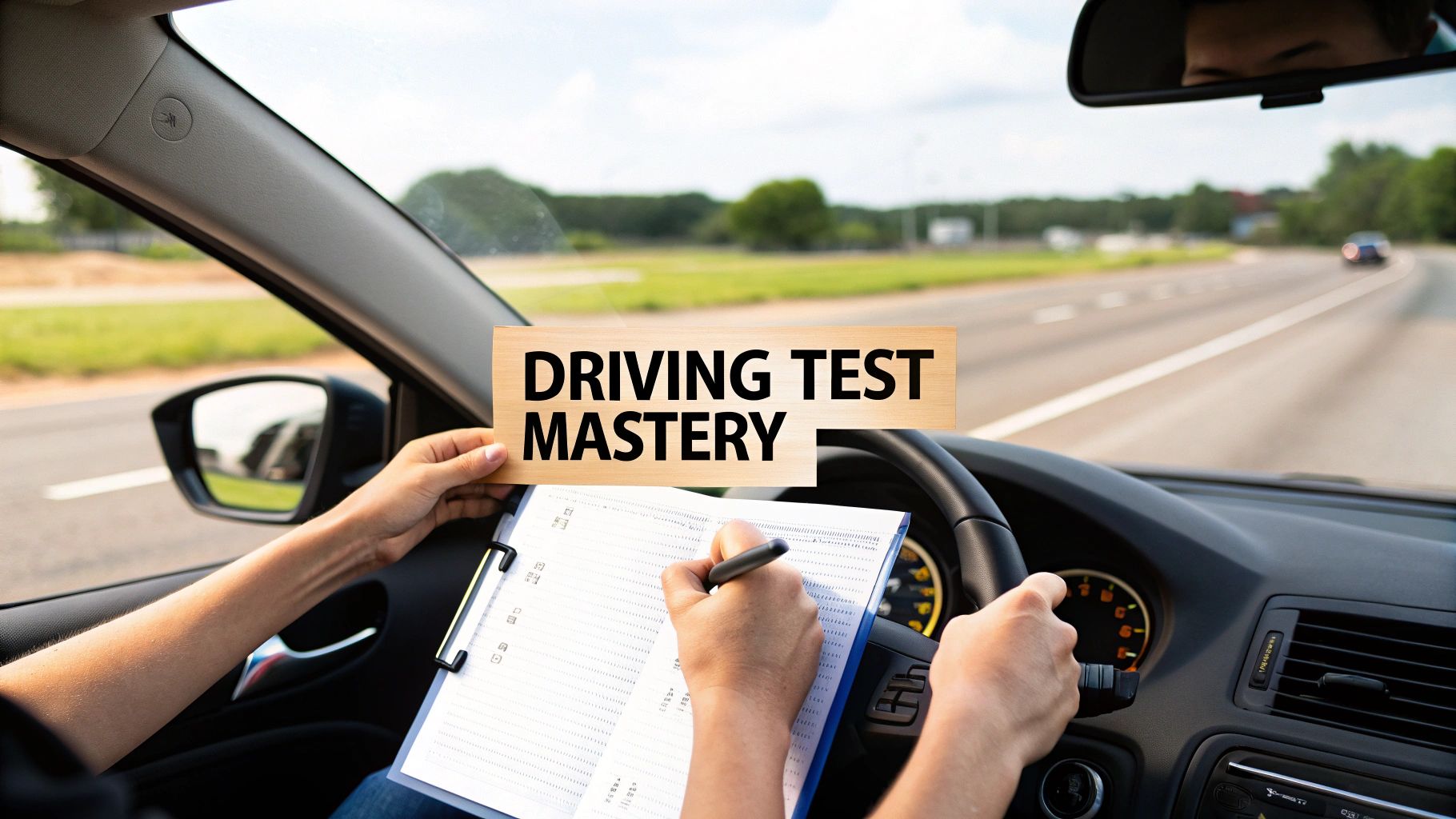
Passing your driving test isn't about luck or just putting in endless hours behind the wheel. It's about smart, focused preparation. The real secret is simple: get a rock-solid grasp of the rules from the driver's manual, then pair that with structured, hands-on practice. That's how you build the kind of genuine confidence and skill that examiners are trained to spot.
Your Blueprint for Driving Test Success
Getting ready for a driving test—whether it's for your first car or a Class A CDL—can feel like a mountain to climb. But success isn't an accident. It comes from a solid game plan that tackles both the book smarts and the practical skills. A common pitfall for new drivers is thinking that just cruising around town is enough practice. It's not.
A truly effective prep plan breaks everything down into smaller, manageable chunks. This way, you build a strong foundation before you start tackling the tricky stuff. It helps you avoid picking up bad habits that are a nightmare to unlearn later. Think of this as your roadmap, designed not just to get you a license, but to make you a safe, confident driver for the long haul.
Building Your Foundation
Everything starts with the official driver's handbook. Don't just skim it for the written test; this book is the source code for safe driving. Understanding why the rules exist—from right-of-way laws to what each road sign means—is what helps you make those critical split-second decisions. For aspiring commercial drivers, this step is even more vital, as you'll need to master specialized knowledge for different vehicle classes and endorsements.
Before you go any further, make sure you're clear on the permit requirements. You can review our guide on the CDL permit process to see exactly what’s involved.
Hands-on time is non-negotiable. The numbers don't lie: learners who get at least 40 hours of professional instruction and another 20 hours of private practice have a much higher chance of passing the first time. The pass rate for drivers with that level of experience hovers around 65%, a huge jump from the 35% pass rate for those with less practice.
"The difference between passing and failing often comes down to one thing: purposeful practice. Don't just drive—practice with a specific goal for every session, whether it's mastering parallel parking or perfecting your pre-trip inspection."
From Knowledge to Action
Once you've got the theory down, it's time to hit the pavement. This is where you turn what you've read into pure muscle memory. The goal is to make safe driving actions feel completely automatic, so you can execute them flawlessly even with an examiner watching your every move.
To help you stay on track, here's a quick look at the essential phases of your preparation.
Your Core Preparation Checklist
| Preparation Phase | Key Focus | Recommended Time Allocation |
|---|---|---|
| Knowledge Base | Thoroughly studying the official driver's manual. | 10-15 hours |
| Basic Maneuvers | Practicing core skills (parking, backing, turns) in a safe, empty lot. | 15-20 hours |
| Real-World Driving | Applying skills in varied traffic, weather, and road conditions. | 20-25 hours |
| Mock Tests | Simulating the official test with a professional or experienced driver. | 3-5 hours |
This checklist gives you a clear framework, ensuring you cover all your bases before the big day.
The infographic below perfectly illustrates this simple, three-stage flow.
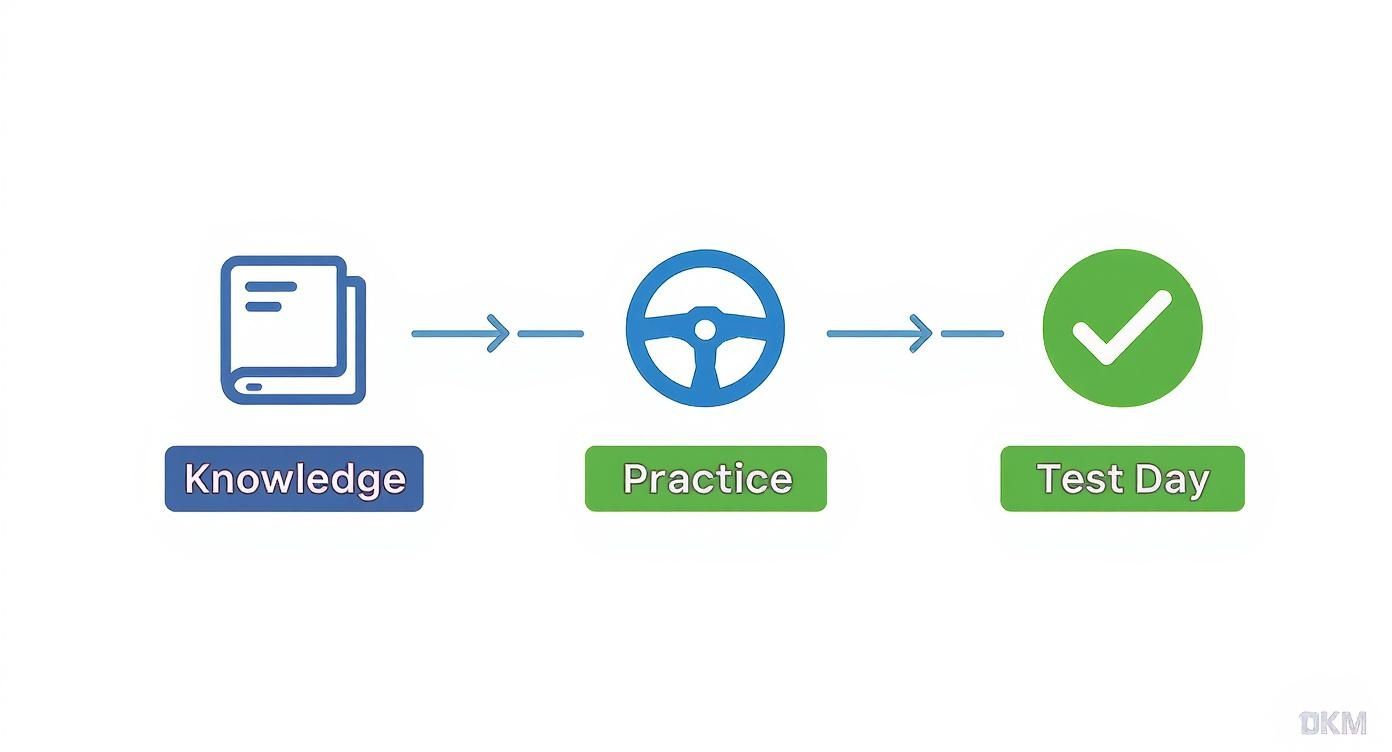
It’s a great reminder that success is a straightforward process. Each stage builds on the last, leading you right up to a confident performance on test day.
Mastering the Written Knowledge Test

Before you ever get behind the wheel, you have to prove you know the rules of the road. Passing that written knowledge test is your first real hurdle, and trust me, a last-minute cram session isn't going to cut it. This exam is designed to make sure you truly understand traffic laws, road signs, and the fundamentals of safe driving.
Your state's official driver's handbook? That's your bible. So many people just skim it, but every single question you'll see on the test comes straight from that book. The most reliable way to prepare is to treat that manual like the essential tool it is.
Build a Smart Study Plan
Just reading the manual front-to-back is a pretty inefficient way to learn. Our brains work better when we actively engage with the material. So, instead of just letting your eyes glaze over the pages, break the handbook down into smaller, digestible chunks.
Try dedicating one study session to road signs, another to right-of-way rules, and a separate one just for parking regulations. This keeps you from getting overwhelmed and actually helps the information stick.
A technique I always recommend is active recall. After you finish a chapter, close the book. Try to explain the concepts out loud to yourself or jot down the key points from memory. This simple act of retrieving the information, rather than just rereading it, is what builds strong, long-term knowledge.
The goal here isn't just to pass a test. It's about building a solid foundation of knowledge that makes you a safer, more confident driver for the rest of your life. True understanding means you know the why behind every rule.
Focus on CDL Specific Knowledge
Now, for those of you aiming for a Commercial Driver's License, the written test is a whole different beast. It’s far more demanding and dives deep into specialized topics that a regular driver never thinks about. You have to prove you’ve got the expertise to handle these big rigs safely.
You'll be tested on some seriously technical subjects, including:
- Air Brakes: You need to know this system inside and out—from its components and proper use to performing a complete air brake check cold.
- Combination Vehicles: This section covers the unique physics of driving an articulated vehicle, including proper coupling and uncoupling, and the critical skills needed to prevent rollovers.
- Hazardous Materials (Hazmat): If you're going for the Hazmat endorsement, you must master everything from placarding and shipping papers to emergency response procedures.
These topics are complex, so they demand extra time and focus. To see exactly what you’re up against, take a close look at the Patriot CDL general knowledge test requirements to make sure your study plan is on point.
Use Practice Tests to Your Advantage
Practice tests are your secret weapon. They do more than just show you what you know; they get you comfortable with the exam’s format, timing, and the way questions are worded. Walking into the real test feeling like you’ve been there before is a massive confidence booster.
But don't just take a test and look at the score. Dig into your results. Pinpoint the exact areas where you’re weak. Are you consistently tripping up on questions about speed limits in work zones? Or maybe the details of a pre-trip inspection?
That feedback is gold. It tells you exactly where to focus your attention back in the handbook. Every wrong answer is a chance to turn a weakness into a strength before it counts.
Perfecting Your Behind-the-Wheel Skills
Alright, you’ve hit the books and learned the rules of the road. Now it's time for the real work: getting behind the wheel and making it all second nature. This is where theory gets put to the test, and where you build the muscle memory and instincts that will get you through the exam. Just cruising around isn't going to cut it; you need to drill the specific maneuvers that examiners zero in on.
Think of it this way: knowing the rules is one thing, but proving you can apply them smoothly and safely when the pressure is on? That's the whole ballgame.
Drills for Standard License Hopefuls
If you're going for your standard driver's license, you already know which maneuvers trip people up the most. Instead of dreading them, you need to own them. Before you even tackle busy streets, find a big, empty parking lot and dedicate some serious time to these fundamentals.
Get these down until you can do them without thinking:
- Parallel Parking: Set up some cones to mimic a real parking spot. Your goal here isn't speed, it's consistency. Practice judging your angles and distances over and over again.
- Three-Point Turns: Find a quiet, narrow road where you can practice this. Work on making the turn flow smoothly with as few movements as possible, all while constantly scanning for any potential traffic.
- Smooth Lane Changes: Once you're comfortable, find a road with multiple lanes and light traffic. Practice the whole sequence: signal, check your mirrors, glance over your shoulder, and glide into the next lane. No jerking the wheel, no hesitation.
Drilling these in a low-stress environment is the key. It builds a solid foundation of confidence, so these maneuvers feel like just another part of driving during your test.
Mastering CDL-Specific Maneuvers
For all you future professional drivers, the stakes are higher and the skills are far more demanding. The sheer size of a commercial vehicle requires a whole different level of precision. Your practice needs to be methodical, covering every single skill the examiner will be watching for.
The absolute first thing to master is the pre-trip inspection. Examiners want to see a systematic routine where you not only check every component but also clearly explain what you're looking for and why. To develop a rock-solid routine, you should review our detailed guide on the CDL pre-trip inspection. This isn't just a checklist—it's a critical safety protocol that proves you’re a competent professional.
After that, it's all about precision backing.
Mastering the alley dock isn't just about avoiding cones; it's about proving you have complete control over your trailer's pivot point and can accurately judge distances in your mirrors. This skill is a direct reflection of your spatial awareness and vehicle command.
To become a truly well-rounded professional, you also need to be ready for any conditions the road throws at you. Learning essential winter driving tips is invaluable preparation for the real world of trucking.
Leveraging Simulators for Safer Practice
These days, we have incredible tools that can give you a real advantage. Driving simulators are a game-changer for preparing for your test, offering a completely safe environment to practice difficult scenarios without any real-world risk.
There's a reason the global market for these simulators is growing—they work. Studies have shown the impact: in China, using simulators has been tied to a 15% increase in first-time pass rates. In Germany, it's led to a 10% reduction in accidents among student drivers.
Using a simulator lets you get reps in against heavy traffic, bad weather, and all sorts of unexpected hazards you might not encounter in your regular practice. That experience sharpens your reflexes and decision-making, which translates directly into a more confident, capable performance when it's just you, the examiner, and the open road.
Bringing It All Together: Mock Tests and Taming Test-Day Nerves
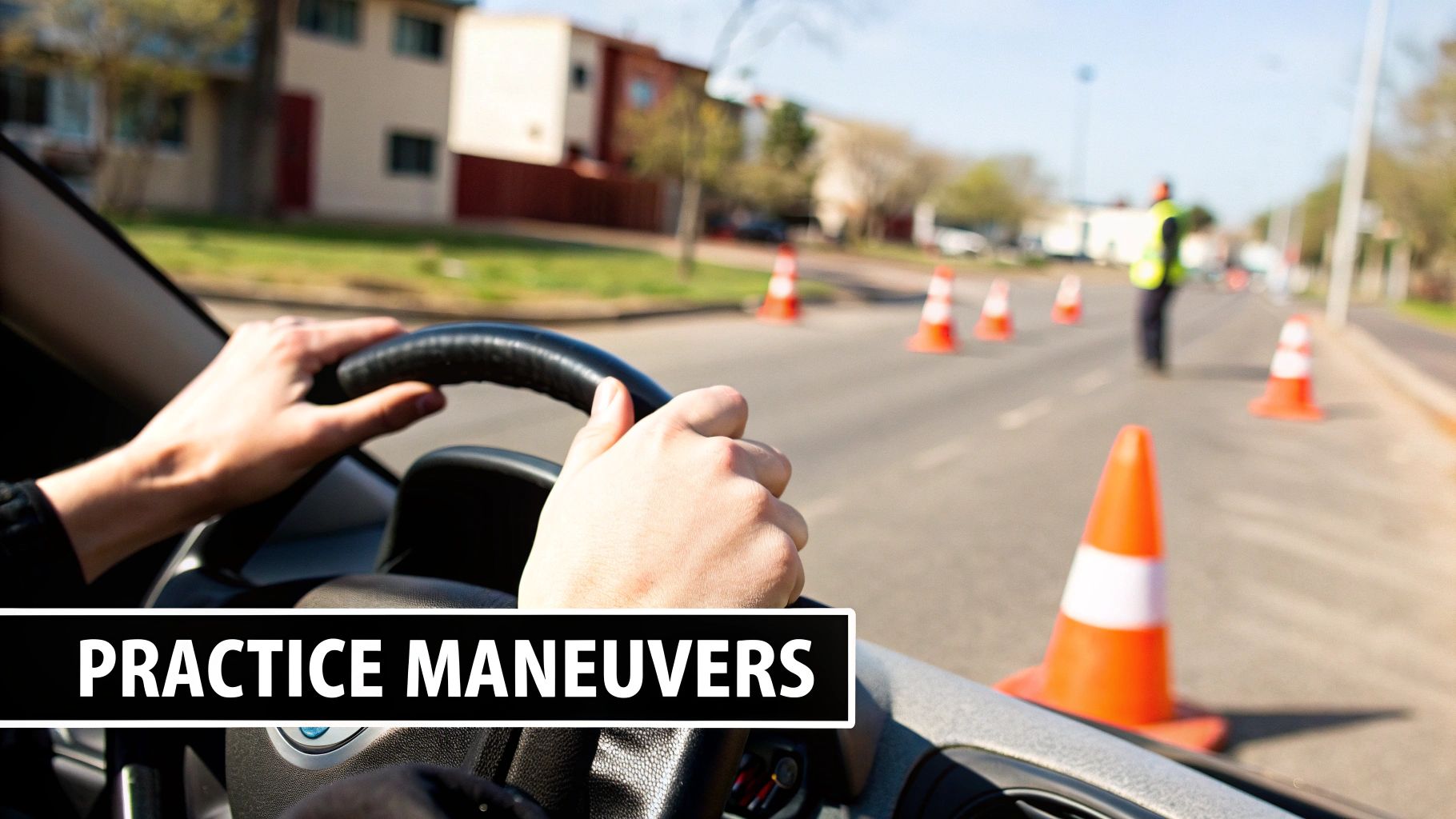
It’s one thing to nail a perfect three-point turn in an empty lot with your instructor. It’s a whole different ball game when an examiner is sitting in the passenger seat, silently making notes on a clipboard. That pressure is real, and it can cause even the best-prepared drivers to make simple, silly mistakes.
The best way to beat this performance anxiety is to make the test feel familiar before you even get there. By simulating the real thing as closely as possible, you start to strip away the fear and unknown, bridging the gap between knowing how to drive and proving you can do it under pressure.
Conduct Realistic Mock Tests
Think of a mock test as a full dress rehearsal, not just another practice drive. The entire point is to mimic the official test environment, from the rules down to the scoring. Having an experienced driver or, ideally, an instructor play the part of the examiner will give you the most honest, unfiltered feedback you can get.
Here’s how to make your mock tests count:
- Get the Official Scoresheet: Search online for your state’s official driving test scoresheet. This is your cheat sheet—it tells you exactly what the examiner is looking for and where you can lose points.
- Play by the Rules: The "examiner" should only give directions, no coaching or hints. Your job is to follow every traffic law to the letter, just like on the real test.
- Drive Unfamiliar Roads: Don't just circle your neighborhood. Get out into areas you don’t know well. This forces you to react to new signs, unexpected traffic patterns, and different road layouts.
After you’re done, go over that scoresheet together. This isn't about beating yourself up over mistakes. It's about finding your weak spots so you know exactly what to drill down on next. The data backs this up: 80.1% of learners who are aware of test-readiness campaigns run a mock test, a big jump from the 70.7% who don't.
The Power of Talking to Yourself
Here’s a technique that feels a little weird at first but works wonders: narrate what you're doing out loud. This simple trick accomplishes two huge things. First, it forces you to slow down your brain and be more deliberate with your actions, which cuts down on rushed, careless errors.
Second, it tells the examiner exactly what you’re thinking. They aren’t left guessing whether you saw that pedestrian or checked your blind spot—they hear you say it.
As you approach an intersection, say: "Okay, checking my mirrors… scanning left and right for pedestrians… my light is green. The intersection is clear, and I'm proceeding through."
This verbal checklist keeps you locked in and proves to the examiner that you're an active, defensive driver, not just someone along for the ride. At Patriot CDL, we incorporate this method into our structured training programs because it builds a rock-solid foundation of situational awareness.
Turn That Anxiety into Focus
Look, a few butterflies on test day are totally normal. The goal isn't to eliminate them but to have the tools to manage that nervous energy and channel it into laser-sharp focus.
Simple breathing and mindfulness exercises can make a world of difference. In fact, studies show that 37% of learners who try these techniques feel much better prepared for their test.
Before you get out of the car, try this:
- Sit quietly in your parked vehicle.
- Close your eyes. Take a slow, deep breath in through your nose for a count of four.
- Hold it for four seconds.
- Exhale slowly through your mouth for six seconds.
- Repeat this about five times.
This little exercise physically slows your heart rate and clears the mental clutter, letting you walk into the test center feeling calm and in command. When you combine realistic practice with this kind of mental prep, you build the unshakable confidence you need to pass.
Your Test Day Game Plan and Final Checklist
https://www.youtube.com/embed/gyKiDvjVjkQ
The last 24 hours before your driving test aren’t about cramming new maneuvers. Honestly, that’s the worst thing you can do. This final stretch is all about getting your head in the right space and making sure your logistics are squared away so there are no last-minute surprises.
Think of it like a pre-flight check. You're not learning to fly the plane; you're just making sure every dial is set, every flap is checked, and the fuel tanks are full. A calm, methodical approach now will prevent the kind of panic that tanks an otherwise solid driver.
The Night Before
Your test-day prep really kicks off the evening before. Forget about that one last-ditch effort to practice your alley dock at 10 PM. If you don't have it by now, an hour of frantic practice in the dark isn't going to help. It'll just fray your nerves.
Instead, get all your documents together. I mean all of them. Put your permit, registration, proof of insurance, and (for CDL folks) your DOT medical card in a single folder. Then put it by the door. Don't leave it to chance in the morning rush.
The most important thing you can do now is sleep. A good night's rest is your best friend when it comes to dealing with pressure. Aim for 7-9 hours. You need your brain sharp and your reaction times on point.
A well-rested mind is a focused mind. You can't fake it with coffee. Seriously, a good night's sleep will do more for your performance than another hour of studying ever will.
The Morning of the Test
Wake up early. I can’t stress this enough. Give yourself enough time so you aren't slamming down breakfast and sprinting out the door. Kicking off your day in a panic is a surefire way to bring that nervous energy with you right into the truck.
Eat something solid—oatmeal, eggs, something that will stick with you. Lay off the giant coffee or energy drinks; too much caffeine will just amplify any jitters you already have. And while you want to be hydrated, don't chug a gallon of water right before you leave. Trust me, you don’t want that distraction.
Plan to get to the test center 15-20 minutes early. This gives you a buffer for traffic and time to park, check in calmly, and just sit for a minute to breathe and get centered.
Final Checks Before You Go
Before you pull out of the driveway, do one last run-through. This is your final defense against a simple mistake that could get your test cancelled before you even start the engine.
- Paperwork: You already gathered it, but physically touch it one last time. Permit? Check. Registration and insurance? Check. DOT Med Card? Check.
- Vehicle Lights: Run through a quick light check. Headlights (high and low beams), turn signals, brake lights, and hazards. Get a buddy to help if you need to.
- Tires & Horn: Give the tires a quick visual inspection. They look good? Great. Give the horn a quick tap. Does it work? Perfect.
- Mirrors & Windshield: Make sure your windshield is clean, with no major cracks in your line of sight. Get your mirrors adjusted exactly where you want them before you're under the eye of an examiner.
It's a fact that drivers who get formal training are just better prepared. In the US, learners who complete a certified course are 20% more likely to pass on their first go. A structured approach, like the kind we drill in our CDL training programs, builds the muscle memory and confidence you need to nail it.
A final checklist helps organize everything for the big day, making sure you haven't forgotten a single detail.
Essential Test Day Checklist
| Category | Item/Action | Status |
|---|---|---|
| Documents | Valid Learner's Permit / License | ☐ |
| Vehicle Registration | ☐ | |
| Proof of Insurance | ☐ | |
| DOT Medical Card (CDL) | ☐ | |
| Vehicle | Check Headlights (High/Low) | ☐ |
| Check Brake Lights & Turn Signals | ☐ | |
| Test Horn | ☐ | |
| Inspect Tires for Proper Inflation | ☐ | |
| Clean Windshield & Windows | ☐ | |
| Adjust All Mirrors | ☐ | |
| Personal | Get 7-9 hours of sleep | ☐ |
| Eat a balanced meal | ☐ | |
| Arrive 15-20 minutes early | ☐ | |
| Take a few deep breaths before starting | ☐ |
Walking through this list item by item will give you the peace of mind that you've controlled everything you can control. Now, all that's left is to go show them what you can do.
Common Questions About Driving Test Prep
Even with the best game plan, you're going to have questions as test day gets closer. That’s perfectly normal. Getting straight answers can settle your nerves and help you focus on what really counts. This section is all about tackling the most common questions we hear from both standard license and CDL candidates.
Think of this as your final briefing. We'll get into how much practice you really need, what happens if things don’t go perfectly, and more, so you can walk into that test center feeling prepared and confident.
How Much Practice Do I Really Need?
Forget the bare minimums for a second. The real goal is to be proficient, not just to check a box. For a standard license, a good benchmark to aim for is at least 40-50 hours of supervised driving. Make sure at least 10 of those hours are at night, because it’s a completely different ballgame.
For you CDL folks, the hours are much higher and are baked into your training program for a reason. The point isn’t just to hit a number; it’s about getting a feel for the rig in all sorts of situations—from tight city streets to slick, rainy highways.
You’ll know you're ready when you can handle the vehicle safely and consistently without your supervisor having to say a word. It’s about building that muscle memory and instinct to react to whatever the road throws at you.
What Are the Most Common Automatic Fails?
Every examiner has a list of "critical driving errors" that will end your test immediately. These aren't minor slip-ups; they're serious safety risks. Knowing what they are is the first step to avoiding them.
Some of the most common instant fails we see are:
- Rolling a stop sign. You need to come to a full, complete stop behind that white line. No exceptions.
- Failing to yield. This could be at an intersection or to a pedestrian in a crosswalk. Always be scanning.
- Making another driver swerve. If someone has to take evasive action because of you, the test is over.
- Speeding or driving dangerously slow. You have to match the flow of traffic while staying within the legal limits.
For CDL drivers, there are even more tripwires, like messing up a key step in the air brake test or bumping a cone during a backing maneuver. The best way to avoid these is to be deliberate, stay calm, and always be aware of your surroundings.
What Should I Do If I Fail My Test?
First off, don't beat yourself up. Failing a driving test is incredibly common, and it’s a huge learning opportunity if you let it be. The most important thing you can do is listen carefully to the examiner’s feedback.
They’ll give you a scoresheet that breaks down exactly where you went wrong. This isn’t a criticism—it’s your personalized roadmap for what to work on. Most states make you wait a short period before you can try again.
Use that waiting period wisely. Get back out there with your instructor or an experienced driver and drill the specific skills that gave you trouble. Don't just drive; practice those weak spots until they become second nature.
Only book your re-test when you're genuinely confident you've fixed the problems. Rushing back in without addressing the root cause is just setting yourself up to fail again.
Are There Specific Tips for the CDL Pre-Trip Inspection?
Absolutely, and you need to nail this part. The CDL pre-trip is a major part of the test where a lot of people lose points, usually because they don't have a solid system.
The secret here is twofold: be systematic and be verbal. You need a routine you can do in your sleep. Start at the front of the truck and work your way around in the exact same order, every single time. No jumping around.
As you check each component—tires, brakes, lights, fluids—you have to say out loud what you're looking for. For instance, when you get to a tire, say, "I am checking for proper inflation, even tread wear, and no cuts or bulges in the sidewalls." The examiner can't read your mind. They need to hear you explain what makes each part safe. It shows you know your stuff.
Once you have that license in hand, the learning doesn't stop. Getting a handle on insurance is your next big step. A good place to start is understanding what comprehensive auto insurance is so you can make sure you’re fully protected out there.
At Patriot CDL, we're all about accelerated, hands-on training that gets you into a successful career in as little as three weeks. Our expert instructors are with you every step of the way, making sure you have the skills and confidence to pass your test and excel in the industry. Visit us at https://patriotcdl.com to start your journey today.