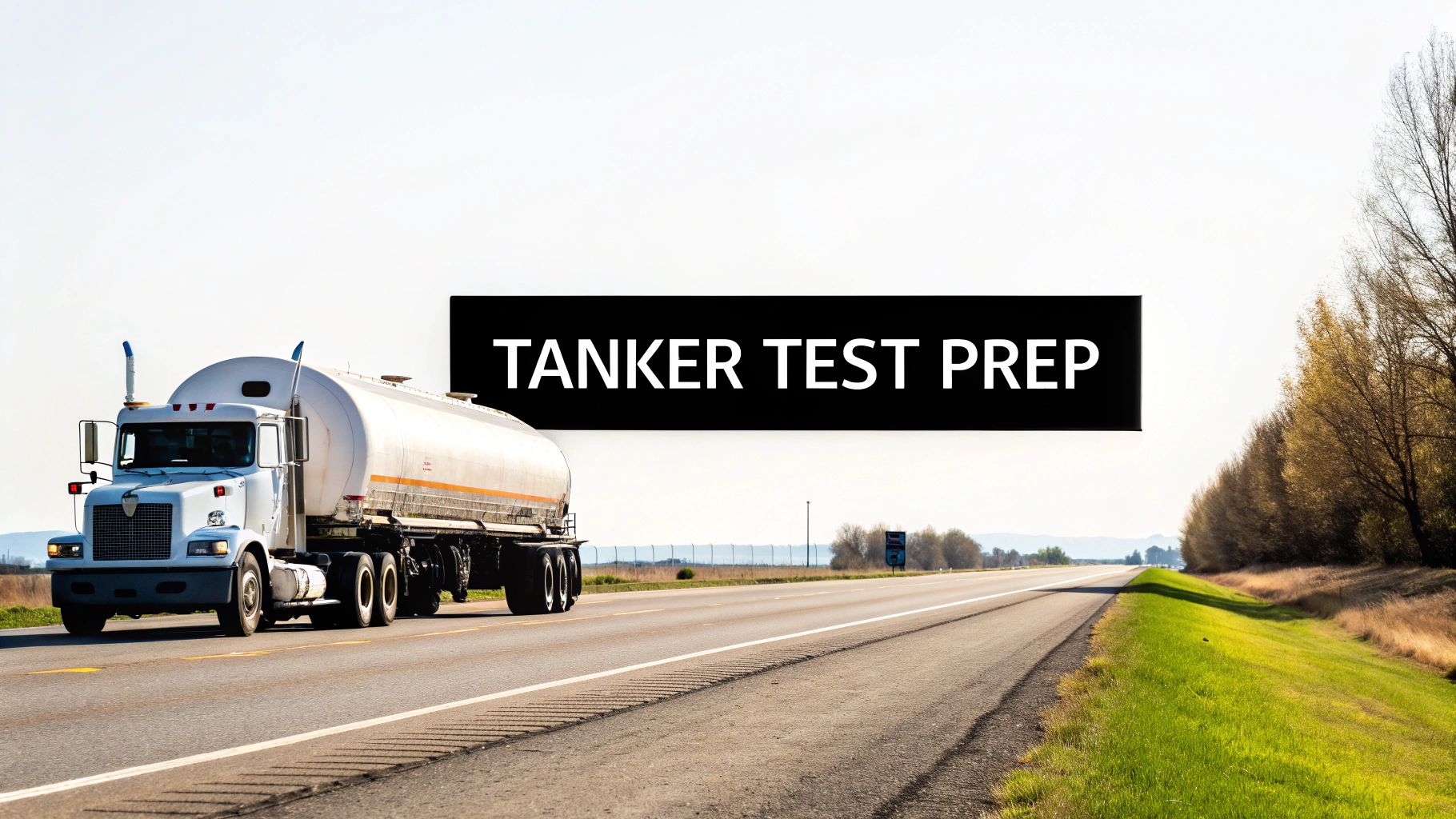
If you're looking at your CDL and thinking about what's next, the tanker endorsement is more than just another letter to add. It’s your ticket to better-paying jobs and more stable career paths. Once you pass your exam, you open the door to hauling high-demand cargo like fuel, milk, and industrial chemicals—loads that always need to move.
Why Mastering the Tanker Endorsement Matters
Getting your "N" endorsement is a smart, strategic move for your trucking career. It tells every potential employer that you've got specialized skills and can be trusted with loads that require a whole different level of care and know-how. That trust almost always translates directly into higher per-mile rates and more consistent work.
Let's be real—the economy can be unpredictable. But while general freight might slow down, people always need gasoline, and grocery stores always need milk. Many tanker jobs, like fuel delivery and food-grade transport, are more resistant to those economic dips. This gives you a kind of job security that can be tough to find anywhere else on the road.
Unlocking Premium Career Paths
Think about the doors this one endorsement opens. You’re not just a truck driver anymore; you become an essential part of critical supply chains.
- Fuel Hauling: These are often local or regional gigs, which means more home time. For a lot of drivers, that’s a game-changer for their quality of life.
- Food-Grade Transport: Moving things like milk, juice, or cooking oil means you're an expert in sanitation and temperature control. Companies pay a premium for that level of skill.
- Chemical Transport: This is one of the most demanding fields, requiring a rock-solid understanding of safety protocols. It also happens to come with some of the highest paychecks in the entire tanker world.
The industry is facing a massive shortage of qualified drivers for bulk liquid transport, especially for anything over 1,000 gallons. Experts estimate there's an annual shortfall of over 80,000 drivers for these jobs. Why the gap? It's risky work. The powerful surge of liquid cargo means tankers can be twice as likely to crash as a standard dry van.
This high demand creates a huge financial opportunity for drivers willing to step up. The numbers don't lie: endorsed drivers often earn an extra $0.10 to $0.20 per mile. For a regional fuel or food-grade hauler, that can easily add up to $10,000 or more each year.
The real value of the N endorsement isn't just about hauling liquids. It’s about proving you can manage dynamic, unpredictable loads, a skill that commands respect and better compensation across the board.
The Responsibility and Reward
Of course, with better pay comes bigger responsibility. Driving a tanker isn't like pulling a dry van. You have to understand the physics of liquid surge, why you need proper outage for expansion, and how a high center of gravity changes everything about how you drive. For a refresher on the basics, you can review our guide on CDL requirements.
Getting serious about a study plan for the tanker test is your first real step. When you understand the real-world value of this endorsement, you’re not just studying for a test—you’re investing in a more secure and profitable future out on the road.
Decoding the CDL Tanker Endorsement Test
So, you're ready to get your tanker endorsement. Before you start hammering away at practice tests, it’s crucial to understand what you’re really being tested on. The official exam isn’t about trick questions; it’s designed to make sure you have a rock-solid grasp of the unique physics and safety rules for hauling liquid cargo.
Think of it this way: passing isn't about rote memorization. It’s about internalizing the principles that will keep you, and everyone else on the road, safe.
Most states will give you a multiple-choice test with around 20 to 30 questions. The bar is set high—you’ll likely need to score 80% or better to pass, which doesn't leave much wiggle room. There’s a good reason for that standard. The risks that come with hauling thousands of gallons of liquid are huge, and every driver needs to prove they know their stuff.
Understanding the Test Structure
The questions you'll face all revolve around one central challenge: managing a dynamic, shifting load. A dry van full of pallets is one thing, but a tanker's cargo is constantly in motion.
This movement, called liquid surge, is the single biggest factor you’ll deal with. It can literally push your truck forward when you brake or pull it back when you accelerate, completely changing how the vehicle handles.
Because of this, the test is laser-focused on concepts like:
- High Center of Gravity: A tanker’s center of gravity is much higher than a standard trailer, making rollovers a constant threat.
- Outage: This is the empty space, or "ullage," you must leave in a tank. It gives the liquid room to expand with temperature changes, preventing spills or even a ruptured tank.
- Baffles and Bulkheads: You'll need to know the difference. Baffles are partitions with holes that slow down the forward-and-back surge, while bulkheads are solid walls that create separate compartments. Critically, baffles do very little to stop side-to-side surge in a turn.
The test is built to see if you can apply these ideas to real driving. It's not enough to define "surge." You have to know how that surge forces you to increase your following distance or slow down well before a curve. This foundational knowledge is just as critical as what you learned for the main exam, which we cover in our guide to the CDL general knowledge test.
Mapping Out the Key Knowledge Areas
To make your study time count, you need to know exactly where to focus. By breaking down the topics that will definitely be on the exam, you can prepare efficiently. This isn't just about passing a test; it’s about being a competent, safe tanker hauler from your very first day.
The tanker endorsement test is a direct measure of your ability to manage risk. Every question about surge, inspection, or liquid weight distribution is fundamentally a question about preventing catastrophic accidents on the road.
The table below breaks down the must-know topics for the N endorsement. We'll look at what you need to know for each and, more importantly, why it's so critical when you're on the job.
Key Topics on the Tanker Endorsement Knowledge Test
| Knowledge Area | What You Need to Know | Why It's Critical |
|---|---|---|
| Inspecting Tank Vehicles | How to conduct a thorough pre-trip, focusing on tank mounting, leak detection, valves, and manhole covers. You must know how to check for structural integrity and secure all fittings. | A small leak can lead to a significant environmental hazard, costly cleanup, and severe fines. A loose manhole cover could cause a major spill while you're driving. |
| Liquid Surge Dynamics | The causes of liquid surge and its effect on braking, turning, and acceleration. Understand the differences between baffled, unbaffled (smooth bore), and bulkheaded tanks and how each impacts handling. | Uncontrolled surge is a leading cause of tanker rollovers. Misjudging how the liquid will shift in a turn or during a sudden stop can lead to a complete loss of vehicle control. |
| Safe Driving Rules | Specific techniques for managing a high center of gravity, proper speed for curves, safe stopping distances (which are much longer), and avoiding sudden steering maneuvers. | Tankers have a significantly higher rollover risk than dry vans. Adhering to these specialized driving rules is the primary way to mitigate that danger and protect yourself and the public. |
| Loading and Unloading | The importance of proper weight distribution, understanding liquid density, grounding the vehicle to prevent static electricity, and following strict procedures for connecting hoses. | Improper loading can cause overweight violations, vehicle instability, and dangerous spills. For flammable liquids, failing to ground the truck can create a spark, leading to a fire or explosion. |
| Emergency Procedures | How to respond to a rollover, leak, or fire. This includes your role in containing a spill, notifying authorities, and knowing the properties of the liquid you're hauling. | In an emergency, your immediate actions can prevent a minor incident from becoming a major disaster. Quick, correct responses protect the environment, the public, and first responders. |
Mastering these areas will give you the confidence you need to not only pass the test but to handle the immense responsibility that comes with operating a tanker.
Building Your Strategic Study Plan
Let's be real: just flipping through the CDL manual and hoping for the best isn't going to cut it for the tanker endorsement test. If you want to walk in there confident and walk out with a pass, you need a smart plan that actually fits your schedule. The goal here isn't just to memorize facts for a day, but to truly understand what you're doing.
That means you have to get active with your learning. Ditch the passive reading and start using methods that stick, like active recall (forcing your brain to pull up information without looking) and spaced repetition (reviewing topics just as you're about to forget them). It’s all about how to study smarter, not harder and making the most of your time.
Anchor Your Learning in Official Materials
Your first and most important resource is your state's official CDL manual. Everything on the test comes directly from this book, so make it your new best friend. Start by reading the entire tanker section, and don't be shy with the highlighter—mark up anything that seems important.
You'll want to pay extra close attention to a few key areas:
- Surge Dynamics: This is a big one. You have to understand how that sloshing liquid completely changes how your truck handles.
- Vehicle Inspections: Tankers have their own unique set of pre-trip items. You need to know the specifics for tanks, valves, and piping like the back of your hand.
- Safe Driving Rules: A high center of gravity and much longer stopping distances are no joke. The manual spells out exactly how to manage them.
Once you feel like you have a decent handle on the manual's content, it’s time to see what you actually know. This is where a good practice cdl tanker endorsement test becomes absolutely critical. Taking these tests will show you where you're strong, shine a bright light on your weak spots, and get you used to how the real exam words its questions.
Treat every wrong answer on a practice test as a gift. It's a free lesson! Don't just shrug it off; go back to the manual, find out why you got it wrong, and lock that knowledge in.
This whole process boils down to a few core concepts that work together. You need to master the physics of surge, be meticulous with your inspections, and then apply that knowledge when you drive.
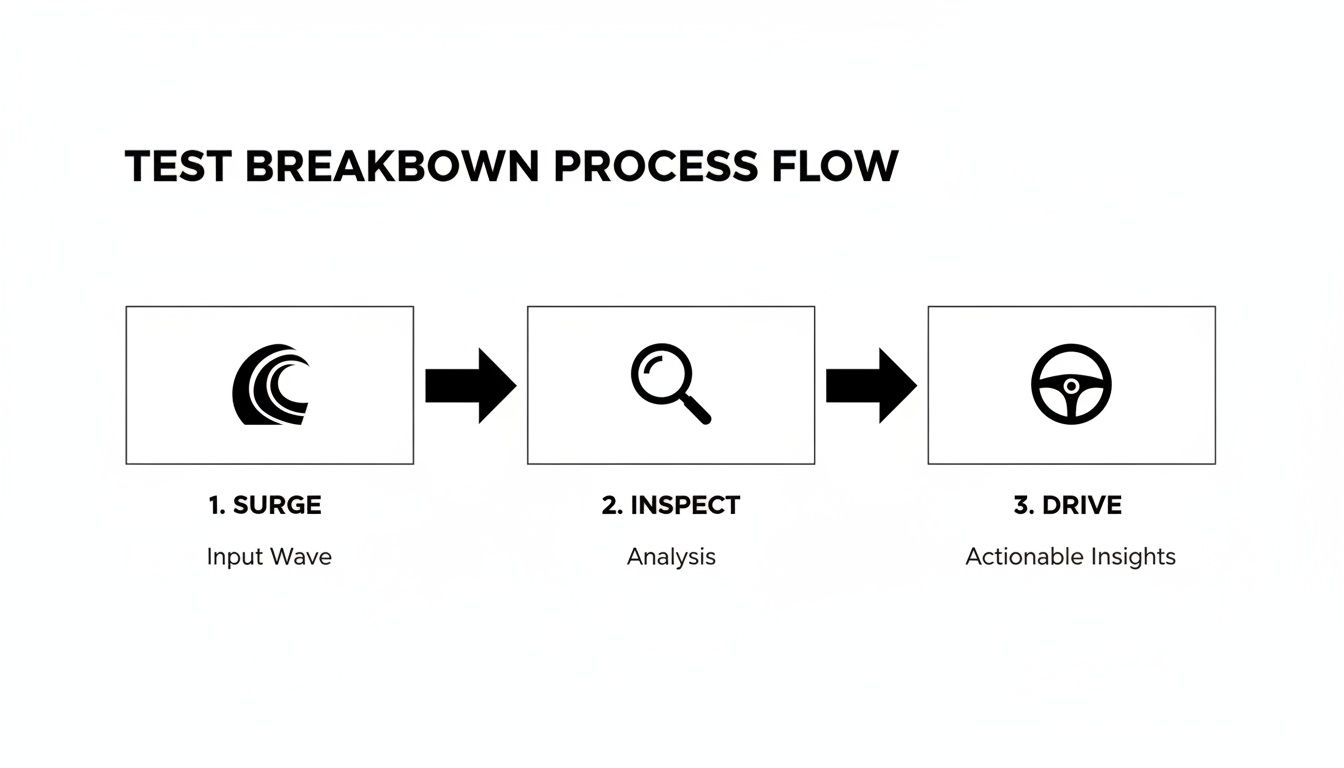
Think of it this way: mastering surge, inspections, and driving techniques aren't separate skills—they're three legs of the same stool that keeps you and everyone else safe on the road.
Understand the Rules That Govern the Road
Knowing the federal regulations isn't just for the test; it's what keeps you employed and out of serious trouble. Take the rule the Federal Motor Carrier Safety Administration (FMCSA) put in place back in July 2015. It completely changed the game by redefining what a "tank vehicle" is.
Essentially, if your total liquid load hits the 1,000-gallon mark, you need the N Tanker Endorsement. It doesn't matter if the liquid is in portable totes inside a regular dry van—the rule still applies. The penalties for getting this wrong are severe: we're talking civil penalties up to $5,000 per violation and possible license suspensions of 90 days or more.
This wasn't just bureaucracy. The rule was a direct response to the serious danger of liquid surge, which dramatically increases rollover risk. And it worked. Since it was implemented, statistics show a 15-20% drop in incidents involving liquid freight, proving that proper training makes a real difference.
Putting Your Plan into Action
Okay, let's get down to brass tacks. Here’s a simple, effective way to structure your study time.
- The First Pass: Block out some time to read the entire tanker section of the manual. The goal here isn't memorization, just a solid overview. Get a feel for the landscape.
- Deep Dives: Now, break it down. Dedicate your next few study sessions to one topic at a time—surge control one day, inspections the next. After each deep dive, immediately take a practice quiz on only that topic to cement it.
- Full-Scale Practice: Once you’ve covered all the individual topics, start taking full-length practice tests. Your goal should be to consistently score much higher than you need to pass. This builds a nice cushion for test-day jitters.
- The Final Review: The day before your test, do a light review. Glance over your notes and the questions you got wrong on practice tests. This isn't the time to cram; it's just about refreshing what you already know.
Following a structured plan like this takes the guesswork out of preparing. For drivers who want an even more hands-on approach, a comprehensive CDL training program can provide the expert guidance and practical experience to really master this material.
Get a Feel for the Real Test with Practice Questions

Book smarts are one thing, but applying that knowledge when the pressure's on is what really counts. This is where you put your studying to work with questions that are just like the ones you'll see on test day.
It's not enough to just memorize the right answer; you need to understand why it's the right answer. We've put together some realistic practice questions below. After each one, I’ll break down the logic, connecting it back to the core principles of driving a tanker—things like liquid surge, a high center of gravity, and rock-solid inspection habits.
This is all about active learning. Working through these scenarios is the best way to build the confidence you need behind the wheel. If you're interested in the "why" behind this method, check out the definitive guide to hands-on learning, which explains how doing something solidifies knowledge way better than just reading about it.
Questions on Surge Control and Vehicle Handling
Let's dive into the topic that trips up most drivers: managing the incredible force of moving liquid. These questions will test if you really understand the physics that dictate every single move you make in a tanker truck.
Question 1: You're driving a tanker equipped with baffles. When you take a turn, what should you be most worried about?
A) Forward-and-backward surge
B) The high density of the liquid
C) Side-to-side surge
D) The baffles breaking loose
Correct Answer C
Explanation: This is a classic "gotcha" question. Baffles are great for one thing: disrupting the front-to-back surge you feel when you hit the brakes or accelerate. But they do almost nothing to stop liquid from sloshing side-to-side in a curve. That sideways motion can shift your center of gravity in a heartbeat, putting you at a huge risk for a rollover.
Question 2: How should you stop a tanker that is only half full?
A) Brake later than you would with a full load.
B) Use the stab braking method.
C) Brake earlier and more gently than normal.
D) Pump the brakes to keep the liquid moving.
Correct Answer C
Explanation: A half-empty tank is arguably the most dangerous load you can haul because of surge. With all that open space, the liquid can build up serious momentum. Hit the brakes, and that wave of liquid will slam into the front of the tank, pushing your rig forward right into an intersection. The only way to counter this is to give yourself way more room, braking much sooner and smoother than you would with any other load.
The force of liquid surge in a partially loaded tanker can feel like being hit from behind by another vehicle. Always respect this force by increasing your following and stopping distances.
Questions on Inspections and Equipment
Your ability to spot a problem before you even turn the key is what makes you a professional. These questions focus on the gear that's unique to a tanker.
Question 3: During your pre-trip inspection of a tanker, you need to pay special attention to:
A) The tire pressure on the rear axles.
B) Any signs of leaks from the tank or piping.
C) The cleanliness of the cab.
D) The color of the paint on the tank.
Correct Answer B
Explanation: While every part of a pre-trip is critical, a leak is the number one red flag on a tanker. Even a tiny drip can signal a major structural failure and could lead to a hazardous spill, environmental damage, and fines that could ruin a company. You have to check every valve, fitting, pipe, and the tank shell itself like a hawk. This builds on the foundational knowledge of a standard CDL pre-trip inspection but takes it to a new level.
Question 4: In the world of tankers, what does the term "outage" mean?
A) The time the truck is out of service for repairs.
B) A power failure at the loading dock.
C) The empty space left in a tank for liquid expansion.
D) The amount of product lost during transport.
Correct Answer C
Explanation: "Outage" (sometimes called ullage) is the practice of leaving room at the top of the tank after loading. This isn't just for avoiding spills—it's a critical safety measure. Liquids, especially fuels, expand when they heat up. If you fill a tank to the very top on a cool morning, the afternoon sun could cause the liquid to expand so much it either ruptures the tank or forces product out of the vents. Forgetting to leave the proper outage is a major violation.
Leveling Up to the X Endorsement
So you've got your N endorsement under your belt. That’s a huge step, but if you're ambitious, you're probably already asking, "What's next?" The single most powerful move you can make from here is to go for the X endorsement.
It’s not a whole new test. Think of it as a combination deal. You earn the Tanker (N) and Hazardous Materials (H) endorsements separately, and the DMV combines them into the highly respected X endorsement on your CDL. This puts you in a different league entirely.
Why the X Endorsement Is So Valuable
When you have that "X" on your license, it tells every potential employer that you're a top-tier driver. You've proven you can manage the tricky physics of liquid cargo and you're trusted with the immense responsibility of hauling hazardous materials. This dual qualification is what opens the door to the highest-paying jobs in the industry, plain and simple.
Companies hauling fuel, industrial chemicals, or other sensitive liquids can't just throw any driver in the seat. They need someone with a specific, proven skill set and a rock-solid background. The X endorsement is the gold standard they look for.
The demand for these drivers is intense, and the supply is limited. The X endorsement is one of the hottest tickets in trucking because the need for hauling hazardous liquids and gases is always high. Class A CDL holders with the X can pull in 20-30% higher wages than drivers without it. We're talking $80,000-$100,000 a year for over-the-road jobs, compared to a $60,000 baseline. In an industry with a 95% turnover rate and a major driver shortage, that "X" gives you incredible job security.
Navigating the Path to the X Endorsement
The journey involves two separate hurdles, but you're already halfway there. You've done the work for the tanker part.
Now, you just need to tackle the Hazardous Materials (H) endorsement. Here's what that involves:
- Passing the HazMat Knowledge Test: This test is no joke. It covers everything from identifying hazardous materials and understanding placards to proper loading procedures and what to do in an emergency.
- Completing a TSA Security Threat Assessment: Since you'll be responsible for potentially dangerous materials, you have to pass a thorough background check from the Transportation Security Administration (TSA). This involves fingerprinting and a deep dive into your records.
Think of the X endorsement as the master key to the trucking world. While the N endorsement opens many doors, the X endorsement unlocks the ones that lead to the most lucrative and stable career paths.
What This Means for Your Career
Having both credentials makes you incredibly versatile. You're not stuck hauling just one thing. One week you could be moving gasoline, and the next it might be a non-hazardous liquid like milk. That kind of flexibility is a massive career advantage.
As you grow your career, you'll find that adding endorsements and clearing restrictions often go hand-in-hand. For example, many tanker jobs require a truck with a full air brake system. If your license has an E restriction, you might also look into an E restriction removal course to open up even more opportunities.
Going after the X endorsement is a direct investment in your future. It’s a clear statement that you're a serious professional who is committed to safety and ready for the most challenging—and rewarding—jobs out there.
Answering Your Top Questions About the Tanker Test
As you gear up for test day, a few last-minute questions always seem to pop up. Getting straight answers can be the difference between walking into the DMV feeling confident or feeling nervous. Let's clear up some of the most common points of confusion.
How Many Questions Are On the Tanker Endorsement Test?
You can expect to see 20 to 30 multiple-choice questions on the exam in most states. The bar is set high—you'll need to score an 80% or better to pass, which means you can only afford to miss a handful of questions.
That tight margin for error is exactly why you need to truly understand the material. You can't just memorize answers from a practice cdl tanker endorsement test; you have to get a real feel for concepts like liquid surge, proper inspections, and safe handling. Always check your state's official CDL manual to confirm the exact numbers.
What Is the Biggest Mistake Drivers Make When Studying?
Hands down, the most common mistake is underestimating the physics of liquid surge. It's easy to get bogged down in memorizing regulations and forget about what's actually happening in the tank behind you.
That sloshing liquid completely changes how your truck brakes, accelerates, and takes a curve. It's the number one reason for tanker rollovers. Your study time has to go beyond the book and into real-world scenarios. You need to ask yourself why these forces are so dangerous and how you'll manage them on the road.
The most critical skill for a tanker driver is not just knowing the rules, but developing an intuitive feel for how the liquid load is behaving behind them at all times. This is what separates a good driver from a great one.
Do I Need an N Endorsement for Portable Tanks?
Yes, and this one trips up a lot of drivers. The FMCSA is very clear on this: you need an N endorsement if you're hauling 1,000 gallons or more in portable tanks, as long as the individual tanks are rated for more than 119 gallons each.
The key takeaway here is that it’s about the total volume, not the type of trailer. If you're hauling totes on a flatbed or in a dry van, this rule applies to you. Getting caught without the right endorsement during a roadside inspection means steep fines and serious trouble.
How Long Is the Tanker Endorsement Valid?
Here's the good news. Your tanker endorsement is tied directly to your Commercial Driver's License. As long as your CDL is valid, so is your N endorsement.
When you renew your CDL, the endorsement comes along for the ride. You won't have to retake the tanker knowledge test unless you let your CDL expire or it gets suspended or revoked. Think of it as a one-time investment that pays off for your entire career.
Ready to turn your knowledge into a high-paying career on the open road? At Patriot CDL, we provide the expert, hands-on training you need to pass your exams and master the skills that employers are looking for. Learn more about our comprehensive CDL programs at https://patriotcdl.com.