Picking the right "commercial driving school near me" is the single most important decision you'll make when launching your trucking career. Think of it as the foundation for everything that comes next. It’s more than just getting a piece of plastic in your wallet; it’s a direct investment in your future.
With the demand for qualified drivers skyrocketing, getting your CDL is a smart play for anyone looking for real job security and a sense of independence on the open road.
Why Your Choice of CDL School Really Matters
Starting a career behind the wheel opens up a world of opportunity, but your training is what truly sets the stage. Let’s be honest: not all schools are created equal. A top-notch program produces a confident, road-ready driver, while a subpar one just gets you through the test, leaving you unprepared for the actual job.
This guide is your roadmap. We’ll walk through how to size up your local options, so you can spot the difference between a school that builds skilled professionals and one that just takes your money. The goal is to find a place that prepares you for a long, successful career, not just the exam.
The Booming Demand for Skilled Drivers
The need for professional truck drivers has never been this high. You can see it in the numbers—the global driving school market was recently valued at a massive $98.71 billion and is expected to climb to $124.64 billion by 2029. What’s driving that growth? A huge demand for licensed pros in our logistics-driven economy. For you, that means one thing: your skills will be highly sought after for years to come.
This industry explosion is exactly why quality training matters so much. Companies aren't just looking for a warm body with a license; they want genuinely competent drivers. The "commercial driving school near me" you choose directly impacts how hireable you are and what you can earn right out of the gate.
A great CDL program does more than prepare you for the license exam; it equips you with the confidence and practical skills needed to handle real-world driving scenarios safely and effectively.
What Sets the Best Schools Apart
The best schools offer a lot more than just the basics. They build a learning environment that’s all about helping you succeed—and succeed fast. Here are a few things that make the top-tier programs stand out:
- Accelerated Programs: Why spend months in training when you can be on the road in weeks? Intensive, focused models, like the one here at Patriot CDL, get you licensed and earning money fast.
- Instructors with Real-World Miles: There's a huge difference between learning from a textbook and learning from someone who has spent years on the road. Seasoned pros offer insights you just can't get anywhere else.
- Serious Job Placement Support: The best schools have solid connections with trucking companies. They don’t just train you; they actively help you land a job, sometimes before you even graduate.
Before you even think about enrolling, make sure you know what it takes to get your CDL. You can find a complete overview by checking out our guide on CDL requirements and what to expect. It's best to start this journey with your eyes wide open.
Your Vetting Checklist for Local Driving Schools
Alright, you’ve got a shortlist of potential schools. Now comes the most important part: digging in and asking the tough questions. This is where you shift from just browsing online to becoming an informed buyer. A good checklist is your best friend here, helping you see past the sales pitches and figure out which school is truly invested in your success.
The first thing I always tell people to look at is the instructors. Don't be shy about this. Ask about their background. Are they just certified trainers, or are they seasoned drivers with years of real over-the-road experience? The best teachers are the ones who’ve been there, done that. They can share the kind of practical wisdom you’ll never find in a textbook.
Hands-On Training and Equipment Quality
Classroom learning gets you your permit, but time behind the wheel builds your career. This is a non-negotiable. Pin every school down on exactly how much hands-on driving time you’ll get. How many hours will you physically be in the driver’s seat, running through gears, backing into tight spots, and dealing with actual traffic?
And what about the trucks you'll be driving? Training on old, beat-up equipment is a huge disservice. You need to learn on modern, well-maintained vehicles that are similar to what you'll find on the job. Learning on a clunker can teach you bad habits that are hard to break.
A low student-to-instructor ratio is another deal-breaker. You want personalized attention, not a crowd.
- Small Groups: Make sure you're not just a number. You need enough one-on-one time with the instructor to get your questions answered and your mistakes corrected.
- Transmission Options: Does the school have both manual and automatic trucks? Knowing how to drive a stick can open up more job opportunities, so it's a huge plus.
- Practice Yard: A dedicated, off-road space for practicing skills like backing and docking is critical. It lets you build confidence without the pressure of public roads.
Understanding the nuts and bolts of driving school industry operations can give you a better lens for judging quality. A well-managed school invests in its students, its fleet, and its instructors.
To help you stay organized, here's a simple framework for comparing the schools on your list. Use it to score each one as you gather information from their websites, phone calls, or in-person visits.
Key Features to Compare in Local Driving Schools
| Feature | What to Look For (Ideal Standard) | Why It Matters |
|---|---|---|
| Instructor Experience | Seasoned, former truck drivers with years of OTR experience, not just textbook trainers. | Real-world insights and practical advice are invaluable for preparing you for the realities of the job. |
| Hands-On Driving Time | A clear, guaranteed number of hours you will personally be behind the wheel. | This is where you build core skills and confidence. More driving time equals better preparation. |
| Student-to-Instructor Ratio | Small groups, ideally no more than a few students per instructor in the truck. | Ensures you get personalized feedback and aren't just waiting around for your turn to drive. |
| Equipment Quality | Modern, well-maintained trucks (both manual and automatic) that reflect current industry standards. | Training on relevant equipment makes your transition to your first job much smoother. |
| Job Placement Assistance | A dedicated team with strong, established relationships with reputable carriers. Ask for placement rates. | A good school's reputation is built on its graduates getting good jobs quickly. |
| Training Schedule | Flexible options (full-time, part-time, weekends) to fit your life. | A school that accommodates your schedule shows it understands student needs. |
| Cost & Financing | Transparent, all-inclusive pricing with no hidden fees. Multiple financing or payment plan options. | You need to know the full cost upfront to budget properly and avoid surprises. |
Taking the time to fill this out will give you a clear, objective picture of which school truly offers the best value and the most direct path to a successful career.
Avoiding the Pitfalls of a "CDL Mill"
It's no secret that the quality of CDL training varies wildly. Recently, the Department of Transportation targeted nearly 7,000 of the nation's 16,000 listed programs, with 3,000 facing immediate shutdown for failing to meet federal standards.
These places are often called "CDL mills." They focus on churning out as many students as possible, as quickly as possible. The result? Rushed courses that leave new drivers unprepared and, frankly, unsafe. This crackdown is a good thing for the industry, and it highlights why schools like Patriot CDL, which prioritize comprehensive training even in an accelerated format, are so important.
Choosing a school is a huge investment of your time and money. Don't rush it. Ask the hard questions and expect straight answers. Any school worth its salt will be happy to prove its value to you.
By focusing on instructor quality, behind-the-wheel hours, and modern trucks, you can steer clear of the mills and find a top-tier driving school near you. To see how we structure our training to build road-ready professionals, feel free to explore our accelerated CDL program.
Decoding Costs, Schedules, and Job Placement
Beyond the shiny trucks and experienced instructors, you've got the practical stuff to figure out: the money, the time, and the job waiting for you on the other side. Honestly, this is where a lot of people get tripped up by misleading promises or hidden details. Getting straight answers on costs, scheduling, and actual career support is the only way to make a decision you won’t regret.
When a school gives you a tuition figure, it needs to be crystal clear. Don't just accept a single number; ask for an itemized breakdown of everything. Does that price include your DOT physical, drug screening, road test fees, and all your books? Little fees can stack up fast, and a transparent school has nothing to hide.
Finding a Schedule That Fits Your Life
Flexibility is a big deal, especially if you’re juggling a job or family. Lots of folks immediately look for night or weekend classes, but I'll be blunt: most veteran trainers will tell you that’s not the best way to learn. Daytime training is just safer. You have better visibility, and you’re learning when your brain is actually awake and alert.
An accelerated, full-time program is often a much better route. Committing to a few weeks of intensive, daily training helps you build momentum and lock in skills way faster.
- You'll actually remember what you learn. Daily practice helps cement new skills—like shifting and backing—so you spend less time re-learning and more time moving forward.
- You get to the finish line faster. A focused, three-week course gets you licensed and earning a paycheck months sooner than a program that drags on for half a year.
- It’s a better taste of the real world. Full-time training does a much better job of mimicking the life of a professional driver, preparing you for the real demands of the job.
This is the whole philosophy behind our model at Patriot CDL. We focus on getting you road-ready quickly and safely. It respects your time and gets you into your new career without cutting corners on quality. It's also worth checking if a school offers specialized training; for instance, knowing how they handle something like an E restriction removal course tells you a lot about their program's depth.
Separating Real Job Placement from Empty Promises
This might be the most important service a school provides after the training itself. A great commercial driving school doesn't just hand you a generic list of trucking companies and wish you luck. That’s not placement assistance; that's a cop-out.
True job placement means the school has a dedicated person or team actively working for you, using their established industry connections to open doors.
A school's job placement program is a direct reflection of its reputation. If top carriers are actively recruiting from a school, it's a huge vote of confidence in the quality of its graduates.
Genuine career support means they help you build a professional resume, prep you for interviews, and connect you with actual hiring managers at reputable companies—often before you even finish your course. You should always ask for their placement rate and for a list of companies that consistently hire their grads.
This kind of support is more valuable than ever. The U.S. trucking industry is facing a massive driver shortage, with over 80,000 heavy and tractor-trailer jobs recently open. This demand means graduates from good schools are getting job offers right away, with median pay starting above $55,000 a year and even higher potential in specialized roles. That reality makes a school's ability to connect you with the right employer absolutely critical.
From Enrollment to Your First Day on the Job
You’ve done your research and picked a commercial driving school that feels right. Now the real work begins. The next few weeks will be a whirlwind of paperwork, tests, and hands-on training, but a good school will lay out a clear path for you.
Think of it less like a mountain to climb and more like a series of steps. The first one? Getting your documents in order. You'll need to prove your identity and eligibility, so having everything ready to go will prevent any annoying delays right at the start.
Preparing for the Initial Hurdles
Before you ever touch the steering wheel of a big rig, you have to clear two major hurdles: the DOT medical exam and the Commercial Learner's Permit (CLP) knowledge tests. These aren't school rules; they're federal mandates.
The DOT physical is just a health check to make sure you're medically cleared to handle a commercial vehicle. They'll check your vision, hearing, blood pressure, and overall health. Be upfront about your medical history—this is all about keeping you and everyone else on the road safe.
Then comes the CLP exam. It’s a written test covering a few key areas, mainly general knowledge, combination vehicles, and air brakes. Don't blow this off. It requires real studying. Your school should be arming you with study guides and practice tests to make sure you walk in confident and pass the first time.
This flowchart gives you a bird's-eye view of the entire process, from that first stack of papers to your first day behind the wheel.
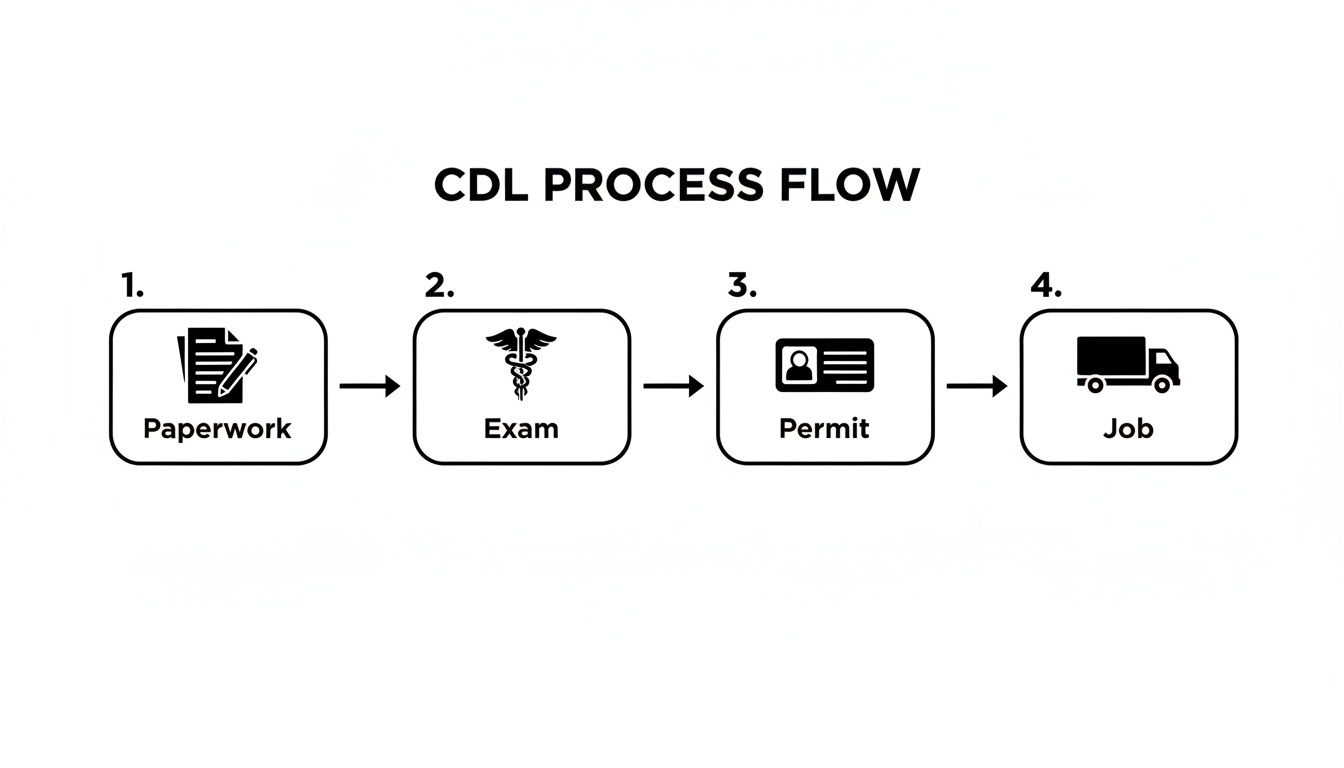
As you can see, getting the paperwork and permits squared away is the foundation for everything that follows.
From the Classroom to the Cab
Once you have that CLP in your hand, things get exciting. This is where the classroom theory meets the asphalt. A supportive school with patient instructors makes all the difference here.
You’ll start with the basics—pre-trip inspections and learning the controls—before moving on to the skills that really count, like tricky backing maneuvers and handling the truck in actual city traffic. It's all about building muscle memory and confidence. The point isn't just to pass the road test; it's to make you a safe, competent driver who’s ready for the job.
A great training program does more than teach you how to drive; it prepares you for the lifestyle and responsibilities of being a professional trucker. It builds the habits and mindset needed for a long, successful career.
At Patriot CDL, we walk you through this entire process, step-by-step. We know what it takes to get from an aspiring student to a professional driver, and we're here to make that journey as smooth as possible. If you’re ready to get started, you can sign up for our program and take that first step today.
Is an Accelerated Program Your Fastest Path to Success?
For a lot of people ready to jump into a new career, time is money—literally. If you're transitioning out of the military, fresh out of school, or just ready for a change, you can't afford to spend months in training. This is where an accelerated commercial driving school really shines.
Instead of dragging things out, these programs pack everything you need to know into a super-focused timeframe. It’s not about cutting corners. It’s about total immersion. When you’re living and breathing trucking every day, the information sticks. Daily, hands-on practice builds a kind of momentum that a part-time schedule just can’t replicate.
The Power of Intensive Training
Think about the alternative for a second. With a weekend-only class, you might spend the first hour of every Saturday just trying to shake off the rust and remember what you practiced last Sunday. That constant stop-and-start cycle makes it incredibly tough to build the muscle memory you need for tricky maneuvers like alley docking or handling a rig on crowded city streets.
An accelerated program, like the three-week course we run at Patriot CDL, keeps you in the driver's seat day in and day out.
- Consistent Practice: You’re behind the wheel constantly, turning new skills into automatic reflexes.
- Faster to the Finish Line: You could be licensed and earning a paycheck in your new career in less than a month.
- Realistic Preparation: The full-time schedule gets you into the mindset of a professional driver, who needs to be focused and dedicated every day.
This approach is smart with both your time and your wallet. The faster you get your CDL, the faster you start bringing in an income. One of the most crucial skills you'll master is the daily pre-trip inspection, which is fundamental to a safe career. You can learn more about the pre-trip inspection and see why it’s so important.
An accelerated program is all about efficiency, not shortcuts. It’s a concentrated dose of top-tier, hands-on training built to turn out confident, road-ready drivers in the shortest time possible.
Built for Immediate Employment
This kind of focused training model depends on expert instructors who can spot and fix bad habits before they even start. You learn the right way from day one. As you search for a "commercial driving school near me," keep in mind that the way a school teaches directly impacts how prepared you'll be for your first job.
At the end of the day, the goal isn’t just to get a license—it's to get a job. Trucking companies want to hire graduates who are competent and confident from the moment they get the keys. An accelerated program is designed to produce exactly that kind of driver, making it the most direct route to a great career on the open road.
Your Top Questions About Local CDL Training, Answered
When you start Googling "commercial driving school near me," a flood of questions usually follows. That's completely normal. Making the right choice means getting straight answers, so let's cut through the noise and tackle the questions I hear most often from new drivers.
Think of this as your personal FAQ. We'll cover everything from the real cost of tuition to what kind of license you actually need. Getting these details sorted out now will help you compare schools honestly and know exactly what to expect.
So, What's This Going to Cost Me?
The price for CDL training is all over the map, but you can generally expect to see figures between $3,000 and $10,000. Where a school falls in that range depends on its location, the quality of its equipment, and how long the program runs. Before you even think about signing on the dotted line, you absolutely must get a detailed cost breakdown.
A good, transparent school won't hide anything. You need to know precisely what your tuition dollar covers. Ask them directly:
- Are the fees for my DOT physical and drug screen included?
- What about the cost of the commercial learner's permit (CLP)?
- Will I have to pay extra to use a school truck for my final road test?
- Are all the books and study materials part of the package?
Nothing sours the experience like surprise fees. Always ask about their financing options, too. Many of the best schools have payment plans or can point you toward grants to make the investment feel a lot less intimidating.
How Long Until I Actually Have My CDL?
This really comes down to the kind of program you choose. Some schools offer traditional, part-time courses that can drag on for months. Frankly, that can be a slow, frustrating way to start a new career. Weekend-only classes are particularly tough—you often spend half of Saturday just trying to remember what you learned last Sunday.
On the flip side, you have accelerated programs built for one thing: getting you licensed and working, fast. A full-time, intensive course like the one we run at Patriot CDL can have you fully trained and ready for the road in just three to four weeks. It's an immersive approach that works best for people who are serious about earning a paycheck sooner rather than later.
The secret to effective training is daily, hands-on practice. That constant repetition builds the muscle memory and confidence you need behind the wheel, something a drawn-out schedule just can't replicate.
What's the Real Difference Between a Class A and Class B CDL?
Knowing which license to go for is critical—it sets the entire trajectory of your career. The main difference is all about the size and type of vehicle you'll be certified to operate.
A Class A CDL is the king of the road. It’s the most versatile license you can get, letting you drive combination vehicles (like a tractor-trailer) with a gross weight of 26,001 pounds or more.
A Class B CDL is for heavy single vehicles, like straight trucks, dump trucks, or buses, that weigh more than 26,001 pounds. If you're dreaming of a long-haul career with the maximum number of job opportunities, the Class A is the industry standard and the one you'll want.
Do I Need to Find a Job Before I Enroll?
Nope, not at all. In fact, it's the other way around. One of the biggest perks of going to a top-tier driving school is the job placement assistance they offer. You shouldn't be stressing about finding work while you're trying to master a 9-speed transmission.
Any school worth its salt will have solid connections with major trucking companies that are eager to hire their graduates. It's common for students to get pre-hire letters or even solid job offers before they've finished the program. When you're talking to schools, make sure to ask about their placement rate and which specific carriers recruit from their campus. That support is the bridge that takes you from the classroom to your first paycheck.
Ready to stop searching and start driving? Patriot CDL offers an accelerated, three-week program designed to get you on the road to a successful new career faster. Learn more and enroll today.