


An instructor can correct a visible mistake, but cannot always see the uncertainty that produced it. A student may nod after a demonstration while still wondering which mirror mattered, why movement stopped, or whether the same technique works with a different trailer. Good questions make that hidden gap visible before it turns into a repeated habit. Asking them is part of learning to operate a commercial vehicle responsibly.
The goal is not to interrupt every instruction or turn a road lesson into a debate. It is to describe an observation clearly, select a safe time for discussion, and leave with something you can demonstrate. This guide explains how to move from a broad complaint such as “I cannot back” to a precise conversation about observation, decisions, and vehicle control. The examples are learning exercises, not instructions to attempt a maneuver without supervision.
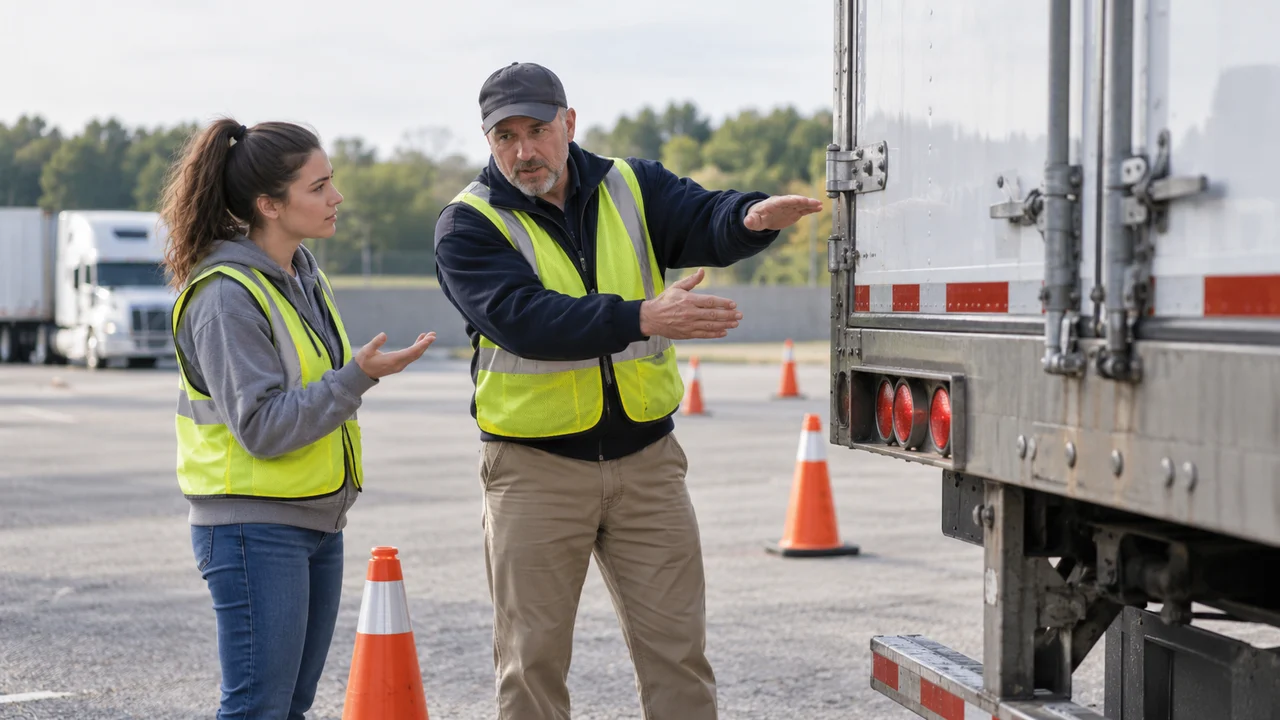
Replace broad confusion with an observable problem
Name the task
Describe the exact maneuver or inspection section you were performing, rather than saying that the entire lesson went badly. A straight-line setup and a late correction during an offset create different teaching problems. Write one sentence naming the task and the point where you became unsure.
“When did you first become unsure?” is often more useful than “Why did I fail?” A task can contain several successful decisions before the problem appears. Locating that first uncertain moment helps the instructor avoid reteaching parts you already understand.
Separate observation from interpretation
Tell the instructor what you saw, heard, or felt before offering your explanation of the cause. The trailer disappearing from one mirror is an observation; saying the steering was wrong is a conclusion that may miss the earlier setup problem. List the visual cue first and your interpretation on a separate line.
A mirror image can be described without knowing the correct response yet. Explain which boundary remained visible, which side you had not updated, and whether the vehicle was moving. Those details provide a better starting point than a confident theory about steering.
Choose a safe moment and a useful question format
State the decision you made
Explain which action followed the uncertain cue so the instructor can reconstruct the sequence. A correction may be reasonable in isolation but too late for the space available. Describe your action without defending it, then ask which earlier cue mattered.
Include the sequence, not just the last action. If you turned, looked again, and then stopped, say so. The instructor may find that the late observation mattered more than the size of the correction, which changes what you should practice next.
Reserve nonurgent discussion
Save extended questions for a secured vehicle or another pause approved by the instructor. Detailed conversation while entering a junction can compete with scanning and listening. Mark the question mentally and discuss it once the instructor says it is safe.
A parked discussion also allows a diagram, demonstration, or manual reference without dividing the instructor’s attention. Ask when the lesson has an appropriate review point. On the road, necessary communication should remain short enough to preserve attention for traffic and control.
Learn from demonstrations without copying blindly
Clarify before uncertain movement
Ask a short, direct question when you do not understand an instruction that affects the immediate path. Guessing which cone or lane the instructor means can create a preventable conflict. Rehearse a brief request such as “Please confirm the destination before I move.”
There is a difference between questioning an explanation and clarifying an instruction before movement. “Which opening do you mean?” can prevent an immediate misunderstanding. A long discussion about why the route was selected normally belongs at a safer point in the lesson.
Ask for one demonstration objective
Request that the instructor point out a particular cue instead of trying to absorb every hand and eye movement simultaneously. Watching the steering wheel alone hides the mirror observation that triggered a correction. Choose a cue to watch and explain it back after the demonstration.
Watch for the cue before watching the action. If you copy the instructor’s hands, you may reproduce steering while missing why it was appropriate. Ask the instructor to describe the observation first, then connect it to the demonstrated response afterward.
A practical comparison to keep in your notes
| Checkpoint | What to confirm | Why it matters |
|---|---|---|
| Name the task | Describe the exact maneuver or inspection section you were performing, rather than saying that the entire lesson went badly. | A straight-line setup and a late correction during an offset create different teaching problems. |
| State the decision you made | Explain which action followed the uncertain cue so the instructor can reconstruct the sequence. | A correction may be reasonable in isolation but too late for the space available. |
| Clarify before uncertain movement | Ask a short, direct question when you do not understand an instruction that affects the immediate path. | Guessing which cone or lane the instructor means can create a preventable conflict. |
| Ask what would change the answer | Find out which equipment, surface, clearance, or traffic difference would require a different choice. | A technique demonstrated with one wheelbase should not become a universal steering formula. |
| Connect a manual paragraph | Bring a marked section of the CDL manual and ask how its safety principle appears in the training vehicle. | Knowing a definition of offtracking is different from noticing the rear wheels approaching a curb. |
| Request measurable feedback | Ask what successful performance would look like before repeating the task. | “Be smoother” provides less direction than identifying an early observation and controlled response. |
Use questions to connect theory and the truck
Ask what would change the answer
Find out which equipment, surface, clearance, or traffic difference would require a different choice. A technique demonstrated with one wheelbase should not become a universal steering formula. Name one changed condition and ask whether the same method still applies.
Ask about transfer deliberately: would the explanation change with a longer trailer, a different starting angle, or reduced visibility? The answer prevents a useful example from becoming a rigid formula. Keep each changed condition separate so you can understand its effect.
Use teach-back
Restate the explanation in your own words, including the reason for stopping or changing the plan. Repeating the instructor’s phrase perfectly does not prove you can identify the situation independently. Explain the cue, decision, and stopping point without looking at notes.
Teach-back should include uncertainty as well as the answer. Say what you would still need to check before acting. An instructor can then correct an incomplete interpretation before it becomes a confident but unsafe habit during the next attempt.
A worked lesson: uncertain trailer clearance
Connect a manual paragraph
Bring a marked section of the CDL manual and ask how its safety principle appears in the training vehicle. Knowing a definition of offtracking is different from noticing the rear wheels approaching a curb. Locate the physical example that corresponds to the reading.
For inspection questions, point to the component only in an approved safe setting. Ask which condition you are evaluating and what you cannot determine visually. Learning the phrase without locating the part can leave a gap hidden until a later assessment.
Identify an actual knowledge gap
Distinguish not knowing a component name from not understanding how to inspect its condition. Additional vocabulary practice cannot by itself fix an unsafe inspection method. Ask whether the next exercise should target language, observation, or judgment.
Language can create a separate barrier. If you understand the physical idea but not an English term, ask for the term and use it in a complete explanation. Do not assume that memorizing vocabulary alone establishes understanding of the required safety decision.
Make each answer part of your next practice
Request measurable feedback
Ask what successful performance would look like before repeating the task. “Be smoother” provides less direction than identifying an early observation and controlled response. Agree on one observable behavior the instructor will watch.
Useful success criteria describe behavior rather than emotion. “I can identify the boundary before correcting” can be observed; “I feel better” cannot establish that the observation improved. Confidence may follow practice, but the instructor needs evidence of the actual skill.
Close the question loop
Record the answer and test your understanding in a later supervised attempt. A useful explanation is easily forgotten when the lesson moves to a different skill. Return with the previous question and describe what you did differently.
At the next lesson, state what you tried after the explanation and what remained difficult. This lets the instructor refine the answer instead of repeating it unchanged. A question has done its job when it leads to understanding you can demonstrate, not merely an agreeable conversation.
Checklist for your next step
- Identify the task and the moment of uncertainty
- State what you observed before describing your theory
- Ask for clarification before an unclear movement
- Wait for a safe pause for extended discussion
- Explain the answer back and practice under supervision
- Record the cue you will look for next time
Choose the checklist item that remains least certain and turn it into a concrete question. For this topic, a useful starting point is “Identify the task and the moment of uncertainty: what have I actually confirmed?” Work through that answer before moving to the next item. Keep a note of the source or instructor feedback that supports your decision, especially where a requirement, equipment difference, or employer process could change what happens next.
Frequently asked questions
Will asking questions make me look unprepared?
A specific question shows that you are paying attention. Prepare by reviewing the assigned material, then identify what remains unclear. An instructor can work more effectively with an honest uncertainty than with a student who agrees but guesses during the maneuver.
Should I ask while the truck is moving?
Keep immediate safety communication brief and follow your instructor’s directions. Save long explanations for an approved pause with the vehicle secured. If you do not understand an instruction that affects movement, request clarification before committing to an uncertain path.
What if two instructors explain a skill differently?
Describe the equipment and situation attached to each explanation. Ask which safety principle both methods address and which conditions make one appropriate. Do not combine partial procedures or choose whichever version seems easiest without having the difference resolved.
How many questions should I bring to a lesson?
Prioritize a few questions that affect the next planned skill, especially safety-critical uncertainties. A short list with clear observations is more useful than a large collection of unrelated questions. Add follow-up questions after you demonstrate the first answer.
Official references and next steps
Use the for state study material and to confirm the federal training framework. These sources answer different questions; neither should be confused with a school advertisement or an employer’s individual hiring terms.
Originally dated 2026-10-02; expanded and reviewed October 19, 2026. Examples are illustrative and do not describe a promised test or employment outcome. Follow current official requirements and qualified instruction for the actual vehicle and setting.