


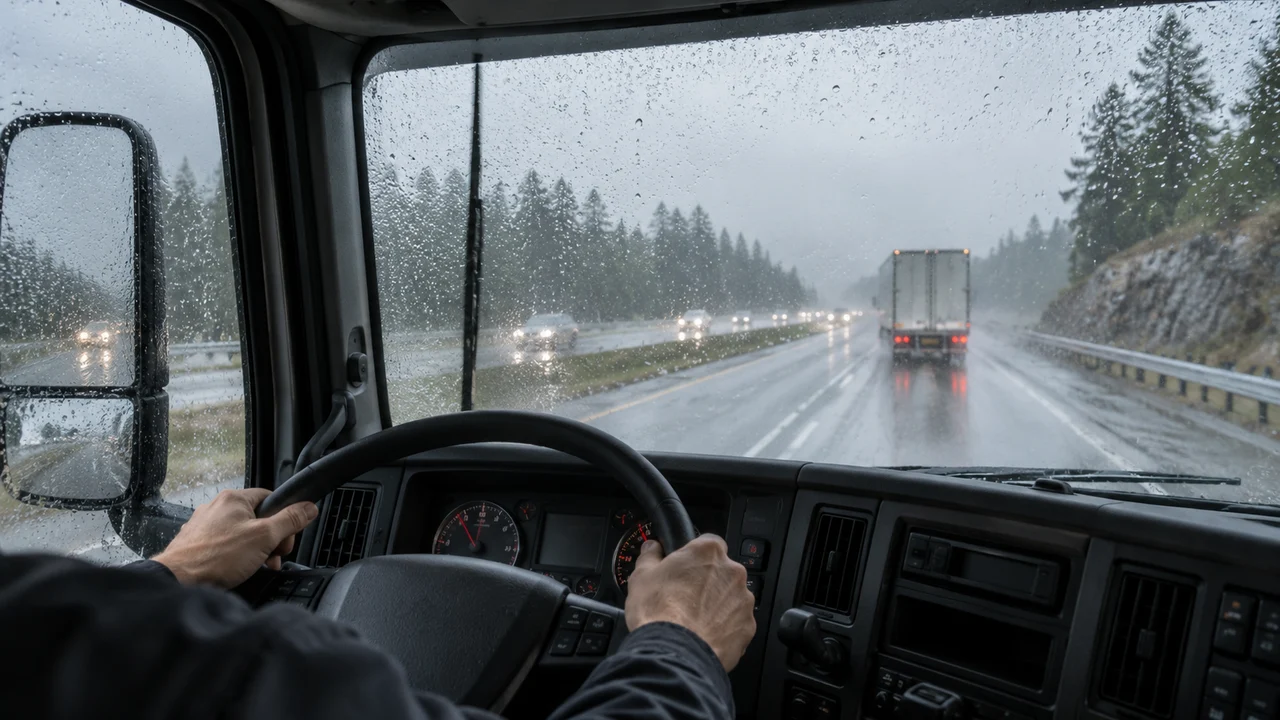
Fog changes more than how far a driver can see. It can hide a stopped queue, obscure a ramp, reduce the usefulness of road markings, and make the speed of other vehicles harder to judge. A commercial driver must respond before the limited view becomes a last-second emergency. Slowing is part of the response, but it does not automatically make continued travel safe. The driver also needs a plan for route decisions, following space, visibility equipment, and an appropriate place to discontinue the trip if necessary. This guide explains how CDL students can discuss low-visibility decisions with an instructor and how to evaluate them afterward. It does not supply a universal visibility distance or speed that makes fog safe. The actual conditions, vehicle, traffic, current rules, and available stopping options must determine the response. A lesson or delivery schedule should never be treated as proof that the road remains suitable.
Make the weather decision before visibility disappears
Check more than the forecast headline
Review current conditions along the route, including areas where visibility may change quickly. A departure point with clear weather does not establish that the entire trip will remain clear. Consider low-lying areas, water crossings, grades, and the possibility of rapidly changing conditions without assuming a local pattern will occur exactly as expected.
During training, discuss the route and weather with the instructor before moving. Ask which conditions would lead to a different route, a delayed lesson, or a stop. Defining those decision points early is easier than debating them after the truck enters a dense patch and attention is already heavily occupied.
Understand the rule as a decision responsibility
FMCSA’s hazardous-conditions framework addresses reduced visibility and traction, including fog. It requires extreme caution, reduced speed, and discontinuing operation when conditions become sufficiently dangerous, subject to the rule’s limited safety provision about stopping. Read the current text and applicable guidance directly rather than reducing it to “drive slowly and continue.”
For a student, the instructor directs the safe conduct of the lesson, and the student should communicate a concern promptly. In employment, use the carrier’s reporting process while preserving the driver’s safety responsibilities. A weather conversation should describe the conditions and decision needed, not merely ask whether the schedule can still be met.
Prepare the vehicle’s visibility systems
Check the equipment that supports the view
Before departure, confirm through the instructed inspection that relevant lights, mirrors, windshield, wipers, washers, and defogging systems are ready for the expected conditions. A dirty windshield or poorly adjusted mirror can make a reduced-visibility situation harder to interpret. Report an unresolved concern before the trip rather than hoping the weather will stay favorable.
Learn the controls while stationary. Searching for a defogging setting after entering fog adds a nonessential task at the wrong moment. Ask the instructor to explain the appropriate lighting and visibility-control use for the actual vehicle. Do not assume that a control position from a previous truck works identically on another.
Keep the cab from adding another visibility problem
Secure objects that obstruct the view or distract attention. Manage interior reflections and avoid unnecessary screen use. If the windshield begins to fog internally, address it through the proper controls before the usable view becomes inadequate. If the problem cannot be resolved safely while operating, seek an appropriate safe stopping opportunity.
Good equipment preparation does not make dense fog harmless. It removes avoidable limitations so the driver can judge the actual road conditions more accurately. The decision to continue still depends on the view ahead, traffic, stopping needs, and current requirements. A clear windshield cannot reveal a hazard hidden farther down the road by weather.
Connect speed and following space to the usable view
Do not let another vehicle become your visibility strategy
Following tail lights can feel reassuring, but the vehicle ahead may be traveling too fast for the conditions or may brake suddenly. Keep a following margin appropriate to the actual situation and continue evaluating the visible roadway. A pair of lights does not show that the pavement beyond them is clear.
Reduce speed early as visibility declines and avoid abrupt changes when a controlled adjustment is available. Consider the traffic behind as well as the road ahead. The response should remain predictable without allowing pressure from following vehicles to determine an unsafe pace. During instruction, communicate briefly and let the instructor guide any route or stopping decision.
Recognize when reduced speed is no longer enough
If the usable view becomes too limited for safe operation, a further trip decision is needed. Do not continue indefinitely at a crawl simply because the truck remains upright and in the lane. Other vehicles, ramps, hidden queues, and stopping locations still create hazards. The question is whether safe operation remains possible, not whether the driver can tolerate the discomfort.
A student should learn to identify the change in conditions that triggers the concern. “Visibility is decreasing and I cannot establish the traffic picture beyond the nearest lights” is more informative than “I dislike fog.” Accurate language helps the instructor respond to the actual limitation and later helps a professional driver communicate with a dispatcher or supervisor.
Keep lane and route decisions simple
Reduce nonessential movements
Fog makes it harder to judge gaps, locate exits, and identify vehicles beside the truck. Avoid unnecessary lane changes and keep the driving task as simple as conditions permit. A missed exit is not a reason for a sudden movement. Preserve control and follow an appropriate route-review plan instead.
Read the visible road markings and signs while maintaining the broader scan. Do not fixate on one line or object so completely that other hazards disappear from attention. If the route becomes uncertain, acknowledge that uncertainty early rather than trying to solve it with navigation adjustments while driving.
Expect hazards hidden by ordinary features
A crest, curve, entrance ramp, or work zone can already limit the view; fog can compound that limitation. Treat the combination as a planning demand. A familiar road does not guarantee familiar conditions, and knowing where the next turn lies does not reveal whether traffic is stopped beyond it.
Review warning and regulatory signs before the lesson so recognition requires less effort, but do not assume study removes the need to see and interpret the current control. If the route is unsuitable, the correct response is a safer plan, not a more determined attempt to follow the original line.
Plan a safe discontinuation and a careful restart
Identify an appropriate place before it becomes urgent
Where practical, include suitable stopping locations in pre-trip planning. A travel lane or exposed shoulder is not a routine place to wait out fog. The available location must be evaluated for traffic exposure, access, space, and lawful use. Follow the instructor’s or carrier’s appropriate procedure and current emergency guidance when a safe normal stop is not immediately available.
Communicate the decision when safely able. Describe the location, conditions, and plan. Do not send messages or search for parking while simultaneously trying to maintain control in deteriorating visibility. A short earlier discussion can reduce the temptation to multitask at the worst point.
Restart because conditions support it
Waiting a certain number of minutes does not establish that the route is safe again. Reassess visibility, traffic, weather information, and the route ahead. A clear patch near a parking area may not describe the next segment. Confirm the next step with the instructor or relevant operating process.
After the trip, review the earliest useful warning and the decision that followed. Ask whether a stopping option should have been identified sooner or whether a nonessential task added workload. Connect the lesson with vehicle preparation and supervised road training. Low-visibility judgment improves when the student can describe the decision process clearly rather than remembering only that the drive felt stressful.
Separate discomfort from an observable limit
Students sometimes hesitate to raise a weather concern because they worry it will sound like a lack of confidence. Use observable information instead: a sign cannot be read at a useful distance, the queue disappears from view, or a control is not clearing the windshield. That description gives the instructor something concrete to assess. It also prevents the opposite error of continuing merely because the driver feels calm. Confidence and safe visibility are different measures, and neither anxiety nor familiarity should replace an evaluation of the actual road.
Worked example: turning the plan into action
A clear departure followed by a dense low-lying patch
A student and instructor leave in clear conditions after reviewing weather and route information. The route includes a lower area where visibility may change. They have discussed an appropriate stopping option before that segment and agreed that the lesson will change if the view becomes unsuitable.
As visibility begins to decline, the student reduces speed appropriately and preserves additional space rather than closing on the tail lights ahead. The windshield and defogging controls were checked before departure, so no search for a control is needed. Navigation remains untouched.
The next section becomes substantially more obscured. The student reports the limitation in specific terms: the roadway and traffic picture ahead cannot be established reliably. The instructor directs the appropriate change in plan and uses the previously discussed stopping opportunity while conditions still allow a controlled approach. The lesson objective is deferred rather than treated as a reason to continue.
While stopped safely, they review current information and the route ahead. They do not restart solely because the clock has advanced or nearby pavement appears clearer. During debrief, the student identifies the useful decisions: preparing controls, recognizing the decline early, avoiding reliance on another vehicle’s lights, and discussing a stopping option before the need became urgent.
A low-visibility decision checklist
| Decision area | Question | Action to prepare |
|---|---|---|
| Before departure | Where could conditions change, and what current information is available? | Review the route and identify suitable stopping options. |
| Vehicle | Are visibility systems ready and controls understood? | Resolve concerns and learn settings while stationary. |
| Traffic | Can the visible distance support safe operation? | Adjust early and reconsider continued travel if necessary. |
| Route | Would a lane change or exit add avoidable uncertainty? | Keep movements simple and avoid a last-second correction. |
| Restart | Do current conditions support the next segment? | Reassess the route instead of relying only on elapsed time. |
Read the primary and for the current federal framework.
Archive entry for October 15, 2026; added October 19, 2026.
Frequently asked questions
Is driving slowly always enough to make fog safe?
No. Reduced speed may be necessary, but conditions can become too dangerous for continued operation. Evaluate visibility, traffic, stopping needs, and the available route. FMCSA’s hazardous-conditions framework includes discontinuing operation when required by the conditions. During training, communicate the concern early and follow the instructor’s safe direction.
Should I follow another truck’s tail lights through fog?
Do not make another vehicle your visibility plan. Its driver may be moving too fast or may encounter a hazard you cannot see. Preserve an appropriate margin and evaluate the visible roadway yourself. Tail lights show a vehicle’s location, not that the pavement and traffic beyond it are safe.
Can I stop on the shoulder to wait for fog to clear?
An exposed shoulder is not a routine waiting location and can create serious traffic exposure. Plan suitable stopping options before visibility deteriorates where possible. If an emergency develops, follow applicable emergency procedures and qualified direction. The appropriate response depends on the actual location and conditions; avoid treating any paved space as automatically safe.
When is it reasonable to restart after stopping for poor visibility?
Reassess current visibility, traffic, weather information, and the next route segment. Do not rely only on elapsed time or a clearer patch near the parking location. During a lesson, the instructor determines the next safe activity. In employment, follow the carrier’s appropriate communication process while maintaining the applicable driver safety responsibilities.
Official sources and next steps
For Pennsylvania licensing and vehicle-operation guidance, consult the current . For entry-level training applicability and provider requirements, use . These are primary references; a study article does not replace current official instructions, an enrollment agreement, or supervised instruction.
Discuss your next step with Patriot CDL at , or visit 7800 Bristol Pike, Levittown, PA 19057. Compare training programs and ask which preparation will be most useful for your intended vehicle and license.