


A student may recognize every answer in a CDL practice quiz and still feel lost beside a tractor. The problem is often the gap between a word, a component, and the decision that component helps the driver make. A careful vehicle walkthrough closes that gap without turning a parked lesson into an improvised repair job. Your purpose is to understand the equipment you will train in, explain its safety function, and recognize when a condition needs the instructor’s attention. This guide shows how to turn a manual chapter into a useful supervised learning session rather than another list to memorize.
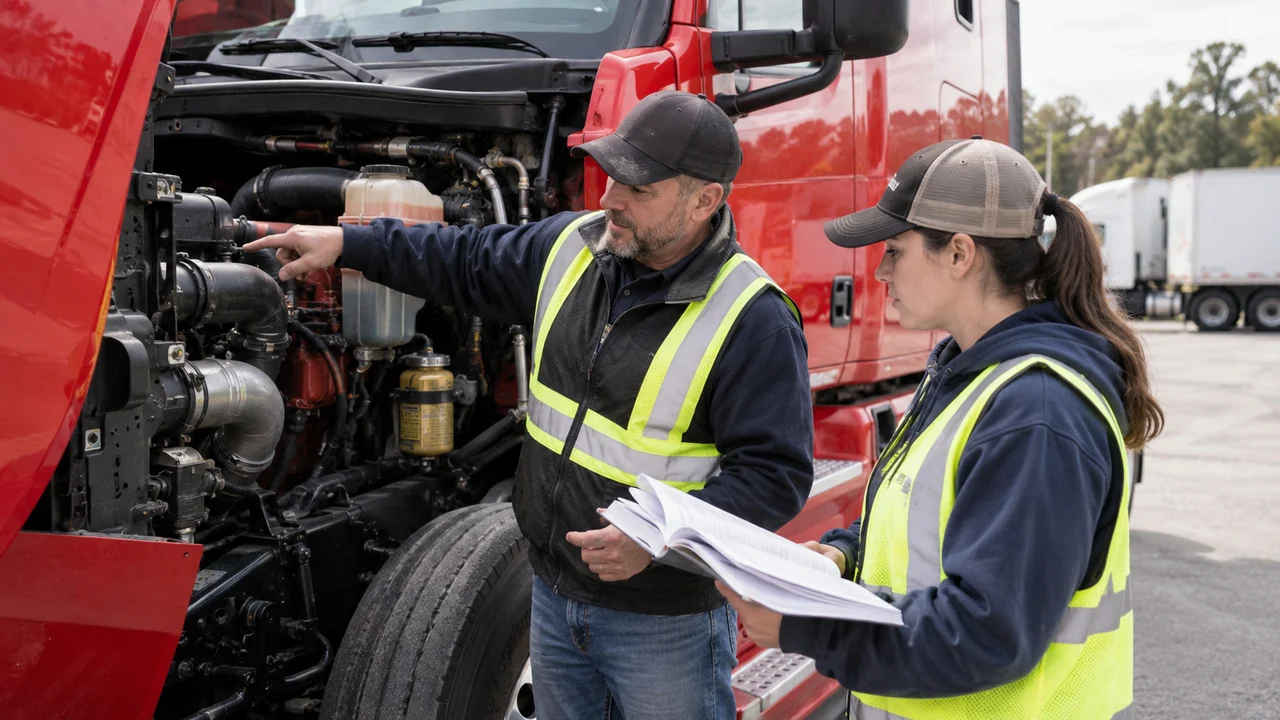
Build a bridge from manual diagrams to actual equipment
Begin with one vehicle system rather than an entire inspection. Steering, suspension, braking, coupling, and lighting each contain related parts that are easier to understand together. Read the relevant manual explanation before approaching the truck. Write the name of a component, its basic purpose, and the area where you expect to find it. Leave room to correct your assumption. The training truck may use a different arrangement from an illustration, and differences are a reason to ask a question rather than force the actual equipment to match your notes.
A situation to discuss
You studied steering linkage and expect every visible bar near the axle to be part of steering. Your instructor separates the steering components from suspension components and explains how movement reaches the wheels. The correction matters because naming the wrong system makes a later defect explanation unreliable.
Practice with a clear purpose
Draw a simple relationship map with arrows between the driver’s input, the linkage, and the road wheels. Explain each arrow in ordinary words before adding technical names. Then compare the map with the actual vehicle while it is properly secured.
Ask yourself: Which part of the system can I identify confidently, and which relationship am I still guessing about?
Set safe boundaries before the walkthrough begins
A learning visit to a truck is still an equipment exposure. Ask the instructor how the vehicle has been secured and where you may stand. Remain clear of traffic routes, moving vehicles, hot surfaces, pinch points, and areas where the instructor has prohibited access. Do not crawl underneath, release brakes, start the engine, move controls, or disconnect anything just to improve your view. Some checks require a particular setup or a second person. A photograph taken safely can support later study, but it cannot authorize access to a hazardous location.
A situation to discuss
A learner wants a clearer picture of a coupling component and begins moving between tractor and trailer. The instructor stops the approach, explains the restricted space, and chooses a safe viewing position. The useful lesson includes both the component and the boundary around observing it.
Practice with a clear purpose
Before the session, identify the permitted walking route and the instructor’s stop signal. Ask where to wait if another vehicle enters the area. State which controls and components you will observe only and which checks the instructor will demonstrate.
Ask yourself: What would make me stop this observation and move to a safer position?
Use function before inspection language
A phrase such as securely mounted has meaning only when you know what is mounted and why movement would matter. Ask the instructor to explain the component’s job first. Then connect that job to the condition being inspected. Look for the relevant mounting points, connections, surfaces, or other accessible features. Avoid claiming that everything is satisfactory merely because a familiar sentence came out smoothly. An honest explanation distinguishes what you can see, what requires a prescribed test, and what is outside your knowledge. This is a stronger foundation than memorizing one broad description for every part.
A situation to discuss
Two components can both have fasteners, yet their failure consequences differ. A loose mirror support affects the usable view. A loose mounting in another safety system may affect vehicle control. The same inspection adjective should lead to a specific understanding of the problem.
Practice with a clear purpose
Select three components and finish these sentences: this part helps the vehicle do something; I inspect this visible feature; an abnormal condition here could create this risk. Have the instructor correct both terminology and reasoning.
Ask yourself: Can I explain the consequence of the condition I am describing?
Connect cab controls with the systems outside
The cab offers a second perspective on the same equipment. A gauge is an indication, a warning device draws attention, and a control produces a response. Learn the difference before combining them into a procedure. While parked, locate relevant controls and explain what information each provides. Ask which readings change normally during an authorized demonstration and which behavior calls for stopping. Do not assume that a dashboard indicator proves every part of a system is working. Learning the relationship between indication and physical equipment makes later troubleshooting questions more precise.
A situation to discuss
An air-pressure gauge reading becomes easier to understand when the instructor connects it to stored air and demonstrates the approved check sequence. A learner who understands that relationship is less likely to confuse an ordinary gauge change with permission to continue an incomplete test.
Practice with a clear purpose
Create a two-column card pairing a cab item with the outside system it relates to. Add a third column for what the item cannot prove. Use the card only while parked, then practice locating the controls without unnecessary searching.
Ask yourself: What information does this gauge provide, and what must still be inspected separately?
Turn the walkthrough into a useful study record
Record corrections immediately after the instructor finishes, away from moving equipment. A productive note contains the official term, a simple description, a permitted photograph or sketch, and a question resolved during the session. Keep vehicle-specific observations separate from general principles. The position of a reservoir or a particular switch may differ on another truck, while the reason for checking the system remains important. Date the notes and identify the vehicle so an old observation is not mistaken for the current condition of different equipment.
A situation to discuss
Your notebook says that a control is on the left side of the dash. The next training vehicle places it elsewhere. If your notes also explain its function and symbol, the equipment change becomes manageable. If the notes contain only a location, your understanding disappears with the familiar dashboard.
Practice with a clear purpose
Rewrite one page after the lesson using two headings: principles that transfer and details specific to this truck. Ask the instructor to review any statement that sounds universal but came from observing only one vehicle.
Ask yourself: Which detail would I need to relearn on a different truck?
Test understanding without turning recall into a performance
Close the manual and describe one system to a classmate or instructor. Use accurate names where you know them and ask when you do not. Start with the function, move through the accessible components, and explain the inspection purpose. An interruption or correction is useful evidence of what to study next. Avoid judging progress only by the speed of a recitation. A slower explanation that accurately connects parts, conditions, and consequences is more useful than a polished sentence that hides confusion. Knowledge retrieval should reveal uncertainty early while the vehicle remains stationary.
A situation to discuss
The instructor changes the question from what is this part to why do you check this connection. A student who memorized labels may stall, while a student who understands the system can explain the relationship and then refine the technical wording.
Practice with a clear purpose
Ask for three different kinds of questions: identification, purpose, and a hypothetical abnormal condition. Record which kind causes difficulty. Build the next study session around that gap rather than rereading every chapter equally.
Ask yourself: Can I answer a changed question without relying on the original sentence?
Carry one learning objective into the next lesson
End with a small objective that affects the next supervised session. You might identify a system accurately, locate two controls confidently, or explain why a visible condition needs attention. Discuss the objective before training starts so the instructor can connect it with appropriate tasks. Keep repairs and operational decisions with qualified personnel. A walkthrough supports skill development; it does not replace the required training, an inspection procedure, or a readiness evaluation. The value appears when the next lesson includes fewer uncertain searches and better explanations of what you observe.
A situation to discuss
After reviewing the visibility system, the learner enters the next lesson able to locate defogging controls while parked and describe a mirror-view concern precisely. That improvement supports a safer departure discussion without suggesting the learner can diagnose or repair every visibility defect.
Practice with a clear purpose
Write a goal with observable evidence: I will locate the relevant control, explain its purpose, and identify when to ask for help. Review the result after the next lesson and choose the next system only after the first connection is clear.
Ask yourself: What specific improvement should my instructor be able to observe next time?
Decision worksheet
| Focus | Why it matters | Practical action |
|---|---|---|
| Manual term | Identify its function | Paraphrase before visiting the truck |
| Diagram | Locate the actual arrangement | Ask about differences instead of assuming |
| Inspection phrase | Connect condition with risk | Explain what you can actually observe |
| Cab indication | Relate display to the system | Separate indication from proof of condition |
Preparation checklist
- Choose one vehicle system and read its manual section.
- Confirm safe access and the vehicle setup with the instructor.
- Identify components without touching controls or entering restricted spaces.
- Explain purpose, visible condition, and safety consequence.
- Separate general principles from truck-specific locations.
- Retrieve the explanation later and record remaining questions.
Workshop: trace one symptom without guessing at a repair
Imagine an instructor has identified a visibility concern during a parked walkthrough. Your job is not to announce which part should be replaced. Begin by describing the information that is unavailable to the driver: perhaps the mirror view does not cover the expected area, or a clearing pattern leaves an important section of glass obscured. Identify the relevant components and ask which observation can be made safely from the authorized position. This keeps the discussion focused on evidence and prevents a memorable component name from becoming an unsupported diagnosis.
Next, separate three statements in your notes. The first is an observation: what was seen or demonstrated. The second is an explanation supplied by the instructor: how that feature normally supports visibility. The third is an unresolved question: what still needs evaluation by appropriate personnel. Do not merge those statements into a single confident claim. Students learn more reliably when uncertainty has a visible place in the notebook rather than being covered by technical language.
Finally, return to the manual and locate the principle behind the observation. Explain why that principle transfers to a different vehicle even when component locations change. On the next supervised visit, identify the equivalent function before searching for the same shape or mounting position. This is the difference between recognizing one familiar truck and developing a method for learning unfamiliar equipment.
A useful assessment asks you to identify the system, explain its purpose, state a relevant condition, and describe the limit of your observation. Ask the instructor to change the question order. If the explanation still works, the knowledge is becoming connected. If the answer collapses without the original order, return to the relationship map. The objective is not an impressive recitation beside the truck; it is an explanation that remains accurate when the vehicle, question, or visible arrangement differs.
Check transfer on an unfamiliar arrangement
For a final review, ask the instructor to describe a vehicle whose component locations differ from your training truck. You do not need to guess where every item has moved. Explain the system function, the information you would seek, and the safe way you would obtain guidance before operating or inspecting unfamiliar equipment. This tests whether the walkthrough taught a method or only a set of locations.
Then return to one original note and remove the photograph. Can you explain the purpose accurately from the name alone? Restore the photograph and remove the label. Can you identify what is visible without claiming to inspect hidden features? These two questions test different skills. Record the weaker one as the next study objective. A useful walkthrough leaves the learner better able to ask an accurate question, recognize the boundary of an observation, and connect the instructor’s answer with the manual. Those habits remain useful when the vehicle changes.
Frequently asked questions
Can I learn vehicle inspection from pictures alone?
Pictures help with recognition, but supervised access to actual equipment is needed to connect diagrams, locations, inspection methods, and safe boundaries. Use the current manual and your instructor’s vehicle-specific guidance.
Should I memorize component names before training?
Learn a small group of accurate names and their functions first. Expand the vocabulary as you see the system. Memorizing long lists without understanding relationships often makes later explanations harder.
What if the truck looks different from the manual?
Ask the instructor to explain the configuration. Manuals illustrate principles and common arrangements, while actual vehicles vary. Do not invent a procedure or assume a component is missing because the picture differs.
Where can I discuss hands-on CDL preparation?
Contact Patriot CDL at 267-910-2000 or visit 7800 Bristol Pike, Levittown, PA 19057 to discuss your experience, licensing goal, and appropriate training options.
Official references and further reading
- : consult the current sections relevant to your vehicle and test.
- : an official starting point for road-safety topics.
- : check the categories covered by federal entry-level training requirements.
Reviewed October 19, 2026. Educational preparation supports, and does not replace, current official requirements and supervised vehicle-specific instruction.