


The next CDL lesson often begins before you reach the training yard. If the instructor asks what happened last time and you cannot remember the correction, several useful minutes may disappear while you reconstruct it. A small preparation routine gives the lesson a starting point: the skill you are working on, the evidence from your previous attempt, and the question you need answered.
Twenty minutes is a planning tool, not a promise that every student can master a subject that quickly. Difficult theory may need longer study, and vehicle skills require supervised practice. The purpose of this routine is to arrive organized and ready to learn without sacrificing sleep or substituting home rehearsal for instruction.
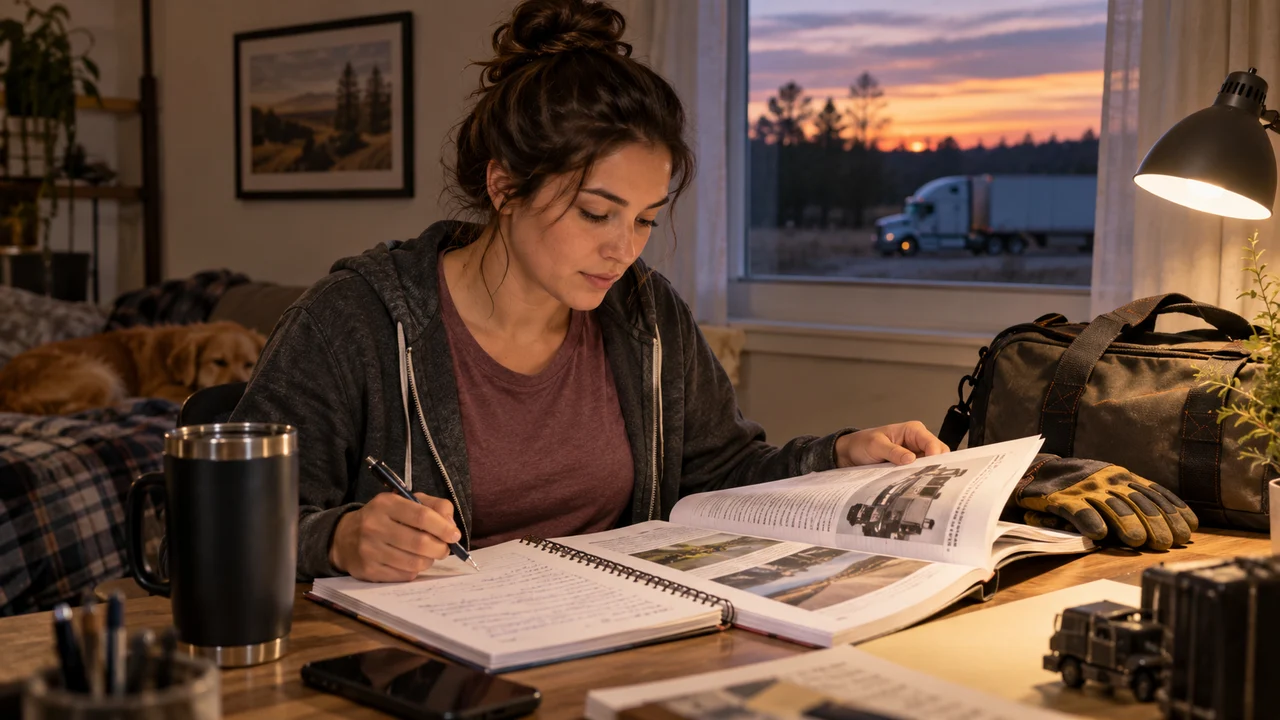
Choose a specific outcome before you start
Replace a broad ambition with an observable action
“Get better at backing” is a reasonable ambition but a weak preparation target. It includes setup, observation, steering, trailer response, clearance, and recovery. Pick the part your instructor actually identified. A more useful note might say, “I began the correction after the trailer had already crossed my intended path; ask how to recognize that movement sooner.” The difference is that the second statement gives both of you something to observe.
Start with the lesson record, not the most dramatic moment you remember. An uncomfortable stall may stand out even though the instructor considered late mirror checks the larger problem. Write down the correction in the instructor’s language, then add your interpretation underneath. Keeping those separate makes it easier to discover a misunderstanding before it becomes a habit.
Separate knowledge from performance
If you cannot explain what a warning means, the next step is reading and clarification. If you can explain it but fail to notice it while driving, the next step is supervised observation practice. If your hands move correctly only when prompted, the next step concerns consistency. Labeling the problem prevents you from answering every training difficulty with another online quiz. Choose one priority and one secondary question; leave room for the instructor to change the plan after checking your readiness.
Minutes 1–5: reconstruct the last lesson accurately
Record what happened, what changed, and what helped
Take a blank sheet and describe one attempt in sequence. What was your starting position? What did you notice? What action followed? What feedback did you receive? Details such as “I was too far left before the turn” are more useful than “the turn was bad.” Avoid diagnosing a technical cause you do not understand; identifying the point of uncertainty is already valuable work.
Compare the recollection with written feedback or your training checklist. If your memory and the record disagree, put a question mark beside the item rather than choosing the version you prefer. A student might believe a maneuver failed because the steering was too slow, while the instructor’s note identifies an unsuitable setup. More practice with the same setup would repeat the difficulty.
Keep the record short enough to reuse
Use three entries: continue, correct, clarify. Under continue, name something that worked reliably. Under correct, name one action needing adjustment. Under clarify, ask for an explanation. This keeps review balanced and avoids turning preparation into a list of everything you dislike about your driving. Save the date and vehicle used so you can distinguish a new truck’s characteristics from a recurring personal habit. Stop reviewing when the five minutes end; unresolved questions belong in the next lesson.
Minutes 6–15: study one idea in the official material
Read for the decision, not the highlighted sentence
Open the relevant section of the Pennsylvania CDL manual or the material assigned by your instructor. Read the surrounding explanation as well as the rule itself. A question about a curve, for example, concerns approach speed, traction, vehicle balance, and the available sight line. Memorizing one phrase without its context may leave you unable to apply it when the road looks different.
Close the page and explain the idea aloud using plain words. State the situation, the hazard, and the intended response. Then reopen the material and check what you omitted. The exercise is useful because it exposes a missing connection: perhaps you remember that more space is needed but cannot explain when to begin creating it. Write the gap as a question instead of hiding it behind a memorized definition.
Use a second example
Change one condition in your example. How would the issue differ in rain, with a longer trailer, or near a pedestrian crossing? You are not inventing an independent driving procedure; you are testing whether the reading makes sense. Bring uncertain cases to the instructor. For inspection topics, use the pre-trip inspection resource as a study companion and confirm the actual component names on your training vehicle. Avoid collecting several conflicting internet scripts in the final minutes before class.
Minutes 16–20: remove logistical distractions
Prepare the items that make the lesson possible
Confirm the lesson time, location, clothing requirements, and anything the school has asked you to bring. Place your license or permit and other requested materials in the same secure location each time. Check the weather and travel conditions early enough to adjust departure. Rushing through traffic to avoid being late creates a poor starting point for a lesson about controlled decisions.
Bring water and any approved personal items you need, but keep the cab free of loose objects. Choose footwear suitable for the pedals and yard conditions. If the school has given specific instructions about protective clothing or equipment, follow them. Do not assume a personal preference is acceptable because another student uses something different.
Tell the school about a meaningful change
If you are ill, unusually fatigued, experiencing medication side effects, or unable to attend, communicate through the school’s usual process. Do not arrive expecting an instructor to overlook a condition that affects learning or safe vehicle operation. Likewise, mention a changed permit status or an administrative issue before the lesson begins. A preparation plan is useful only when it reflects your real circumstances. The twenty-minute timer should end with a clear stop: materials ready, question written, travel arranged, and time left for adequate rest.
Adapt the routine to permit, inspection, and road lessons
Permit study needs explanation and recall
Before a theory session, choose one misunderstood topic and bring a fresh example. If a practice question seemed wrong, save the topic and the reason for your concern rather than memorizing its answer. Review the permit preparation information and your assigned manual sections. A question list helps an instructor distinguish a vocabulary problem from a misunderstood driving principle.
For a vehicle inspection lesson, mentally walk through the area being studied and identify the component, its function, and the condition you need to evaluate. Keep the rehearsal verbal or on a diagram. Do not climb under, enter, or operate a vehicle without authorization and proper supervision. Air-brake checks and other operating procedures must follow the current manual and the actual equipment, not a remembered sequence from an unrelated truck.
Road and range lessons need a plan for feedback
Before road practice, review the specific observation or space-management habit your instructor selected. Before range practice, review the setup and the point where you should reassess rather than continue an unsuccessful movement. Do not build a rigid script that assumes every lane, intersection, or backing area looks the same. Preparation gives you questions and concepts; supervised driving teaches you how those concepts fit changing conditions. Students comparing equipment can discuss the differences between Class A and Class B training with the school.
Use the opening and closing minutes of the lesson well
Offer a short briefing, then listen
When the instructor is ready, state your priority in one or two sentences. For example: “Last lesson I checked the mirror after the trailer was already close to the line. I reviewed observation and would like feedback on when I should recognize that movement.” This is more useful than presenting a long personal theory about what the instructor should teach next.
The instructor may choose a different priority because of weather, equipment, traffic, or your current performance. Treat that decision as information. Ask how the new task connects to your longer-term goal, and note the explanation after the lesson. A good preparation routine supports instruction without demanding that the day follow your private timetable.
Close the loop while the feedback is fresh
After the vehicle is secured and the lesson ends, record one corrected behavior, one remaining problem, and the next recommended study task. If you do not understand a comment, ask for a concrete example. “Be smoother” might mean a different steering rate, earlier braking, or better planning; those require different work. Confirm which one applies. Do not judge progress solely by whether the lesson felt easy. A difficult lesson can reveal an important gap, while an easy route may conceal one. Your notes should make the next preparation session more precise.
Build a sustainable weekly rhythm
Use preparation as a bridge between lessons
A short session works best when it connects regular practice rather than replacing it. Put the review near a predictable point in your day: after dinner, before packing your work bag, or at another time when you can concentrate. If a full study assignment is also due, schedule it separately. Calling a twenty-minute review complete does not complete required coursework.
Keep a small record of the topics you revisit. If the same difficulty appears across several lessons, ask for a different explanation or a more focused supervised exercise. Repeating an unsuccessful method with greater intensity is rarely the best use of limited time. Conversely, do not abandon a useful skill simply because it felt comfortable once; check whether it remains reliable when conditions change.
Know when to stop adding tasks
The night before training is a poor time to compare dozens of unfamiliar videos or attempt a last-minute overhaul of your inspection language. Select the official source, record the question, and protect your rest. If your schedule is crowded, prepare the materials and one focused question rather than pretending to finish several subjects while distracted. Over a week, the value comes from clear transitions: feedback becomes a study target, study becomes a question, and the lesson provides evidence of what to work on next.
Worked example: applying the plan
Imagine a student who completed an offset-backing lesson on Monday and returns Wednesday. The student remembers several pull-ups and concludes, “I need to turn the wheel faster.” The written feedback says the trailer angle developed too far before the student reassessed. During the first five minutes of preparation, the student records the starting position and the moment the trailer left the intended path. That reveals the assumption: the student was treating a late observation as a steering-speed problem.
During the next ten minutes, the student reviews the assigned backing material and writes a question about identifying trailer movement earlier. No vehicle is operated at home. In the final five minutes, the student packs the requested documents, checks the lesson location, and writes a single briefing sentence.
At Wednesday’s lesson the instructor first checks setup and mirror use. The student is asked to stop and describe the developing angle during a supervised exercise. The useful result is not a promised reduction in pull-ups; it is more accurate feedback about the observation that should lead to a correction. Afterward the student notes which visual information was useful and whether it was noticed without prompting. The next twenty-minute session now has a specific subject instead of another vague intention to practice harder.
| Preparation block | Deliverable | Check before stopping |
|---|---|---|
| Review, five minutes | One correction from the last lesson | Can I describe what happened without blaming the equipment? |
| Study, ten minutes | A plain-language explanation and one question | Did I check the assigned source? |
| Organize, five minutes | Materials, travel plan, and lesson goal | Have I left enough time to rest and arrive calmly? |
Use the routine for your own preparation rather than comparing how quickly classmates study. One student may need vocabulary support, another may need to connect a diagram to the vehicle, and another may need more consistent observation under supervision. Ask for the kind of help the record shows you need. A useful preparation page is short because it identifies the next learning task clearly, not because the underlying task is simple.
Frequently asked questions
Is twenty minutes enough to prepare for a CDL lesson?
Twenty minutes can organize your notes, one study topic, and your materials. It does not replace assigned coursework, supervised driving, or additional study when you need it. Use the time limit to focus the review rather than to claim that a difficult subject is finished.
What should I review before a backing lesson?
Review the setup and the specific observation or correction your instructor identified. Write down where you became uncertain. Avoid inventing new steering reference points from unrelated videos; ask the instructor how the actual vehicle and exercise affect the procedure.
Should I practice inspection procedures alone at home?
You can study diagrams, terminology, and the reasons for checks at home. Operating or entering a truck requires authorization and appropriate supervision. Confirm procedures on the actual training vehicle, especially when controls or brake-system checks are involved.
What if my instructor changes the goal I prepared?
Explain your preparation briefly and follow the instructor’s plan. Conditions and your current performance may make a different task more useful. Ask how the revised goal relates to your progress, then record the answer for your next review.
Official sources and further reading
Updated October 19, 2026. This educational guide supports classroom and instructor-led learning. Use current agency instructions and the procedures for the actual vehicle; practice exercises are not an official assessment.