


City driving puts a commercial vehicle beside people whose next movement may be difficult to predict. A pedestrian can emerge between parked cars, a cyclist can move along the curb while the truck waits, and a person using a wheelchair may need more crossing time than the surrounding traffic expects. Large blind areas and a long turning path make those situations especially important for a new CDL driver.
Sharing the street begins with planning and continues through every stop and turn. The aim is to preserve enough time and space to notice a person, understand the possible conflict, and avoid forcing a movement. This guide supports instructor-led practice and equipment-specific instruction; no mirror routine or vehicle technology can guarantee that every person is visible.
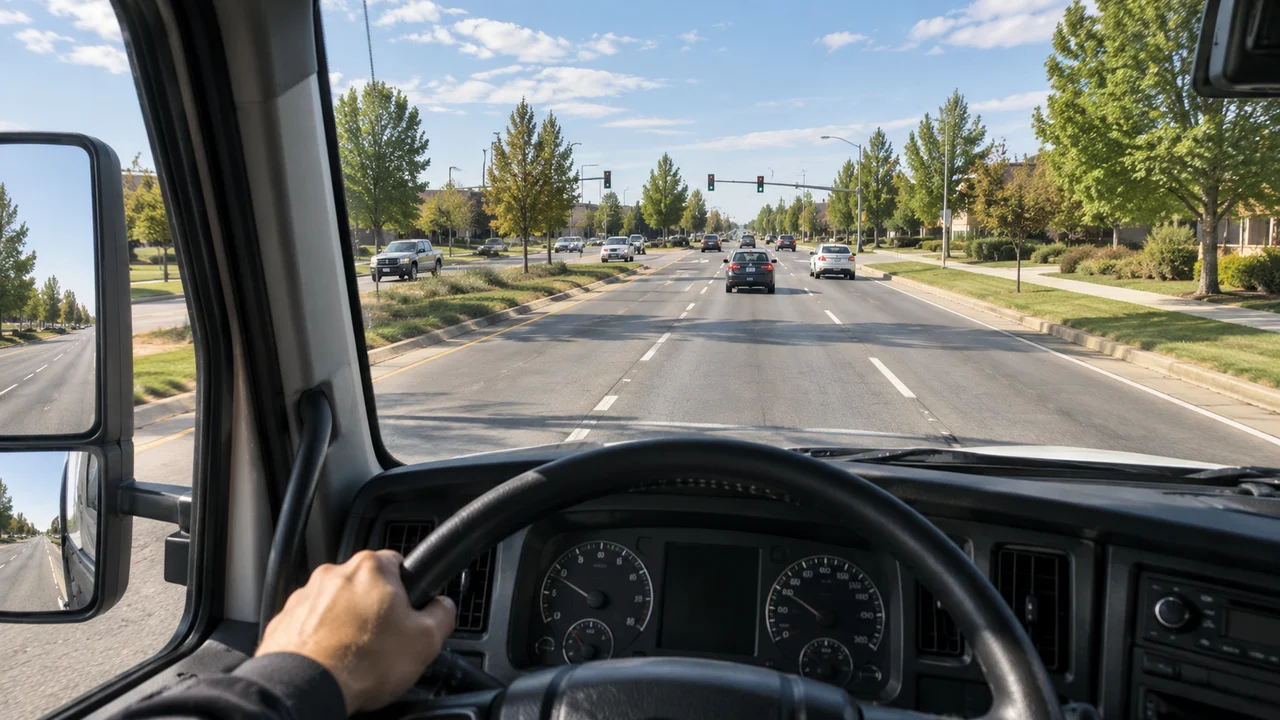
Plan the urban approach before reaching the crowded block
Verify the commercial entrance and route
A delivery address may identify a building without identifying the correct truck entrance. Review the commercial approach, relevant restrictions, staging arrangements, and loading location before departure or from a suitable parked place. A passenger entrance may lead to a narrow lot, a pedestrian plaza, or a corner the vehicle cannot negotiate safely.
Ask about access hours and unusual site conditions through verified contacts and the employer’s process. Customer directions are useful information, but they do not cancel road restrictions or establish that every suggested path fits your truck. Compare the instructions with the actual vehicle and current signs.
Anticipate where people are likely to appear
Crosswalks, transit stops, schools, hospitals, shops, driveways, parking garages, and construction sites can all increase the number of people near the vehicle path. You do not need to predict a person’s exact intention to recognize that the location demands attention. Reduce the driving task early enough to preserve options.
Parked cars and street furniture can conceal people. A delivery van with open doors may indicate a worker moving around it. A bus can hide someone crossing nearby. Treat those as developing conditions, not proof that someone will behave in a particular way. The practical question is whether your speed and space leave room for a controlled response if the person appears.
Understand what your mirrors and cameras cannot confirm
Learn the actual vehicle’s blind areas
Large commercial vehicles have areas around the front, sides, and rear that may not be fully visible from the driving position. Their size and location vary with equipment and adjustment. Learn the mirror setup for your vehicle and check that windows, mirrors, and relevant camera views are ready before moving.
A mirror image is useful only when you know what area it covers and when you last checked it. A cyclist disappearing from view may have moved into a blind area rather than away from the truck. Do not convert a loss of visual contact into an assumption that the path is clear.
Use technology as support
Cameras, warning systems, and sensors may add information, but they have limitations. Weather, dirt, glare, obstructions, coverage gaps, or equipment faults can affect what they show. Learn the manufacturer and employer instructions and report concerns. Do not continue a questionable maneuver solely because a warning system is silent.
During a supervised lesson, ask the instructor to explain where a person could remain hidden and how observation should be organized around that risk. Use a safe controlled demonstration if the instructor considers it appropriate; never ask someone to stand in a dangerous position around a moving vehicle to prove a blind spot. The objective is awareness of uncertainty and appropriate control, not confidence that one quick glance can clear every area.
Protect crossings from the approach through the exit
Look for people before the stopping decision becomes urgent
Scan the crossing area and its approaches as you approach an intersection. Watch for people near the curb, people partly hidden by vehicles, and movement from driveways or transit stops. Read the traffic controls and the available receiving space. Avoid entering a crossing or intersection that you cannot clear appropriately.
Stop and yield as required by the applicable rules. Do not let traffic behind pressure you into creeping across a pedestrian path. A large vehicle can block visibility for other road users, so your position affects more than your own view. The correct response depends on the actual location and controls, and your instructor should teach the relevant procedure.
Recheck when the scene changes
A crossing that was clear when the truck stopped may not remain clear when the light changes. People can enter after your initial observation, and a long vehicle may take time to complete the movement. Continue checking relevant areas as appropriate while maintaining forward control.
Avoid gestures that imply you can guarantee safety across other lanes. You control your truck, not every vehicle approaching the crossing. Clear yielding and patient vehicle control are more dependable than an ambiguous wave. Give additional time where a person’s movement or mobility requires it, and do not interpret slower crossing as a reason to move closer. If a person’s position becomes uncertain, resolve that uncertainty before proceeding into a possible conflict.
Manage turning conflicts with cyclists and pedestrians
Think about the area beside the truck
A right turn can bring the truck or trailer across a cyclist’s path near the curb. A cyclist may arrive while the truck waits, including after a previous mirror check. Identify relevant bicycle lanes and crossing paths early, signal as required, and use the observation and turning procedure taught for the actual vehicle and local layout.
A signal communicates intent but does not prove another road user understands or will yield. Do not assume that a cyclist will stop because the truck is larger or because you began signaling earlier. Likewise, do not rely on eye contact as a guarantee that the person understands the planned movement.
Preserve the full turning path
The front, rear wheels, trailer, and body may require different clearance. Watch the relevant areas without fixating on one mirror. If the path is occupied or the position of a vulnerable road user is uncertain, do not force the maneuver. Wait or stop appropriately and follow the instructor’s or employer’s safe process.
A wide setup needs particular care because it can create a space someone enters beside the truck. Learn the lawful setup rather than inventing a universal “swing left” rule. A left turn also requires attention to crossings and the receiving lane; do not treat it as free of pedestrian conflict because the cyclist beside the right side is no longer the main concern. Use lane-use and crossing-sign study to support planning, while leaving the vehicle-specific technique to supervised instruction.
Handle parked vehicles, delivery activity, and passing decisions patiently
Expect the curbside scene to change
A vehicle door can open, a worker can step from behind a van, or a person can enter the road between parked vehicles. Maintain suitable space and speed rather than passing close to the curb simply because the lane appears open. If adequate clearance is unavailable, reassess instead of squeezing through.
Delivery activity can obscure both the road and sidewalk. A hand truck, loading ramp, or worker may extend farther than expected. Watch for the whole activity rather than only the parked vehicle. If a site requires a maneuver that would place people at risk, communicate the problem and request an appropriate arrangement.
Pass only when the complete movement is suitable
Passing a cyclist requires compliance with the applicable law and enough space for the actual conditions. Do not assume the vehicle fits because the cab appears to clear. Consider the full length and width, oncoming traffic, lane markings, visibility, and whether another conflict is developing ahead.
When a safe lawful pass is unavailable, wait. Passing immediately before a turn can create a new conflict by putting the truck across the cyclist’s path. Avoid overtaking merely to stop at a nearby signal or turn across the person’s line. Discuss these situations in lessons so patience becomes a deliberate operating choice rather than a frustrated response after a gap fails to appear. The standard is an appropriate complete maneuver, not the smallest opening that the truck might physically fit through.
Practice a city-street scenario and review the uncertainty
Worked example: a bus stop, bicycle lane, and right turn
Imagine an instructor-led lesson approaching a right turn near a bus stop. A bus is stopped ahead, a cyclist is traveling in a curbside lane, and pedestrians are waiting near the crossing. The student sees a green signal and begins thinking mainly about steering clearance. The instructor asks the student to assess the people and the available path before committing.
The bus may hide a pedestrian’s approach, and the cyclist may enter an area beside the truck that is difficult to see. The student needs to organize speed, position, signaling, and observation early. If the cyclist’s position becomes uncertain, continuing the turn on the assumption that the person has stopped is not a sound plan. The actual response must be safe for the scene and follow the instructor’s direction; this example does not prescribe a fixed stopping point or lane position.
After the crossing clears and the maneuver can be completed appropriately, the student continues tracking the full vehicle path and settles into the receiving lane. The task does not end when the cab passes the curb. A person or traffic queue beyond the turn still requires attention.
Once parked, the debrief identifies the earliest useful clues: transit activity, bicycle-lane markings, people near the curb, and the bus’s effect on visibility. The next lesson goal is recognizing that combination before arriving at the corner. The improvement is not simply a more frequent mirror check. It is a better understanding of what the check can show, what remains uncertain, and when that uncertainty should change the movement.
| City feature | Potential concern | Question before proceeding |
|---|---|---|
| Stopped bus | People or crossing approaches hidden from view | What part of the scene is blocked? |
| Bicycle lane beside a turn | Cyclist enters the turning conflict area | Do I know the current position and applicable movement rules? |
| Parked delivery van | Worker, ramp, door, or equipment enters the road | Is the available clearance suitable for the whole truck? |
| Busy crossing | People continue entering while the truck waits | Is the crossing currently clear, and can I complete the movement? |
| Unfamiliar entrance | Truck is directed into pedestrian or unsuitable space | Has commercial access been verified? |
Turn observations into a specific practice request
Ask the instructor to choose an appropriate route and explain which urban conflicts you should focus on during that session. Keep any spoken commentary brief and only use it when the instructor considers it helpful. Long narration can compete with driving attention in a busy scene.
Afterward, record one situation handled early and one that remained confusing. Describe the person’s position, the blocked view, the vehicle path, and the decision. Students in Class A and Class B training may encounter similar streets but have different vehicle geometry and duties. Bring the actual equipment into the discussion.
A strong urban-driving routine leaves room for another person to behave unexpectedly. It does not depend on the assumption that everyone sees the truck or understands its limitations. Early planning, current observation, and patient control make that routine practical when the street becomes crowded.
Archive entry for October 14, 2026; added October 19, 2026.
Discuss site movements separately from road driving
A delivery yard, loading area, or parking lot can contain pedestrians without the same lane markings and crossings found on the public road. Workers may approach the cab, move equipment, or appear behind a trailer. Learn the site’s rules and the employer’s procedures before maneuvering. Do not assume that arriving at the customer ends the need for careful observation.
When backing or another limited-visibility movement is required, use the authorized observation and assistance process. If a spotter is involved, confirm communication and what to do when contact is lost. Do not treat a person waving from an unknown position as proof that every part of the path is clear. A paused movement gives you an opportunity to resolve uncertainty. In the lesson debrief, distinguish the site-access problem from the street approach so each receives the appropriate instruction instead of being bundled into the vague advice to be more careful around people.
Frequently asked questions
Do mirrors eliminate a commercial vehicle’s blind spots?
No. Coverage depends on the vehicle, setup, and conditions, and some areas may remain hidden. Learn the actual equipment’s limitations. If a person disappears from view near the vehicle path, do not assume the area is clear.
What if a cyclist is beside the truck before a right turn?
Assess the actual position, applicable controls, and turning conflict using the procedure taught for the vehicle. Signal and recheck appropriately, but do not force the turn or assume the cyclist will yield. Stop or wait when necessary to resolve the conflict safely.
Should I pass a cyclist if I will turn shortly afterward?
Consider the complete maneuver, not just the initial pass. Overtaking and then turning across the cyclist’s path can create a serious conflict. Pass only when the movement is lawful and suitable for the full vehicle, road, and upcoming situation.
Can a camera warning system replace checking around the truck?
No. Cameras and sensors can support observation but have coverage and performance limits. Follow the manufacturer and employer instructions and report faults. A silent system does not prove that every relevant area is clear.
Official references
Updated October 19, 2026. Use current official instructions and the procedures for the actual vehicle. Educational examples support supervised learning and do not establish eligibility, test results, or a guarantee of safe performance.