


A railroad crossing is a short piece of roadway with unusually high consequences. For a new commercial driver, the safe decision begins before the front bumper reaches the tracks: identify the crossing, understand whether the vehicle must stop, confirm that the entire combination will fit beyond the far rail, choose the right gear, and keep the vehicle moving until every part is clear.
This guide turns those ideas into one repeatable plan for CDL study and supervised practice. It reflects federal rules and the Pennsylvania CDL manual but does not replace an instructor, carrier policy, or authorized directions.
1. Treat the Crossing as a Decision Zone, Not a Single Sign
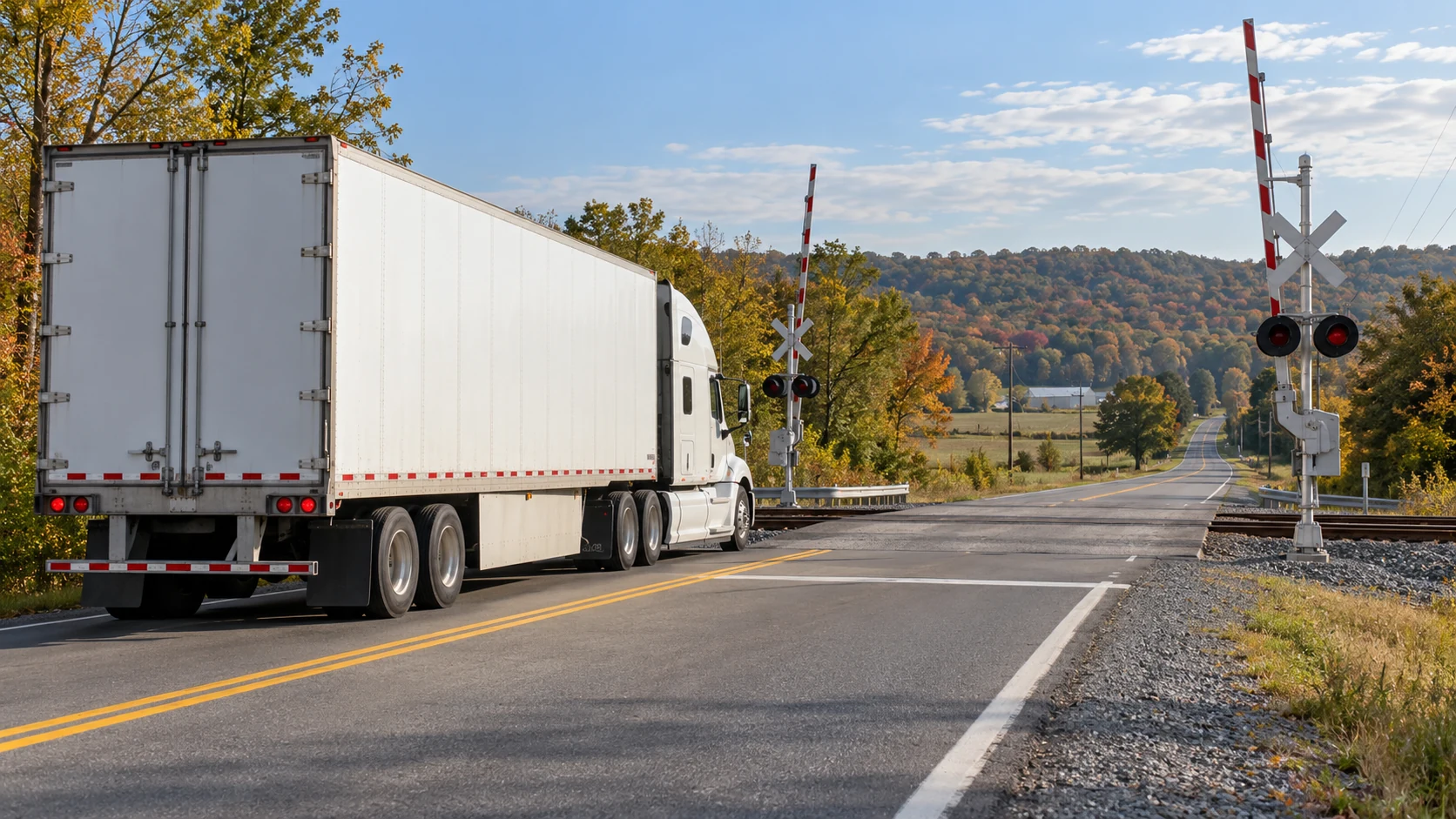
A crossbuck, round warning sign, flashing light, or gate is only one part of the situation. A commercial driver also has to read the traffic beyond the rails, the surface profile, the number of tracks, sight distance, nearby intersections, and the length of the vehicle. That is why the safest mental model is a decision zone that starts early and ends only after the trailer and any overhanging cargo are beyond the far rail.
Separate three questions
Ask three questions in order. First, must this vehicle stop? The answer depends on the vehicle, cargo, controls, law, and authorized directions. Second, is the crossing clear of rail traffic? Look and listen; silence or familiarity is not proof. Third, is there enough room to clear? The far side must hold the tractor, trailer, and overhang.
These questions are not interchangeable. A green traffic light or raised gate does not create far-side storage space, and a clear rail view does not solve a low-clearance problem. Give each question a separate answer.
Build recognition before speed
Students often focus on the moment of crossing. Better preparation begins with early recognition: the advance warning sign, pavement markings, crossbuck, signal mast, roadway grade, or a line of vehicles ahead. If road-sign vocabulary is still developing, use the exercises in our CDL road signs and English practice guide to connect each symbol with an action. The goal is not to name a sign quickly; it is to create enough time and space for a safe decision.
2. Review the Route and Vehicle Before the Trip
Railroad-crossing safety is partly a route-planning task. Before departure, review the planned route for grade crossings, tight turns immediately before or after tracks, steep profiles, work zones, and intersections that can queue traffic across the rails. Navigation software can help locate a road, but it does not replace posted restrictions, current conditions, dispatch instructions, or a carrier-approved route.
Know the combination you are driving
Vehicle length matters because the usable space on the far side must accept the complete combination. Ground clearance matters because a long wheelbase or low-slung equipment can contact a sharply crowned crossing. Overhanging cargo changes the rear clearance point. A student should learn to describe these features before moving: tractor type, trailer length, axle position, low components, and any overhang.
A route that works for a straight truck may be unsuitable for a tractor-trailer or low-clearance combination. FMCSA advises extra precautions for long-wheelbase, low-ground-clearance, and specially permitted vehicles. If the profile is uncertain, contact the carrier, dispatcher, permit office, or road authority rather than experimenting at the crossing.
Plan an alternate before you need one
If a crossing appears unsuitable, identify a legal alternate while parked. Our low-clearance route-planning guide applies the same principle: verify before committing. Uncertainty is a reason to pause and escalate, not to squeeze through.
3. Use a Consistent Approach Sequence
A repeatable sequence reduces the chance that one important check disappears under pressure. The sequence below is a study framework. It does not replace applicable law or the exact procedure required for a bus, placarded load, cargo tank, school vehicle, or carrier operation.
| Stage | What to observe | Driver action | Reason |
|---|---|---|---|
| Recognize | Advance warning signs, pavement markings, crossing devices, traffic queue | Release the accelerator early, scan mirrors, and prepare to slow | Creates time without abrupt braking |
| Communicate | Following traffic and lane position | Use signals and warning devices as required; make the slowdown predictable | Helps traffic behind respond safely |
| Classify | Vehicle, cargo, signs, signals, officer or flagger directions | Determine whether a full stop is legally required | Different CMVs do not all have the same stop rule |
| Clear the course | Both rail directions, multiple tracks, gates, lights, bells, far-side traffic | Look and listen; do not enter until the course is clear | A second train or blocked exit may be hidden |
| Measure fit | Space beyond the farthest rail, trailer length, cargo overhang, road profile | Enter only when the entire unit can clear without stopping | Federal rules prohibit entering without sufficient clearance |
| Commit | Selected gear, path, steering, traffic | Cross steadily without an unnecessary gear change and continue until fully clear | Reduces hesitation and exposure on the tracks |
Approach early and smoothly
Mirror checks matter because a following vehicle may not expect a large truck to slow. Reduce speed early enough to avoid a hard application near the rails. The Pennsylvania CDL manual advises checking traffic behind, slowing gradually, using a pullout lane when available, and using four-way flashers when stopping. Apply the procedure your instructor and vehicle operation require.
Cab noise can mask rail sounds. FMCSA guidance recommends reducing noise sources and looking carefully in both directions. Do not let a radio, conversation, or phone interaction compete with the crossing scan.
Look beyond the first track
Multiple-track crossings require another scan after one train passes. A train on the nearer track can hide movement on another track. Wait until warning devices permit movement and you can verify the entire course. Never drive around a lowered gate, enter while lights are active, or assume the crossing is safe merely because another road user moves first.
4. Know When Stopping Is Required
Federal regulations distinguish between CMVs that must stop at most grade crossings and other CMVs that must approach at a speed allowing a stop and use due caution before crossing. Under , listed vehicles include every bus transporting passengers, certain vehicles carrying specified hazardous materials, and certain cargo tank vehicles. The regulation contains detailed categories and limited exceptions, so drivers should verify their exact operation rather than rely on a simplified memory phrase.
For vehicles covered by 49 CFR 392.10
Unless an exception in the rule applies, the driver must stop within 50 feet of and not closer than 15 feet to the tracks, listen and look in each direction, and determine that no train is approaching. When safe, the driver crosses in a gear that allows completion without changing gears; the rule says not to shift while crossing. The listed exceptions include specific situations such as direction by a police officer or crossing flagger, a functioning highway traffic signal showing green when local law permits proceeding, an officially marked abandoned crossing, and an authorized “Exempt” industrial or spur crossing.
Do not turn the exceptions into guesses. A raised gate is not the same wording as an official “Exempt” sign. A track that looks rusty is not the same as an abandoned line marked by the proper sign. If the vehicle or cargo category is unclear, resolve that question with the carrier or instructor before operating.
For other commercial motor vehicles
requires other CMVs to approach at a speed that permits stopping before the nearest rail and prohibits driving over the crossing until due caution establishes that the course is clear. A stop may still be required by a stop sign, active signal, state or local law, traffic conditions, or the direction of an authorized person. “Not always required to stop” never means “continue without preparing to stop.”
CDL students should also remember that a test examiner evaluates safe observation, speed control, and compliance with signs and signals. The tells commercial drivers to decelerate and brake smoothly, shift as necessary before reaching the crossing, look and listen for trains, and check traffic in all directions.
5. Prove That the Entire Vehicle Will Clear
The most important far-side question is simple: if traffic stops immediately after you enter, where will the back of the vehicle be? prohibits a CMV driver from entering a highway-rail grade crossing without enough space to drive completely through without stopping.
Count usable space, not hopeful space
Usable space ends where the vehicle would have to stop for a traffic signal, stop sign, queue, turn, gate, or other obstruction. It is not the whole visible roadway. Before moving, compare that usable space with the complete length of the tractor, trailer, and overhang. FMCSA’s “7 Steps for Safety” guidance adds a practical margin: before entering, make sure the rear of the vehicle and any overhanging cargo can be at least six feet beyond the farthest rail.
Never assume cars ahead will move or leave a gap. If the exit area cannot hold the unit now, wait before the tracks even if a driver behind honks. Pressure from traffic does not change vehicle length or the safe-clearance rule.
Check vertical profile as well as horizontal space
A crossing can provide enough forward room and still be unsuitable for a low vehicle. A steep approach and raised track profile can catch landing gear, a lowboy, a lift axle, or another component. When warning signs, route notes, permit conditions, or the visible profile raise doubt, do not commit. Use an approved alternate or obtain qualified guidance. Stopping on the rails to inspect after contact is far too late.
Select the gear before the tracks
Choose a gear that supports a steady crossing before entering. Avoid a planned shift while any part of the unit is on the rails. For vehicles governed by section 392.10, completing the crossing without a gear change is an explicit requirement. For other drivers, preselection remains a sound way to reduce hesitation and loss of momentum. Training should connect this decision to vehicle-specific instruction rather than a one-size-fits-all gear number.
6. Read Active, Passive, and Multiple-Track Crossings
An active crossing uses devices such as flashing lights, bells, or gates to warn of an approaching train. A passive crossing relies on signs and markings rather than active warning equipment. Both demand observation. Devices can be absent, obscured, damaged, or misunderstood, and a driver remains responsible for obeying the applicable signs, signals, and laws.
At an active crossing
Obey the lights and gates. Do not start around a gate that is descending, lowered, or rising. After a train passes, wait for the devices to complete their warning cycle and verify that another train is not approaching on a second track. If a device appears to malfunction, stay off the crossing and use the emergency notification information rather than treating the malfunction as permission to proceed.
At a passive crossing
Reduce speed early enough to stop, search both directions, and account for sight obstructions such as vegetation, buildings, curves, weather, or the vehicle’s own mirrors and pillars. Familiarity is a hazard when it produces assumptions. “I have never seen a train here” is not evidence that the line is inactive.
When an officer or flagger is present
Follow lawful directions, but still control the vehicle and verify that it can physically clear the route. An instruction to proceed does not shorten the trailer or flatten a high-profile crossing. If you cannot comply safely because of vehicle geometry or blocked space, communicate the problem instead of entering and hoping conditions improve.
7. Worked Example: A Delivery Beyond a Two-Track Crossing
Imagine a student riding with an instructor in a standard tractor and dry van. The route approaches a passive two-track crossing. A signalized intersection sits a short distance beyond the far rail. The light is green, but traffic is moving slowly and the available space beyond the tracks is shorter than the complete combination.
The student recognizes the advance warning sign, checks mirrors, releases the accelerator, and communicates the slowdown. Because this ordinary property-carrying combination is not assumed to be one of the always-stop categories, the student does not invent a legal rule. Instead, the student approaches slowly enough to stop before the nearest rail, looks and listens in both directions, and evaluates the far-side queue.
The key decision is to wait before the tracks. The green light does not matter if the trailer would remain over a rail when the queue stops. After the signal cycles, the queue clears and opens enough usable space for the whole unit plus a margin beyond the farthest rail. The student checks both rail directions again, confirms no active warning, selects the appropriate gear, and crosses steadily without shifting. The instructor then asks the student to explain the decision in one sentence: “The tracks were clear, and the exit space could hold the whole combination before I entered.”
What the scenario teaches
- A highway traffic signal beyond the crossing is part of the clearance problem.
- The first safe gap may be for cars, not for a tractor-trailer.
- A second look matters after waiting because rail and road conditions can change.
- The driver should be able to explain the decision using observable facts, not confidence or habit.
During supervised training, vary the scene: add a stop sign beyond the rails, a long overhang, a rising profile, or a second train hidden by the first. Keep the decision sequence stable as conditions change.
8. If a Vehicle Stalls or Hangs Up on the Tracks
A vehicle immobilized on the tracks is an emergency. FMCSA guidance says to get out immediately and move away from the tracks. Do not remain in the cab trying repeated restarts or unloading cargo while exposed to rail traffic. Once safely away, use the crossing’s blue-and-white Emergency Notification System sign to call the railroad, and call 911 or local police as needed.
The explains that the ENS sign contains the railroad emergency number and the U.S. DOT National Crossing Inventory Number. Give the dispatcher that crossing number, the road or location, and a clear description of the emergency. The number identifies the exact crossing and helps the railroad respond to the correct place.
If warning equipment appears stuck, damaged, or falsely activated, do not diagnose it from the driver’s seat or drive around a gate. Stay clear and report the condition through the ENS number. A delayed delivery is manageable; an occupied track is not.
9. A Practical Railroad-Crossing Practice Plan
Railroad-crossing skill should be practiced first as observation and explanation, then as a supervised driving routine. A student who can clearly state what is visible, what rule applies, and what space is available is less likely to act on vague assumptions.
Before a supervised route
- Review the vehicle length, trailer position, overhang, and low-clearance components.
- Identify crossings on the route and any nearby intersections or tight turns.
- Confirm whether the vehicle, passengers, cargo, or carrier policy creates a mandatory-stop procedure.
- Review the meanings of advance warning signs, crossbucks, multiple-track signs, lights, bells, gates, and “Exempt” markings.
- Discuss who the student should contact if a route or crossing appears unsuitable.
At each crossing
- Recognize the crossing early and check following traffic.
- Slow smoothly and prepare to stop before the nearest rail.
- Obey all signs, signals, gates, and authorized directions.
- Look and listen in both directions; check again for multiple tracks.
- Verify that the entire combination and any overhang will fit beyond the farthest rail.
- Evaluate the road profile for hang-up risk.
- Select the proper gear before entering and cross steadily.
- Continue until the rear of the vehicle and cargo are fully clear.
After the route
- Name one crossing that required waiting and explain why.
- Identify any sight obstruction or misleading cue.
- Explain whether the vehicle had to stop under the applicable rule.
- Describe how far-side traffic changed the decision.
- Write one improvement for the next drive, such as earlier mirror checks or better gear selection.
Use specific review notes. “Recognize the crossing before the pavement marking” or “check the far-side signal sooner” gives the next lesson a clear target. For a broader practice framework, see our guide to choosing CDL training near you.
Frequently Asked Questions
Do all commercial vehicles have to stop at every railroad crossing?
No. Federal rules require certain vehicles, including buses carrying passengers and specified hazardous-material or cargo-tank vehicles, to stop in most situations covered by 49 CFR 392.10. Other CMVs must approach slowly enough to stop and use due caution under 49 CFR 392.11, but signs, signals, state law, traffic, or authorized directions may still require a full stop.
How far from the tracks should a required-stop CMV stop?
For a vehicle covered by the stopping rule in 49 CFR 392.10, the stop is within 50 feet of and not closer than 15 feet to the tracks, unless a listed exception applies. Drivers should verify the rule for their vehicle and cargo and follow any additional lawful signs or directions.
Can a CDL driver enter when the tracks are clear but traffic is stopped beyond them?
No. A commercial motor vehicle may not enter a highway-rail grade crossing unless there is enough space to drive completely through without stopping. The driver must wait before the tracks until the whole vehicle, trailer, and any overhanging cargo can clear the farthest rail.
What should a driver do if the truck stalls or becomes stuck on the tracks?
Get everyone out immediately and move away from the tracks. From a safe location, call the railroad using the blue-and-white Emergency Notification System sign and provide the crossing identification number and emergency details; also contact 911 or local police as needed. Do not stay in the vehicle trying repeated restarts.
Train the Decision Before the Test
A safe crossing is the result of early recognition, correct rule identification, enough clear space, and a steady plan. Patriot CDL helps students connect manual knowledge with supervised vehicle practice. To discuss training options, call or visit us at 7800 Bristol Pike, Levittown, PA 19057.
Official Sources Reviewed
Rules and official guidance reviewed October 21, 2026. Always follow current law, posted controls, authorized directions, vehicle-specific procedures, and your carrier’s policies.