


A CDL study partner can help you explain ideas, notice gaps, and keep a realistic routine. The risk is that two learners can also make an incorrect answer sound convincing through repetition. Effective paired study therefore needs more than a list of quiz questions. It needs a source, defined roles, a way to record uncertainty, and clear boundaries around activities that belong in supervised vehicle training. The strongest partner is not necessarily the person who answers fastest. It is someone willing to ask how an answer was verified, listen to an explanation, and change their mind when the source shows a mistake. This guide describes a practical approach for permit topics, inspection terminology, sign interpretation, and preparation for instructor-led lessons. You can use it with a classmate, friend, or family member, provided everyone understands that study support does not make a person qualified to supervise commercial-vehicle operation.
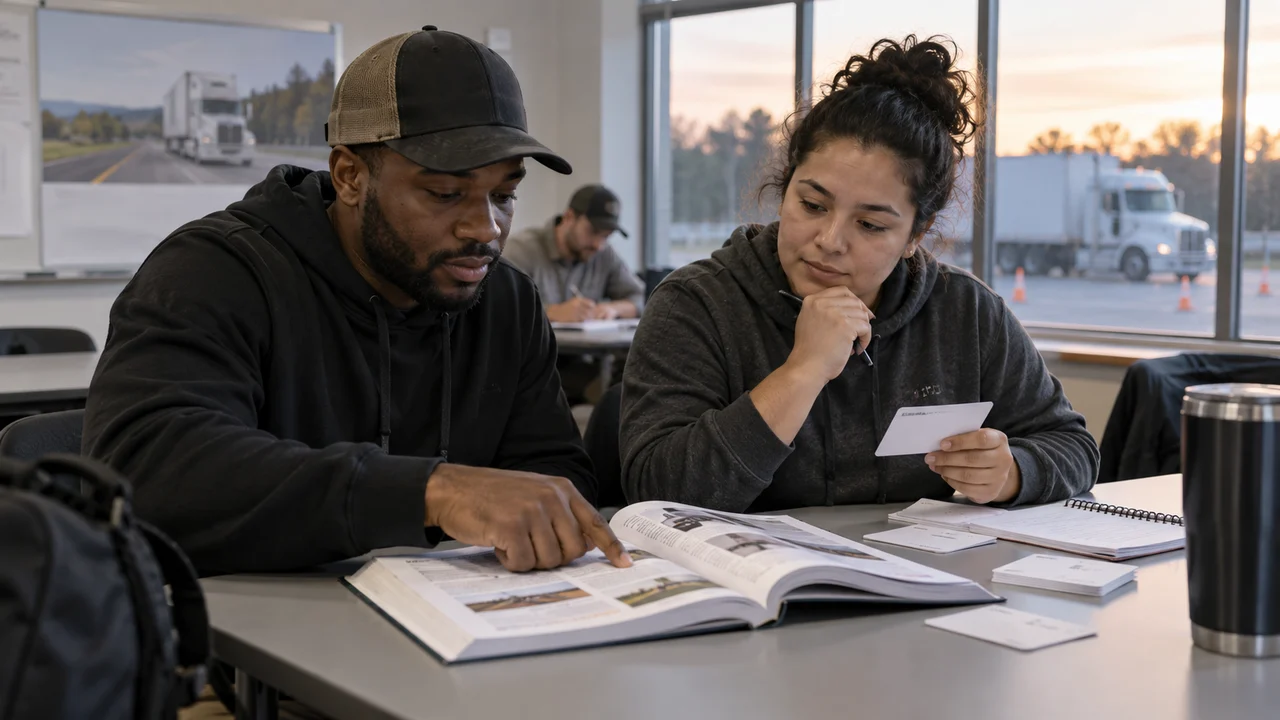
Begin with one source and one learning objective
Agree on the source before discussing the answer
Use the current Pennsylvania CDL manual and school materials appropriate to the vehicle and license you are pursuing. Keep the source open or easy to locate. A question bank can help identify a topic, but an answer remembered from an unfamiliar website should not outrank current official guidance. When materials appear to conflict, note the exact wording and ask the instructor to resolve it.
Choose a narrow objective for the session. “Study brakes” is broad enough to produce an hour of disconnected facts. “Explain what each part of the instructed air-brake check is intended to establish” provides a clearer task. The objective should fit the material already introduced in your course; paired study is not a reason to improvise a new operating procedure.
Bring individual preparation
Read the selected section separately before meeting. Mark unfamiliar terms and write one question you could not answer confidently. This prevents the session from becoming one person reading aloud while the other listens passively. Both people should have something to explain and something to investigate.
Check that the material belongs to your license class and equipment. A Class A combination-vehicle topic may not apply in the same way to a Class B straight truck. Likewise, a classmate’s testing location or vehicle may use a different arrangement. Compare Class A and Class B program goals, then keep the study session aligned with your instructor’s sequence and current official requirements.
Use roles that make understanding visible
Rotate the explainer and verifier
The explainer answers in their own words without looking at the page initially. The verifier listens while following the source. The verifier should not interrupt with the answer at the first hesitation; allow enough time for the other person to organize the reasoning. Then compare the explanation with the material and identify what was accurate, incomplete, or confused.
Switch roles regularly. If one learner always asks and the other always answers, the partnership can hide a large difference in understanding. Both learners need retrieval practice, and both need experience checking someone else’s reasoning. A stronger student often discovers a gap while trying to explain why an answer changes under different conditions.
Ask follow-up questions that change the situation
After an explanation, ask what observation would lead to a different decision. For a traffic sign, ask what the driver should do before reaching it. For an inspection component, ask what condition is being checked and whom the student should notify about uncertainty. These questions connect vocabulary to action rather than rewarding an isolated phrase.
Avoid turning the exchange into a guessing game. Repeated hints can make an answer feel retrieved when it was effectively supplied by the partner. Record that help and try the question independently later. The useful outcome is knowing which part you can explain without assistance, not producing the largest possible number of correct-looking answers during the meeting.
Resolve disagreements with evidence instead of confidence
Build an uncertainty log
When answers differ, write the question, both interpretations, and the source location you need to check. Do not settle it by voting or by choosing the person with more confidence. Even a learner who has driven other vehicles may be remembering a rule that belongs to another context. A specific log makes it possible to resolve the issue without arguing around it.
Use three simple states: verified, unresolved, and instructor question. Verified means the explanation has been checked against the chosen source. Unresolved means the relevant passage has not yet been found or understood. An instructor question means the wording, vehicle configuration, or practical application needs clarification. This keeps uncertain material from silently entering the next session as fact.
Correct the whole explanation
If a mistake is found, replace the reasoning, not merely the final answer. Suppose both partners chose the correct sign meaning but described an unsafe response. Keeping the answer while ignoring the response would preserve the important error. Write a short corrected explanation and a new example that demonstrates the difference.
Revisit the corrected item after a delay. If both partners immediately repeat the correction while the page is still open, that shows recognition more than independent understanding. At the next meeting, explain it without the original cues and then verify it again. This helps prevent the earlier confident version from becoming the answer that returns under pressure.
Practice inspection language without inventing vehicle procedures
Connect names, locations, and conditions
Inspection study becomes more useful when each term is connected to a component, its function, and the condition being checked. A long list of names can sound impressive while providing little help when the learner stands beside a different truck. Use approved diagrams or photographs to identify where a component is located and how it relates to nearby systems.
Ask your partner to explain the difference between an observation and a diagnosis. A student might identify a visible condition or warning but should not claim a repair conclusion they are not qualified to make. The study goal is accurate recognition and reporting, guided by the course and official materials.
Keep operation within its proper boundaries
Independent paired study can include reading, flashcards, diagrams, and spoken walkthroughs. Moving a commercial vehicle, operating controls for a procedure, or setting up a backing exercise requires the proper authorization, supervision, vehicle, and setting. A classmate’s enthusiasm does not replace those conditions. If you are unsure whether an activity is permitted, ask the instructor before attempting it.
Use the pre-trip inspection resource to organize questions for the next lesson, not to construct a new procedure from separate online clips. If the study partner notices that you consistently reverse two terms or skip one system, bring that pattern to the instructor. This gives supervised instruction a precise starting point without allowing informal study to become informal vehicle training.
Run a session that produces a useful next step
Keep the meeting short enough to stay deliberate
A practical session might begin with a brief recall of the previous uncertainty log, continue with explanation and verification, and end with a summary of what remains open. The exact length matters less than the quality of attention. When both learners are tired and begin accepting answers without checking them, continuing for another hour may reinforce weak study habits.
Use a small number of topics in depth. Five questions that require explanation, a changed scenario, and a verified correction can be more useful than fifty questions answered by recognition. Track which items were independent and which required cues. This allows each learner to choose a personal review task rather than assuming both need the same work.
End with an instructor-ready question
An effective unresolved question includes the source passage, your interpretation, and the practical point you do not understand. “We read this paragraph, but we cannot explain how it applies to our training truck” gives the instructor something concrete. “We do not get inspections” is too broad and may lead to a repeat of information you already know.
Maintain respectful boundaries. Agree that correcting an answer is not a personal criticism and that either person can pause the session to verify a claim. If one partner repeatedly dismisses the source, pressures the other to memorize shortcuts, or turns study into competition, change the arrangement. The purpose is accurate learning and preparation for permit work and supervised lessons, not winning an argument.
Worked example: turning the plan into action
Two students disagree about a sign and a clearance decision
Two students are reviewing truck-related signs before a road lesson. One recognizes a clearance sign and confidently says that a truck can proceed if the roof looks lower than the opening. The other remembers that the actual vehicle height and the posted restriction matter but cannot explain how to verify the route. They mark the answer unresolved instead of accepting the more confident explanation.
They open the official material and separate two learning points: identifying the sign and making an appropriate route decision. Their original flashcard tested only recognition, so it did not reveal the weakness in the action that followed. They rewrite the card to ask what information a driver needs before approaching the restriction and what to do if that information is uncertain.
Neither student tries to measure or operate a truck independently. At the next lesson, they ask the instructor how vehicle dimensions are established for the training equipment and how a driver should respond to an unsuitable route. The question includes the sign, the disputed answer, and the missing decision.
During the following study meeting, each explains the corrected principle separately. They also apply it to a weight restriction to check that they understand the broader need to verify vehicle and route compatibility. The second topic is a reasoning exercise, not a claim that height and weight rules are identical. The partnership has produced better questions and a more complete explanation rather than simply changing one answer on a flashcard.
A repeatable paired-study sequence
| Stage | What the partners do | What gets recorded |
|---|---|---|
| Prepare | Read the selected official material independently. | One objective and unfamiliar terms. |
| Explain | One learner describes the principle without cues. | Independent points and missing steps. |
| Verify | The other checks the source and asks a changed-situation question. | Accurate reasoning and needed corrections. |
| Resolve | Check disagreements or prepare a focused instructor question. | Verified, unresolved, or instructor-question status. |
| Revisit | Recall the corrected explanation at the next session. | Whether the earlier misunderstanding has returned. |
Frequently asked questions
Can a friend without a CDL help me study?
Yes, a friend can read questions, follow an approved source, and listen to your explanation. They should not invent technical answers or supervise commercial-vehicle operation based on the study session. Provide the exact source and explain the verifier role. Questions involving vehicle procedures or conflicting material should go to your instructor.
What should we do when two practice websites give different answers?
Record the exact wording and identify whether the questions actually describe the same situation. Check the current official manual and relevant school material rather than choosing whichever answer is repeated more often. If the difference remains unclear, bring both versions and the source passages to the instructor. Do not memorize an unresolved answer as fact.
Is reading an inspection script together enough preparation?
Reading can help with terminology, but it does not establish that you can locate components, understand the checks, or perform the required routine on the actual vehicle. Pair the spoken study with approved diagrams and instructor-led vehicle work. Ask what each check is intended to establish and how to report an uncertain or abnormal condition.
How can we avoid giving each other too many hints?
Let the explainer finish an initial attempt before helping. Record whether the answer was independent, prompted, or looked up. After correcting it, revisit the question later without the original cues. Rotate roles and use changed examples. This makes the session a measure of understanding instead of a sequence of answers assembled from a partner’s hints.
Official sources and next steps
For Pennsylvania licensing and vehicle-operation guidance, consult the current . For entry-level training applicability and provider requirements, use . These are primary references; a study article does not replace current official instructions, an enrollment agreement, or supervised instruction.
Discuss your next step with Patriot CDL at , or visit 7800 Bristol Pike, Levittown, PA 19057. Compare training programs and ask which preparation will be most useful for your intended vehicle and license.