


A correction heard during a lesson can disappear by the time the truck is parked. Students remember the frustration or the successful final attempt but lose the observation that explained the result. A feedback notebook preserves the useful part: what happened, what the instructor identified, and what you will practice differently. It should make your next lesson more focused, not turn training into a paperwork exercise.
The most effective notes are short, factual, and tied to an observable action. “I am bad at backing” is a judgment about yourself. “I did not update the passenger-side mirror before correcting” describes something you can discuss and improve. This guide shows how to build a notebook that supports knowledge study, inspection practice, range work, and road lessons without replacing the instructor’s assessment.
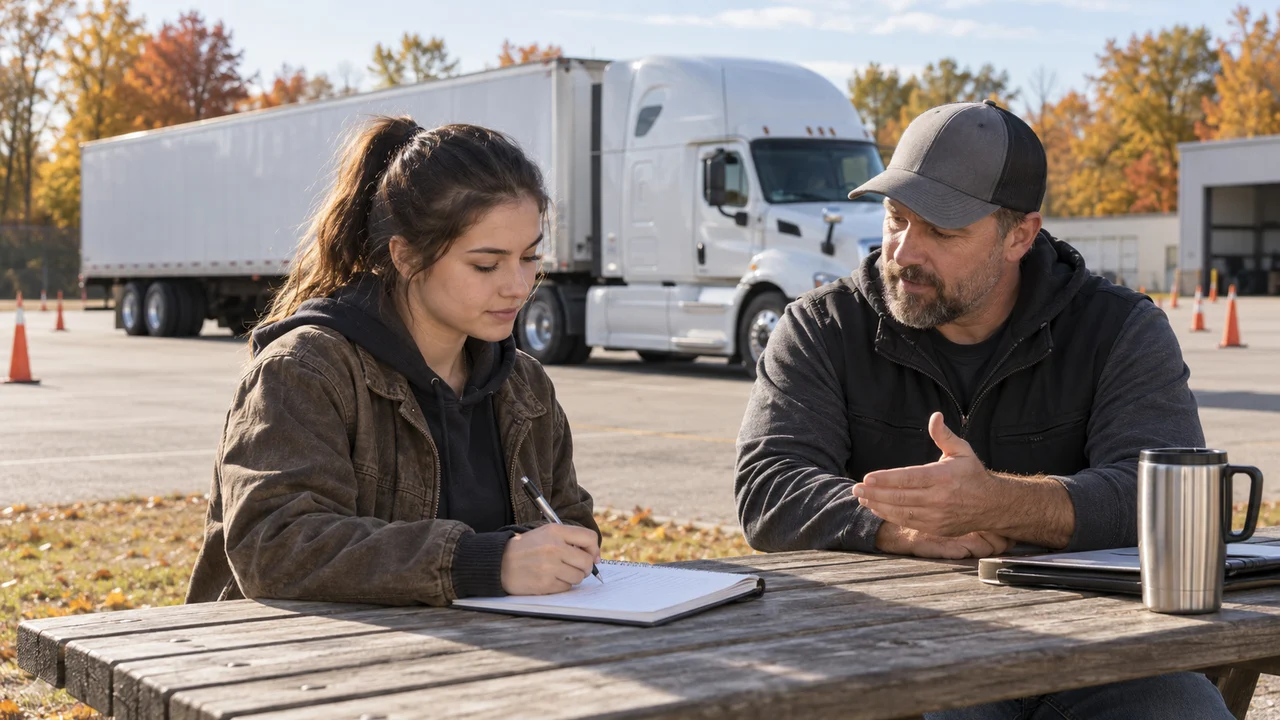
Record the event rather than a label about yourself
Capture the task and setting
Identify the maneuver, inspection section, or knowledge topic and the conditions in which the feedback occurred. A reminder during a simple range setup may have a different meaning from one during a busy road approach. Use a brief heading with the task and the lesson date.
A date and task heading helps distinguish a repeated problem from a new challenge. Include only conditions that affected the learning point. A short note that identifies a different trailer or reduced visibility can explain why an apparently familiar task needed additional guidance.
Write the observed action
Describe the thing you did or omitted rather than calling the attempt good or bad. Labels do not explain what a future observer should watch. Write a sentence that another person could verify from the lesson.
A useful entry could be read aloud without sounding like a judgment about your ability. Describe the omitted glance, incomplete explanation, or delayed decision. That language gives both student and instructor something observable to compare during the next practice attempt.
Turn a correction into a specific practice target
Preserve the instructor’s reason
Record why the correction mattered, including the hazard or misunderstanding it addressed. A steering instruction without its observation cue can become a brittle rule. Ask for the reason if you cannot explain it in ordinary language.
Write the reason soon after the review while it is still clear. If you remember only “watch the mirror,” ask which mirror, at what stage, and for what information. An incomplete note can accidentally reinforce a technique the instructor did not intend.
Choose a safety priority
Separate an issue affecting safe control or observation from a detail that can be refined later. A long list of equal goals can distract attention from the most important correction. Ask the instructor which one item should lead the next practice.
Ask which correction must come first because it affects the safe foundation of later work. Trying to solve every detail simultaneously can scatter attention. A notebook should support the instructor’s progression rather than create an independent lesson plan that competes with it.
Organize notes across theory, inspection, and driving
Make the target observable
Define the behavior you intend to demonstrate before the next attempt. Wanting more confidence cannot tell the instructor whether the specific skill improved. Describe the cue you will identify and the action you will take.
A target needs both a cue and a response. “Observe the reference before moving” is clearer than “improve the setup.” Confirm that the proposed behavior fits the actual equipment and exercise. Otherwise, the notebook can preserve a well-worded but inappropriate goal.
Mark the level of help
Note whether the task required a full demonstration, a reminder, or independent performance under supervision. A successful result after continuous prompts differs from a result achieved without them. Use a simple description of assistance instead of an invented pass percentage.
Track assistance honestly. “Completed after one reminder” preserves useful progress without claiming independence. It also helps the instructor decide whether to repeat the same task, reduce prompts, or introduce a different condition. The record is for learning, not for impressing another student.
A practical comparison to keep in your notes
| Checkpoint | What to confirm | Why it matters |
|---|---|---|
| Capture the task and setting | Identify the maneuver, inspection section, or knowledge topic and the conditions in which the feedback occurred. | A reminder during a simple range setup may have a different meaning from one during a busy road approach. |
| Preserve the instructor’s reason | Record why the correction mattered, including the hazard or misunderstanding it addressed. | A steering instruction without its observation cue can become a brittle rule. |
| Make the target observable | Define the behavior you intend to demonstrate before the next attempt. | Wanting more confidence cannot tell the instructor whether the specific skill improved. |
| Connect a missed answer to a principle | For knowledge study, record why the correct answer addresses the hazard rather than copying only a letter. | Question order can change, while the underlying safety concept remains useful. |
| Review before the lesson | Read the most recent priority shortly before practice so the next attempt starts with a clear objective. | A notebook consulted only after training cannot guide attention during preparation. |
| Close completed items | Mark an objective as demonstrated only after the instructor confirms the relevant performance. | Keeping every historical correction active can make a useful notebook feel overwhelming. |
Measure independence without inventing a score
Connect a missed answer to a principle
For knowledge study, record why the correct answer addresses the hazard rather than copying only a letter. Question order can change, while the underlying safety concept remains useful. Explain the principle and create a different example that uses it.
For a missed knowledge question, write why the unsafe alternatives are unsuitable. This exposes whether you understand the concept or merely recognize the correct wording. Revisit the official manual when the explanation is uncertain rather than copying an unreliable practice-app comment.
Use component locations in inspection notes
Tie inspection feedback to the actual area and condition being assessed. Reciting a phrase accurately does not prove that you inspected the intended component. Sketch or describe the location after the vehicle is secured.
Inspection notes should connect words with physical observations. If you cannot safely see or identify the relevant component, ask during an appropriate demonstration. A notebook that contains only recited phrases may look complete while the practical inspection skill remains unfinished.
A worked example: from repeated reminders to a clear cue
Review before the lesson
Read the most recent priority shortly before practice so the next attempt starts with a clear objective. A notebook consulted only after training cannot guide attention during preparation. Tell the instructor the goal and confirm that it fits the lesson plan.
Before the lesson, read the active goal and tell the instructor what you intend to work on. The instructor may change the priority based on conditions or recent performance. That adjustment is part of useful coaching, not a failure of the notebook system.
Record changed conditions
Note when a different vehicle, route, or weather condition affects the task. An apparent setback may reveal a new transfer challenge rather than loss of the original skill. Compare the conditions before assuming that earlier learning disappeared.
Changing conditions can reveal whether a skill transfers. Record what changed before interpreting the result. A different truck, task setup, or traffic environment may require a new observation strategy even when the underlying principle remains the same. Ask how the instructor interprets the difference.
Keep the notebook useful as training becomes harder
Close completed items
Mark an objective as demonstrated only after the instructor confirms the relevant performance. Keeping every historical correction active can make a useful notebook feel overwhelming. Retain the lesson but move resolved priorities away from the next-session list.
Completed goals should remain available as references without crowding the next-session page. A brief summary of what finally made the skill clear can be valuable later. Keep the active list short enough that you can actually use it during preparation.
Protect private information
Avoid storing license numbers, medical details, or other sensitive records in a casual practice notebook. A notebook left in a training vehicle may be read by someone else. Record learning observations and keep required personal documents in their appropriate secure place.
Learning notes rarely need a full license number or medical information. If the school requires a separate official record, follow that process instead of duplicating sensitive details casually. Keep the notebook focused on instruction, observations, and goals that can be discussed safely.
Checklist for your next step
- Name the task and conditions
- Describe the observed action
- Record the reason for the correction
- Choose one agreed priority
- Track the amount of help required
- Review and update the goal at the next lesson
Choose the checklist item that remains least certain and turn it into a concrete question. For this topic, a useful starting point is “Name the task and conditions: what have I actually confirmed?” Work through that answer before moving to the next item. Keep a note of the source or instructor feedback that supports your decision, especially where a requirement, equipment difference, or employer process could change what happens next.
Frequently asked questions
How long should a lesson note be?
Usually a few precise sentences are enough for one learning point: task, observation, correction, and next goal. Length is less important than usefulness. If you cannot explain the instructor’s reason, ask for clarification before turning a vague phrase into a practice rule.
Should I write during driving?
No. Take notes only when safely stopped and permitted by the instructor. Your attention during movement belongs on driving and necessary communication. Review the lesson after the vehicle is secured rather than attempting to capture every comment immediately.
Can I use a phone instead of paper?
Use whichever method is permitted and practical outside active driving. Keep the format simple and protect personal information. The purpose is to retrieve the next learning goal quickly; an elaborate app is not helpful if maintaining it displaces actual study or practice.
How do I know a correction is resolved?
Ask the instructor to assess the relevant task under appropriate conditions. Record whether you needed prompts and whether the skill transfers when conditions change. Do not replace that assessment with a self-awarded score or a single attempt that happened to end successfully.
Official references and next steps
Use the for state study material and to confirm the federal training framework. These sources answer different questions; neither should be confused with a school advertisement or an employer’s individual hiring terms.
Originally dated 2026-09-08; expanded and reviewed October 19, 2026. Examples are illustrative and do not describe a promised test or employment outcome. Follow current official requirements and qualified instruction for the actual vehicle and setting.