

Choose a CDL class by starting with the work you would realistically accept. A Class A license may fit a tractor-trailer position, while a Class B license may fit a heavy straight-truck or bus role when the required endorsements are present. Neither class, by itself, promises a particular paycheck, schedule, or amount of time at home.
A useful career decision compares actual equipment, daily duties, hiring requirements, physical demands, and future options. This guide turns the Class A versus Class B question into a job-research process. It is intended for a prospective student considering training near Philadelphia or Bucks County who wants to connect the license with a practical first employment goal.
Start with three real jobs rather than a license label
Find three current job descriptions you would seriously consider and save the employer's stated requirements. Record the equipment, license class, endorsements, experience, schedule, location, and any physical duties. A job title such as delivery driver is not specific enough. One delivery job may use a small vehicle, another a heavy straight truck, and another a tractor-trailer.
Read beyond the job title
Separate requirements from preferences. An employer may prefer previous experience but accept selected new drivers through a separate process; another may require experience without exception. Confirm uncertain language directly with the employer. Do not enroll based on a claim that a license automatically qualifies every graduate for every advertised opening.
Look beyond the first line of the advertisement. Loading, unloading, customer interaction, outdoor work, early starts, and equipment checks can be central to the job. The CDL authorizes a vehicle category within applicable rules; it does not describe the complete working day. The best training choice supports work you actually want to perform.
Understand the equipment distinction correctly
Class A generally concerns a qualifying combination with a gross combination weight rating or gross combination weight of 26,001 pounds or more, whichever is greater, when the towed unit exceeds 10,000 pounds under the applicable definition. Class B generally concerns a qualifying single vehicle of 26,001 pounds or more and can include a trailer not exceeding the relevant 10,000-pound threshold. Consult the official definitions for the exact vehicle.
Check the full vehicle configuration
This is not simply a rule that any detachable trailer requires Class A or that every box truck requires Class B. Ratings, actual weights where the definition applies, configuration, passengers, hazardous materials, and exceptions can change the analysis. A prospective employer should be able to identify the required class for its assigned equipment.
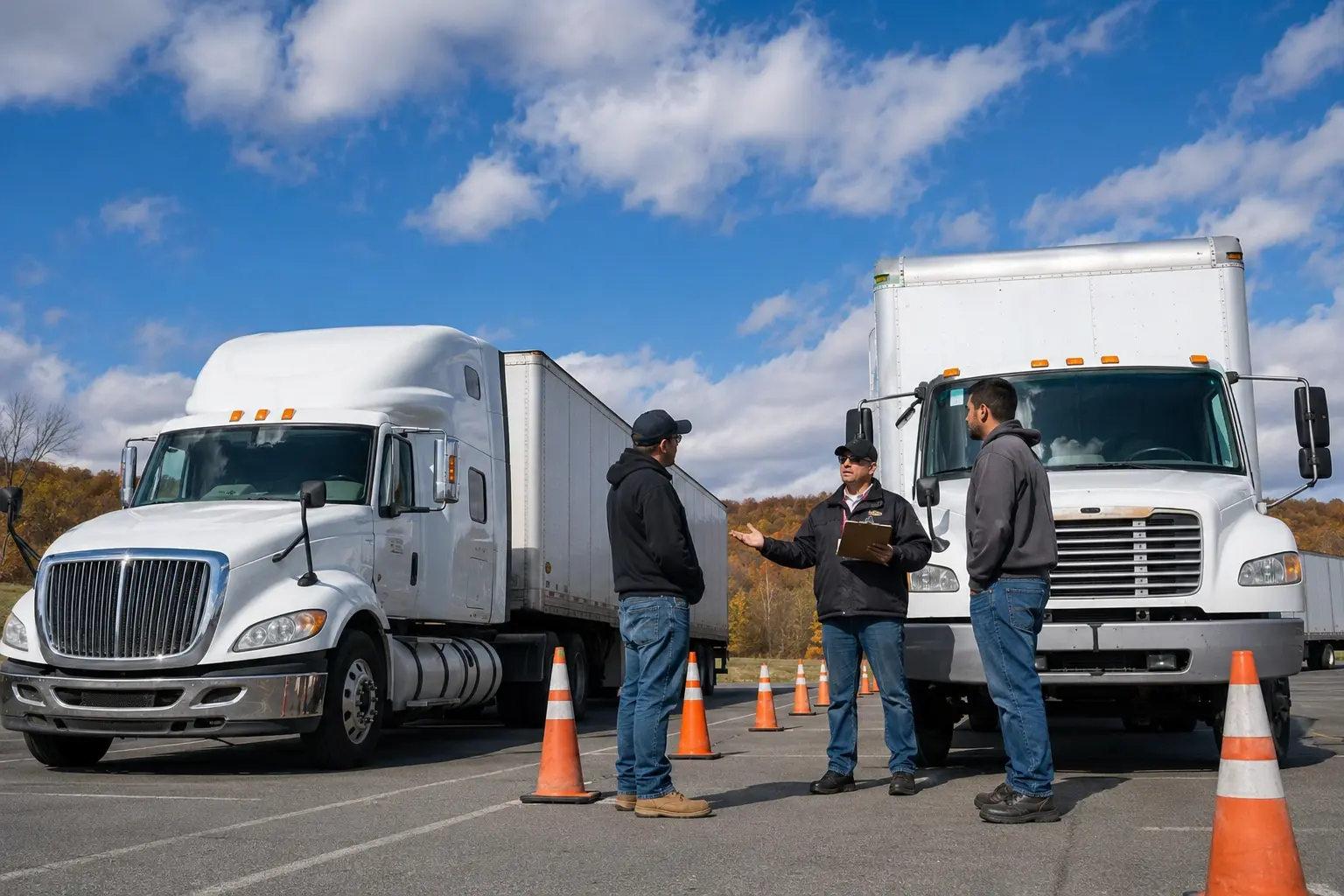
For career planning, common Class A examples include tractor-trailer freight operations. Common Class B examples include many heavy straight trucks, mixers, refuse vehicles, and buses with the proper endorsements. Treat those as examples rather than universal classifications. Review Class A training and Class B training after identifying the actual vehicles in your target jobs.
Compare the workday, not stereotypes about home time
Class A work can be local, regional, dedicated, or over the road. Class B work is often associated with local routes or municipal and construction operations, but its schedule is still employer-specific. A class does not guarantee evenings at home, weekends free, or predictable finishing times. Ask about the actual dispatch pattern and the longest typical workday.
Ask about real start and finish times
Consider the commute to the terminal and where a shift begins and ends. A nominally local job with an early start and a long commute may fit family responsibilities less well than expected. Ask whether schedules change seasonally, whether work includes nights, and what happens when a route runs late. These details matter more than a broad local-versus-long-haul label.
For passenger work, include responsibility for boarding, passenger behavior, stops, and communication. For delivery or construction work, include site access and non-driving duties. A student who enjoys highway travel but dislikes frequent handling of freight may evaluate jobs differently from a student who wants repeated customer contact and an established route.
Compare compensation in a way that supports a decision
Do not compare only the largest annual figure in two advertisements. Identify whether compensation is hourly, mileage-based, salary, load-based, or a combination. Ask what work is paid, how training or onboarding is compensated, and whether a quoted figure depends on overtime, bonuses, exceptional mileage, or experience. Written details are more useful than a headline.
Compare the compensation method
Consider benefits, deductions, waiting time, travel costs, and the stability of available work. Two jobs with similar advertised totals can produce different weekly budgets. Avoid assuming that Class A always pays more or Class B always provides more reliable income. Equipment specialization, experience, employer practices, region, and schedule can matter more than the letter on the license.
Build a conservative personal budget using confirmed information. Include the period before a first paycheck and the possibility that hiring takes time. Training expenses and employment income are separate questions. Ask the school for a written cost breakdown, then ask employers about their hiring process; do not merge the two into a promised return on investment.
Map endorsements and restrictions to target equipment
The license class is only one part of authorization. Passenger, school bus, tanker, hazardous-material, and double or triple trailer work can require additional endorsements and processes. The combination depends on the vehicle and operation. An unrestricted Class A alone does not authorize every bus or specialized cargo assignment.
Consider the complete credential
Test equipment can also affect restrictions. An automatic transmission test can lead to an E restriction; other configurations can produce air-brake or combination-related restrictions. Ask which test vehicle is planned and compare the likely result with job requirements. Avoid paying for a pathway that leaves a restriction incompatible with your intended equipment without understanding the later steps.
ELDT applies to specified first-time classes, upgrades, and endorsements. Confirm which theory and behind-the-wheel components apply to your case with the training provider and official FMCSA guidance. Employer onboarding may add substantial training after licensing. A new CDL is a starting qualification, not evidence that every specialized vehicle or customer operation has already been mastered.
Choose a first step that leaves a realistic next step
Class A can provide broader combination-vehicle authority, but broader authority is useful only when it aligns with your goals, available training, and willingness to perform the work. Class B can be an appropriate direct route when the target occupation uses a qualifying heavy single vehicle. Treat the choice as a match between a documented job and a feasible learning plan.
Write a decision supported by evidence
Ask each school how training time is organized, which equipment is used, what is included in the written price, and how proficiency is assessed. Compare actual student driving opportunities and instruction, not just total scheduled attendance. A plan should explain what happens when a student needs more practice or misses a session.
Finish the research by writing a one-paragraph decision: the target job, required class and endorsements, acceptable schedule, known training costs, and remaining questions. If the evidence changes, revise the decision. Contact Patriot CDL with those questions rather than asking only which license is better.
A practical training example
A prospective student finds two appealing jobs. One is a local tractor-trailer position with early starts, while the other uses heavy delivery straight trucks and requires frequent unloading. The student originally assumed Class A meant weeks away from home and Class B meant an easier local day. The actual descriptions do not support that assumption.
The student asks each employer about start times, experience requirements, physical duties, and compensation structure. The tractor-trailer employer requires a qualification the student does not yet have, while the delivery employer describes a possible entry route but makes no hiring promise. The student then compares training and budget without treating either conversation as an offer.
The decision is based on which pathway fits the student's immediate work preferences and future equipment interests. A clear first-job target supports the choice, while a backup plan accounts for hiring uncertainty. The value of the exercise is replacing stereotypes with evidence before committing time and money.
| Area to compare | What to establish | Useful next action |
|---|---|---|
| Equipment | Tractor-trailer or qualifying heavy combination | Heavy single vehicle or qualifying light-trailer combination |
| Schedule | Local, regional, dedicated, or long-haul depending on job | Route, construction, passenger, or other employer schedule |
| Skills emphasis | Combination tracking, coupling, and trailer control | Single-vehicle dimensions and occupation-specific operation |
| Additional authority | Endorsements and compatible restrictions still matter | Passenger, school bus, or other endorsements may matter |
| Decision evidence | Actual employer requirements | Actual employer requirements |
Action plan and review
Create a job comparison worksheet with one row for each employer and columns for equipment, class, endorsements, restrictions, experience, schedule, physical work, and compensation method. Use “unknown” wherever the advertisement does not answer a question. The unknown fields become a practical phone-call agenda.
Next, rank the jobs by fit rather than headline pay. Decide which responsibilities you want, which you can accommodate, and which would be difficult to sustain. A role that fits your family calendar but requires physical duties you cannot perform is not a complete match. Neither is a high advertised income attached to a schedule you cannot accept.
Finally, take the top two job profiles to a training conversation. Ask how the proposed program connects to those vehicle requirements and what additional steps remain afterward. This makes the enrollment discussion concrete while preserving the difference between training preparation and an employer's independent hiring decision.
Job research also needs a reality check on location. An advertisement may name a large metropolitan area while the actual reporting terminal is far from home. Ask where the work begins, whether assignments move between facilities, and whether travel is part of onboarding. A desirable driving schedule can become impractical when the commute is added.
For compensation, request an example of a normal workweek under the employer's stated pay structure. Ask which activities are included and which are paid separately. The goal is understanding, not asking an employer to guarantee a particular income. Be cautious when an explanation depends on exceptional performance or an unspecified bonus.
For physical duties, ask concrete questions: how frequently freight is handled, what equipment supports it, and what outdoor or customer-site work is expected. “Driver unload” can describe very different tasks. Matching a role to your capabilities requires more detail than a broad job category.
For entry requirements, distinguish obtaining the CDL from satisfying the employer. A carrier may have its own training, insurance-related requirements, evaluations, and experience criteria. The school's completion record cannot substitute for an independent hiring process. Keep a second realistic option in the research worksheet.
Review restrictions with the actual fleet in mind. An automatic-only restriction may be compatible with one employer and a barrier at another. Do not assume every fleet uses the same equipment simply because its trucks appear similar from the road. Ask rather than infer.
A strong final career choice can explain its tradeoffs. You might prefer one class because its immediate target work fits your schedule, while accepting that a later change would require more training. Or you might choose broader combination authority because several realistic target jobs use it. The quality of the decision lies in the evidence and fit, not in which class wins an abstract debate.
Before choosing a pathway, also ask how the role develops after hiring. A new employee may begin on a particular route, equipment type, or supervised assignment before moving to other work. Confirm whether that progression is a defined process or merely a possibility. Do not base the budget on a later role that has not been offered.
Compare the learning environment at the employer as well as the initial license requirement. Ask what onboarding covers, how a new driver requests coaching, and who evaluates readiness for different assignments. A supportive process can matter greatly during the transition from school to employment.
Then revisit the original three job descriptions. If the preferred class serves only one uncertain role while another class serves several realistic options, that is useful evidence. If broader authority supports your genuine equipment interests and a feasible training plan, that is also useful evidence. The decision should reflect your circumstances rather than a universal ranking.
Readiness checklist
- I have reviewed at least three realistic job descriptions.
- I know the equipment and license requirements for each.
- I have compared duties and actual schedules.
- I understand the compensation structure rather than one headline number.
- I have checked endorsements and possible restrictions.
- My budget allows for hiring uncertainty after training.
Frequently asked questions
Does Class A automatically mean long-haul work?
No. Class A jobs can be local, regional, dedicated, or over the road. Confirm the employer schedule and location rather than inferring them from the license class.
Is Class B always the better choice for being home daily?
No class guarantees home time. Many Class B roles are local, but shift length, nights, weekends, and route demands depend on the employer.
Does Class A guarantee higher earnings?
No. Compensation depends on the role, experience, schedule, employer, region, and pay structure. Compare verified job terms and a conservative budget.
Should I choose the school before researching jobs?
Researching target work first helps identify the equipment, class, endorsements, and schedule you need. Then compare schools against those requirements and your learning needs.
Official references and further reading
- — vehicle operation, inspection, and CDL study guidance.
- — applicability and federal training framework.
- — training components, proficiency, and completion records.
Updated October 19, 2026. Educational guidance: use current official requirements, the actual vehicle procedure, and qualified instruction for your situation.