


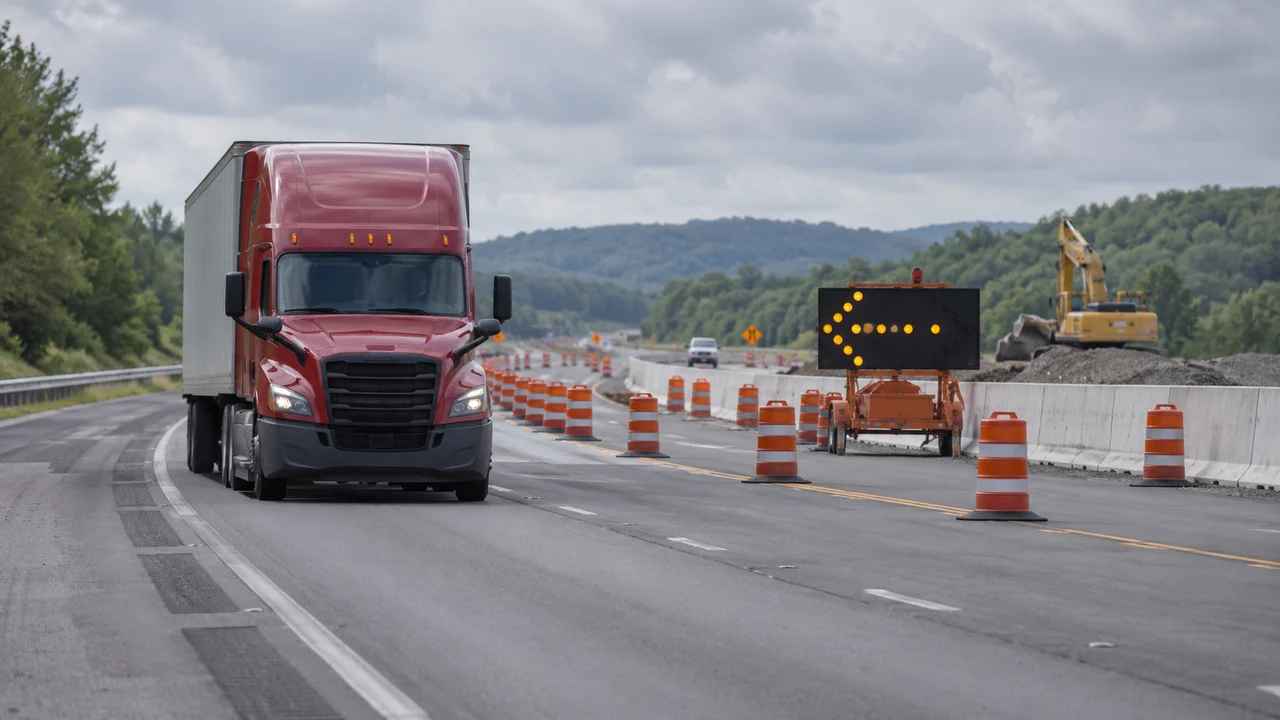
A work zone begins affecting a commercial driver before the first barrel or worker comes into view. Traffic may stop beyond a curve, an entrance ramp may feed vehicles into a narrowing lane, and an ordinary shoulder may disappear just when a driver expects recovery space. The useful plan therefore starts with the approach. It combines route awareness, early speed adjustment, deliberate space management, and a willingness to delay a nonessential task until the truck is safely clear. This guide explains how CDL students can prepare for supervised work-zone driving and how to evaluate their decisions afterward. It focuses on the changing geometry and traffic demands of construction areas rather than on memorizing one arrangement. Every site is different, and posted controls, lawful instructions, current road conditions, and the actual vehicle must guide the decision. A familiar route is still a new operating problem when its lanes, surface, or access points have changed.
Prepare for the approach before leaving
Check the route for more than the construction location
Review current road information and the planned route before travel. Knowing that construction exists is only the first step. Consider where queues may extend, which exits remain usable, whether an official detour affects commercial vehicles, and where a safe stopping location is available if the plan needs review. General navigation guidance may not account for every truck restriction.
For a student trip, discuss the route with the instructor before moving. Ask what types of lane changes or temporary traffic controls might appear and when verbal instructions will be given. This reduces the chance of a last-moment conversation competing with the driver’s observation. The instructor may change the lesson or route if conditions are unsuitable.
Remove avoidable distractions
Set navigation, secure loose items, and make necessary adjustments before the approach. A work zone is a poor place to search for a charging cable, read a message, or debate which exit was intended. If directions become uncertain, preserve vehicle control and use an appropriate safe stopping opportunity rather than solving the problem while threading through narrow lanes.
Review relevant symbols with the Traffic Signs library. Focus on what each warning changes: speed planning, lane selection, stopping readiness, or route choice. Recognition is useful only when it leads to a timely response. Do not depend on encountering every warning in a familiar order; temporary layouts and maintenance activities can differ from the examples in a study guide.
Read the whole traffic picture as the queue develops
Look beyond the nearest vehicle
The first evidence of a work zone may be brake lights, a line of trucks, or a change in traffic flow. Keep scanning far enough ahead to identify a developing stop while maintaining awareness around the vehicle. Fixating on the bumper immediately ahead can delay recognition of a problem farther up the queue.
Reduce speed progressively when conditions permit and communicate the change through appropriate early signaling and braking. Abrupt reactions leave less time for following traffic. A larger vehicle needs planning space, and that space should be protected before the queue compresses. Do not let the pace of nearby passenger vehicles determine a speed that is unsuitable for the truck and available visibility.
Keep room when other drivers enter the gap
A vehicle may merge into the space you deliberately left. Rebuild an appropriate cushion smoothly rather than accelerating to defend the gap. The cushion exists to provide time for the next stop, not to prove that the space belongs to you. Watch for drivers who change lanes repeatedly as they search for a faster line.
When traffic slows to a crawl, continue scanning for workers, emergency access, and vehicles approaching from ramps. Low speed does not eliminate risk. A truck can still contact a barrier, a worker, or a nearby vehicle if the driver becomes absorbed in the queue. Use the instructor’s guidance to maintain a steady, predictable pace and avoid unnecessary position changes.
Choose a lane early and track temporary boundaries
Understand the intended path before committing
Temporary markings, signs, cones, barriers, and the surrounding traffic pattern all help show the usable lane. Old pavement markings may remain visible. Do not simply follow a faded line because it resembles the route from a previous trip. Read the current arrangement and ask for clarification early during instruction if the path is unclear.
Where a lane closes, make the required movement in a controlled way consistent with the posted arrangement and lawful directions. Do not invent a universal merge rule for every construction site. Check mirrors, signal appropriately, verify space, and make a deliberate decision. A missed opportunity does not justify forcing a truck into an inadequate gap.
Protect the entire vehicle through a shift
A tractor’s position alone does not describe the trailer’s clearance. In a lane shift, consider the path of the complete combination and the space available beside barriers. Keep the scan moving between the roadway ahead and relevant mirrors without staring at a single close object. Looking only at the barrier can draw attention away from the actual lane path.
Watch surface changes, raised edges, drainage features, and narrow shoulders. Avoid unnecessary steering corrections that consume the little side clearance available. If the intended path cannot be used safely, the response is to slow, stop where appropriate, and follow qualified guidance rather than assuming the vehicle will fit because another truck passed through earlier.
Handle workers, flaggers, and equipment as changing hazards
Expect movement near the lane
Workers and equipment may be close to moving traffic, sometimes partly hidden by other vehicles or barriers. A machine that appears stationary may have an operating envelope beyond what you first see. Keep attention on the whole scene and be prepared for a lawful stop or a temporary change in direction.
Follow work-zone controls and lawful flagger instructions. Do not continue merely because a navigation device says the route remains open. If an instruction appears unclear, avoid guessing while moving toward the conflict. During training, communicate the uncertainty to the instructor while maintaining the safest available position.
Keep the truck predictable
Give workers and nearby motorists a clear indication of what the truck will do. Sudden lane changes, impatient acceleration, and unnecessary close approaches make the scene harder for everyone to interpret. Do not use the horn to pressure a worker or another driver to move sooner. Use warning devices only as appropriate to an actual safety need and applicable rules.
If a work vehicle needs to enter or leave the site, anticipate that traffic may pause. Leave access points clear when directed and do not block a controlled crossing simply because the queue moved a few feet. The objective is orderly movement through a constrained area, not gaining a single vehicle length at the expense of visibility or access.
Leave the work zone with the same discipline
Wait until the operating conditions actually improve
The last visible worker does not necessarily mark the end of restrictions or hazards. Continue following current signs and controls until they change. A rough surface, narrow lane, or queue can persist beyond the main activity. Accelerate only when the posted conditions and the traffic picture support doing so safely.
After a lane shift ends, reestablish the normal scan and following-space routine. Nearby drivers may accelerate sharply or make delayed lane changes. Resist matching a burst of speed simply because the area feels less confined. The truck still needs room for whatever traffic is doing ahead.
Debrief the earliest useful decision
During a supervised lesson, review where the first warning appeared, when speed changed, how the lane was selected, and where the space cushion was rebuilt. Ask the instructor to identify the decision that provided the most time. This makes the lesson transferable to a different construction layout.
Also identify a decision that came late. Perhaps the truck remained in the ending lane too long, or the student focused on a barrier and reduced forward observation. Choose a specific correction for the next route rather than saying only “be more careful.” Work-zone learning belongs within broader commercial-driving training, where observation, signaling, speed, and vehicle position can be evaluated together.
If the lesson uses a familiar construction corridor, compare today’s arrangement with the last trip without assuming they match. A moved barrier, altered ramp, or new queue can change the decision even when the road name and destination are unchanged.
Worked example: turning the plan into action
A lane closure beyond an entrance ramp
A student and instructor approach a highway construction area where a right lane will close after an entrance ramp. Traffic is moving but brake lights appear farther ahead. The student notices the pattern before reaching the first tight section and begins a controlled speed reduction. The instructor confirms that the route remains appropriate for the lesson and reminds the student to read the current controls.
A car enters from the ramp and occupies part of the following space. The student does not accelerate to prevent the merge. Instead, the student eases back enough to rebuild a cushion while monitoring traffic behind. The closing lane and the ramp create two demands, so an unnecessary navigation adjustment is left alone.
The current signs and traffic arrangement indicate the intended merge. The student checks the available lane, signals, and makes the movement only when a suitable gap exists. At the shift, attention remains on the lane ahead while mirror checks confirm the trailer’s position relative to nearby traffic and barriers. The speed stays appropriate to the narrowed path.
Beyond the main equipment, the pavement remains uneven and a temporary restriction continues. The student waits before accelerating. During debrief, the instructor identifies early queue recognition and a calm gap adjustment as strengths. The next goal is to identify the temporary lane path sooner, reducing the need for a late question close to the shift.
Work-zone observation checklist
| Stage | Look for | Useful response |
|---|---|---|
| Before departure | Current construction, official detours, truck restrictions, stopping options. | Review the route before driving and ask about uncertainty. |
| Approach | Brake lights, queue warnings, speed changes, entrance ramps. | Adjust early and protect stopping space. |
| Lane transition | Current markings, lane closure instructions, usable gaps. | Signal, verify clearance, and avoid a forced movement. |
| Inside the zone | Workers, equipment movement, barriers, surface edges. | Maintain a steady path and be prepared to stop. |
| Exit | Continuing restrictions and delayed lane changes. | Return to normal speed only as conditions permit. |
Frequently asked questions
When should a truck driver begin slowing for a work zone?
Respond to the earliest relevant warning or changing traffic condition, including a queue that begins before the signed activity. The appropriate speed depends on visibility, traffic, roadway, vehicle, and current controls. Waiting until the truck reaches the first worker or barrel can remove the space needed for a controlled response.
What if another car enters the following gap I left?
Rebuild an appropriate cushion smoothly rather than accelerating to defend the space. Continue watching traffic ahead and behind. The gap provides time for a developing stop and should not become a contest over lane position. During instruction, ask for feedback on whether the adjustment was timely and controlled.
Can I rely on old lane markings if the construction layout is confusing?
Read the current traffic-control arrangement, including temporary signs, markings, barriers, and lawful instructions. Old markings may remain visible and may no longer show the intended path. Avoid a last-second guess. During training, raise the uncertainty early so the instructor can guide the situation before the truck reaches the conflict.
Is the work zone over as soon as I pass the equipment?
Not necessarily. Restrictions, narrow lanes, surface changes, and queues can continue beyond the main work activity. Follow the current controls and evaluate traffic before increasing speed. Use the exit as another observation task rather than a signal to accelerate automatically because the most visible workers are behind you.
Official sources and next steps
For Pennsylvania licensing and vehicle-operation guidance, consult the current . For entry-level training applicability and provider requirements, use . These are primary references; a study article does not replace current official instructions, an enrollment agreement, or supervised instruction.
Discuss your next step with Patriot CDL at , or visit 7800 Bristol Pike, Levittown, PA 19057. Compare training programs and ask which preparation will be most useful for your intended vehicle and license.