


A loading dock is one of the few places where a commercial driver, a warehouse team, a forklift operator, a trailer, and building equipment all depend on the same movement decision. The tractor may be stationary, but the work is not passive. A trailer can creep from the dock, a forklift can still be inside, cargo can shift, a dockboard can remain engaged, or a pedestrian can enter the driver’s blind area during the final walkaround.
The safest response is a disciplined arrival-to-departure routine: confirm the dock, control the backing zone, secure the vehicle, follow restraint and key procedures, verify the load, and obtain a positive release. This guide separates federal motor-carrier requirements, workplace rules, and site procedures so a driver does not rely on one light or hand signal.
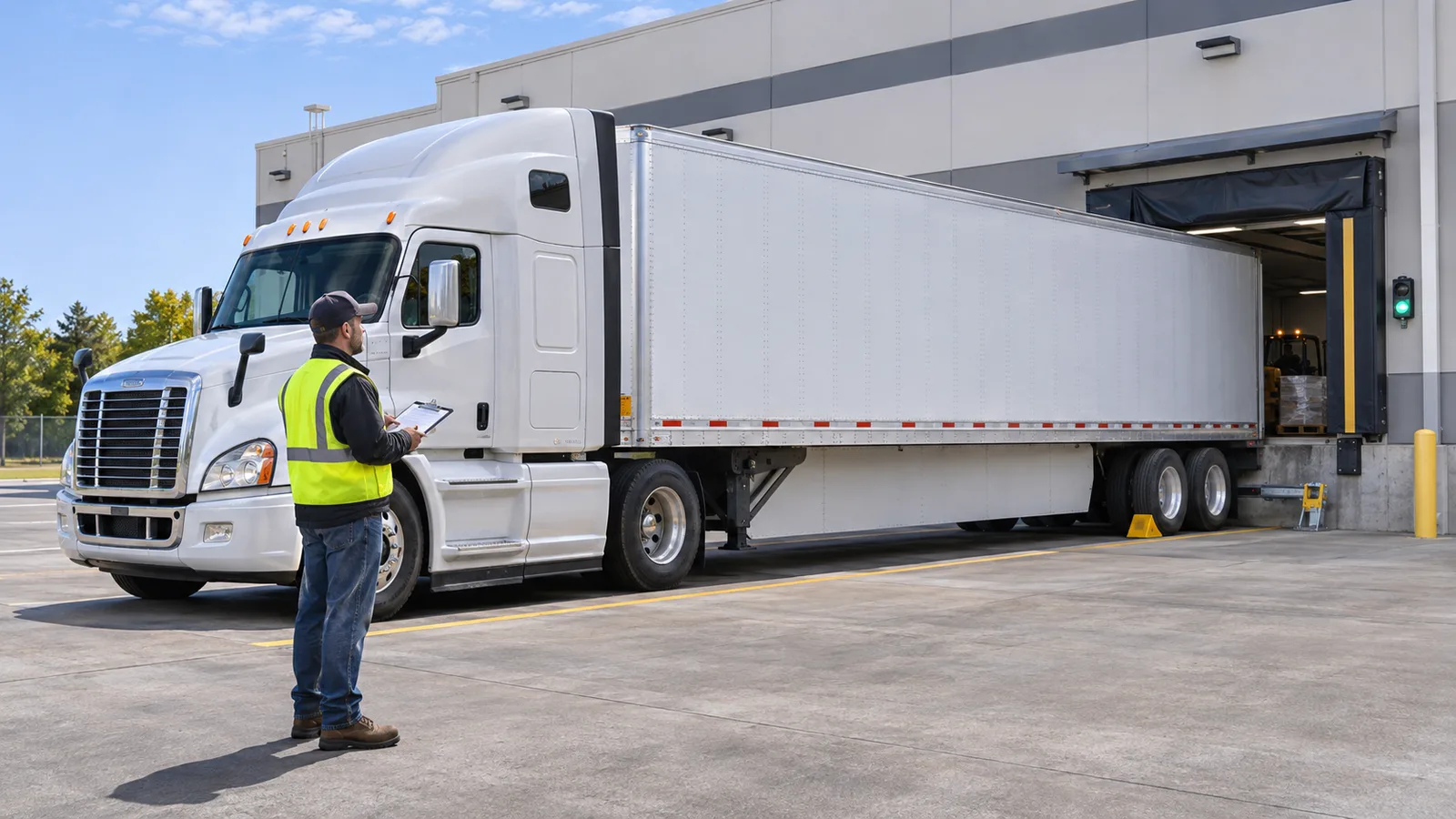
Treat the loading dock as a shared safety system
A dock restraint, wheel chock, parking brake, dockboard, signal light, and written procedure do different jobs. None should be treated as permission to skip the others. The driver controls the commercial vehicle; the facility controls its dock equipment and employees; the carrier may add rules for keys, tandems, landing gear, refrigeration units, seals, and cargo documents. Safe work requires those responsibilities to connect.
Know what the federal sources actually say
requires applicable commercial motor vehicles to have a parking-brake system capable of holding the vehicle or combination stationary under specified loading conditions. For cargo, requires the driver to ensure before driving that cargo is properly distributed and adequately secured, and that doors, tailgates, tarpaulins, spare tires, and other operating equipment are secured.
At the workplace, OSHA’s powered-industrial-truck and dockboard standards address employer controls for forklift and dock operations. However, OSHA’s current explains an important jurisdictional point: FMCSA parking-brake rules preempt OSHA’s wheel-chocking standards with respect to commercial motor vehicles, while a facility employer still has duties to protect its own workers from trailer movement. That is why a driver may encounter chocks, mechanical restraints, air-line locks, key control, or combined systems at different docks.
Site procedure can be stricter than the minimum
A facility may require the driver to set brakes, shut down, surrender a key, disconnect air lines, place chocks, slide tandems, lower landing gear, use a trailer restraint, or wait in a marked area. Follow the documented procedure unless it would create a hazard or conflict with carrier instructions; if it does, stop and escalate. A sign, light, or local custom should never be interpreted in a way that tells the driver to move before people and equipment are clear.
Plan the yard approach before committing to a dock
Reduce speed at the property entrance and read every truck-routing sign. Confirm the shipping or receiving office, assigned door, direction of travel, staging area, pedestrian lanes, stop lines, speed limit, and whether the facility uses right-side or blind-side setups. Check overhead clearances, pavement condition, parked trailers, hostlers, forklifts, and employees walking between vehicles.
Get a complete dock assignment
Before moving toward the door, confirm the dock number and special instructions. Ask whether trailer doors must be opened before backing, whether tandems must be slid, whether the tractor stays attached, where the driver waits, how keys are controlled, and what signal means released. If the load is temperature controlled, clarify refrigeration-unit operation. If the facility uses seals, record who may break or apply them.
Do not let a line of trucks create pressure to guess. A wrong door can force extra backing, place the trailer in the wrong traffic flow, or expose someone to moving equipment. If directions are unclear, stop in an authorized staging area and contact the shipping office or yard controller.
Before backing, notice the future pull-away path, including turning room, fire lanes, poles, curbs, and opposing traffic. Apply the turn-planning and trailer-clearance routine to the entire combination.
Control the backing maneuver and the danger zone
Back only after the path and dock assignment are confirmed. Activate the required warning devices, check both mirrors, and move at a speed that allows an immediate stop. Use a trained spotter when the site or carrier requires one, agree on signals in advance, and stop if the spotter disappears from view. Other people should remain out of the path and away from pinch points between the trailer and dock.
Get out and look before the final approach
G.O.A.L. is most valuable before a small error becomes a collision. Step out using three points of contact and inspect the dock face, bumpers, restraint position, door height, overhead equipment, adjacent trailers, pedestrians, and trailer-door clearance. Look beneath the trailer path for chocks, debris, dock hardware, or a person. The backing practice guide explains how setup and small corrections reduce the need for aggressive steering.
Open swing doors only in the location specified by the facility. Secure them fully so wind or vehicle movement cannot swing them into a person, wall, or adjacent trailer. Stand clear of the door path: cargo may have shifted against a door in transit. A roll-up door should remain closed or be handled according to equipment and facility instructions.
Finish straight and centered
A trailer angled against one bumper can leave an uneven gap, interfere with the restraint, and complicate dockboard placement. Use both mirrors and make a pull-up if needed. Stop gently against the dock bumpers without striking the building. Confirm the trailer is centered at the assigned door and that the tractor does not block a fire lane or travel aisle.
Secure the combination before loading begins
Once positioned, place the transmission in the appropriate parked or neutral condition, set tractor and trailer parking brakes, shut down as required, and follow the site’s key-control process. Verify that the combination remains stationary. Do not depend on transmission selection alone. The commercial-truck secure-shutdown routine provides a repeatable cab sequence.
Understand chocks and mechanical restraints
requires employers to ensure dockboards support the intended load, remain in a safe position, and use measures to prevent the transport vehicle from moving while employees are on a dockboard. OSHA’s powered-industrial-truck standard also contains parking, chocking, trailer-support, and floor-condition provisions for workplace loading operations. For a CMV driver, the practical rule is to follow the facility’s approved control system and never remove or defeat a device without authorization.
A dock lock may engage the rear impact guard, while another facility may use wheel chocks or another positive restraint. A green exterior light may tell the driver one thing while an interior light tells the forklift operator another. Do not assume color conventions are universal. Read the posted instructions and ask what each indication means at that specific door.
Do not enter equipment danger areas casually
Never place hands or feet near a tire, landing gear, restraint mechanism, or moving dockboard. Do not walk between the trailer and dock face. If the site requires driver-installed chocks, use the approved chocks, placement, and retrieval sequence on stable footing while remaining visible to yard traffic. If a chock, restraint, or air-line device is damaged or cannot engage, report it and use the facility’s alternate safe door or procedure.
Support an uncoupled trailer correctly
If the tractor will be disconnected, follow trained coupling and uncoupling verification. Confirm the surface can support the landing gear, lower it according to procedure, disconnect lines without contamination, release the fifth wheel safely, and pull forward only far enough for the required verification before clearing. Facility equipment or fixed jacks may be needed to prevent trailer upending when a forklift enters an uncoupled semitrailer. The driver should not improvise trailer supports.
Use positive communication while loading is active
Once the trailer is secured, check in with the designated employee. Confirm the trailer number, door, load or pickup reference, whether the driver may enter the trailer, and where to wait. Some facilities keep the ignition key, lock the air line, or use a sign-in board to create a physical barrier to early departure. Treat those controls as part of the process, not an inconvenience to bypass.
Know who can authorize movement
A forklift operator, dock clerk, yard hostler, guard, and dispatcher may each know only part of the operation. Identify the role that issues final release. If anyone tells the driver to move while a restraint light is red, a dockboard is engaged, the door remains open, or forklift noise is still coming from the trailer, stop and ask the designated contact to reconcile the conflict.
Use closed-loop communication: repeat the door number, instruction, and release back to the sender. A simple “Trailer 482 at door 19 is complete and released; I may retrieve the key and pull forward after my walkaround—is that correct?” is clearer than a wave through glass. Record unusual instructions under carrier policy.
Wait only in the approved location
Do not wander through the warehouse, stand beside an active dock, or remain where a hostler cannot see you. If the driver must stay in the cab, keep the truck off and secured and do not touch the controls. If the site requires a waiting room or marked safe zone, remain there until called. Manage the hours-of-service clock accurately; the property-carrying driver clock plan explains why duty status depends on the work actually being performed, not merely the truck’s location.
Verify cargo, doors, and trailer condition before driving
Loading completion does not automatically mean the load is road-ready. Where the load is accessible and inspection is permitted, examine distribution, securement, blocking and bracing, damaged packaging, and obvious leakage. Confirm the load does not exceed documents or equipment limits and that axle-weight planning is consistent with carrier procedure. If sealed or loaded in a way that makes inspection impracticable, document the seal and follow the applicable exception and carrier process rather than breaking a seal without authority.
Apply the public-road securement standard
requires cargo on public roads to be contained, immobilized, or secured to prevent leaking, spilling, blowing, falling, or shifting enough to harm vehicle stability or maneuverability. A closed trailer door is not a substitute for proper securement when the cargo requires it. Use the cargo inspection and recheck plan for the first-50-mile and en-route checks in 49 CFR 392.9.
Inspect the trailer after forklift traffic
Look at the floor, walls, roof, doors, hinges, latch hardware, lights, reflective material, rear impact guard, mudflaps, tires, and suspension area. Forklift loading can reveal or worsen floor damage. If the trailer was dropped, inspect the landing gear and confirm the fifth-wheel connection after recoupling, including a visual lock check, tug test, air and electrical connections, and raised landing gear. Report damage before accepting movement.
Use a positive-release sequence before pulling away
Early pull-away is prevented by a deliberate sequence, not by guessing that loading “sounds finished.” The facility should confirm that workers and equipment are out of the trailer, the dockboard or leveler is withdrawn, the restraint is released, and its door process is complete. The driver should receive the key or release documentation and a clear authorization under the site’s procedure.
Perform an exterior release walkaround
Walk around the tractor and trailer before entering the cab. Confirm chocks or alternate restraints have been removed or released by the authorized person, doors are closed and latched, seals are correct, landing gear is raised, lines are connected, tires are unobstructed, and no person or equipment is beneath or beside the combination. Check that the dockboard is no longer bridging the trailer and building.
Treat a green exterior light as one part of the release protocol, not proof that every person and device is clear. Complete the walkaround and positive communication.
Pull forward slowly and stop for a final check
Start only after the cab check and surrounding scan are complete. Release brakes, sound the required warning, and ease forward while checking mirrors. Watch the trailer rear and adjacent doors. After clearing the dock, stop in the designated inspection or staging area—not the travel lane—to recheck doors, seals, cargo documents, axle configuration, lights, and route. If a new defect or unsecured condition appears, correct or report it before entering public traffic.
Action table for common dock signals and conflicts
| Observed condition | Safe driver action | Do not assume | Confirm with |
|---|---|---|---|
| Assigned door is occupied or blocked | Stop in authorized staging and request a new instruction | That an adjacent empty door is available | Yard controller or shipping office |
| Restraint will not engage | Keep the truck secured and request the approved alternate process | Parking position alone protects workers | Dock supervisor and carrier |
| Green light but forklift noise continues | Remain stopped and resolve the conflict | The light proves the trailer is empty | Designated release person |
| Load appears shifted or damaged | Do not depart; document and request correction | Closed doors make the load roadworthy | Shipping supervisor and carrier |
| Paperwork signed but dockboard remains engaged | Stay secured until equipment is withdrawn and release is confirmed | A signature overrides physical conditions | Dock supervisor |
| Person enters the path during pull-away | Stop immediately and hold position | The pedestrian will move around the truck | Visual clearance and spotter if used |
Worked scenario: a green light conflicts with the trailer condition
Maya backs a dry van to door 14 after confirming that doors must be opened in the staging lane and that drivers wait in the lounge. She uses G.O.A.L. before the final approach, centers the trailer, sets both parking brakes, shuts down, and gives the key to the clerk. The facility engages its trailer restraint, and Maya confirms the exterior red light means “do not move.”
The apparent release is incomplete
Forty minutes later, the exterior light changes to green and the clerk returns Maya’s paperwork. At the trailer, Maya still hears a forklift and sees the dock door open. Instead of starting the tractor, she returns to the clerk and asks whether the trailer has been positively released. The clerk checks with the dock lead and discovers that the restraint was released during a system reset even though the last pallet and dockboard remain inside.
The facility re-secures the trailer, completes loading, withdraws the dockboard, closes the dock door, and issues a second release. Maya performs a walkaround, verifies the doors and seal, checks tires and clearance, starts the truck, and pulls forward slowly. In the staging area she inspects the load documents and confirms the trailer condition before entering the road.
Why the stop decision matters
Maya treated the light, paperwork, sound, and physical condition as separate inputs. When they disagreed, she stopped and found the person responsible for release. That prevented an early departure with a forklift operator and dockboard still exposed. The correct habit is not “trust no one”; it is “move only when the complete release system agrees.”
Commercial truck loading-dock checklist
Adapt this checklist to the carrier, equipment, cargo, and facility. It supports communication and memory but does not replace site training or manufacturer instructions.
Arrival and backing
- Enter through the designated truck route at the posted speed.
- Confirm door number, traffic direction, and staging location.
- Ask about doors, tandems, keys, seals, waiting area, and release signal.
- Scan for pedestrians, hostlers, forklifts, curbs, poles, and overhead hazards.
- Plan the exit path before backing.
- Use flashers, horn, spotter, and G.O.A.L. as required.
- Stop if the spotter disappears or any person enters the path.
- Finish straight, centered, and gently against the dock bumpers.
Securement and active loading
- Set tractor and trailer parking brakes and shut down as directed.
- Verify the combination remains stationary.
- Follow the approved chock, restraint, air-line, and key procedure.
- Never defeat, move, or repair unfamiliar dock equipment.
- Confirm the person or role authorized to release the trailer.
- Wait only in the approved cab, lounge, or marked safe zone.
- Do not enter the trailer or warehouse without permission.
- Report conflicting lights, instructions, damage, or restraint failure.
Release and departure
- Obtain a positive release from the designated facility contact.
- Confirm people and powered equipment are out of the trailer.
- Confirm the dockboard is withdrawn and restraint released.
- Verify doors, latches, seals, cargo, and documents.
- Check landing gear, coupling, lines, lights, tires, and clearances.
- Start and pull forward slowly while scanning both mirrors.
- Stop in designated staging for the final road-readiness check.
- Do not enter public traffic with an unresolved defect or unsecured load.
Frequently asked questions
Does federal law require wheel chocks at every loading dock for every commercial motor vehicle?
Not as a universal driver-side federal rule. OSHA’s current interpretation says FMCSA parking-brake requirements preempt OSHA’s wheel-chocking standards with respect to commercial motor vehicles, while OSHA can still require employers at a facility to protect their workers from trailer movement. A facility or carrier may require chocks, a dock restraint, or both. Follow the documented site procedure and do not move until the trailer is positively released.
When may a driver pull a trailer away from a loading dock?
Pull away only after the facility has completed loading or unloading, removed people and equipment from the trailer, withdrawn the dockboard, released the dock restraint or chocks under its procedure, closed the dock door as applicable, returned any keys or paperwork, and given a clear release. The driver should then perform a walkaround and verify doors, cargo, landing gear, lines, lights, tires, and surrounding clearance before moving.
What should a driver do if dock lights, paperwork, and verbal instructions conflict?
Stop and resolve the conflict with the designated facility contact. Do not assume a green light, an open door, or a signed bill of lading by itself proves that every person and device is clear. Ask for one positive release under the site’s procedure, repeat it back, and verify the exterior condition before starting or moving the truck.
Can a CDL driver stay in the cab while a trailer is being loaded?
That depends on the facility and carrier procedure. Some sites direct drivers to a marked waiting area, some use key-control systems, and some allow a driver to remain in the cab under specific conditions. Follow the posted and communicated instructions. Wherever the driver waits, the truck must remain secured and the driver must not start or move it until the facility issues a positive release.
Official references and training next step
This guide was checked on November 18, 2026 against the current eCFR provisions cited above, OSHA’s , its dockboard standard and CMV chocking interpretation, and the agency’s . Employers, carriers, facilities, equipment, and cargo may require additional controls.