

A DOT physical is a safety-focused medical examination used to determine whether a commercial driver can safely perform the demanding work of operating a commercial motor vehicle. For most Pennsylvania CDL and commercial learner’s permit applicants, medical certification is an essential early step—but the exact requirement depends on the driving category selected during self-certification.
This guide explains what the examiner reviews, what to bring, the possible certification outcomes, and how Pennsylvania’s electronic reporting process works in 2026. It is general educational information, not medical advice or a prediction of any applicant’s result.

DOT Physical for a Pennsylvania CDL: Quick Answer
The examination must be completed by a medical professional listed on the FMCSA National Registry of Certified Medical Examiners. The driver completes the health-history section of Form MCSA-5875, and the examiner reviews identification, medications, medical history, vision, hearing, blood pressure, pulse, urinalysis results, and multiple body systems.
A driver who meets the applicable standards may receive a Medical Examiner’s Certificate, Form MCSA-5876, for up to 24 months. The examiner may issue a shorter certificate when periodic monitoring is appropriate, place the decision in pending status while awaiting information, or determine that the driver does not currently meet the standards.
| Question | Practical answer |
|---|---|
| Who performs the exam? | An examiner with an active listing on the FMCSA National Registry |
| What form records the full exam? | Medical Examination Report Form MCSA-5875 |
| What document shows qualification? | Medical Examiner’s Certificate MCSA-5876 |
| How long can certification last? | Up to 24 months; a shorter period may be issued |
| How does PennDOT receive CDL/CLP results? | Electronically through FMCSA’s National Registry system |
| Is the standard urinalysis a drug test? | No. The medical-exam urinalysis records specific gravity, protein, blood, and sugar; employer or federal drug testing is a separate process |
Place the medical step within the complete Pennsylvania CDL requirements and licensing path before scheduling training or permit testing.
Who Needs a DOT Physical in Pennsylvania?
Every Pennsylvania CDL holder and every applicant for a commercial learner’s permit must submit a self-certification form. The driver selects one of four operating categories. That category determines whether medical certification must be maintained on the PennDOT record.
| Self-certification category | General medical-certification effect | Typical description |
|---|---|---|
| Non-excepted interstate | Federal medical qualification and a current MEC are required | Commercial work connected to interstate commerce without an applicable exception |
| Excepted interstate | Federal MEC requirement may not apply to the excepted operation | Only specific federally excepted activities |
| Non-excepted intrastate | Pennsylvania medical requirements and a current MEC generally apply | Commercial operation only within Pennsylvania without an applicable exception |
| Excepted intrastate | Medical requirements depend on the specific Pennsylvania exception | Only qualifying state-excepted activities |
PennDOT says Pennsylvania incorporates the federal medical standards for intrastate CDL drivers with limited exceptions, so nearly all commercial drivers must keep a current medical certificate on record. Do not choose an excepted category simply to avoid an examination. Select the category that accurately describes the work you perform or expect to perform.
Read PennDOT’s current and complete Form DL-11CD accurately. If a job’s operating category is unclear, verify it with PennDOT and the prospective employer.
How to Find the Right Certified Medical Examiner
A family physician or urgent-care provider cannot perform a valid FMCSA physical merely because the provider is licensed to practice medicine. The examiner must also have a current National Registry listing.
- Search the official by location.
- Confirm that the clinic schedules FMCSA commercial-driver examinations, not only ordinary employment physicals.
- Ask what identification and supporting medical records the clinic wants you to bring.
- Verify the total exam fee and whether follow-up paperwork has a separate charge. FMCSA does not set a nationwide examination price.
- Confirm that the examiner submits CDL/CLP examination results electronically through the National Registry.
Protect your record: Use the legal name, date of birth, driver-license number, and issuing state exactly as shown on your license. A data mismatch can interfere with electronic posting to the correct driving record.
What to Bring to a DOT Physical
| Item | Why the examiner may need it |
|---|---|
| Current driver’s license, CDL, CLP, or accepted photo ID | Verifies identity and licensing information |
| Current medical certificate, if renewing | Shows the existing expiration date and any restrictions |
| Complete medication list | Includes prescriptions, over-the-counter products, supplements, dose, and prescribing professional |
| Glasses or contact lenses | Allows vision testing with the correction normally used for driving |
| Hearing aids | Allows testing with the device when one is used |
| Relevant medical records | May document evaluation, treatment, stability, monitoring, or specialist recommendations |
| Condition-specific FMCSA forms, when applicable | May be required for insulin-treated diabetes, the alternative vision standard, or medication review |
| Payment method | Clinics set their own fees and payment policies |
Answer the health-history questions completely. Form MCSA-5875 warns that inaccurate, false, or missing information may invalidate the examination and medical certificate. A “yes” answer does not automatically mean disqualification; it tells the examiner what should be evaluated and documented.
What Happens During the DOT Physical?
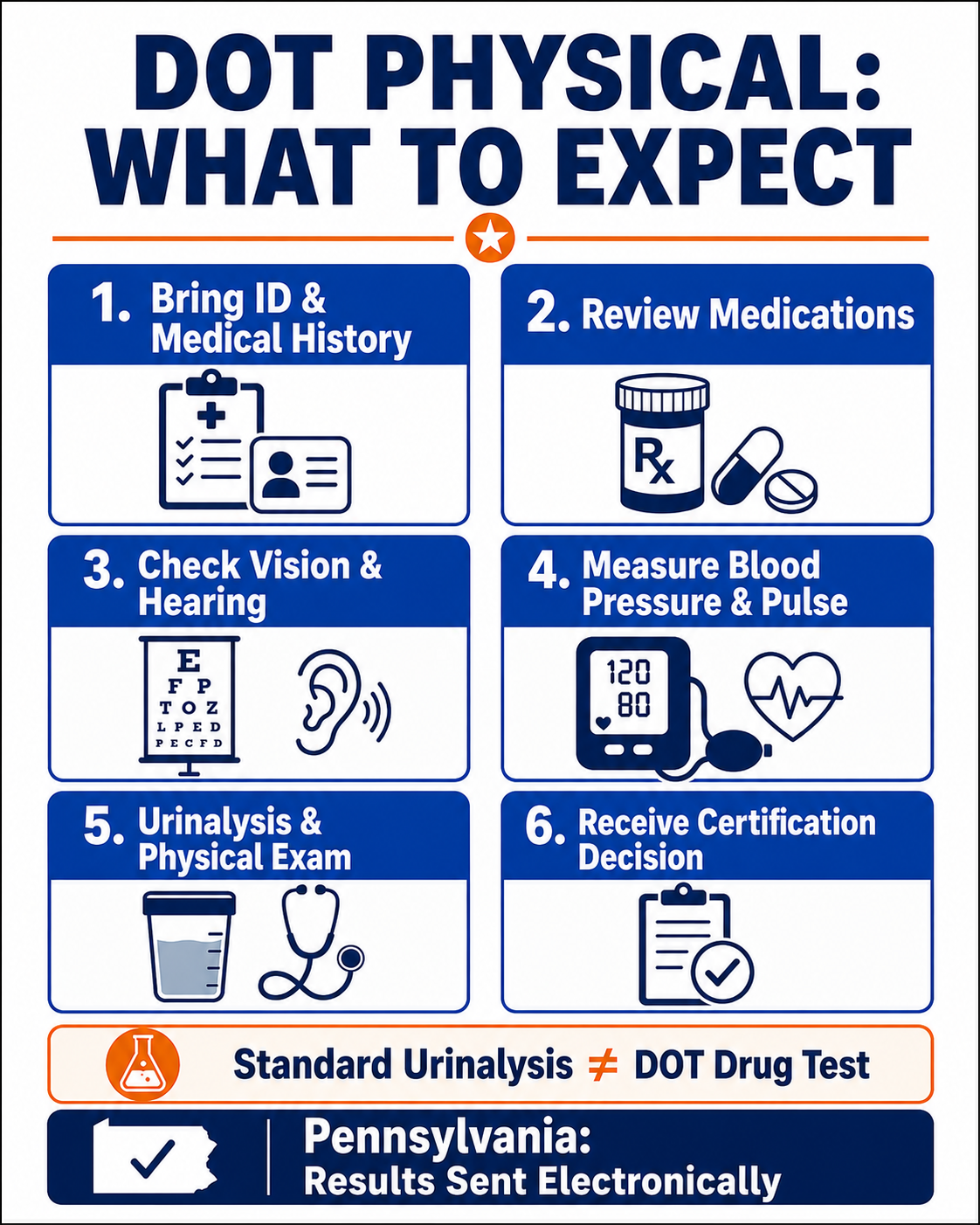
1. Identity and health-history review
The driver completes the first section of MCSA-5875. It asks about surgery, current medications, previous medical certification, and a detailed history covering neurological, vision, hearing, cardiovascular, respiratory, kidney, digestive, diabetes, mental-health, fainting, musculoskeletal, sleep, substance-use, and other topics.
2. Basic measurements
The examiner records height, weight, pulse, pulse rhythm, and blood pressure. A second blood-pressure reading may be taken when appropriate. The examiner interprets the results using the regulations, current FMCSA guidance, and medical judgment.
3. Vision testing
The examination records visual acuity in each eye and both eyes, horizontal field of vision, ability to recognize traffic-signal colors, and whether corrective lenses are required. The federal form identifies the standard as at least 20/40 acuity in each eye with or without correction and at least a 70-degree horizontal field in each eye. Drivers who do not meet the ordinary standard may need evaluation under a current alternative standard or variance pathway.
4. Hearing testing
Hearing is evaluated using either a forced-whisper test or an audiometric test. The federal form states that the driver must first perceive a forced whispered voice at not less than five feet, or have an average hearing loss of no more than 40 decibels in the better ear, with or without a hearing aid.
5. Urinalysis
The required urinalysis records specific gravity, protein, blood, and sugar. Those findings can signal that further medical evaluation is appropriate. This standard urinalysis is not the DOT controlled-substances test; drug and alcohol testing is governed by a separate process.
6. Physical examination
The examiner evaluates general appearance and multiple body systems, including the eyes, ears, mouth and throat, heart and circulation, lungs and chest, abdomen, genitourinary system including hernias, back and spine, extremities and joints, neurological function and reflexes, gait, skin, and vascular system.
Possible DOT Physical Outcomes
The result is not limited to a simple pass or fail. The current federal examination form gives the certified examiner several possible determinations.
| Outcome | What it means | Practical next step |
|---|---|---|
| Qualified for up to two years | The driver meets the applicable standards without a shorter monitoring interval | Check all personal details, restrictions, and expiration information |
| Qualified for a shorter period | The driver meets standards, but periodic monitoring is appropriate | Plan follow-up and renewal well before the printed expiration date |
| Determination pending | The examiner needs additional information before making a final decision | Provide the requested records and return by the examiner’s deadline, which cannot exceed 45 days |
| Qualified with a restriction or variance | Corrective lenses, a hearing aid, an SPE certificate, or another authorized condition applies | Understand and comply with every restriction and required document |
| Does not currently meet standards | The examiner cannot certify the driver under the applicable standards at that time | Ask what standard was not met and whether treatment, documentation, re-examination, or a lawful variance path may apply |
| Incomplete examination | The examination was not completed | Contact the examiner about the appropriate next step |
FMCSA’s current explains how examiners apply the regulations and medical advisory criteria. The examiner—not a driving school, recruiter, or online article—makes the individual qualification determination.
How Pennsylvania Medical Certification Is Reported in 2026
Pennsylvania implemented the National Registry II electronic process on June 23, 2025. For CLP applicants and CDL holders, the certified examiner submits the examination result to FMCSA’s National Registry, FMCSA transmits the information to PennDOT, and PennDOT posts the medical status to the driver record. PennDOT says it no longer accepts Medical Examiner’s Certificates in person or by email.
- The examiner verifies the driver’s identity and completes the examination.
- The examiner reports the result electronically to the National Registry.
- FMCSA sends the CDL/CLP examination information to PennDOT.
- PennDOT updates the commercial driving record.
- The driver follows up with the examiner if the expected status is not posted.
Review the dated before relying on it, because it expires October 11, 2026 unless official action changes the date.
How to Prepare Responsibly
- Schedule before a deadline. Do not wait until the last day of an existing certificate or an enrollment requirement.
- Use the correct examiner. Confirm the active National Registry listing before the appointment.
- Bring complete information. Gather medication details, relevant specialist records, and condition-specific forms requested by the clinic.
- Use prescribed devices. Bring the glasses, contacts, or hearing aids normally required.
- Follow normal medical instructions. Do not stop medication, change a dose, overhydrate, fast, or attempt to manipulate results unless your treating professional gives you specific instructions.
- Ask questions. If the examiner requests more information, get the exact document and deadline in writing.
- Verify the record. Keep the paper certificate provided during the transition and follow up if the electronic status does not post.
After medical qualification and self-certification are addressed, use Patriot CDL’s permit preparation resources to study the knowledge areas required for your intended class and endorsements.
DOT Physical Appointment Checklist
- □ Examiner’s National Registry listing verified
- □ Appointment type confirmed as an FMCSA DOT physical
- □ Current license, CDL, CLP, or accepted photo ID packed
- □ Legal name and license information checked for accuracy
- □ Complete medication and supplement list prepared
- □ Relevant medical and specialist records gathered
- □ Glasses, contacts, and hearing aids packed if used
- □ Condition-specific FMCSA forms completed when applicable
- □ Current MEC brought if this is a renewal
- □ Clinic fee and payment method confirmed
- □ Paper MCSA-5876 reviewed and retained when issued
- □ Electronic PennDOT record follow-up planned
Frequently Asked Questions
How long is a DOT medical certificate valid?
A medical examiner may issue a certificate for up to 24 months. A shorter period may be used when the driver is qualified but needs periodic monitoring. Always follow the expiration date printed on the certificate and shown on the driving record.
Is the urine sample during a DOT physical a drug test?
No. The required medical-exam urinalysis records specific gravity, protein, blood, and sugar. A DOT controlled-substances test is a separate procedure, although an employer or clinic may schedule both services during the same visit.
Can my regular doctor perform my DOT physical?
Only if that professional is currently listed on FMCSA’s National Registry of Certified Medical Examiners. Verify the listing before the appointment.
Do I submit my paper medical card to PennDOT?
PennDOT says MEC results for CDL and CLP records must be received electronically through FMCSA’s National Registry and are no longer accepted in person or by email. Keep any paper certificate the examiner gives you and contact the examiner if your electronic status does not update.
Educational content only; not medical or legal advice. Medical qualification depends on the applicable regulations, the driver’s individual history, supporting documentation, and the certified medical examiner’s determination. Confirm current procedures with FMCSA and PennDOT. Official sources reviewed July 28, 2026.