

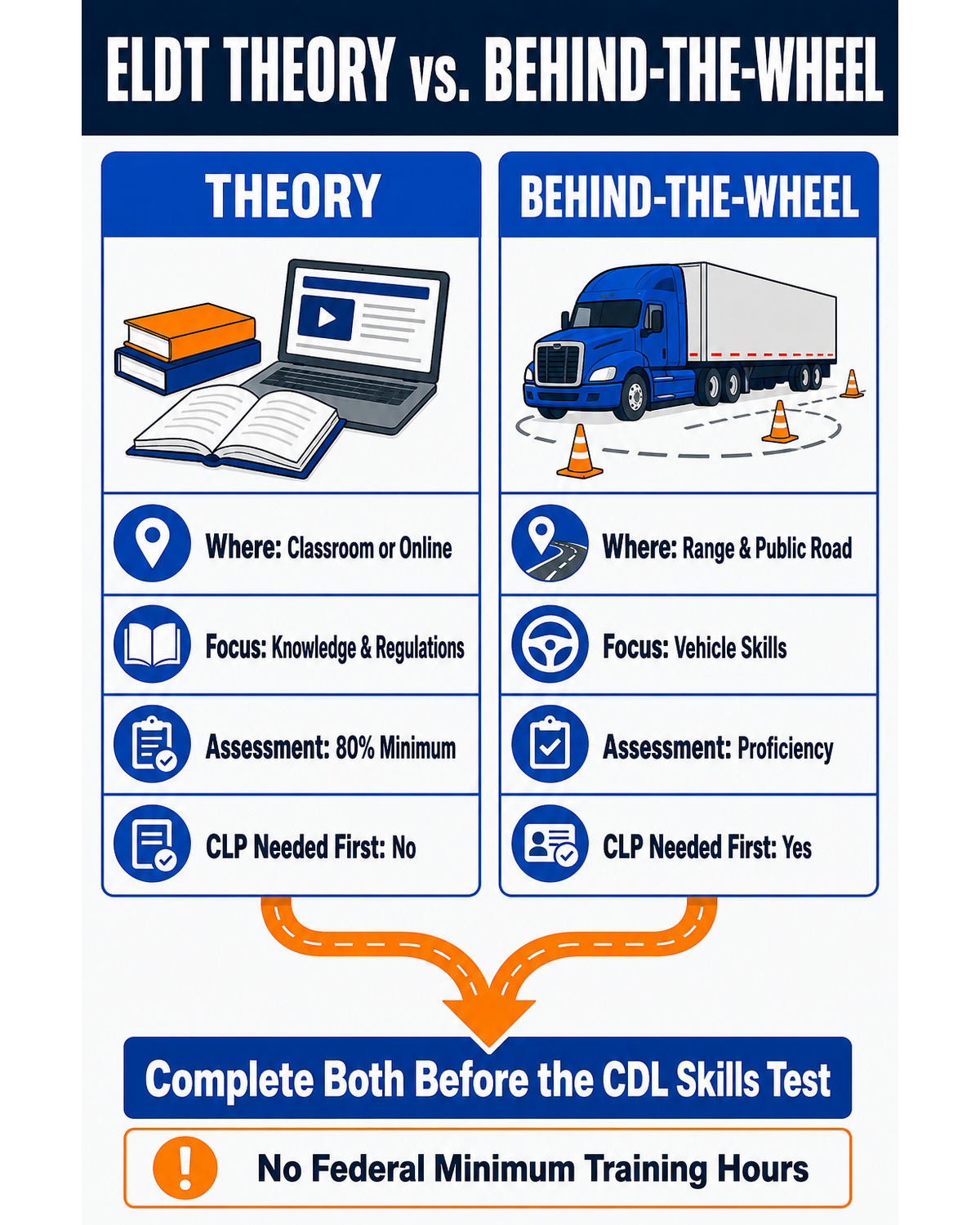
Entry-Level Driver Training is not one interchangeable course. For a first Class A or Class B CDL, it has two distinct parts: theory training builds the knowledge needed to make safe decisions, while behind-the-wheel training develops and verifies practical skill in a representative commercial vehicle.
Understanding the difference helps you choose the correct provider, build a realistic schedule, and avoid reaching test day with only half of the required training recorded. This guide compares both stages under the current federal framework and shows how they fit into a complete CDL plan.

ELDT Theory vs. Behind-the-Wheel Training at a Glance
Theory and behind-the-wheel training serve different purposes and use different completion standards. Passing an online theory course does not replace in-vehicle instruction when BTW training applies. Likewise, driving practice does not replace the required theory curriculum and assessment.
| Comparison point | ELDT theory | Behind-the-wheel training |
|---|---|---|
| Primary purpose | Teach regulations, vehicle systems, safety concepts, and decision-making | Develop and verify practical control of a commercial vehicle |
| Delivery | Classroom or online through a registered provider | In person in a representative vehicle |
| Main settings | Classroom, learning platform, or blended course | Range and public road, as required by the curriculum |
| Completion standard | All required topics plus an overall written or electronic assessment score of at least 80% | Instructor-documented proficiency in every required BTW element |
| Federal minimum hours | None | None |
| CLP needed before starting? | No federal requirement to hold a CLP before theory | Yes; lawful BTW instruction on public roads requires the appropriate CLP and supervision |
| Can a simulator substitute? | A simulator may support theory instruction | No; FMCSA does not allow a simulator to replace mandatory BTW training |
| Who reports completion? | The registered theory provider | The registered BTW provider |
Before enrolling, place ELDT within the full CDL requirements and licensing path. Medical qualification, the commercial learner’s permit, state procedures, ELDT, and the skills test are related—but they are not the same requirement.
Who Must Complete ELDT?
The federal ELDT requirements have applied since February 7, 2022. They generally cover applicants seeking any of the following for the first time:
- A Class A CDL
- A Class B CDL
- An upgrade from Class B to Class A
- A passenger (P) endorsement
- A school bus (S) endorsement
- A hazardous materials (H) endorsement
The required components depend on the credential. According to the , first-time Class A and Class B applicants need theory plus BTW range and public-road training before the skills test. Passenger and school-bus applicants also need the applicable theory and BTW curricula. HazMat is different: the federal ELDT requirement is theory only, and completion is verified before the state HazMat knowledge test.
| Credential goal | Theory required? | BTW required? | Verification occurs before |
|---|---|---|---|
| First Class A CDL or B-to-A upgrade | Yes | Yes: range and public road | Class A skills test |
| First Class B CDL | Yes | Yes: range and public road | Class B skills test |
| First passenger endorsement | Yes | Yes, as applicable | Passenger skills test |
| First school bus endorsement | Yes | Yes, as applicable | School bus skills test |
| First HazMat endorsement | Yes | No federal ELDT BTW component | HazMat knowledge test |
Federal and state exceptions can apply. For example, FMCSA identifies certain military, restricted-CDL, and other applicants who are excepted from the relevant skills-test requirement. A student should confirm personal applicability with the state licensing agency instead of assuming that prior experience automatically creates an exemption.
What ELDT Theory Training Covers
Theory training is the knowledge side of ELDT. It explains how and why commercial drivers perform critical tasks before a student is evaluated on practical vehicle control. For Class A and Class B curricula, the required subject areas extend well beyond memorizing road signs.
Five major knowledge areas
| Area | Examples of topics | Why it matters in the truck |
|---|---|---|
| Basic operation | Vehicle controls, inspections, shifting, backing, coupling and uncoupling when applicable | Builds the mental model for operating the vehicle correctly |
| Safe operating procedures | Visual search, communication, distracted driving, speed, space, night and extreme conditions | Supports decisions before a hazard becomes an emergency |
| Advanced operating practices | Hazard perception, skid recovery, jackknifing, emergencies, railroad crossings | Prepares the driver to identify and manage high-consequence risks |
| Vehicle systems and reporting | Malfunctions, roadside inspections, maintenance | Connects mechanical awareness to safe, compliant operation |
| Non-driving activities | Cargo, hours of service, fatigue, post-crash duties, trip planning, drugs and alcohol, medical requirements | Covers responsibilities that exist before, during, and after a trip |
How theory can be delivered
A provider may deliver theory in person, online, or through a structured combination of both. Online access can make scheduling easier, but the provider must still be listed on the Training Provider Registry for the exact theory curriculum being offered. A website selling “CDL prep” is not automatically an ELDT provider.
The provider must cover every topic in the applicable federal curriculum. To complete theory, the student must achieve an overall score of at least 80 percent on the provider’s written or electronic assessment. Practice quizzes, a state permit test, and the provider’s ELDT assessment are three different things.
What theory completion does—and does not—mean
- It does mean the student completed the applicable knowledge curriculum and met the federal assessment threshold.
- It does not mean the student has completed required range or road training.
- It does not issue a CLP, CDL, or endorsement; the state licensing agency issues credentials after its own requirements are met.
- It does not guarantee success on a state knowledge or skills test.
What Behind-the-Wheel Training Covers
Behind-the-wheel training is the practical side of ELDT. It must be conducted by a qualified instructor through a provider listed on the Training Provider Registry for the correct BTW curriculum. The student trains in a vehicle representative of the CDL class or endorsement sought.
Range training
The range is a controlled environment used to establish vehicle familiarity and low-speed control before complex public-road situations are added. The exact curriculum depends on the credential, but Class A and Class B students generally practice areas such as:
- Pre-trip, en-route, and post-trip vehicle inspection procedures
- Starting, stopping, steering, and controlled acceleration
- Shifting and transmission operation when appropriate
- Straight-line and offset backing
- Alley docking and parallel parking practice
- Coupling and uncoupling for applicable Class A combination vehicles
Students who need a repeatable inspection method can review Patriot CDL’s hands-on pre-trip inspection training. Inspection practice should connect component identification with safety condition, not rely on disconnected memorization.
Public-road training
Public-road instruction evaluates how the student combines vehicle control with observation, communication, traffic law, and risk management. Required skills include appropriate operation through turns, intersections, lane changes, curves, railroad crossings, upgrades and downgrades, and traffic conditions while maintaining safe speed and space.
Proficiency—not a quiz score
There is no federal 80 percent score for the BTW portion. Instead, the instructor must determine and document that the student has demonstrated proficiency in each required element. Completing a scheduled block of driving time is not enough if required skills have not been demonstrated.
Important: FMCSA states that a driving simulator cannot substitute for mandatory BTW training. Simulators may support theory learning, but required practical proficiency must be shown in a representative commercial vehicle.
Training Order, CLP Timing, and Separate Providers
FMCSA does not require theory, BTW range, and BTW public-road training to occur in one prescribed sequence. Theory also does not have to be completed before a student obtains the CLP. In practice, however, a logical order reduces delays and makes each step more useful.
- Confirm the credential. Decide whether the goal is Class A, Class B, an upgrade, or a specific endorsement.
- Verify applicability and providers. Search the TPR for the exact theory and BTW training types needed.
- Prepare for and obtain the CLP. Theory may begin before the permit, but the appropriate CLP is needed before lawful in-vehicle training on public roads.
- Complete theory. Cover every required topic and meet the 80 percent assessment threshold.
- Build range proficiency. Learn inspection language, vehicle control, and backing in a controlled setting.
- Build public-road proficiency. Apply safe observation, speed, space, communication, and control in traffic.
- Verify both records. Confirm that the required completions appear before the state skills test.
Can you use two different training providers?
Yes. FMCSA allows one registered provider to deliver theory and another registered provider to deliver BTW training. Each provider must be listed for the training it delivers, and each submits its own driver-specific completion record.
Before splitting the stages, ask the BTW school whether it accepts outside theory completion, what record it needs, how it evaluates incoming students, and whether its schedule assumes a particular theory sequence. A coordinated Class A or Class B CDL program can simplify the handoff by aligning theory, range, road, inspection, and test preparation.
Does ELDT Require a Minimum Number of Training Hours?
At the federal level, no fixed minimum number of hours applies to either ELDT theory or BTW training. The states that theory completion depends on required content plus the 80 percent assessment, while BTW completion depends on the instructor’s assessment of proficiency in every required skill.
That does not mean training time is unimportant. A school should give students enough structured instruction and practice to learn safely and demonstrate consistent performance. Program hours may also be set by a state, a licensing or education agency, an employer, a funding program, or the school’s approved curriculum. Federal ELDT is the baseline, and states may impose more stringent requirements.
| Statement | Accurate? | Why |
|---|---|---|
| “Federal ELDT requires exactly 40 theory hours.” | No | FMCSA sets curriculum and assessment requirements, not a universal theory-hour minimum |
| “Federal ELDT requires a fixed number of BTW hours.” | No | BTW completion is proficiency-based under the federal rule |
| “A school can finish BTW after any amount of driving time.” | No | The instructor must document proficiency in all required elements |
| “A state or approved school program may require hours.” | Yes | Additional state and program standards can exceed the federal baseline |
How ELDT Completion Reaches the State
After the student successfully completes an applicable curriculum, the registered provider electronically submits certification information to FMCSA’s Training Provider Registry. FMCSA says providers must submit it by midnight of the second business day after completion.
The record identifies the driver, license or CLP information, credential and training type, completion date, and—when applicable—BTW clock hours. The state licensing agency checks the registry before allowing the relevant Class A, Class B, passenger, or school-bus skills test, or the HazMat knowledge test.
- □ Legal name matches the driver license or CLP
- □ CDL/CLP number and issuing state are accurate
- □ Correct class or endorsement is reported
- □ Theory completion appears when required
- □ BTW completion appears when required
- □ Any mismatch is reported to the training provider before test day
Drivers can use FMCSA’s official . If a record is missing or incorrect, contact the provider that delivered that portion of training; the state licensing agency does not create the provider’s certification.
How to Compare ELDT Providers
A TPR listing is the minimum eligibility check, not a complete quality review. Compare the exact service, equipment, instruction, schedule, and reporting process before paying.
| Question to ask | Strong answer should clarify |
|---|---|
| Which TPR training types are offered at this location? | Theory and/or BTW for the exact class or endorsement you need |
| Is theory online, classroom, or blended? | Delivery format, access period, language support, and assessment process |
| What does BTW access include? | Range work, public-road instruction, vehicle type, observation time, and actual driving opportunities |
| How is proficiency evaluated? | Required skills, instructor feedback, progress checks, and remediation options |
| When is completion reported? | Who submits each record and how the student confirms it |
| What is included in the quoted price? | Training, materials, vehicle use, test preparation, testing, and any separate fees |
| What happens if more practice is needed? | Scheduling, cost, and a safe plan for additional instruction |
Common ELDT Planning Mistakes
- Buying theory from an unlisted website. Confirm the provider and exact training type in the TPR before enrollment.
- Assuming online ELDT includes driving. Online theory cannot replace required range and public-road training.
- Using the wrong curriculum. Class A, Class B, B-to-A, HazMat, passenger, and school-bus paths are not interchangeable.
- Confusing the theory assessment with the state permit test. One completes the provider’s ELDT requirement; the other is administered for the state credential.
- Scheduling the skills test before both records post. Build reporting time into the plan and check the record in advance.
- Shopping only by the advertised number of hours. Ask how much supervised practice, feedback, and actual driving access the schedule provides.
- Ignoring vehicle configuration. Transmission and brake-system choices can affect the restrictions on the CDL earned.
Frequently Asked Questions
Can I complete ELDT theory online?
Yes. A provider listed on the FMCSA Training Provider Registry may deliver theory online. You still need the applicable BTW training in person when pursuing a first Class A or Class B CDL, a passenger endorsement, or a school-bus endorsement.
Do I need a CLP before starting ELDT theory?
No. FMCSA does not require theory to be completed after CLP issuance. The appropriate CLP is needed before behind-the-wheel instruction on public roads, and all applicable training must be completed before the relevant state test.
Can theory and behind-the-wheel training come from different schools?
Yes. Each provider must be listed in the TPR for the training it delivers, and each provider submits its own completion certification.
How many hours of ELDT training are federally required?
FMCSA sets no universal minimum number of hours for theory or BTW training. Theory requires all topics and an overall assessment score of at least 80 percent; BTW requires instructor-documented proficiency in every required element. State or program requirements may add hours.
Educational information only; not legal advice or an individual eligibility determination. Confirm current requirements with FMCSA, the Training Provider Registry, and your state licensing agency. Official federal sources reviewed July 29, 2026.