

The FMCSA Drug and Alcohol Clearinghouse can affect a new driver before the first paid mile. A motor carrier must complete a pre-employment Clearinghouse query before allowing a CDL or CLP holder to perform safety-sensitive work, and the driver must give electronic consent for that full query. A prohibited status can also block commercial driving privileges.
This guide explains what first-time CDL applicants need to do, when student drivers become subject to federal drug-and-alcohol rules, how full and limited queries differ, and what happens after a violation. It reflects official FMCSA information reviewed August 1, 2026.

FMCSA Clearinghouse: The Quick Answer for New CDL Drivers
| Question | Practical answer |
|---|---|
| Must every driver create an account? | Registration is not universally mandatory, but a driver must register to give electronic consent to a full query, view a personal record, and complete Clearinghouse steps in the return-to-duty process. |
| When should a new driver register? | Before applying for a job that requires a CDL. It prevents avoidable delay when an employer sends the required pre-employment full-query request. |
| Does registration replace a drug test? | No. The Clearinghouse query and the employer's federally compliant pre-employment drug test are separate requirements. |
| Can a violation appear without an account? | Yes. A verified violation may be reported even when the driver has never registered. |
| What does “prohibited” mean? | The person may not perform safety-sensitive functions, including operating a commercial motor vehicle, until completing the federal return-to-duty process. |
New Pennsylvania applicants should coordinate the Clearinghouse with the state's licensing steps. Start with the broader Pennsylvania CDL requirements, then build the account and consent steps into your employment plan.
What Is the FMCSA Drug and Alcohol Clearinghouse?
The Clearinghouse is FMCSA's secure online database for drug-and-alcohol program information involving drivers covered by 49 CFR Parts 382 and 383. It gives employers, state driver licensing agencies, FMCSA, and state enforcement personnel access to information necessary to determine whether a driver is prohibited from performing safety-sensitive work.
According to , the record can include:
- verified positive drug-test results;
- alcohol-test results at or above 0.04;
- refusals to test, including certain situations defined by federal regulation;
- an employer's actual-knowledge report of prohibited drug or alcohol use;
- a substance abuse professional's report that the driver completed the initial evaluation and education or treatment requirements;
- a negative return-to-duty test result; and
- completion of the required follow-up testing plan.
The Clearinghouse is not a public criminal-background database, an ordinary driving record, or a substitute for testing. Routine negative pre-employment and random tests are not entered as violations. The database is designed to keep unresolved Part 382 violations visible when a driver changes employers.
Registration does not create your record
A common misconception is that staying unregistered keeps information out of the system. FMCSA states that a violation can be reported even if the driver does not have a Clearinghouse account. Registration gives the driver the ability to see the record, respond to full-query requests, designate a substance abuse professional when necessary, and monitor progress through return-to-duty—not control whether a verified report exists.
Who Needs to Register for the Clearinghouse?
says a driver is not required to register merely because the person holds a CDL. In practice, registration becomes essential when the driver needs to:
- give electronic consent for a current or prospective employer to run a full query;
- review the driver's own Clearinghouse record;
- identify the substance abuse professional conducting an initial evaluation; or
- view return-to-duty and follow-up testing information.
Every pre-employment query is a full query, so a job applicant who does not register and consent cannot be cleared through the required process. Registration itself is free. The employer normally pays the query fee; a legitimate recruiter should not ask a driver to buy a query plan for the carrier.
Register before the hiring process reaches the query
Create your account before applications begin, use the exact identifying information associated with your CDL or CLP, and keep access to the email and authentication method tied to the account. A mismatch in name, license details, or state can slow the employer's request. Never approve an unexpected request until you confirm the motor carrier's identity and the position.
The Clearinghouse is only one part of job readiness. Your license class, endorsements, medical status, and state record still have to match the work. Patriot CDL's Pennsylvania CLP checklist helps applicants organize the licensing documents that come before road training and employment.
When Do Clearinghouse Rules Apply to Student Drivers?
The timing depends on both licensing status and the vehicle operation. draws an important line:
| Student situation | Part 382 / Clearinghouse implication |
|---|---|
| No CLP or CDL yet | The individual is not yet subject to Part 382 as a CDL driver. A test performed by a school at this stage is not a DOT test under Part 382. |
| Holds a CLP or CDL and operates a CDL-required CMV in commerce | The student is subject to Part 382 drug-and-alcohol testing requirements while performing that covered operation. |
| School employs the student and operates a CMV in commerce | The school may have employer responsibilities under Part 382, including testing-program and Clearinghouse duties. |
| School does not employ the student | FMCSA says the student is ultimately responsible for meeting Part 382 requirements; the school may ensure compliance before allowing covered operation. |
This distinction prevents two opposite mistakes. A private admissions screening before the applicant holds a permit should not be represented as a federal DOT test. Once a permit holder begins covered commercial-motor-vehicle operation, however, the training environment does not automatically remove Part 382 obligations.
Ask any school to explain in writing which tests are school policy, which are federal DOT tests, who acts as the employer for covered training, and how results are handled. A responsible provider will distinguish admission requirements from federal compliance instead of using the terms interchangeably.
Full Queries vs. Limited Queries
Employers use two types of Clearinghouse queries. Both require consent, but the consent method and information returned are different.
| Feature | Full query | Limited query |
|---|---|---|
| When used | Before hiring or whenever detailed Clearinghouse information is needed | For the employer's annual query when no detailed record is initially needed |
| What it shows | Detailed violation and return-to-duty information in the driver's record | Only whether information exists; it does not disclose the details |
| Driver consent | Electronic consent inside the Clearinghouse for each full query | General written consent obtained outside the Clearinghouse may cover a stated period |
| If the driver refuses | The employer may not permit that driver to perform safety-sensitive functions for the employer | The employer cannot complete the required annual check |
| If the limited query finds a record | Not applicable | The employer must obtain electronic consent and run a full query within the required timeframe |
that employers must conduct a full query before employing a driver in a safety-sensitive position and query each employed driver at least once each year. An annual limited query can satisfy the recurring requirement when supported by valid general consent. If it reveals that information exists, the carrier must move to a full query.
Consent is employer-specific, not a blanket waiver
When a full-query request appears, check the company name and request purpose. Electronic consent authorizes that employer's query; it is not permission for unrelated businesses to view your information. If you decline, the consequence is that the requesting employer cannot use you for safety-sensitive duties. Declining does not by itself place a violation in the database, but it stops the employer from clearing you for the position.
The Pre-Employment Clearinghouse Workflow
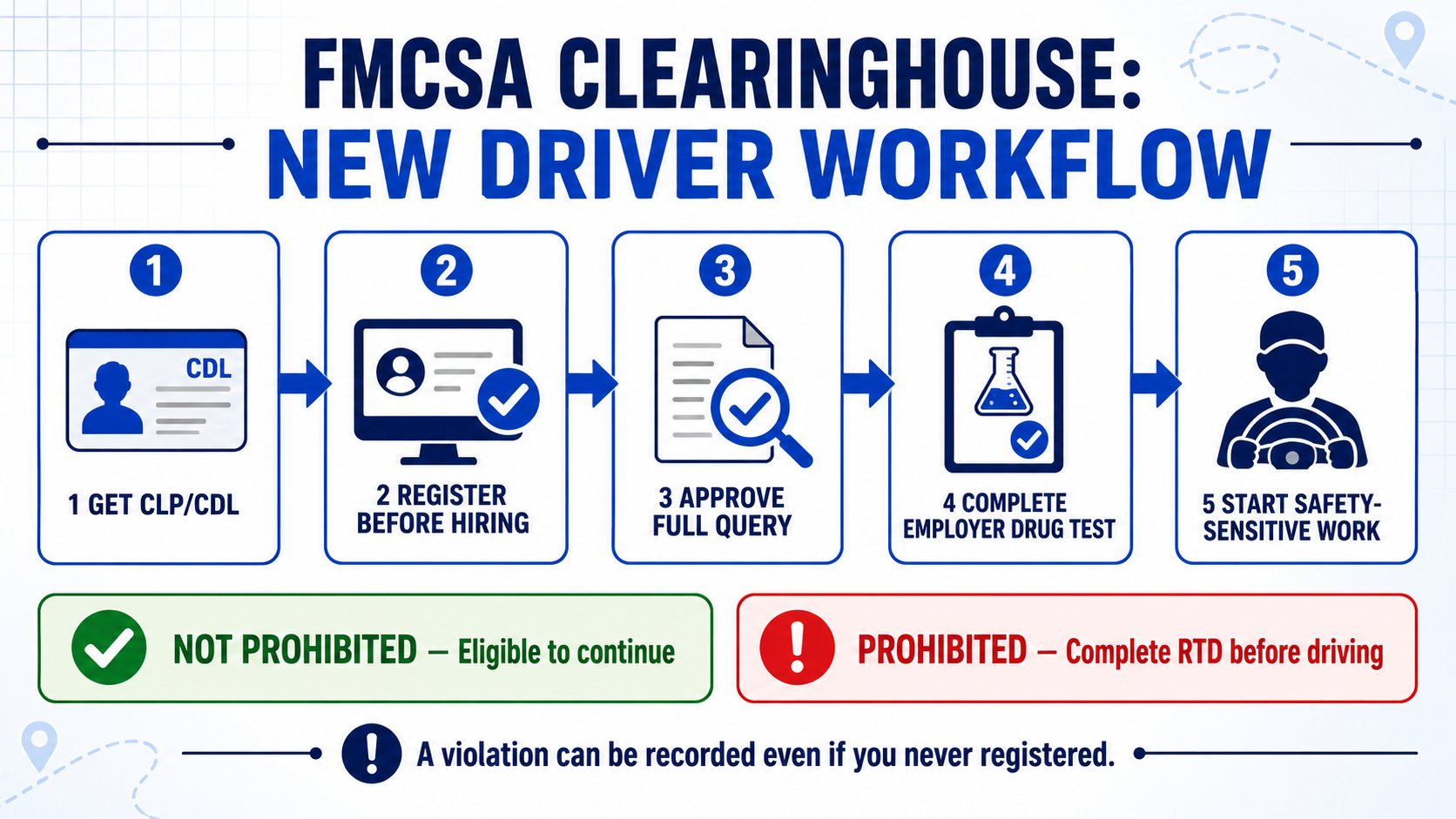
- Obtain the appropriate CLP or CDL. Complete the state application, knowledge testing, medical-certification steps, and ELDT requirements that apply to your license or endorsement.
- Register with the Clearinghouse. Enter license information exactly as it appears on the state record and secure the account.
- Apply to a legitimate motor carrier. Confirm the legal company identity before acting on an electronic consent request.
- Review and approve the full-query request. The employer cannot complete the required pre-employment query without your electronic consent.
- Complete the employer's pre-employment drug test. A negative result must be received before the employer allows safety-sensitive work. The query does not replace this test.
- Wait for clearance. Do not drive a CMV requiring a CDL for the employer until the carrier confirms that every pre-employment requirement is satisfied.
- Monitor future requests. Employers continue to conduct annual queries, and other DOT testing categories may apply after employment begins.
Important distinction: “No information found” on a pre-employment query is not the same document as a negative pre-employment drug-test result. The carrier needs both the required query outcome and the applicable test result before safety-sensitive work begins.
What Prohibited Status Means—and Why CDL Downgrades Matter
A driver in prohibited status may not perform safety-sensitive functions for a DOT-regulated employer. For a CDL holder, that includes operating a commercial motor vehicle. Changing employers, leaving the trucking industry temporarily, or failing to create an account does not resolve the status.
Since November 18, 2024, the federal Clearinghouse-II rule has also connected this status to state licensing action. that state driver licensing agencies must:
- review the Clearinghouse before issuing, renewing, upgrading, or transferring a CDL or CLP;
- deny those licensing transactions while the person is prohibited; and
- remove commercial driving privileges from a driver who becomes prohibited, following the state's downgrade process.
FMCSA's implementation material says the state must initiate the downgrade process when notified and complete the removal of commercial privileges within the applicable federal timeframe, generally no later than 60 days after state notification. State notice, hearing, surrender, and reinstatement procedures can differ, so respond promptly to every licensing-agency notice.
A downgrade does not erase the underlying violation
Giving up the CDL or allowing it to expire does not complete return-to-duty. The unresolved status remains in the Clearinghouse until the required steps are recorded. Conversely, completion of the federal return-to-duty process changes Clearinghouse eligibility, but the driver may still need to satisfy the state's separate restoration requirements before commercial privileges are active again.
How the Return-to-Duty Process Works
Only drivers with a violation need the return-to-duty process. It is not a general course and a school cannot remove a violation. At a high level, the federally required sequence is:
- Select a qualified substance abuse professional. The driver designates the SAP in the Clearinghouse.
- Complete the initial SAP evaluation. The SAP recommends education, treatment, or both based on the individual assessment.
- Complete the recommendation. The driver must follow the plan; shopping for a different recommendation is not a shortcut.
- Return for the follow-up SAP evaluation. The SAP determines whether the education or treatment requirement has been completed successfully.
- Take an observed return-to-duty test. A current or prospective employer orders the test. A negative result must be reported before safety-sensitive duties resume.
- Complete the follow-up testing plan. The SAP gives the employer a plan with at least six unannounced tests in the first 12 months; additional testing may continue for up to five years.
The driver pays many return-to-duty costs unless an employer or agreement provides otherwise. Neither payment nor SAP completion alone changes the status. The required negative return-to-duty result must be recorded, and the driver must continue the follow-up plan after becoming eligible to return.
New CDL Driver Clearinghouse Checklist
- □ My name, date of birth, and license details match the state record
- □ I created a Clearinghouse account before employment applications
- □ I can access the account's email and authentication method
- □ I verify the carrier before approving a full-query request
- □ I understand that consent and a pre-employment drug test are separate
- □ I will not operate a CDL-required CMV until the employer confirms clearance
- □ I know that a violation can be reported even without registration
- □ I will review any unexpected record and use FMCSA's correction process
- □ I will respond promptly to a state notice involving commercial privileges
Questions to ask a school or employer
- At what point will my training involve a CDL-required CMV in commerce?
- Who is responsible for the Part 382 testing program during that operation?
- Is this test a federal DOT test or a separate school or employer policy test?
- When will the employer send the pre-employment full-query request?
- Who should I contact if the company name in the request is unfamiliar?
Frequently Asked Questions
Do all CDL drivers have to register for the FMCSA Clearinghouse?
No. FMCSA does not require registration solely because someone holds a CDL. However, a driver must register to give electronic consent to a full query, including every pre-employment query, and to view a personal record or complete key return-to-duty actions.
Can a Clearinghouse violation be reported if I never registered?
Yes. Registration is not a shield against reporting. Employers, medical review officers, and other authorized parties can report verified Part 382 violations even when the driver has no account.
Does a drug test taken before I receive a CLP go into the Clearinghouse?
A school-administered test taken while the person has neither a CLP nor CDL is not a DOT test under Part 382, according to FMCSA, so it is not reported as a Part 382 Clearinghouse violation. A separate federal testing obligation can begin once a CLP or CDL holder performs covered commercial-motor-vehicle operation.
What happens when a CDL driver has prohibited status?
The driver cannot perform safety-sensitive work, including operating a CMV, and the state licensing agency must deny certain CDL or CLP transactions and remove commercial privileges through its downgrade process. The driver must complete the federal return-to-duty process and any state restoration steps before resuming commercial driving.
Educational information only; not legal, medical, or employment advice. Verify your record and current requirements with FMCSA, the state driver licensing agency, and the motor carrier. Official sources reviewed August 1, 2026.